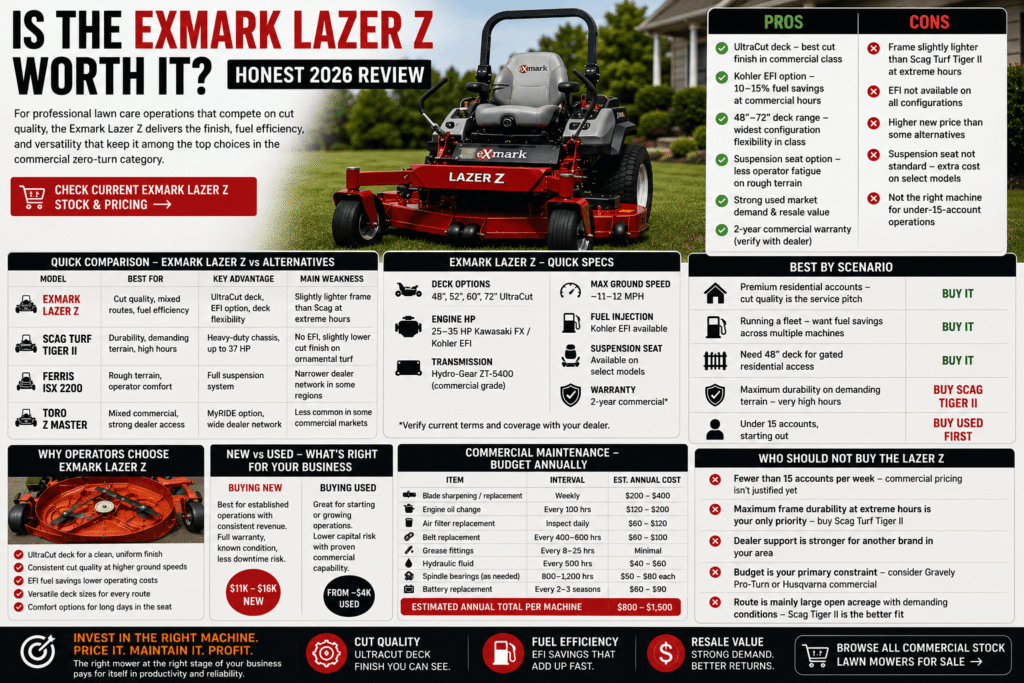
Is Exmark Lazer Z worth it in 2026? For professional lawn care operations that compete on cut quality — where the finish on a client’s lawn is part of the service pitch — yes, and it earns that recommendation consistently. The UltraCut deck is frequently cited by professional operators as producing one of the best cut finishes available in the commercial zero-turn category. Add the Kohler EFI fuel savings option, the widest deck configuration range in its class, and one of the stronger used market demands among commercial machines, and the Lazer Z makes a compelling case at commercial scale.
The cases where it isn’t worth it are specific: operations that prioritise frame durability above everything else (the Scag Turf Tiger II leads there), buyers who need fuel injection and can’t access an EFI-equipped unit, and solo operators running under 15 accounts where commercial pricing isn’t yet justified.
👉 Check current Exmark Lazer Z stock and pricing →
Written by: Farmers Equipment editorial team — based on 2024–2026 dealer service trends, manufacturer specifications, and commercial used market data.
Buy the Exmark Lazer Z if you:
✅ Compete on cut quality — premium residential and ornamental commercial accounts
✅ Want the Kohler EFI fuel savings option across a fleet
✅ Need deck flexibility from 48″ to 72″ including gated residential access
✅ Plan to sell or trade — strong used market demand with documented service history
❌ Don’t buy it if maximum frame durability at extreme hours is the only priority — the Scag Turf Tiger II leads there
❌ Don’t buy it if you’re under 15 accounts — commercial pricing isn’t yet justified
Exmark Lazer Z Pros and Cons
| ✅ Pros | ⚠️ Cons |
|---|---|
| UltraCut deck — frequently cited for best finish in commercial class | Frame construction slightly lighter than Scag Turf Tiger II at extreme hours |
| Kohler EFI option — approximately 10–15% fuel savings at commercial hours | EFI premium adds to purchase price — longer payback on low-hour use |
| 48″–72″ deck range — widest configuration flexibility in class | Higher new price than some commercial alternatives |
| Suspension seat option — reduces operator fatigue on rough terrain | Suspension seat not standard — additional cost on select configurations |
| Strong used market demand with documented service history | No EFI option on all configurations — check before ordering |
| 2-year commercial warranty (verify current terms with dealer) | Not the right machine for sub-15-account operations |
Quick Comparison — Exmark Lazer Z vs Alternatives
| Model | Best For | Key Advantage | Main Weakness |
|---|---|---|---|
| Exmark Lazer Z | Cut quality, mixed routes, fuel efficiency | UltraCut deck, EFI option, deck flexibility | Slightly lighter frame than Scag at extreme hours |
| Scag Turf Tiger II | Durability, demanding terrain, high hours | Heavy-duty chassis, up to 37 HP | No EFI, slightly lower cut finish on ornamental turf |
| Ferris ISX 2200 | Rough terrain, operator comfort | Full suspension system | Narrower dealer network in some regions |
| Toro Z Master | Mixed commercial, strong dealer access | MyRIDE option, wide Toro network | Less common in some commercial markets than Exmark or Scag |
Exmark Lazer Z Quick Specs
| Spec | Detail |
|---|---|
| Deck options | 48″, 52″, 60″, 72″ UltraCut |
| Engine HP | 25–35 HP Kawasaki FX / Kohler EFI |
| Transmission | Hydro-Gear ZT-5400 (commercial grade) |
| Max ground speed | ~11–12 mph |
| Fuel injection | Kohler EFI available on select configurations |
| Suspension seat | Available on select models |
| Warranty | 2-year commercial (verify current terms with dealer) |
| New price | generally $11,000–$16,000 depending on configuration |
| Used from | ~$4,000 in working condition |
Is Exmark Lazer Z Worth It — What It Does Well
UltraCut deck — the main reason to buy it
The UltraCut deck is the feature that most professional operators cite when explaining why they run Exmark. It produces a clean stripe, uniform cut height, and minimal grass tear at commercial ground speeds — the combination that clients on premium residential and ornamental commercial accounts notice and remember. On standard commercial grass the difference between a good commercial deck and the UltraCut is subtle. On high-end accounts where cut appearance is part of the service value — the UltraCut earns its reputation.
Most common feedback from Exmark operators: the UltraCut is the deck they’d choose again. Many professional operators regard it as the finish benchmark other commercial decks are compared against — though the Scag Velocity Plus performs closely on standard commercial grass.
If your business competes on cut appearance, this is the reason to buy the Lazer Z over alternatives.
Kohler EFI — real fuel savings at commercial hours
The Kohler EFI option on the Lazer Z provides approximately 10–15% fuel savings over carburetted equivalents at sustained commercial use rates. Across a full season running one machine at commercial hours, that represents a meaningful reduction in operating cost. Running multiple machines, the saving compounds further. The EFI premium at purchase typically pays back within one to two full commercial seasons — faster on multi-machine operations.
No comparable EFI option is available on the Scag Turf Tiger II in most configurations. For operations where fuel cost is a line item — and at commercial hours it should be — the EFI Lazer Z has a real operating cost advantage.
Deck range — 48″ to 72″
The Lazer Z’s deck range starts at 48″ — the Scag Turf Tiger II starts at 52″. For operations that include gated residential properties or tighter access commercial sites where a 52″ won’t fit, the 48″ Lazer Z is the configuration that works. Most commercial operators run 60″ as their primary, but the configuration flexibility across a mixed route operation is a real advantage the Scag doesn’t offer at the lower end.
Suspension seat option — operator comfort on longer sessions
The Lazer Z offers a suspension seat option on select configurations — meaningful for operators running 6–8 hour days on terrain with any roughness. It doesn’t match the Ferris ISX 2200’s full suspension system, but it’s a meaningful improvement over no suspension at all. The Scag Turf Tiger II has no standard suspension seat option — operators who’ve run both tend to notice the Exmark comfort advantage on longer daily sessions.
Is the Exmark Lazer Z Worth It — What It Doesn’t Do Well
Frame construction at extreme hours
The Lazer Z is a well-built commercial machine. At normal professional use levels — a full commercial route run consistently — it holds up reliably and operators don’t typically notice a durability difference versus the Scag. At the extreme end of commercial use — machines running 8–10 hours per day on demanding terrain, high-impact conditions, very high annual hours — many operators who’ve run both machines at that intensity regard the Scag Turf Tiger II‘s heavier chassis construction as slightly more durable at that extreme. For normal commercial operations, this difference is marginal.
EFI not available on all configurations
The Kohler EFI option is one of the Lazer Z’s strongest advantages — but it isn’t available across all deck sizes and configurations. If EFI is a priority, confirm availability on your specific configuration before ordering. Not all dealers stock EFI-equipped units and lead times can vary.
Not the right machine for under 15 accounts
At $11,000–$16,000 new, the Lazer Z is a commercial machine priced for commercial revenue. A solo operator running 10 residential accounts per week doesn’t need this machine yet — a used residential zero-turn or a used commercial machine at $4,000–$5,000 handles that volume with far less capital commitment. Commercial pricing makes sense when consistent revenue justifies the investment, not before.
What Goes Wrong — Real Ownership Costs
| Item | Cost | Interval |
|---|---|---|
| Blade sharpening / replacement | $40–$70 per set | Weekly on active commercial routes |
| Engine oil change | $20–$30 | Every 100 hours |
| Air filter | $15–$25 | Inspect daily, replace as needed |
| Drive belt | $60–$100 | Every 400–600 hours |
| Grease fittings | Minimal cost | Every 8–25 hours per manufacturer spec |
| Hydraulic fluid | $40–$60 | Every 500 hours |
| Spindle bearing replacement | $50–$80 each | As needed — typically 800–1,200 hours |
| Battery (if needed) | $60–$90 | Every 2–3 seasons |
| Annual maintenance budget | ~$800–$1,500 | At full commercial hours |
Running costs are broadly comparable to the Scag Turf Tiger II. The EFI option on Lazer Z-equipped configurations reduces fuel cost by approximately 10–15% annually — a real operating advantage that compounds across a fleet over a full season and partially offsets the EFI purchase premium.
Is the Exmark Lazer Z Worth It New vs Used?
Buying new
At generally $11,000–$16,000 new depending on deck size and engine configuration, buying new makes most sense for established operations running consistent commercial revenue on multiple accounts. The 2-year commercial warranty and known condition from day one reduce downtime risk when the machine is carrying real revenue. The EFI option is most practical to spec on a new machine purchase where you can confirm availability.
Buying used
Based on observed listings on TractorHouse across 2024–2026, clean Lazer Z units with documented service history at 800–1,200 hours commonly list in the $6,000–$9,000 range. Machines at 1,500–2,000 hours in working condition from $4,000. Prices vary by condition, location, engine option, deck size, and hours — treat these as general reference points rather than fixed market prices.
Key checks on any used Lazer Z: transmission smoothness at both slow and high speed, UltraCut deck condition (look for cracks around spindle housings and anti-scalp wheel mounting points), caster fork wear, engine oil colour and condition, belt wear, and service history. A machine with dealer service stamps is worth paying significantly more for.
Exmark Lazer Z Resale Value
The Lazer Z holds its value well on the commercial used market. Machines with documented maintenance histories tend to attract strong buyer interest when priced appropriately — professional buyers know what a well-kept Lazer Z is worth and are willing to pay for it. The UltraCut deck’s reputation for cut quality makes well-maintained examples attractive to operations upgrading from lighter commercial alternatives.
If you maintain the machine on schedule and keep service records, you will recover a meaningful portion of the purchase price when you sell or trade. That resale confidence is part of what makes the Lazer Z’s higher new price a reasonable investment for operations that plan ahead.
Who Should NOT Buy the Exmark Lazer Z
- Fewer than 15 accounts per week — the revenue doesn’t yet justify commercial pricing. A used residential zero-turn or a used commercial machine at $4,000–$5,000 handles that volume without the capital commitment
- Maximum frame durability at extreme hours is your top priority — the Scag Turf Tiger II’s heavier chassis construction is the better choice for the hardest daily commercial use at very high hours
- Your dealer support is significantly stronger for another brand — if there is a well-supported Scag, Ferris, or Toro dealer nearby and the nearest Exmark dealer is far away, that local reality should outweigh spec differences
- Budget is the primary constraint — Gravely Pro-Turn and Husqvarna commercial machines offer competitive construction at pricing that can undercut Exmark new. Worth evaluating if strong local dealer support exists for those brands
- Your route is primarily large open acreage with demanding conditions — the Scag’s construction and HP headroom (up to 37 HP) suits that use case better
Best by Scenario
| Your Situation | Verdict |
|---|---|
| Premium residential accounts — cut quality is the service pitch | ✅ Exmark Lazer Z — buy it |
| Running a fleet — want fuel savings across multiple machines | ✅ Exmark Lazer Z EFI — buy it |
| Need 48″ deck for gated residential access | ✅ Exmark Lazer Z — only commercial option at this size |
| Maximum durability on demanding terrain — very high hours | ❌ Buy Scag Turf Tiger II instead |
| Under 15 accounts, starting out | ❌ Buy used commercial at $4,000–$7,000 first |
| Operator comfort on rough terrain is the priority | ⚠️ Consider Ferris ISX 2200 — better suspension system |
Verdict — Is the Exmark Lazer Z Worth It?
Is the Exmark Lazer Z worth it? Yes — for the right operation. If your business competes on cut quality, the UltraCut deck is the machine feature that earns client retention on premium accounts. The EFI option provides real fuel savings at commercial hours. The 48″–72″ deck range covers more route configurations than most commercial alternatives. And the used market demand means you recover a meaningful portion of the investment when you sell.
If frame durability at extreme hours matters more than cut finish — buy the Scag Turf Tiger II. If you’re under 15 accounts — buy used and grow into it. But if you’re running a professional lawn care operation where appearance matters and fuel costs are a real line item — the Lazer Z earns its place on the trailer.
For the full comparison: Scag Turf Tiger II vs Exmark Lazer Z → · Best Commercial Zero-Turn for Landscaping → · Best Commercial Mower for a Lawn Business →
👉 See current Exmark Lazer Z listings — commercial stock available →
The Commercial Zero-Turn Market — Honest Rankings
What Is the #1 Rated Zero-Turn Mower?
No single machine tops every category — the #1 ranking depends on what you’re measuring:
| Category | #1 Machine | Why |
|---|---|---|
| Commercial cut quality | Exmark Lazer Z | UltraCut deck consistently rated the best commercial finish in professional landscaper surveys |
| Commercial frame durability | Scag Turf Tiger II | 7-gauge steel chassis — the heaviest commercial construction in its class |
| Commercial fuel efficiency | Exmark Lazer Z (EFI) | Kohler EFI — only commercial zero-turn with EFI offering 10–15% fuel savings at scale |
| Commercial rough terrain | Ferris ISX 2200 | Only commercial zero-turn with a full suspension system — unique advantage on uneven ground |
| Residential #1 by owner satisfaction | Toro TimeCutter / John Deere Z300 | Consistently top residential surveys — MyRIDE (Toro) and resale/dealer (JD) are the deciding factors |
| Residential #1 by hardware value | Ariens IKON XD | Fabricated deck and ZT-2800 transmission outspec all competitors at $3,699 |
What Is the Most Reliable Zero-Turn Mower on the Market?
By class:
- Commercial most reliable: Exmark Lazer Z and Scag Turf Tiger II — both designed for 2,000–3,000+ hours and both backed by commercial warranties. The most reliable commercial zero-turn is the one with the stronger local dealer support in your area — service access is a reliability multiplier
- Residential most reliable: Toro TimeCutter and John Deere Z300 Series — strongest residential owner satisfaction, widest service networks, most parts available nationally
- Least reliable class: Residential machines pushed into daily commercial use — any residential zero-turn used for professional daily work will wear out significantly faster than its residential design life
Which Zero-Turn Mower Has the Least Problems?
For commercial machines: Exmark and Scag both report low problem rates relative to hours when maintenance schedules are followed. The most common source of problems on either machine is deferred maintenance — particularly spindle greasing intervals (every 8–25 hours) and hydraulic fluid changes (every 500 hours). Machines maintained on schedule consistently outperform poorly maintained machines of the same brand. For residential machines: John Deere reports the fewest problems per operating hour in consumer surveys, followed by Toro.
Which Zero-Turn Mower Is the Most Durable?
For commercial durability at the extreme end: the Scag Turf Tiger II — 7-gauge steel frame, highest HP ceiling (37 HP), and commercial design life of 2,000–3,000+ hours. The Exmark Lazer Z is comparably durable at normal professional use rates, with the Scag showing a marginal advantage only at the most demanding commercial intensity. For residential durability, the Ariens IKON XD (fabricated deck, ZT-2800 transmission) outlasts competitors in its class.
What Are the 5 Best Zero-Turn Mowers?
| Rank | Machine | Class | Price | Why It Makes the List |
|---|---|---|---|---|
| 1 | Exmark Lazer Z | Commercial | ~$11,299 | Best cut quality in commercial class. UltraCut deck and EFI option make it the most complete commercial package for operations competing on finish |
| 2 | Scag Turf Tiger II | Commercial | ~$17,800 | Best frame durability in commercial class. 7-gauge steel, 37 HP ceiling, 2,000–3,000+ hour design life. The machine for demanding terrain and high-hour operations |
| 3 | Ferris ISX 2200 | Commercial | ~$10,000–$14,000 | Full suspension system — unique commercial advantage for operators on rough terrain. Significantly reduces daily fatigue vs no-suspension alternatives |
| 4 | Ariens IKON XD | Residential | ~$3,699 | Best hardware per dollar in residential class. Fabricated deck and ZT-2800 transmission outspec every competitor at this price |
| 5 | Toro TimeCutter (MyRIDE) | Residential | ~$3,500 | Best operator comfort in residential class. MyRIDE suspension is unique — no other residential zero-turn at this price offers equivalent comfort for long mowing sessions |
What Is the Rolls-Royce of Lawn Mowers?
In the commercial zero-turn class: Scag and Exmark are the consistent answers — both engineered for decades of professional daily use at standards no residential machine reaches. Scag for raw construction quality at extreme hours; Exmark for cut finish refinement on premium ornamental turf. Between them: the Exmark Lazer Z X-Series and Scag Sabre Tooth Tiger represent the absolute ceiling of commercial zero-turn engineering. Beyond zero-turns in the broader grounds maintenance world, professional reel mowers (Jacobsen, Ransomes) for golf courses and sports fields represent an entirely different price and engineering class.
Is 200 Hours a Lot on a Zero-Turn Mower?
For the Exmark Lazer Z — no. 200 hours is very low for a commercial machine. At typical commercial use of 6–8 hours per day, 200 hours represents approximately 3–4 weeks of active professional operation. The Lazer Z is designed for 2,000–3,000+ hours — 200 hours is the very beginning of its commercial life and tells you almost nothing about remaining productive life.
For residential zero-turns designed for 400–700 hours total life, 200 hours is mid-range — approximately half of expected engine life. Always evaluate hours relative to the machine’s design class, not just the number itself.
What Zero-Turn Mowers to Stay Away From?
- Generic import / white-label zero-turns — sold through discount retailers with no dealer support network. Parts availability mid-season is the primary risk when something breaks
- Residential machines used for commercial daily work — including Husqvarna Z254, Toro TimeCutter, Ariens IKON XD. Residential design life is 400–700 hours. Pushing these into commercial routes accelerates wear by a factor of 3–5x versus their design intent. This is a spec mismatch, not a brand failure
- Older Cub Cadet RZT series — the CVT-based early generation zero-turns (not the current XT1 riding mower) earned a poor reliability reputation that is well-documented. Avoid on the used market
- Any used zero-turn without service history — hours without maintenance records are an unreliable condition indicator on any brand. The maintenance record predicts remaining life more accurately than the hour count
- Heavily discounted old-model-year stock — seals, belts, and fuel system components age even on unrun machines. A steep discount on 3-year-old-model-year “new” stock sometimes reflects this
Which Brands of Zero-Turn Mowers Should I Avoid?
The honest answer: avoid the application mismatch more than the brand. A residential Toro or Husqvarna is not a bad machine — it’s a bad choice for commercial daily use. A commercial Exmark or Scag is not the right machine for a homeowner with one acre. The brand matters less than the match between machine class and intended use. That said: generic import brands without established dealer networks and documented service parts availability carry genuinely higher risk than any of the established brands (Exmark, Scag, Toro, Ferris, Husqvarna, John Deere, Ariens, Cub Cadet) regardless of use case.
Common Problems with Scag Mowers — For Comparison
Since Exmark and Scag are the two machines most often compared head-to-head, here is an honest common problems assessment on the Scag side for comparison with the Exmark ownership costs listed above:
| Problem | Details | Severity |
|---|---|---|
| Spindle bearing wear (deferred greasing) | Most common issue on Scag commercial machines — greasable spindles need service every 8–25 hours. Grinding or vibration from the deck is the early warning. Ignored, a spun bearing escalates into spindle housing damage | ⚠️ Moderate — most preventable issue on the machine |
| Drive belt wear | Standard commercial consumable — budget for replacement every 400–600 hours. Belt squealing or slipping under load signals replacement needed | 🟡 Minor — routine |
| Hydraulic fluid degradation | Most operators never change hydraulic fluid. It degrades causing sluggish transmission response and premature pump wear. Fresh fluid noticeably improves steering precision on any high-hour unit | 🟡 Minor — preventable |
| No EFI option | Scag Turf Tiger II does not offer electronic fuel injection — a real operating cost disadvantage versus the Exmark Lazer Z EFI at high commercial hours. Carbureted Kawasaki FX uses approximately 10–15% more fuel at equivalent load | ⚠️ Moderate operating cost over a full season |
| No standard suspension seat | The Turf Tiger II does not offer a standard suspension seat option — operators running long days on rough terrain notice this disadvantage relative to Exmark’s suspension seat option and Ferris’s full suspension system | 🟡 Comfort consideration — not mechanical |
The comparison is honest: Exmark and Scag have broadly similar maintenance profiles. Scag’s primary disadvantages versus Exmark are the absence of EFI (operating cost) and no suspension seat option (operator comfort). Exmark’s primary disadvantage versus Scag is the marginally lighter frame at extreme commercial intensity. Neither machine has a significant reliability defect — the differences are in specific feature trade-offs.
What Is the Best Zero-Turn Mower According to Consumer Reports?
Consumer Reports focuses primarily on residential zero-turns in their subscriber testing — commercial machines like the Exmark Lazer Z and Scag Turf Tiger II fall outside their typical residential test scope. In Consumer Reports residential zero-turn reliability surveys, John Deere and Toro consistently rank at the top for owner-reported reliability and satisfaction in the under-$5,000 class. For commercial zero-turns, professional landscaper surveys (not consumer publications) are the relevant source — and in those, Exmark and Scag lead consistently. For independent commercial specs and warranty terms, Exmark.com and Scag.com publish full commercial specifications.
Frequently Asked Questions
Is the Exmark Lazer Z worth the money?
For professional operations competing on cut quality — yes. The UltraCut deck finish, EFI fuel savings option, and strong used market demand make the Lazer Z a sound investment at commercial scale. For solo operators under 15 accounts or operations where frame durability at extreme hours is the only priority, a used commercial machine or the Scag Turf Tiger II may be a better fit.
How long does the Exmark Lazer Z last?
With consistent maintenance, the Lazer Z is engineered for 2,000–3,000+ hours before requiring major work. At commercial use rates of 6–8 hours per day, that represents several years of daily operation. Engine oil at 100 hours, spindle greasing on schedule, blades sharpened weekly, hydraulic fluid at 500 hours, and air filter inspection daily are the key maintenance variables that directly affect actual lifespan.
What are common Exmark Lazer Z problems?
The most common maintenance items at commercial hours are blade wear (weekly sharpening on active routes), belt replacement at 400–600 hours, and spindle bearing wear at 800–1,200 hours. These are expected commercial maintenance items, not specific Lazer Z defects. The most consistent operator feedback on limitations: the lack of a standard suspension seat on some configurations, and EFI not being available across all deck size options.
How does the Exmark Lazer Z compare to the Scag Turf Tiger II?
Lazer Z leads on cut quality, fuel efficiency (EFI option), deck flexibility, and suspension comfort. Scag Turf Tiger II leads on frame durability at extreme hours and maximum HP. For most professional operations, both machines are capable — the right choice depends on whether your business prioritises cut finish or construction durability. See the comparison guide linked in the verdict section above.
Is the Exmark Lazer Z EFI worth the premium?
Yes — for operators running machines at full commercial hours. Approximately 10–15% fuel savings at commercial use rates. The EFI premium at purchase typically pays back within one to two full commercial seasons at normal operating hours. On low-hour or occasional use, the payback period extends and the standard carburetted option is sufficient.