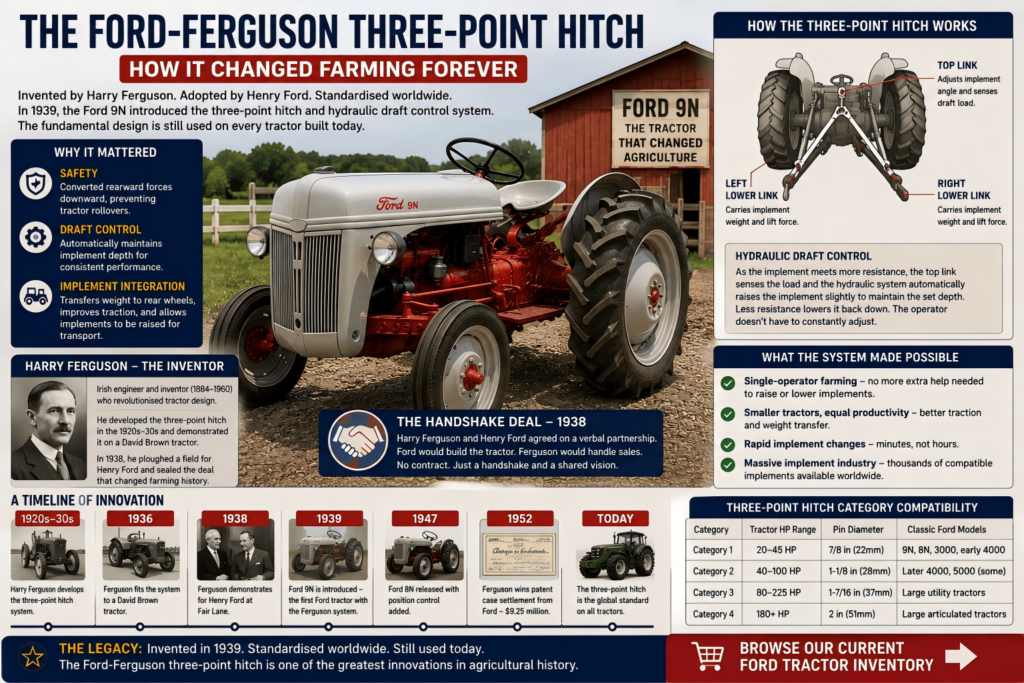
The Ford Ferguson three point hitch history is the story of one of the most consequential mechanical innovations in agricultural history — a system invented by Harry Ferguson, adopted by Henry Ford, and eventually standardised across every tractor manufacturer in the world. In 1939, when the Ford 9N rolled off the line with Ferguson’s three-point hitch and hydraulic draft control, it made the chain-and-rope implement hitching systems that came before it obsolete almost overnight. The fundamental design introduced that year is still in use on every modern tractor built today.
👉 Browse our current Ford tractor inventory →
Written by: Farmers Equipment editorial team — specialising in classic Ford tractors and the agricultural history of the N-Series through the Thousand Series.
Ford Ferguson Three Point Hitch History — Why It Mattered
Before the Ferguson system arrived in 1939, attaching an implement to a tractor was a dangerous and imprecise affair. Implements were connected by drawbars, chains, or rigid hitches that transferred ground forces directly to the tractor — meaning a plough that struck a buried rock could flip the tractor backward, killing the operator. Implement depth was controlled manually by the operator, requiring constant attention to maintain consistent tillage depth across varying terrain.
Ferguson’s three-point hitch solved both problems simultaneously:
- Safety — the geometry of the three-point linkage converted rearward forces (from a plough hitting an obstruction) into downward pressure on the front wheels rather than rearward rotation. It made rollover from implement shock dramatically less likely
- Draft control — the hydraulic draft control system automatically sensed soil resistance through the top link and adjusted implement depth to maintain consistent working conditions without operator input
- Implement integration — implements became part of the tractor rather than trailing behind it. The weight of the implement transferred to the rear wheels, improving traction, and implements could be raised completely clear of the ground for transport
Harry Ferguson — The Man Behind the System
Harry Ferguson was an Irish engineer and inventor born in County Down in 1884. He became involved in aviation and engineering early in his career — he was reportedly the first person in Ireland to build and fly his own aircraft — before turning his attention to the problem of implement attachment on tractors.
Ferguson had observed that existing tractor-implement connections were fundamentally flawed. Drawbar hitching transferred all implement forces to a single point behind the tractor, creating instability. His insight was that a three-point connection — two lower links and one upper link forming a triangle — distributed those forces in a way that made the system inherently more stable and safer.
He developed the system through the 1920s and 1930s, initially fitting it to a David Brown tractor (the Ferguson-Brown Model A) in 1936. When he sought a manufacturing partner with the scale to bring it to a mass market, he turned to Henry Ford.
The Handshake Deal — Ford and Ferguson in 1938
In October 1938, Harry Ferguson travelled to Henry Ford’s Fair Lane estate in Dearborn, Michigan. He demonstrated his three-point hitch system to Ford by ploughing a field — and Ford was immediately convinced. The two men agreed to a partnership in what became one of the most famous informal business arrangements in industrial history: the handshake deal.
There was no written contract. The agreement was verbal — Ford would manufacture a tractor incorporating Ferguson’s system, and Ferguson would handle sales and distribution. The terms were loose, the trust was personal, and neither party felt a written contract was necessary between gentlemen.
The result of that handshake was the Ford 9N, introduced at a public demonstration at Fair Lane in June 1939. Priced at approximately $585 — significantly below existing tractors with comparable capability — it immediately transformed the market.
How the Three-Point Hitch System Works
The Ferguson three-point hitch as implemented on the Ford 9N consists of three elements:
The Three Links
- Two lower links — these attach at the bottom of the tractor’s rear and connect to the implement at two lower attachment points. They carry the primary weight of the implement and transmit the lift force when the hydraulic system raises or lowers
- One upper link (top link) — this connects from a higher point on the tractor to the top of the implement. It controls the implement’s angle and, critically, serves as the sensing element for draft control
Hydraulic Draft Control
The genius of Ferguson’s system was the hydraulic draft control. As the implement encountered harder soil or an obstruction, the increased resistance compressed the top link slightly. This compression was sensed by a mechanical linkage connected to the hydraulic control valve — which responded by raising the implement slightly to reduce the load. As the load eased, the implement returned to its working depth. The result was automatic depth maintenance without operator input — the tractor and implement worked as a single integrated system.
The Safety Geometry
The three-point geometry was not just about convenience — it was fundamentally a safety innovation. When a trailed implement on a drawbar hitch struck an immovable object, the rearward force created a moment that rotated the tractor backward around its rear axle — a rollover. The three-point hitch geometry converted that same rearward force into a downward force on the front wheels, preventing the rotation. This physics-based safety mechanism saved countless lives over the decades that followed.
The Patent Portfolio — What Ferguson Actually Owned
Ferguson held patents on specific implementations of his system — not on the three-point hitch concept itself, which could not be patented as a fundamental mechanical principle. The key patents covered:
- The draft control mechanism — the specific design of the hydraulic sensing system that converted top link compression into hydraulic valve movement
- Position control — the ability to set a fixed implement height rather than relying solely on draft sensing (this was added on the Ford 8N)
- Specific hydraulic control valve designs — the internal mechanisms that translated draft sensing into hydraulic pressure changes
When the Ford-Ferguson partnership ended in 1947 following Henry Ford’s death, Ferguson sued Ford for infringing these patents in the design of the Ford 8N. The lawsuit was settled in 1952 for approximately $9.25 million — one of the largest civil settlements in US history at that time. Ford was required to redesign its control system while retaining the three-point hitch linkage itself.
The Ferguson System Becomes the World Standard
Following the Ford-Ferguson split, Ferguson established his own tractor company and produced the TE20 (the “Little Grey Fergie”) in the UK and the TO-20 in the US. These machines competed directly with the Ford 8N and were themselves instrumental in spreading the three-point hitch across the global market.
By the late 1950s, the advantages of the three-point hitch over drawbar systems were so evident that virtually every tractor manufacturer had adopted some version of it. The American Society of Agricultural Engineers (ASAE — now ASABE) eventually standardised the system into the Category classification still used today:
| Category | Tractor HP Range | Pin Diameter | Classic Ford Models |
|---|---|---|---|
| Category 1 | 20–45 HP | 7/8 inch (22mm) | 9N, 8N, 3000, early 4000 |
| Category 2 | 40–100 HP | 1-1/8 inch (28mm) | Later 4000, 5000 (some) |
| Category 3 | 80–225 HP | 1-7/16 inch (37mm) | Large commercial tractors |
| Category 4 | 180+ HP | 2 inch (51mm) | Large articulated tractors |
The Ford 9N, 8N, and 3000 all use Category 1 — meaning any Category 1 implement designed and built anywhere in the world over the past 80 years connects directly to these machines. That implement compatibility is one of the primary reasons classic Ford tractors remain practical working machines in 2026.
What the Three-Point Hitch Made Possible
The practical consequences of the Ferguson system were transformative:
- Single-operator farming — before the three-point hitch, raising and lowering implements required a second person walking behind the tractor. The hydraulic system eliminated that need entirely
- Smaller tractors, equal productivity — because the three-point hitch transferred implement weight to the rear wheels and improved traction, a smaller tractor with the Ferguson system could do work previously requiring a much larger machine
- Rapid implement changes — the standardised Category 1 connection allowed operators to change implements in minutes rather than the hours sometimes required with older hitching systems
- Implement proliferation — once the three-point hitch became standard, an entire industry of compatible implements developed. The range of implements available for a Category 1 tractor today is virtually unlimited
The Three-Point Hitch on Classic Ford Tractors — Model by Model
| Model | Hitch Type | Control System | Live Hydraulics |
|---|---|---|---|
| Ford 9N | Category 1 — original Ferguson system | Draft control only | No — stops when clutch depressed |
| Ford 2N | Category 1 — identical to 9N | Draft control only | No |
| Ford 8N | Category 1 — revised post-lawsuit design | Draft + position control | No — stops when clutch depressed |
| Ford 3000 | Category 1 | Draft + position control | Yes — live hydraulics standard |
| Ford 4000 | Category 1 / Category 2 | Draft + position control | Yes |
| Ford 5000 | Category 2 | Draft + position control | Yes |
The Legacy — Why This Still Matters in 2026
Harry Ferguson died in 1960, but the system he invented at a demonstration in Dearborn in 1939 is more ubiquitous today than at any point in its history. Every compact tractor, every utility tractor, every agricultural machine with a rear implement attachment sold anywhere in the world uses a derivative of the system he demonstrated on the Ford 9N.
For buyers of classic Ford tractors, this legacy has a direct practical consequence: the Category 1 three-point hitch on a 1948 Ford 8N is compatible with every Category 1 implement manufactured in the past eight decades. A rotary cutter, box blade, or post hole digger bought new in 2026 attaches to and works correctly on a machine built in 1948. That universality is arguably the single most important factor in why classic Ford tractors remain in active agricultural use more than 70 years after production ended.
For the full history of the N-Series models see our Ford N-Series Tractor History guide →
Before purchasing any classic Ford, read our Used Ford Tractor Inspection Checklist →
How to Identify a Ferguson Tractor by Year
How to Tell What Year a Ferguson Tractor Is
Ferguson tractors are identified by their serial number, which encodes the production year. The approach differs between the TE20/TO20 range and later Massey Ferguson models:
Ferguson TE20 / TO20 / TO30 (1946–1956)
| Model | Serial Number Location | Year Identification |
|---|---|---|
| TE20 (UK-built, Standard engine) | Left side of engine block | Serial numbers ran sequentially. TE20 production: 1946–1956. Prefix “TE” followed by sequential number. Cross-reference against published TE20 serial number lists by year |
| TO20 (US-built, Continental engine) | Left side of engine block | TO20: 1948–1951. TO30: 1951–1954. TO35: 1954–1960. Sequential numbering — cross-reference against published TO series lists |
Massey Ferguson (post-1953 merger)
After the Ferguson Company merged with Massey-Harris in 1953 to form Massey Ferguson, serial number formats changed by model series. The most reliable method for any MF tractor:
- Find the serial number plate — typically on the instrument panel (dashboard), left side of the engine block, or on the frame rail depending on model and year
- Record the full serial number — including any letter prefixes
- Cross-reference with published tables — for complete MF serial number year tables, TractorData.com maintains year-by-year production records for all MF models
MF 35 Serial Number Example
| Year | MF 35 Serial Range (approx) |
|---|---|
| 1957 | 1–12,000 |
| 1958 | 12,001–35,000 |
| 1959 | 35,001–60,000 |
| 1960 | 60,001–90,000 |
| 1961–1964 | Sequential continuation |
For the MF 135, MF 165, and other Thousand Series — serial numbers are typically found on the instrument panel and follow a similar sequential format. The most reliable source for specific year-by-year ranges remains TractorData.com or the original parts microfiche at an authorised MF dealer. Browse our Massey Ferguson tractors for sale.
How to Read a Tractor Serial Number
The general principle for most classic tractors:
- Ford N-Series (9N, 2N, 8N): prefix (9N, 2N, or 8N) followed by a sequential production number. The prefix identifies the model; published tables cross-reference the sequence number to production year
- Ford Thousand Series (3000, 4000, 5000): serial number on the instrument panel — first digit(s) of the number identify production year in published Ford serial tables
- Ferguson / Massey Ferguson: sequential number with possible letter prefix — year determined by cross-referencing against published production tables by model
- John Deere: the 8th character of the 17-digit VIN on modern machines identifies model year (A=2010, B=2011, etc.). On older 2-cylinder and pre-VIN machines, sequential serial tables by model apply
- Kubota: the model number itself typically indicates the series — the serial number adds a production sequence and sometimes a date code at the end
What Does Cat 2 Mean on a Tractor?
“Cat 2” or “Category 2” refers to the standardised three-point hitch specification for tractors in the 40–100 HP range. The Category system was developed by ASAE (now ASABE) to ensure implement compatibility across tractor brands worldwide:
| Category | HP Range | Lower Link Pin Ø | Top Link Pin Ø | Typical Tractors |
|---|---|---|---|---|
| Cat 1 | 20–45 HP | 7/8″ (22mm) | 3/4″ (19mm) | Ford 9N, 8N, 3000; Kubota BX/B/L; JD 1-3 Series |
| Cat 2 | 40–100 HP | 1-1/8″ (28mm) | 1″ (25mm) | Ford 4000/5000; Kubota M; JD 5-6 Series; MF 5700 |
| Cat 3 | 80–225 HP | 1-7/16″ (37mm) | 1-1/4″ (32mm) | Large JD 6R/7R, Case IH Puma, MF 6700 |
| Cat 4 | 180+ HP | 2″ (51mm) | 1-3/4″ (44mm) | Very large commercial tractors |
A “Cat 2 implement” has 1-1/8 inch hitch pins and will not directly fit a Cat 1 tractor without reducer bushings. Many implements are sold as “Cat 1/2” — meaning they come with interchangeable pins that fit both categories. When buying implements for your tractor, always confirm the category matches your machine.
What Is the Best 3-Point Hitch?
The three-point hitch is a standardised system — there is no “best brand” for the hitch itself as the geometry is identical across all manufacturers. What does vary is lift capacity, quality of hydraulic system, and draft/position control implementation:
- Highest lift capacity in compact class — Kubota M Series and John Deere 5 Series offer the strongest lift capacity in the utility class
- Best draft control precision — Fendt’s Vario Series and modern John Deere 6R/7R Series have the most refined electronic draft control systems available
- Most compatible (classic) — the original Ferguson Category 1 system on the Ford 9N, 8N, and 3000 connects to the widest range of implements due to the longest production history at that standard
- Best for heavy implements — Category 3 hitches on 100+ HP tractors deliver the highest absolute lift capacity — typically 5,000–10,000+ lbs depending on the tractor
What Is the Most Valuable Tractor in the World?
Tractor value records fall into two categories: production auction records and novelty/custom builds.
Most Valuable Production Tractors at Auction
| Tractor | Record Sale Price | Why It’s Valuable |
|---|---|---|
| John Deere 7020 prototype (articulated) | ~$300,000–$500,000 (rare one-offs) | Factory prototype, documented provenance, one of a kind |
| Ford 9N Serial #1 (first production unit) | Priceless / museum held | The first Ford 9N ever produced — held by the Henry Ford Museum, Dearborn |
| Ferguson Black Tractor (1933 prototype) | Museum held — not publicly auctioned | The original prototype that led to the Ford-Ferguson agreement. Held by the Science Museum, London |
| Fully restored John Deere 4020 — top condition | $50,000–$100,000+ | Most beloved American row-crop tractor — pristine examples from famous collections command significant premiums |
| Early Ford 9N with aluminium components | $15,000–$35,000+ | First-year production with original aluminium hood, grille, and instrument panel — increasingly rare in unmodified condition |
Is There a Million Dollar Tractor?
In the production agricultural tractor world — not yet as a standard transaction, though rare factory prototypes and historically significant one-of-a-kind machines occasionally approach this range in private sales. The closest category: very large, highly specified modern precision agriculture tractors (Fendt 1000 Vario, John Deere 9RX Series) in maximum configuration with full precision agriculture equipment can exceed $500,000 new. Custom-built or historically significant one-off tractors can theoretically reach or exceed $1,000,000 in private negotiation — but no widely documented public auction has reached that figure for a production tractor. In the specialised world of motorsport-derived or custom fabricated tractors for pulling competitions, machines exceeding $500,000 in build cost are not unheard of.
What Is the Greatest Tractor of All Time?
| Tractor | Claim to “Greatest” | Era |
|---|---|---|
| Ford 9N | Most historically significant single model — introduced the three-point hitch and draft control that changed agriculture globally. No other single machine produced more consequential change in farming practice | 1939–1942 |
| Fordson Model F | First mass-produced tractor (1917) — made tractor ownership possible for ordinary farmers for the first time. Changed the scale of agricultural mechanisation | 1917–1928 |
| Massey Ferguson 135 | Most widely farmed tractor globally — built in the largest numbers of any single utility model and still actively used on farms worldwide after 50+ years | 1964–1975 |
| John Deere 4020 | Most beloved American row-crop tractor — the machine that defined American row-crop farming through the 1960s and 1970s | 1964–1972 |
| Fendt Vario | Greatest engineering achievement in modern tractors — the CVT transmission that changed what precision agriculture looks like | 1995–present |
By historical impact on global agriculture: the Ford 9N and the Fordson Model F are the two most consequential single tractors ever produced. The Ford 9N introduced the system that is still the global standard for implement attachment 87 years later.
What Is the Oldest Tractor Company Still in Business?
| Company | Founded | Status in 2026 |
|---|---|---|
| John Deere | 1837 | Publicly traded — largest agricultural equipment company globally by revenue |
| Case IH | 1842 (J.I. Case) / 1985 (Case IH merger) | CNH Industrial subsidiary — active production globally |
| Massey Ferguson | 1847 (Massey) / 1953 (MF merger) | AGCO subsidiary — one of the largest global tractor brands |
| Fendt | 1930 (Xaver Fendt) | AGCO subsidiary — premium European tractor brand, production in Marktoberdorf, Germany |
| Deutz-Fahr | 1864 (Deutz engine company) | SDF Group (Italy) — active production in Germany |
| Claas | 1913 | German family-owned — major combine and tractor manufacturer |
For complete production history and serial number tables for all classic tractor brands, TractorHouse.com lists current used inventory with year identification. John Deere (1837) is the oldest continuously operating company now producing tractors. The Deutz engine company (1864) predates several others by decades and produced some of the earliest internal combustion engines used in agricultural applications. If we count companies whose lineages trace back through mergers — the McCormick reaper business (1831) predates all of them, though the corporate entity now holding that lineage (AGCO, via the McCormick/IH/Case history) is not the same continuous company. John Deere’s direct corporate continuity from 1837 is the clearest claim to oldest tractor company still in production. Browse our John Deere tractors for sale and Fendt tractors for sale.
Frequently Asked Questions
What is the Ford-Ferguson three-point hitch?
The Ford-Ferguson three-point hitch is a hydraulic implement attachment system invented by Harry Ferguson and first produced on the Ford 9N tractor in 1939. It uses two lower links and one upper link to connect implements to the tractor, combined with a hydraulic draft control system that automatically maintains consistent implement depth. The fundamental design became the global standard for tractor implement attachment and is still used on every modern tractor produced today.
Why did Ford and Ferguson split?
Henry Ford II took control of Ford Motor Company following Henry Ford’s death in 1947 and terminated the verbal handshake agreement his grandfather had made with Harry Ferguson. Ferguson subsequently sued Ford for patent infringement on his draft control and hydraulic system designs as implemented on the Ford 8N. The lawsuit was settled out of court in 1952 for approximately $9.25 million — one of the largest civil settlements in US history at that time.
What is Category 1 three-point hitch?
Category 1 is the standardised three-point hitch specification for tractors in the 20–45 HP range, using 7/8 inch (22mm) hitch pins. It was standardised by the American Society of Agricultural Engineers to ensure implement compatibility across tractor brands. The Ford 9N, 8N, and 3000 all use Category 1, meaning they are compatible with any Category 1 implement produced over the past 80+ years.
Did Harry Ferguson invent the three-point hitch?
Ferguson developed and patented specific implementations of the three-point hitch and hydraulic draft control system — but the basic concept of a three-point implement linkage had existed in various forms before his work. What Ferguson invented was the combination of three-point linkage, hydraulic depth control, and implement-weight transfer to the rear wheels that made the system so transformatively effective. He also held specific patents on the draft control mechanism that proved decisive in his later lawsuit against Ford.
Are all three-point hitches the same?
No — three-point hitches are standardised into Categories 1 through 4, based on tractor HP and pin dimensions. Category 1 (7/8 inch pins, 20–45 HP) is the standard on classic Ford 9N, 8N, and 3000. Category 2 (1-1/8 inch pins, 40–100 HP) appears on larger Ford models including the 5000. Implements must match the tractor’s category — using a Category 2 implement on a Category 1 tractor requires adapter bushings.