Choosing the best Ford tractor for small farm comes down to matching the machine to what you actually need to do — not buying the most tractor you can afford. For most small farms under 50 acres, a classic Ford from the N-Series or Thousand Series delivers reliable utility at a fraction of the cost of a modern compact tractor, with parts availability that has never dried up. The right choice depends on your acreage, terrain, implements, and budget. This guide breaks it down honestly.
👉 Browse our current Ford tractor inventory →
Written by: Farmers Equipment editorial team — specialising in classic Ford tractors from the N-Series through the Thousand Series.
Best Ford Tractor for Small Farm — Quick Pick by Situation
| Situation | Best Pick | Why |
|---|---|---|
| Under 10 acres, light use | Ford 8N | Most parts available, affordable, handles all light tasks |
| 10–25 acres, regular mowing and grading | Ford 8N or Ford 3000 | 8N for budget, 3000 for more power and live PTO |
| 25–50 acres, varied farm work | Ford 3000 | 37–47 HP, live PTO, modern hydraulics — most versatile |
| 50+ acres or loader work | Ford 4000 or Ford 5000 | More HP, heavier frame, better suited to demanding work |
| Budget under $3,000 | Ford 8N or Ford 9N | Best value entry into classic Ford ownership |
| Want live PTO | Ford 3000 or above | N-Series (8N, 9N) do not have live PTO |
| Collector + light farm use | Ford 9N | Historical significance + adequate light utility capability |
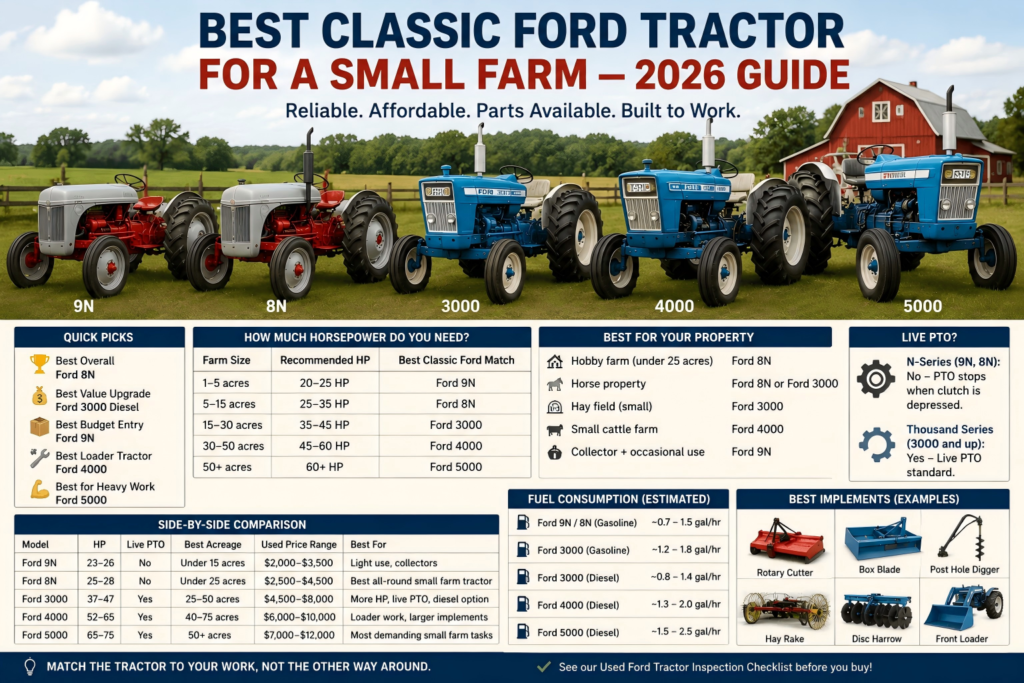
Quick Picks — Best Classic Ford Tractor by Need:
🏆 Best Overall: Ford 8N — widest parts availability, most affordable, handles all standard small farm tasks
💰 Best Value Upgrade: Ford 3000 Diesel — live PTO, diesel efficiency, more HP for 25–50 acres
📦 Best Budget Entry: Ford 9N — historical significance, light use, lowest entry price
🔧 Best Loader Tractor: Ford 4000 — heavier frame, more HP, better suited to regular loader work
💪 Best for Heavy Work: Ford 5000 — most capable classic Ford for demanding daily farm use
What “Small Farm” Actually Means for Tractor Selection
A small farm in tractor terms is defined less by acreage than by what you need to do with the machine. The key questions:
- What implements will you use? — mowing, tilling, box blade grading, post hole digging, and loader work all have different HP and PTO requirements
- Do you need live PTO? — the Ford 8N and 9N have transmission-driven (non-live) PTO that stops when the clutch is depressed. For most implements this is fine. For hay equipment and some commercial implements, live PTO is required
- What is your terrain? — flat fields need less traction capability than hilly ground; loader work needs a heavier rear counterbalance
- How often will you use it? — occasional light use a few times a year is different from regular weekly operation
The most common mistake small farm buyers make: buying more tractor than the property needs. A well-maintained Ford 8N handles most common maintenance tasks on small farms under about 25 acres — mowing, box blade work, tilling, post holes, and light brush clearing — provided the implements and workload are matched to its horsepower and capabilities. The upgrade to a 3000 or 4000 is justified when you need live PTO, more HP for heavier implements, or a loader that the N-Series frame cannot properly support.
How Much Horsepower Do You Need for Your Farm?
| Farm Size | Recommended HP | Best Classic Ford Match |
|---|---|---|
| 1–5 acres | 20–25 HP | Ford 9N (23–26 HP) |
| 5–15 acres | 25–35 HP | Ford 8N (25–28 HP) |
| 15–30 acres | 35–45 HP | Ford 3000 (37–47 HP) |
| 30–50 acres | 45–60 HP | Ford 4000 (52–65 HP) |
| 50+ acres | 60+ HP | Ford 5000 (65–75 HP) |
These are general guidance ranges — actual HP requirements depend on soil type, terrain, and implement selection. A flat 20-acre property with light mowing needs less HP than a hilly 10-acre property with heavy brush.
Ford 8N — Best for Small Farms Under 25 Acres
For most small farm buyers, the Ford 8N is the best classic Ford tractor available — and it is not a close call. The most produced classic Ford at over 524,000 units, the 8N has the broadest parts availability of any vintage tractor on the market, the simplest mechanics for DIY maintenance, and a price point that makes it accessible to most buyers.
At 25–28 HP with a Category 1 three-point hitch, the 8N handles:
- 4–5 ft finish mowers and rotary cutters
- 5 ft box blades and rear blades
- 2-bottom ploughs in most soil conditions
- 6–9 inch post hole diggers in soft to medium ground
- 4–5 ft tillers in prepared soil
- Light snow removal with a rear blade
What it won’t do well: the Ford 8N can be fitted with a front loader and many were, but its manual steering, lighter front axle, and frame design make it less suited to frequent loader work than the Ford 3000 or Ford 4000. Heavy primary tillage in hard unbroken ground and implements requiring live PTO are also beyond its practical range. For farms where those capabilities matter, the Ford 3000 is the more appropriate choice.
Typical used price: $2,500–$4,500 in good working condition.
👉 See current Ford 8N listings →
Ford 3000 — Best for Small Farms 25–50 Acres
The Ford 3000 is the step up that genuinely matters for small farms in the 25–50 acre range. At 37–47 HP with live PTO, live hydraulics, and a more modern drivetrain than the N-Series, it handles a wider range of implements more capably and with less strain than the 8N.
The key advantages of the 3000 over the 8N for small farm use:
- Live PTO — the PTO shaft keeps spinning when the clutch is depressed, which matters for hay equipment, certain mowers, and implements where continuous PTO power is required during manoeuvring
- More HP — 37–47 HP handles 5–6 ft rotary cutters, larger disc harrows, and 3-bottom ploughs that would strain an 8N
- Live hydraulics — the hydraulic system operates independently of the transmission, providing more precise implement control
- Diesel option — the Ford 3000 diesel is more fuel-efficient than the 8N petrol engine at comparable work output, meaningful on a farm where the tractor runs regularly
Typical used price: $4,500–$8,000 in good working condition.
👉 See current Ford 3000 listings →
Ford 4000 and 5000 — When You Need More
For small farms approaching 50 acres, operating a front loader regularly, or running larger implements, the Ford 4000 (52–65 HP) and Ford 5000 (65–75 HP) provide the additional capability that the 3000 cannot match.
The 4000 and 5000 are particularly suited to:
- Front loader work — the heavier frames handle loader forces better than the N-Series or 3000
- Larger rotary cutters (6–7 ft) in heavy brush
- Round bale handling with a loader and spear
- Heavier disc work in unbroken or compacted ground
- Properties where the tractor is used daily for varied tasks
The tradeoff: higher purchase price and slightly higher maintenance cost than the smaller models.
Side-by-Side Comparison — Classic Ford Models for Small Farms
| Model | HP | Live PTO | Best Acreage | Used Price Range | Best For |
|---|---|---|---|---|---|
| Ford 9N | 23–26 | No | Under 15 acres | $2,000–$3,500 | Light use, collectors |
| Ford 8N | 25–28 | No | Under 25 acres | $2,500–$4,500 | Best all-round small farm tractor |
| Ford 3000 | 37–47 | Yes | 25–50 acres | $4,500–$8,000 | More HP, live PTO, diesel option |
| Ford 4000 | 52–65 | Yes | 40–75 acres | $6,000–$10,000 | Loader work, larger implements |
| Ford 5000 | 65–75 | Yes | 50+ acres | $7,000–$12,000 | Most demanding small farm tasks |
Best Ford Tractor by Property Type
| Property Type | Best Pick | Why |
|---|---|---|
| Hobby farm (under 25 acres) | Ford 8N | All standard tasks, best parts, most affordable |
| Horse property | Ford 8N or Ford 3000 | 8N for small paddocks and arena work; 3000 if hay production is involved |
| Orchard | Ford 8N or Ford 3000 | Compact width, low profile hood — both manoeuvre well between rows |
| Hay field (small) | Ford 3000 | Live PTO essential for hay mowers and rakes |
| Small cattle farm | Ford 4000 | Loader capability for feed handling, more HP for varied tasks |
| Small livestock farm | Ford 3000 or Ford 4000 | Live PTO, more HP, loader option — handles daily chores reliably |
| Collector + occasional use | Ford 9N | Historical significance, low use demands, strong collector market |
New vs Used — What Makes Sense for a Small Farm
Every classic Ford tractor is used by definition — the newest Ford 5000 rolled off the line in 1975. What varies is condition and how that condition was reached:
- Farm-used examples — machines that have been working regularly on a farm are often in better mechanical condition than those that sat unused. A tractor used and maintained is generally preferable to one stored and neglected
- Restored examples — cosmetically and mechanically restored machines are available at a premium. The premium is justified if you want a machine that requires nothing immediately. Verify what mechanical work was done, not just how it looks
- Project machines — running but needing work examples at $1,000–$2,000 are viable for mechanically confident buyers. Calculate the repair cost before assuming they represent value
Before any purchase, use our complete Used Ford Tractor Inspection Checklist →
Fuel Consumption — Classic Ford Tractors Compared
| Model | Fuel Type | Estimated Use | Notes |
|---|---|---|---|
| Ford 9N | Gasoline | ~0.5–1.2 gal/hr | Light to moderate work |
| Ford 8N | Gasoline | ~0.7–1.5 gal/hr | Slightly more HP, comparable efficiency |
| Ford 3000 (gas) | Gasoline | ~1.2–1.8 gal/hr | Higher HP draws more fuel at load |
| Ford 3000 (diesel) | Diesel | ~0.8–1.4 gal/hr | Meaningfully more efficient than gas at equivalent work |
| Ford 4000 (diesel) | Diesel | ~1.3–2.0 gal/hr | More HP, higher consumption under load |
| Ford 5000 (diesel) | Diesel | ~1.5–2.5 gal/hr | Most capable — highest fuel draw at full load |
For small farms where the tractor runs regularly, the Ford 3000 diesel offers the best fuel efficiency per unit of work output among the classic Ford range — a meaningful advantage over several seasons of use.
Common Mistakes Small Farm Buyers Make
- Buying too much tractor for the property — a Ford 5000 on 5 acres is like buying a lorry to drive to the corner shop. Match the machine to the actual work
- Ignoring PTO type — buyers who need live PTO for hay equipment and buy an 8N discover the limitation the first time they try to use a hay mower. Confirm your implement requirements before choosing between N-Series and Thousand Series
- Prioritising cosmetics over mechanicals — a freshly painted 8N with bad hydraulics and worn rings costs more to own than a scruffy working machine with service records
- Not accounting for implement costs — the tractor is only part of the purchase. New and used Category 1 implements are widely available from suppliers like Steiner Tractor Parts. A 5 ft finish mower, box blade, and post hole digger can add $1,500–$3,000 to the total cost. Budget for implements before buying the tractor
- Underestimating annual maintenance — budget $100–$300 per year for an 8N, $200–$500 for a 3000 or larger. These are not maintenance-free machines
Best Implements for Each Classic Ford Model
| Model | Ideal Implements | Avoid |
|---|---|---|
| Ford 9N | 4 ft rotary cutter, rear blade, 4 ft finish mower, carry-all | Large rotary cutters, loader, hay equipment |
| Ford 8N | 5 ft brush hog, 5 ft finish mower, box blade, 2-bottom plough, post hole digger | 6+ ft cutters in heavy brush, front loader for regular use |
| Ford 3000 | 6 ft rotary cutter, disc harrow, hay rake, 3-bottom plough, rear blade | Round bale handling, very heavy loader work |
| Ford 4000 | Front loader, round bale spear, 6–7 ft rotary cutter, heavy box blade, hay equipment | Implements requiring 65+ HP |
| Ford 5000 | Large mower, hay equipment, heavy tillage, large disc, front loader | Very large commercial implements |
What Owners Love About Classic Ford Tractors
- Inexpensive repairs — most maintenance items cost a fraction of what modern tractor parts run. A carburettor kit is $30, a hydraulic rebuild kit is $80, an ignition tune-up is $50
- Simple mechanics — no electronics, no dealer-only diagnostic tools, no proprietary software. A service manual and basic hand tools cover the majority of maintenance tasks
- Starts reliably when maintained — a properly tuned Ford 8N with fresh points, plugs, and a good battery starts readily in all but the coldest weather
- Huge aftermarket support — multiple suppliers stock comprehensive parts catalogues in 2026. You rarely wait more than a few days for anything
- Strong resale value — well-maintained classic Fords hold their value better than many modern compact tractors of equivalent original price
- Community — the Ford 8N and 9N have some of the most active online owner communities of any classic tractor, providing free advice and parts guidance
What It Is Really Like Owning a Classic Ford Tractor
We have inspected dozens of Ford 8N and Ford 3000 tractors over the years. Buyers almost always underestimate how much difference live PTO makes once they start mowing or running hay equipment. For hobby farms, however, the 8N still offers the best balance of simplicity, affordability, and available parts — and most small property owners never hit its limits.
Here is what day-to-day ownership actually looks like:
- Parts availability — you will rarely wait more than a few days for any common part. Carburettor kits, hydraulic seals, ignition components, and clutch discs are all stocked by multiple suppliers in 2026
- Winter starting — a well-tuned Ford 8N with fresh ignition components and a strong battery starts readily in cold weather. A neglected 8N with worn points and a weak battery struggles. Annual ignition maintenance is the most impactful thing you can do for cold-start reliability
- Ease of repairs — most owners with basic mechanical confidence handle their own maintenance. The flathead engine, 4-speed transmission, and hydraulic system have no electronics and respond to standard tools and a service manual
- Storage — a shed or covered storage is strongly recommended. Classic Fords stored outdoors develop tyre sidewall cracking, electrical corrosion, and rubber seal deterioration significantly faster than barn-kept machines
- Noise and comfort — these are working machines from the 1940s and 1950s. No cab, no suspension seat, no sound insulation. For occasional use on a small property this is entirely manageable. For daily all-day use, it is something to consider seriously
- Reliability — properly maintained classic Fords are genuinely reliable. The failures that give them a bad reputation almost always trace back to neglect — old oil, ignored hydraulics, deferred ignition service — not inherent mechanical weakness
- Resale value — well-maintained examples hold their value well. A properly kept Ford 8N bought for $3,500 today will sell for a similar price in five years if maintained — something few pieces of modern farm equipment can claim
Annual Maintenance Costs by Model
| Model | Annual Maintenance Estimate | Notes |
|---|---|---|
| Ford 9N | $100–$250 | Lowest cost — simple system, light use typical |
| Ford 8N | $100–$300 | Routine oil, ignition, occasional hydraulic attention |
| Ford 3000 | $200–$450 | More systems to service — diesel filter, injection system check |
| Ford 4000 | $300–$600 | Higher use typical, more HP means more wear items |
| Ford 5000 | $350–$700 | Highest maintenance of the classic Ford range |
Buying Decision Flow — Which Classic Ford Is Right for You?
Work through these questions in order:
1. Under 10 acres, light use? → Ford 9N or Ford 8N
2. 10–25 acres, standard farm tasks? → Ford 8N
3. Need live PTO (hay equipment, specific mowers)? → Ford 3000 or above
4. 25–50 acres or need more than 28 HP? → Ford 3000
5. Regular loader work or 50+ acres? → Ford 4000
6. Demanding daily farm use or heavy implements? → Ford 5000
Verdict — Best Ford Tractor for a Small Farm
The best Ford tractor for a small farm in 2026 is the one that matches what your farm actually needs:
- Under 25 acres, light to moderate use — Ford 8N. Best parts availability, most affordable, handles everything a small farm under 25 acres needs
- 25–50 acres, need live PTO or more HP — Ford 3000. The step up that genuinely matters — live PTO, diesel option, more capable on larger implements
- 50+ acres or regular loader work — Ford 4000 or Ford 5000. The HP and frame construction to handle more demanding daily use
Browse all current stock: Ford tractors for sale →
Beyond Ford — Best Tractor for a Small Farm Overall
This guide focuses on classic Ford tractors, but the PAA data shows buyers also want a broader comparison. If you’re open to other brands alongside Ford, here is an honest overview:
What Is the Best All-Around Tractor for a Small Farm?
| Budget | Best All-Around Pick | Why | Approx Price |
|---|---|---|---|
| Under $5,000 (used classic) | Ford 8N or Massey Ferguson 135 | Widest parts availability, simple mechanics, no software locks. Best right-to-repair classics | $2,500–$5,000 |
| $8,000–$20,000 (used compact) | Kubota L Series (L3901, L4060) | Most reliable compact diesel in its class — 8,000–12,000+ hour design life, strong dealer network | $12,000–$22,000 used |
| $20,000–$35,000 (new compact) | Kubota L3901 or John Deere 3025E | Kubota for reliability; JD for dealer access and resale value — near tie at this price range | $22,000–$32,000 new |
| $35,000+ (new utility) | John Deere 5075E or Massey Ferguson 5711 | JD for dealer access; MF for best value per HP at utility scale | $38,000–$55,000 new |
What Is the Best Tractor for a 1-Acre Farm?
For a 1-acre property the honest answer is: a sub-compact tractor or a compact riding tractor — not a full farm tractor. A Kubota BX Series (23–25 HP) or John Deere 1025R handles everything a 1-acre property needs — mowing, box blade work, light loader tasks — at a fraction of the cost and footprint of a full compact tractor. If you specifically want a classic Ford, an 8N or 9N handles 1-acre tasks comfortably. The limitation at 1 acre is not power — it is manoeuvrability and storage footprint.
What Is the Best Mini Tractor?
By use case for small properties:
- Kubota BX23S — best sub-compact TLB (tractor-loader-backhoe). 23 HP, factory-integrated loader and backhoe, hydrostatic transmission. Approximately $23,000–$27,000 new
- John Deere 1025R — main Kubota BX23S competitor. Strong JD dealer network. Approximately $22,000–$26,000 new
- Kioti CS2510 — best value sub-compact. Lower purchase price, competitive spec. Browse our Kioti tractors for sale
- Branson 2515H — another strong value alternative. Browse our Branson tractors for sale
What Size Tractor Is Best for a Small Farm?
| Farm Size | Recommended HP | Best Classic Ford | Best Modern Alternative |
|---|---|---|---|
| Under 5 acres | 20–25 HP | Ford 9N or 8N | Kubota BX Series or JD 1025R |
| 5–25 acres | 25–40 HP | Ford 8N or 3000 | Kubota L3901 or JD 3025E |
| 25–50 acres | 40–65 HP | Ford 3000 or 4000 | Kubota M5060 or JD 5045E |
| 50–100 acres | 65–100 HP | Ford 5000 or 6000 | MF 5711 or JD 5075E |
A common mistake: buying a 75+ HP tractor for a 10-acre hobby farm. A larger tractor does not do small farm work better — it just costs more to buy, fuel, and maintain. Match the HP to the property and implement size.
Which Brand of Small Farm Tractor Is the Best?
| Brand | Best For | Main Strength | Main Weakness |
|---|---|---|---|
| Kubota | Compact and sub-compact under 60 HP | Most reliable diesel engine in class — outstanding longevity record | Lower resale than JD; smaller dealer than JD in some US regions |
| John Deere | Any size — particularly 60 HP+ | Largest US dealer network — best resale value | Most expensive at equivalent spec |
| Massey Ferguson | Mid-range utility 60–130 HP | Best value per HP at utility scale — global parts network | Smaller US dealer than JD |
| Ford (classic) | Under 50 acres, budget-conscious | Best parts availability of any classic tractor — no right-to-repair issues | Limited by age — no electronics but also no modern comforts |
| Kioti | Value compact — 25–75 HP | Best price per HP in compact class among established brands | Smaller dealer than Kubota or JD |
Which Is the No. 1 Tractor?
By global unit sales: Mahindra (India) — dominant in the global volume market. By US market share: John Deere. By compact tractor reliability: Kubota. By premium engineering: Fendt. By global parts availability: Massey Ferguson. By classic tractor practicality: Ford 8N — most produced, most parts available, most accessible. No single brand is #1 across all dimensions — the answer depends on HP class, budget, and regional dealer access. Browse our Massey Ferguson tractors and Kubota tractors for sale.
What Tractor Brand Has the Least Problems?
In owner surveys and dealer service data by HP class:
- Sub-compact (under 30 HP): Kubota BX Series — lowest reported problems per operating hour in owner surveys
- Compact (30–60 HP): Kubota L Series and John Deere 3-4 Series — broadly tied
- Utility (60–100 HP): John Deere 5-6 Series and Massey Ferguson 5700 — both strong
- Classic: Ford 8N — mechanical simplicity means fewer failure points than any modern tractor. What goes wrong is well-documented and cheap to fix
The consistent finding across all classes: maintenance history predicts problem frequency more reliably than brand. A well-maintained machine of any established brand has fewer problems than a neglected machine of the most reliable brand.
What Are the Most Reliable Ford Engines Ever Built?
| Engine | Found In | Why It’s Reliable |
|---|---|---|
| Ford 3-cylinder diesel (Dorset) | Ford 3000, 4000 (Thousand Series) | Simple, robust design — no electronics, accessible for DIY repair, parts widely available. Engines still running after 50+ years in regular farm use. Widely regarded as the best diesel Ford ever put in a utility tractor |
| Ford flathead gasoline (9N, 8N) | Ford 9N, 2N, 8N | Extraordinary longevity when properly maintained. Simple design with no overhead valves — fewer failure points than any OHV engine. Many original engines from the late 1940s and early 1950s still running with nothing more than rebuilds. Parts universally available |
| Ford 4-cylinder diesel (BSD-444) | Ford 5000, 7000 (Thousand Series) | Higher HP than the 3-cylinder — equally reliable design. The 5000 diesel is widely regarded as one of the most durable working engines in the Ford range for farms that needed 65+ HP |
The honest consensus among Ford tractor owners and dealers: the 3-cylinder diesel in the Ford 3000 and 4000 is the most reliable Ford tractor engine ever built — combining simplicity, fuel efficiency, and documented longevity across millions of hours of farm use globally.
Which Tractor Is Considered the Most Reliable of All Time?
Most frequently cited candidates:
- Ford 8N — most reliable classic in terms of parts access and DIY repairability. Still running 75+ years later on original or once-rebuilt engines
- Massey Ferguson 135 — Perkins 3-cylinder diesel regarded as one of the most reliable small diesel engines ever made. Still actively farmed worldwide after 50+ years
- Kubota BX Series (modern) — most reliable modern sub-compact tractor by owner survey data — diesel engine longevity and low problem rates
- John Deere 4020 — “most reliable American row-crop tractor” in historical surveys — legendary powertrain, strong aftermarket, still working on farms
The honest answer: long-term reliability is more a function of maintenance than brand. Any of the above machines, properly maintained, outlasts poorly maintained examples of the “most reliable” alternative.
Best Compact Tractor for the Money
What Is the Most Reliable Compact Tractor Brand?
Kubota leads compact tractor reliability rankings in most owner surveys — particularly the L Series (L3901, L4060) diesel engines, which have an outstanding track record for low-maintenance longevity. John Deere is the main competitor — equal or very close on reliability, with the advantage of the largest US dealer network. For buyers wanting the most reliable compact tractor: Kubota if reliability per dollar is the priority; John Deere if resale value and dealer access are equally important. Browse our John Deere tractors for sale.
Is Kubota or John Deere Better?
They rarely compete on the same dimensions:
- Under 60 HP compact: Kubota is the stronger reliability and value choice. Better diesel engine reputation, lower purchase price at equivalent spec
- 60 HP+ utility and farm: John Deere is stronger — largest US dealer network, best resale value, most consistent quality at scale
- Resale value: John Deere consistently leads all brands in US resale value retention
- Purchase price: Kubota is typically 15–20% less expensive than John Deere at equivalent HP and spec
The right choice is determined by HP class and priorities — not brand loyalty.
What Is the Best Tractor for the Money?
By budget bracket for small farm buyers:
- Under $5,000 (used classic): Ford 3000 diesel or Massey Ferguson 135 — best value classic farm tractor with real capability
- $10,000–$20,000 (used compact): Kubota L Series with loader — best reliability per dollar in this range
- $20,000–$30,000 (new compact): Kubota L3901 — best value new compact tractor with loader
- $30,000–$45,000 (new utility): Massey Ferguson 5711 — best HP per dollar at utility scale
What Is the Most Sold Tractor of All Time?
The Ford 8N at over 524,000 units (1947–1952) remains the most produced two-plow tractor in US history. Globally, the Massey Ferguson 135 and its related models were produced in the largest total numbers of any single utility tractor platform worldwide through the 1960s–1980s. For modern production: Mahindra‘s various models collectively represent the highest annual production volumes of any tractor brand in the world, driven by the Indian market.
What Is the Best Time to Buy a Tractor?
| Time of Year | Verdict | Why |
|---|---|---|
| October–December | ✅ Best for new tractors | End of model year — dealers clearing current stock, year-end sales targets create negotiating room |
| January–February | ✅ Good for new and used | Post-harvest, low demand, motivated dealers — lowest traffic of the year |
| September–October | ✅ Best for used tractors | Post-harvest machines come to market as farmers sell before winter — best used selection at fair prices |
| March–April | ⚠️ Increasing demand | Pre-season demand builds — dealers gain leverage as buyers urgently need equipment |
| May–August | ❌ Worst for price | Peak demand — dealers have least motivation to negotiate |
For classic Ford tractors specifically: the used market is less seasonal. For full spec sheets on classic Ford models, TractorData.com maintains Nebraska Test records by model and year. than modern tractors since classic machines are not tied to model year inventory cycles. The best classic Ford prices tend to appear September–November when estate sales, farm dispersals, and end-of-season selling create the most inventory. For current pricing on classic Ford tractors, TractorHouse.com lists live market comparables.
Frequently Asked Questions
What is the best Ford tractor for a small farm?
For most small farms under 25 acres, the Ford 8N is the best classic Ford tractor — widest parts availability, most affordable, and capable of all standard small farm tasks including mowing, tilling, box blade work, and post hole digging. For farms of 25–50 acres or where live PTO is needed, the Ford 3000 is the better choice with more HP and a diesel option.
Is a Ford 8N enough for a small farm?
For most small farms under 25 acres — yes. The Ford 8N handles 4–5 ft finish mowers, rotary cutters, box blades, 2-bottom ploughs, and post hole diggers reliably. Its main limitations are no live PTO (stops when clutch is depressed), 25–28 HP ceiling, and unsuitability for serious front loader work. For farms where those limitations matter, the Ford 3000 is the appropriate upgrade.
Should I buy a Ford 8N or Ford 3000 for my farm?
Buy the Ford 8N if: your farm is under 25 acres, your implements are sized for 25–28 HP, and you don’t need live PTO. Buy the Ford 3000 if: your farm is 25–50 acres, you need live PTO for hay equipment or specific implements, or you want the diesel fuel efficiency advantage for regular use. The 3000 costs significantly more used — confirm the upgrade is justified by what your farm actually needs.
What implements can a Ford 8N handle?
The Ford 8N handles Category 1 implements sized for 25–28 HP: 4–5 ft finish mowers, 4–5 ft rotary cutters, 5 ft box blades, 2-bottom ploughs, 6–9 inch post hole diggers in soft to medium ground, 4–5 ft tillers in prepared soil, and rear blades for snow removal and light grading. Oversized implements above these sizes will strain the engine and hydraulic system.
Is a Ford 9N good for a small farm?
Yes — for very light use on small properties under 15 acres. The Ford 9N handles the same basic implements as the 8N but with slightly less HP, a 3-speed transmission (vs 8N’s 4-speed), and narrower parts availability. For a working small farm tractor, the Ford 8N is the more practical choice. The 9N makes most sense for collectors or buyers who specifically want the historical significance of the first Ford tractor.