Is Ford 3000 worth it in 2026? For small to medium farm owners who have outgrown the Ford 8N — or who need live PTO from the start — the Ford 3000 is one of the most capable and practical classic tractors available at its price point. With 37–47 HP, a live PTO, independent hydraulics, and a diesel option that delivers real fuel economy, it represents a meaningful step up from the N-Series without the cost and complexity of a modern machine. It is not without issues — the diesel injection system requires attention, the Select-O-Speed transmission (where fitted) has a troubled reputation, and good examples are harder to find than comparable Ford 8N machines. But for the right buyer, the Ford 3000 earns its asking price in 2026.
👉 Check current Ford 3000 listings — see available stock and pricing →
Written by: Farmers Equipment editorial team — specialising in classic Ford tractors from the N-Series through the Thousand Series.
Buy the Ford 3000 if you:
✅ Need live PTO for hay equipment, certain mowers, or PTO-dependent implements
✅ Farm 25–50 acres and need more than 28 HP
✅ Want the diesel fuel efficiency advantage for regular use
✅ Need independent hydraulics for better implement control
✅ Have a budget of $4,500–$8,000 for a good working example
❌ Don’t buy it if the Ford 8N covers your actual work — it costs significantly less
❌ Avoid the Select-O-Speed transmission variant unless you know its history
Is the Ford 3000 Worth It — Pros and Cons
| ✅ Pros | ⚠️ Cons |
|---|---|
| Live PTO — keeps spinning when clutch is depressed | Higher purchase price than Ford 8N |
| 37–47 HP — handles larger implements than N-Series | Select-O-Speed transmission has a poor reliability reputation |
| Diesel option — better fuel economy than petrol N-Series | Diesel injection system requires periodic professional attention |
| Independent hydraulics — more precise implement control | Good examples harder to find than Ford 8N |
| 3-cylinder engine — simpler than 4-cylinder in some respects | Parts availability narrower than Ford 8N though still good |
| More modern than N-Series — better operator ergonomics | Higher maintenance cost than Ford 8N |
Ford 3000 Reliability Ratings
| Category | Rating | Notes |
|---|---|---|
| Reliability (gear drive diesel) | ⭐⭐⭐⭐⭐ | Proven 3-cylinder diesel — very durable when maintained |
| Ease of repair | ⭐⭐⭐⭐☆ | More complex than N-Series but still DIY-friendly for most tasks |
| Parts availability | ⭐⭐⭐⭐☆ | Good from multiple suppliers — not quite as broad as Ford 8N |
| Fuel economy (diesel) | ⭐⭐⭐⭐⭐ | Best fuel efficiency of any classic Ford — diesel advantage is real |
| Loader suitability | ⭐⭐⭐⭐☆ | Better than N-Series — adequate for occasional loader use |
| Operator comfort | ⭐⭐⭐☆☆ | More modern than N-Series but still a 1960s–70s machine — no cab |
| Select-O-Speed reliability | ⭐⭐☆☆☆ | Known issues — avoid unless professionally rebuilt with documentation |
| Overall value (gear drive diesel) | ⭐⭐⭐⭐⭐ | Best classic Ford for 25–50 acre small farms needing live PTO |
Ford 3000 Quick Specs
| Spec | Detail |
|---|---|
| Production years | 1965–1975 |
| Engine | 3-cylinder, 158 cu in (diesel) or 175 cu in (petrol) |
| HP | ~37–47 HP depending on variant and year |
| Transmission options | 8-speed gear drive (recommended) or Select-O-Speed (avoid) |
| PTO | Live 540 RPM — independent of clutch |
| Hydraulic system | Independent live hydraulics — separate from transmission |
| Hitch | Category 1 three-point, draft and position control |
| Weight | ~3,600–3,900 lbs depending on configuration |
| Fuel | Diesel (most common) or petrol |
| Typical used price | $4,500–$8,000 in good working condition |
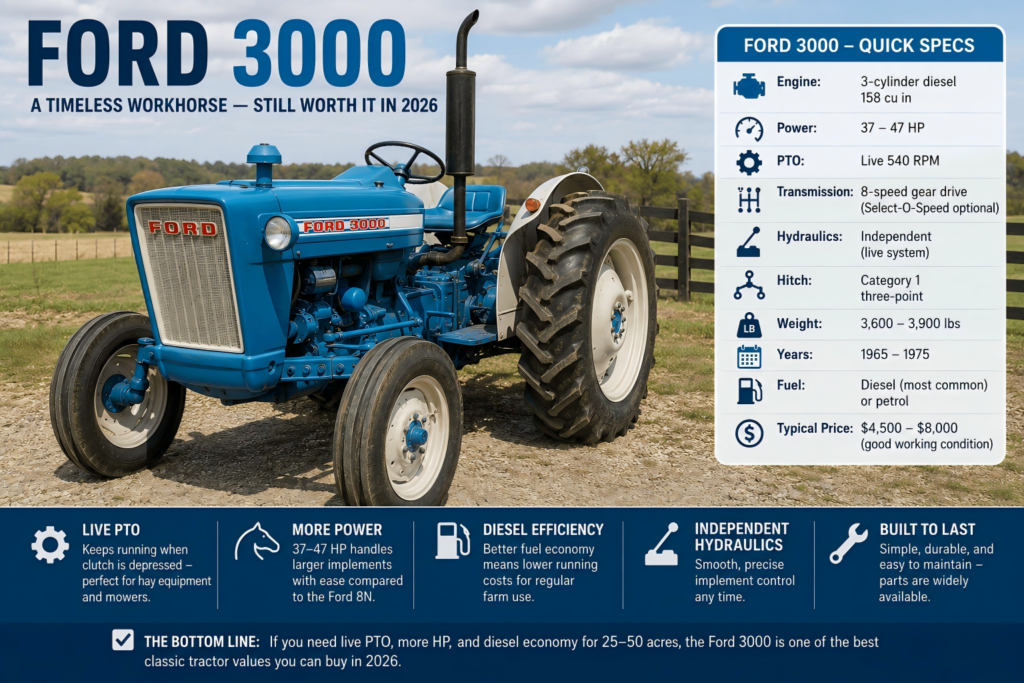
Ford 3000 Background — Why It Still Matters
Produced between 1965 and 1975, the Ford 3000 replaced the Ford 801 series and quickly became one of Ford’s most successful utility tractors. Built at Ford’s Basildon plant in the UK and distributed globally, it sold in large numbers across North America, Europe, and Australia — which is one of the primary reasons aftermarket parts support remains strong in 2026. Tens of thousands of Ford 3000 tractors remain in active service today, a testament to the durability of the basic design and the depth of the parts and knowledge base that has built up around them over six decades.
Are Ford 3000 Tractors Still Easy to Find in 2026?
Yes — the Ford 3000’s large production run and global distribution means examples remain available across the US and UK through multiple channels:
- Online marketplaces — TractorHouse, Craigslist, and Facebook Marketplace consistently list Ford 3000 tractors across the US. Searching by state allows buyers to find local examples that avoid long-distance transport costs
- Farm auctions — estate sales and farm dispersal auctions are a consistent source of Ford 3000 tractors, often at competitive prices. Condition varies widely — always inspect before bidding
- Classic tractor dealers — dealers specialising in classic Fords often carry inspected and serviced 3000 examples at a premium over private sale, with some assurance of condition
- UK market — the Ford 3000 was built at Basildon and sold heavily in the UK. Good examples are available through UK farm auctions and classified platforms at prices that can make importing worthwhile after costs
Gear drive diesel examples — the preferred configuration — are consistently available but command a premium. Budget more time finding the right example than accepting the first available machine.
Ford 3000 vs Ford 8N — Is the Upgrade Worth It?
| Feature | Ford 3000 | Ford 8N | Verdict |
|---|---|---|---|
| HP | 37–47 HP | 25–28 HP | 3000 — significant advantage for heavier work |
| PTO | Live 540 RPM | Transmission-driven (non-live) | 3000 — essential for hay equipment |
| Hydraulics | Independent live system | Non-live Ferguson system | 3000 — more precise control |
| Fuel | Diesel (most) — better economy | Petrol | 3000 — lower running cost at regular use |
| Parts availability | Good | Excellent | 8N — broader supply base |
| Purchase price | $4,500–$8,000 | $2,500–$4,500 | 8N — significantly more affordable |
| Loader suitability | Better than 8N | Limited | 3000 — more appropriate for occasional loader work |
| Maintenance simplicity | Moderate | High | 8N — simpler to maintain DIY |
The verdict: if your work requires live PTO, more than 28 HP, or regular loader use — the 3000 is the right upgrade. If your work stays within what the 8N can handle — the 8N is the better value at a lower price. See our Best Ford Tractor for a Small Farm guide for a full model-by-model comparison, or read our detailed Ford 8N review to compare directly.
Ideal Implements for the Ford 3000
| Implement | Works Well? | Notes |
|---|---|---|
| 5–6 ft rotary cutter (brush hog) | ✅ Yes | Significant advantage over 8N in heavy brush — more HP in reserve |
| Finish mower | ✅ Yes | Live PTO allows clean continuous cutting through turns |
| Disc harrow (5–6 ft) | ✅ Yes | Handles disc work the 8N would struggle with in harder ground |
| Box blade / rear blade | ✅ Yes | More HP gives better control in heavy grading work |
| Hay rake / tedder | ✅ Yes | Live PTO is essential for hay equipment — this is a primary 3000 advantage |
| 3-bottom plough | ✅ Yes | Within capability in most soil conditions |
| Post hole digger (up to 12 inch) | ✅ Yes | Handles larger augers than the 8N can manage |
| Small round baler | ⚠️ Small only | Capable with small balers — large commercial balers exceed HP rating |
| Front loader | ⚠️ Occasional | Better suited than N-Series but not a dedicated loader tractor |
| Large square baler | ❌ No | Exceeds practical HP limit — Ford 4000 or 5000 more appropriate |
Is the Ford 3000 Worth It — What It Does Well
Live PTO — the most important practical advantage
The single biggest reason to choose the Ford 3000 over the Ford 8N is live PTO. Owners who move to a Ford 3000 after using an 8N often note that the live PTO alone changes how the tractor feels to operate. Mowing around trees, stopping to clear debris, or turning at field ends becomes noticeably easier because the implement keeps working while the tractor slows or shifts. On an 8N, every clutch depression stops the mower blade — on the 3000, it keeps cutting. On the N-Series, the transmission-driven PTO stops whenever the clutch is depressed — which means every gear change stops the implement. On the Ford 3000, the PTO shaft keeps turning independently of the clutch and transmission. For hay mowers, tedders, and rakes — where the cutting or conditioning action must continue through turns and manoeuvres — live PTO is not optional. Buyers who plan to run hay equipment and choose an 8N to save money consistently regret it.
Horsepower — meaningful for larger implements
At 37–47 HP, the Ford 3000 handles implements that strain the Ford 8N: 5–6 ft rotary cutters in heavy brush, 3-bottom ploughs, larger disc harrows, and more demanding tilling operations. The additional HP also provides a meaningful reserve when working on hills or in difficult soil conditions — the 8N at full load on a slope has little margin left, while the 3000 has more in reserve.
Diesel fuel economy — significant for regular users
The Ford 3000 diesel typically consumes 0.8–1.4 gallons per hour under moderate load — meaningfully less than the petrol 8N’s 0.7–1.2 gallons at lighter load. For a machine used several hours per week through a farming season, that difference adds up across the year. Diesel also stores better than petrol in a machine that may sit between seasons.
Independent hydraulics — better implement control
The Ford 3000’s live hydraulic system operates independently from the transmission and clutch — unlike the N-Series non-live system. This means the hitch can be raised and lowered while the tractor is stopped or the clutch is depressed, without losing hydraulic pressure. For precision implement work — grading, levelling, seeding — the independent system is more controllable than the N-Series setup.
Is Ford 3000 Worth It — What It Doesn’t Do Well
Select-O-Speed transmission — avoid if possible
The Ford 3000 was available with two transmission options: a conventional 8-speed gear drive and the Select-O-Speed (SOS) — a power-shift transmission that allowed on-the-go gear changes. In theory the SOS was an advantage. In practice it proved mechanically complex and developed a poor reputation for reliability. Rebuild costs are high and specialist knowledge is required.
The clear guidance: buy the 8-speed gear drive variant. If you are looking at a Select-O-Speed Ford 3000, confirm the transmission has been professionally rebuilt recently with documentation before proceeding. An SOS with unknown history is a significant financial risk.
Diesel injection system — requires professional attention
The Ford 3000 diesel’s injection system — pump and injectors — requires periodic professional service that is beyond most DIY owners. Injection pump calibration is a specialist job requiring specific equipment. On a machine that has been sitting or whose service history is unknown, budget for a professional injection system inspection as part of any purchase. Symptoms of injection problems: hard starting when warm, uneven running, black smoke under load, loss of power.
Parts availability — good but not as strong as 8N
The Ford 3000 has good parts availability from suppliers including Steiner Tractor Parts — but it is narrower than the Ford 8N’s exceptionally broad supply base. Most mechanical components are available, but some body panels and trim items require more searching. This is a practical consideration, not a dealbreaker, but worth knowing before purchase.
Higher purchase price
A good working Ford 3000 lists for $4,500–$8,000 — meaningfully more than a comparable Ford 8N at $2,500–$4,500. That price difference is justified if you genuinely need what the 3000 offers. It is not justified if your work stays within the 8N’s capability. Be honest about what your farm actually requires before committing to the premium.
Ford 3000 Common Problems — What to Watch For
| Problem | Symptoms | Typical Cost to Fix |
|---|---|---|
| Injection pump wear | Hard warm starting, uneven idle, black smoke | $400–$900 rebuild |
| Injector fouling | Rough running, smoke, loss of power | $150–$400 clean/replace |
| Select-O-Speed failure | Slipping, no gear selection, jerky shifts | $800–$2,000+ rebuild |
| Hydraulic lift cover wear | Slow lift, hitch drift under load | $150–$400 rebuild kit |
| Rear axle seal leaks | Oil on rear wheels, drips under axle housing | $60–$150 parts |
| Steering box wear | Excessive play, wandering | $200–$500 |
| Coolant system neglect | Overheating, head gasket failure | $300–$800 |
| Clutch wear | Slipping under load, high engagement point | $300–$600 parts + labour |
Real Ownership Costs — Ford 3000
| Item | Cost | When |
|---|---|---|
| Engine oil and filter change | $25–$50 | Every 100 hours or annually |
| Diesel fuel filter | $15–$30 | Every 200 hours or annually |
| Injection system service | $200–$500 | Every 3–5 years or when symptoms appear |
| Hydraulic fluid change | $30–$60 | Every 500 hours or 2–3 years |
| Clutch replacement | $300–$600 parts + labour | Every 1,000+ hours depending on use |
| Rear tyre replacement (pair) | $400–$700 fitted | As needed |
| Annual maintenance estimate | $200–$450 | Routine — varies with use |
Example Annual Ownership Cost — Ford 3000 Diesel (Regular Use)
| Item | Estimated Annual Cost |
|---|---|
| Diesel fuel (est. 60–80 hrs/year at 1.0 gal/hr) | $250–$400 |
| Engine oil and filter changes | $50–$80 |
| Diesel fuel filter | $20–$35 |
| Hydraulic fluid top-up / change | $30–$60 |
| Miscellaneous repairs (seals, belts, minor items) | $100–$200 |
| Typical yearly total | $450–$775 |
Every few years, add the injection system service ($200–$500) and any wear item replacements. A well-maintained Ford 3000 diesel running 60–80 hours per year is a cost-effective working tractor compared to a modern compact diesel at equivalent capability.
What to Check When Buying a Ford 3000
All the checks from our Used Ford Tractor Inspection Checklist apply — plus these 3000-specific items:
- Transmission type — confirm whether it is the 8-speed gear drive or Select-O-Speed before anything else. This single factor shapes the entire purchase decision
- Diesel injection system — start it cold and warm. Listen for uneven running, watch for black smoke, check for hard warm starting. Ask when the injection pump was last serviced
- Live PTO test — engage the PTO with the engine running and confirm it spins freely. Depress the clutch and confirm it keeps spinning — this verifies the live PTO function is actually working
- Independent hydraulics — raise and lower the hitch with the engine running and clutch depressed. It should respond normally — this verifies the independent hydraulic system
- Serial number — confirm the year using our Ford Tractor Serial Numbers guide
Biggest Regrets Ford 3000 Buyers Mention
- Buying a Select-O-Speed without documented rebuild history — the most common and costly mistake. A Select-O-Speed with unknown history is an expensive repair waiting to happen
- Assuming every Ford 3000 has live PTO — many Ford 3000 tractors were equipped with live PTO, but PTO configuration varied by market and specification. Confirm the specific tractor you are buying has live PTO before purchase. Test it: engage PTO, depress clutch, confirm shaft keeps spinning
- Buying worn-out diesel injectors and not budgeting for it — injection system service is not DIY-friendly and costs $200–$500. Buyers who don’t account for this in their first-year budget are regularly surprised
- Expecting modern tractor comfort — the Ford 3000 is a 1960s–70s machine with no cab, no suspension seat, and significant vibration at high throttle. For occasional use this is manageable; for daily all-day sessions it is fatiguing
- Forgetting rear tyre replacement costs — larger rear tyres than the N-Series cost $400–$700 a pair fitted. Buyers who see cracked sidewalls and overlook them consistently face this bill in the first year of ownership
- Not verifying the transmission type before purchase — on a cold inspection it is not always obvious whether a Ford 3000 has the gear drive or Select-O-Speed. Ask specifically and confirm before proceeding
Who Should Buy the Ford 3000
- ✅ Farms of 25–50 acres needing more HP than the Ford 8N provides
- ✅ Anyone running hay equipment — live PTO is required
- ✅ Buyers who want diesel efficiency for regular weekly use
- ✅ Properties where occasional loader work is needed
- ✅ Buyers who have confirmed the 8-speed gear drive variant
Who Should Skip the Ford 3000
- ❌ Your work stays within what a Ford 8N can handle — save the premium
- ❌ Budget under $4,500 — buy a good Ford 8N instead
- ❌ You are looking at a Select-O-Speed variant with unknown history
- ❌ You need more than 47 HP — read our Ford 4000 review or Ford 5000 review
- ❌ You are not comfortable with diesel injection system maintenance costs
Ford 3000 vs Modern Compact Tractor — Which Makes More Sense?
Many small farm buyers in 2026 are choosing between a classic Ford 3000 and a modern compact diesel tractor (Kubota, John Deere, Mahindra, etc.) in a similar HP range. Here is an honest comparison:
| Factor | Ford 3000 (classic) | Modern Compact Tractor |
|---|---|---|
| Purchase price | $4,500–$8,000 | $15,000–$35,000 new; $8,000–$18,000 used |
| Electronics / DEF | None — fully mechanical | Complex electronics, DEF systems on newer models |
| Dealer dependency | Low — most repairs DIY-friendly | High — some repairs require dealer diagnostic tools |
| Parts cost | Low — broad aftermarket supply | Higher — OEM parts expensive, aftermarket less developed |
| Operator comfort | Basic — no cab, no suspension seat | Significantly better — many have cabs, A/C, suspension |
| Emissions complexity | None — pre-emissions machine | DPF, DEF, EGR on post-2014 machines add complexity |
| Resale value trajectory | Stable — classic Ford values holding | Depreciates more steeply in early years |
| HP range | 37–47 HP | 25–60 HP depending on model |
The Ford 3000 makes more sense if: you are mechanically confident, want to avoid electronics and emissions system complexity, and your budget is under $8,000. A modern compact makes more sense if: operator comfort matters, you want a warranty, or your operation requires features the classic Ford cannot provide (loader capacity, cab, precision controls).
Verdict — Is the Ford 3000 Worth It?
Is the Ford 3000 worth it in 2026? Yes — for buyers who genuinely need what it offers. Live PTO, 37–47 HP, diesel efficiency, and independent hydraulics make it a meaningfully more capable machine than the Ford 8N for farms in the 25–50 acre range or where hay equipment is in use. The Select-O-Speed transmission is the biggest risk — avoid it unless it has a documented professional rebuild. The diesel injection system requires more attention than anything on the N-Series, but delivers real running cost savings in return.
If the Ford 8N covers your actual work — buy the 8N and keep the $2,000–$3,000 price difference. If you have outgrown the 8N or know you need live PTO — the Ford 3000 earns its premium and will serve a well-maintained small farm reliably for decades more.
👉 See current Ford 3000 listings — compare available stock and pricing →
Frequently Asked Questions
Is the Ford 3000 a good tractor?
Yes — particularly the diesel, 8-speed gear drive variant. The Ford 3000 offers live PTO, 37–47 HP, independent hydraulics, and diesel fuel economy at a price point that remains accessible in 2026. The main caveats are the Select-O-Speed transmission (avoid) and the diesel injection system (requires periodic professional service). In gear drive diesel form, the 3000 is one of the most capable classic tractors available for small to medium farm use.
How much is a Ford 3000 tractor worth in 2026?
A Ford 3000 in good working condition typically lists between $4,500 and $8,000. Running examples needing work list from $2,000–$3,500. Fully restored or particularly clean examples can reach $9,000–$12,000. Diesel gear drive examples command a premium over petrol or Select-O-Speed variants. Verify current listings on TractorHouse before negotiating.
What are common Ford 3000 problems?
The most common issues: Select-O-Speed transmission failure (avoid this variant), diesel injection pump wear (hard warm starting, black smoke), hydraulic lift cover wear (hitch drift), and rear axle seal leaks. The gear drive diesel variant avoids the transmission problems entirely and is the most reliable configuration.
Ford 3000 vs Ford 8N — which should I buy?
Buy the Ford 8N if your farm is under 25 acres, you don’t need live PTO, and your implements are sized for 25–28 HP — you save $2,000–$3,000. Buy the Ford 3000 if you farm 25–50 acres, need live PTO for hay equipment, or want diesel efficiency for regular use. The 3000 is a genuine upgrade, not just a more expensive alternative.
Does the Ford 3000 have live PTO?
Yes — the Ford 3000 has live 540 RPM PTO that operates independently of the clutch and transmission. Unlike the Ford 8N and 9N (which have transmission-driven PTO that stops when the clutch is depressed), the 3000’s PTO keeps running through gear changes and manoeuvres. This is the primary practical advantage of the 3000 over the N-Series for buyers running hay equipment or PTO-dependent implements.