The Ford 8N hobby farm use is one of the most practical classic tractor choices available in 2026 — for the right property and the right tasks. With 25–28 HP, a Category 1 three-point hitch, the most parts-available drivetrain of any classic tractor, and a used price under $4,500 for a good working example, the Ford 8N covers the majority of tasks most hobby farm owners actually need. The honest question is whether it covers yours specifically — and where it runs out of tractor.
👉 Check current Ford 8N listings — see available stock and pricing →
Written by: Farmers Equipment editorial team — specialising in classic Ford tractors from the N-Series through the Thousand Series.
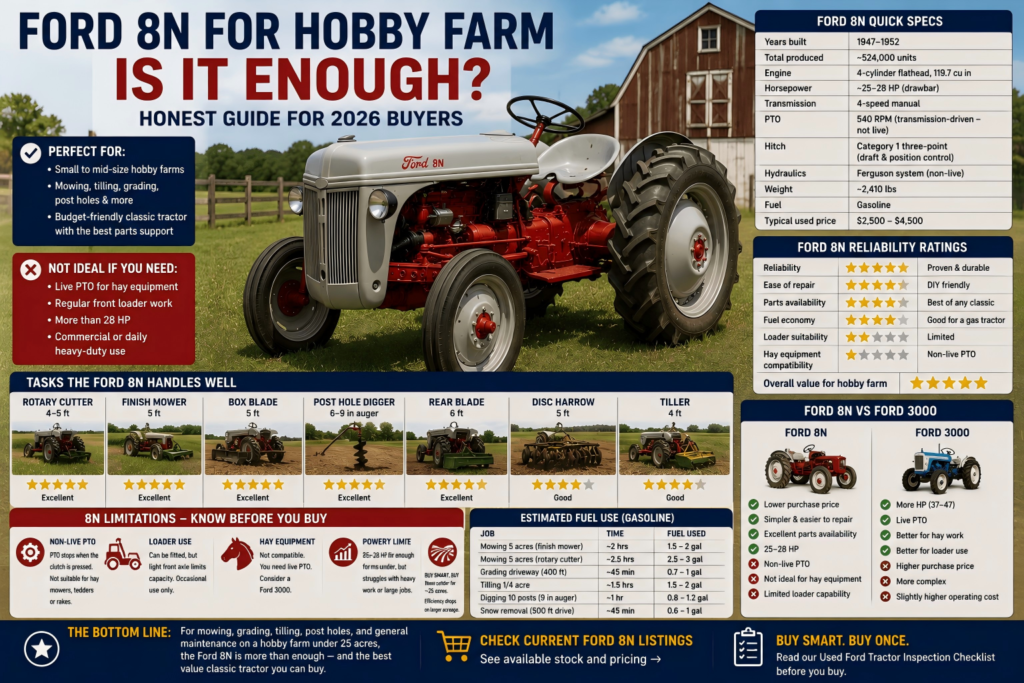
Ford 8N Quick Specs
| Specification | Detail |
|---|---|
| Years built | 1947–1952 |
| Total produced | ~524,000 units |
| Engine | 4-cylinder flathead, 119.7 cu in |
| Horsepower | ~25–28 HP at the drawbar |
| Transmission | 4-speed manual |
| PTO | Transmission-driven 540 RPM (not live — stops when clutch depressed) |
| Hitch | Category 1 three-point — draft and position control |
| Hydraulics | Ferguson system (non-live) |
| Weight | ~2,410 lbs |
| Fuel | Gasoline |
| Typical used price | $2,500–$4,500 in good working condition |
Ford 8N Hobby Farm Reliability Ratings
| Category | Rating | Notes |
|---|---|---|
| Reliability | ⭐⭐⭐⭐⭐ | Proven flathead engine — extremely durable when maintained |
| Ease of repair | ⭐⭐⭐⭐⭐ | No electronics — most repairs DIY with basic tools and a service manual |
| Parts availability | ⭐⭐⭐⭐⭐ | Best of any classic tractor — multiple suppliers, fast delivery |
| Fuel economy | ⭐⭐⭐⭐☆ | Good for a petrol tractor — 0.7–1.2 gal/hr depending on load |
| Loader suitability | ⭐⭐☆☆☆ | Can be fitted but light front axle limits frequent use |
| Hay equipment compatibility | ⭐☆☆☆☆ | Non-live PTO is a hard limitation for hay mowers and tedders |
| Overall hobby farm value | ⭐⭐⭐⭐⭐ | Best value classic tractor for properties under 25 acres |
Ford 8N Hobby Farm — What It Handles Well
For most hobby farms under 25 acres, the Ford 8N handles the core task list reliably:
| Implement | Ideal Size | Verdict | Notes |
|---|---|---|---|
| Rotary cutter (brush hog) | 4–5 ft | ⭐⭐⭐⭐⭐ | One of the most natural 8N pairings — handles standard brush well |
| Finish mower | 5 ft | ⭐⭐⭐⭐⭐ | Excellent — light load, clean results, ideal for pasture and lawn |
| Box blade | 5 ft | ⭐⭐⭐⭐⭐ | One of the 8N’s best tasks — driveway grading and levelling |
| Rear blade | 6 ft | ⭐⭐⭐⭐⭐ | Excellent for snow removal and light grading |
| 2-bottom plough | 2-bottom | ⭐⭐⭐⭐⭐ | Within capability in most soil conditions |
| Post hole digger | 6–9 inch auger | ⭐⭐⭐⭐⭐ | Good in soft to medium ground |
| Disc harrow | 5 ft | ⭐⭐⭐⭐☆ | Good in prepared soil — heavy primary tillage pushes the limit |
| Tiller | 4 ft | ⭐⭐⭐⭐☆ | Good in prepared soil — reduces to 3 stars in unbroken ground |
| Small manure spreader | PTO-driven, small | ⭐⭐⭐⭐☆ | Non-live PTO is manageable for spreader use |
| Front loader | Small — if fitted | ⭐⭐☆☆☆ | Possible but light axle limits capacity — occasional use only |
| Hay mower / tedder | Any | ⭐☆☆☆☆ | Non-live PTO is a hard limitation — buy a Ford 3000 for hay work |
Thousands of Ford 8N tractors have handled these tasks for decades, and many remain in regular hobby farm use today. The machine’s strength is not one particular task — it is the combination of capability, reliability, and parts availability that makes it so consistent for light to moderate farm use.
Ford 8N Hobby Farm — Where It Falls Short
| Task | 8N Limitation | Better Option |
|---|---|---|
| Hay mowing and raking | ❌ Non-live PTO stops on clutch — hay equipment requires live PTO | Ford 3000 or above |
| Heavy brush clearing (6 ft+) | ⚠️ Strains engine and hydraulics — limited reserve HP | Ford 3000 for regular heavy brush |
| Front loader work | ⚠️ Can be fitted but light front axle limits lifting and frequent use | Ford 4000 for regular loader use |
| Large round bale handling | ❌ Requires loader and HP the 8N cannot safely provide | Ford 4000 or 5000 |
| Heavy primary tillage | ⚠️ At the HP limit in hard unbroken ground | Ford 3000 for regular heavy tillage |
| Properties over 25 acres | ⚠️ Will do the work but slower and under more strain | Ford 3000 for efficiency |
| Daily commercial use | ❌ Not a commercial machine — designed for light farm duty | Modern utility tractor |
What Hobby Farm Tasks Actually Require
Most hobby farm buyers overestimate what their property will demand from a tractor. In our experience inspecting and working with classic Fords, the typical hobby farm tractor workload looks like this:
- Mowing — by far the most common use. Most hobby farm owners mow paddocks, lanes, and around buildings far more often than they till or plough. The 8N handles this completely
- Driveway and road maintenance — box blade work a few times a year. Well within 8N capability
- Occasional post hole digging — for fencing, trees, or structures. The 8N handles standard auger work fine
- Winter snow removal — a rear blade on an 8N handles private driveways and farm lanes effectively
- Garden or food plot preparation — tillage a few times a year in manageable soil. Within 8N range
The tasks that push the 8N beyond its capability — hay equipment, heavy loader work, large-scale tillage — are tasks that a significant portion of hobby farm owners either never do or do rarely enough that they hire out rather than purchase equipment.
The Key Question — Do You Need Live PTO?
This is the single most important question for any hobby farm buyer considering the Ford 8N. The N-Series uses a transmission-driven PTO — it stops spinning every time you depress the clutch. For most hobby farm tasks this is not an issue:
- Rotary cutters (brush hogs) — the blade’s flywheel mass keeps the cutter spinning through brief clutch depressions. Most hobby farm mowing works fine with non-live PTO
- Finish mowers — similar to rotary cutters — the brief PTO interruption during gear changes is manageable
- Post hole diggers — not spinning during clutch depressions is not a problem
- Tillers — manageable with care on gear changes
Where non-live PTO becomes a real limitation:
- Hay mowers (sickle bar or disc mower) — the cutting action must be continuous. Every clutch depression risks blade contact with material that jams on restart. Hay equipment effectively requires live PTO
- Hay tedders and rakes — same issue. PTO-driven hay tools are designed for live PTO machines
- Some commercial spreaders — PTO-driven spreaders that cannot tolerate interruption
The verdict on PTO: if your hobby farm involves hay — cutting, tedding, raking, or baling — buy the Ford 3000. The live PTO is not optional for that work. If your hobby farm does not involve hay equipment, the 8N’s non-live PTO is sufficient for the standard task list.
Ford 8N Hobby Farm — Typical Property Scenarios
| Property Type | Ford 8N Verdict | Notes |
|---|---|---|
| 5–10 acre lifestyle property — mowing and maintenance | ✅ More than enough | Will handle all standard tasks with power to spare |
| 10–20 acre horse property — mowing, dragging, occasional tilling | ✅ Good fit | Handles horse property maintenance well — no loader needed |
| 15–25 acre mixed hobby farm — no hay | ✅ Capable | Handles the full range — mowing, tillage, fencing, grading |
| Any size property — cutting hay regularly | ❌ Wrong tool | Buy the Ford 3000 for live PTO — don’t compromise on hay equipment |
| 20–30 acres — occasional heavy brush clearing | ⚠️ At the limit | Doable but straining — 3000 is more comfortable for regular heavy brush |
| Any property — frequent front loader use | ⚠️ Possible but not ideal | Ford 4000 is better suited to regular loader work |
Biggest Regrets Ford 8N Hobby Farm Owners Mention
- Buying it expecting it to replace a modern compact tractor — the 8N is a capable classic machine, not a modern compact. No cab, no power steering, no suspension seat. Buyers with unrealistic comfort expectations are consistently disappointed
- Underestimating manual steering when using a loader — fitting a front loader to an 8N and discovering that steering it with a loaded bucket on rough ground is genuinely hard work. The Ford 4000 exists for a reason
- Forgetting the PTO stops when the clutch is pressed — buyers who come from live PTO machines are surprised on the first gear change with a mower attached. Not a dealbreaker for most tasks, but a real limitation for hay equipment
- Buying one with worn steering and not checking it first — excessive steering play makes the machine unpleasant and less safe to operate. It is fixable, but not cheap. Always check steering play during inspection
- Neglecting the 6-volt electrical system — unmodified 6-volt machines with old wiring, weak generators, and hard-to-source batteries cause frustration. Budget for a 12-volt conversion if the machine hasn’t had one
- Not budgeting for implements — buying a $3,500 tractor and discovering that a finish mower, box blade, and post hole digger add another $2,000–$3,000 to the total
Who Should Not Buy a Ford 8N for a Hobby Farm
- ❌ Buyers who need a front loader every week — the 8N’s light front axle and manual steering make frequent loader use tiring and puts stress on the machine beyond its design intent. The Ford 4000 is a better loader tractor
- ❌ Hay producers — even small scale — non-live PTO makes the 8N unsuitable for hay mowers, tedders, and rakes. Do not try to work around this. Buy the Ford 3000
- ❌ Commercial landscapers or contractors — the 8N is a farm machine from the 1940s and 1950s. Daily commercial use at sustained loads is beyond its design intention and accelerates wear disproportionately
- ❌ Properties regularly over 30 acres of active work — the 8N will do the work but the efficiency cost becomes real. The Ford 3000 is more appropriate for larger weekly workloads
- ❌ Buyers who want modern comfort — no cab, no suspension seat, no power steering, significant vibration at higher throttle settings. For occasional use this is manageable; for daily sessions it is fatiguing
- ❌ Anyone who wants zero mechanical involvement — classic tractors require maintenance. A buyer who wants to pull it out of the shed and have it work without attention will be disappointed eventually
Ford 8N Hobby Farm — Real Ownership Numbers
| Item | Cost |
|---|---|
| Purchase price — good working example | $2,500–$4,500 |
| Basic implement set (finish mower, box blade, post hole digger) | $1,500–$3,000 |
| Annual maintenance estimate | $100–$300 |
| Fuel (est. 40–60 hrs/year at 0.9 gal/hr) | $150–$270 |
| First-year total cost estimate | $4,250–$8,070 |
Other Ownership Considerations
- Resale value after 5 years — well-maintained Ford 8N tractors have generally held their value well over recent years, although prices vary depending on region, condition, and collector demand — unusual for agricultural equipment of this age
- Storage — covered storage is strongly recommended. Outdoor exposure accelerates tyre sidewall cracking, electrical corrosion, and rubber seal deterioration significantly faster than barn-kept machines
- Battery replacement — expect to replace the battery every 3–5 years. Budget $80–$120 for a quality 12-volt replacement (if converted) or $60–$100 for a 6-volt original system battery
- Rear tyre lifespan — agricultural tyres on a machine used seasonally typically last 10–20 years before sidewall cracking requires replacement. A pair of rear tyres costs $300–$600 fitted — check sidewalls at purchase
- Insurance — classic farm tractors are insurable as farm equipment or as collector vehicles depending on use. Rates vary significantly — contact a farm insurance specialist for accurate quotes
Compare this to a new compact tractor of equivalent capability — typically $15,000–$25,000 new, plus implements. Current used Ford 8N listings and pricing can be verified on TractorHouse. For a hobby farm owner who is mechanically comfortable and wants utility without the investment of a modern machine, the Ford 8N represents outstanding value.
A Typical Hobby Farm Weekend with a Ford 8N
To make this concrete — here is what a realistic Saturday morning on a 15-acre hobby farm with a Ford 8N looks like:
- 7:00am — Mow the back pasture with a 5 ft finish mower. Two hours, clean result. 8N handles it at moderate throttle with HP to spare
- 9:00am — Grade the gravel driveway with a 5 ft box blade. Thirty minutes. The 8N’s hydraulic draft control maintains consistent blade pressure through the surface variation automatically
- 9:30am — Set three fence posts with a 9 inch post hole digger in medium ground. Under an hour including moving between locations
- 10:30am — Till the food plot with a 4 ft tiller in prepared soil. One pass, forty minutes
Total: four practical tasks completed before noon on a classic tractor that costs under $4,500 and runs on pump gasoline. All of these jobs are comfortably within the Ford 8N’s capability — none pushed the machine beyond its practical limits. That is what a well-matched hobby farm tractor looks like in practice.
When to Upgrade from the Ford 8N
The Ford 8N is the right starting point for most hobby farms. The right time to upgrade is when one of these specific situations applies — not before:
- You start cutting hay — upgrade to the Ford 3000 for live PTO. This is the clearest upgrade trigger
- Your property grows beyond 30+ acres — the 8N will do the work but a Ford 3000 will do it more efficiently
- You need regular front loader use — look at the Ford 4000 for the frame strength and HP to support it properly
- Your implement list grows beyond 28 HP — when the 8N consistently labours under load, the upgrade is justified
The mistake is upgrading pre-emptively before hitting those limits. Most hobby farm owners run an 8N for years without encountering them.
Estimated Fuel Use by Job — Ford 8N
| Job | Estimated Time | Estimated Fuel Used |
|---|---|---|
| Mowing 5 acres (finish mower) | ~2 hrs | ~1.5–2 gallons |
| Mowing 5 acres (rotary cutter, heavier grass) | ~2.5 hrs | ~2.5–3 gallons |
| Grading 400 ft driveway (box blade) | ~45 min | ~0.7–1 gallon |
| Tilling a 1/4 acre food plot | ~1.5 hrs | ~1.5–2 gallons |
| Digging 10 fence posts (9 inch auger) | ~1 hr | ~0.8–1.2 gallons |
| Snow removal — 500 ft private drive | ~45 min | ~0.6–1 gallon |
| Full Saturday morning (4 tasks) | ~4–5 hrs | ~4–6 gallons |
Ford 8N vs Modern Compact Tractor — Hobby Farm Comparison
| Feature | Ford 8N | Modern 25 HP Compact (e.g. Kubota BX, JD 1025R) |
|---|---|---|
| Purchase price | $2,500–$4,500 | $18,000–$30,000 new; $10,000–$18,000 used |
| Electronics | None — fully mechanical | Yes — sensors, fault codes, dealer diagnostics |
| DEF / emissions system | No | Often on post-2014 models |
| DIY repair friendliness | Excellent | Moderate — some repairs dealer-only |
| Parts cost | Low — broad aftermarket | Higher — OEM parts expensive |
| Operator comfort | Basic — no cab, no suspension | Significantly better — many have cabs, A/C |
| Live PTO | No | Yes — standard |
| Loader capability | Limited | Excellent — designed for loader use |
| Resale value trajectory | Stable — classic values holding | Depreciates in early years |
The Ford 8N makes more sense if: budget is under $5,000, mechanical confidence is high, and the task list stays within 25–28 HP without live PTO. A modern compact makes more sense if: comfort matters, loader work is frequent, or live PTO is required.
What to Check Before Buying a Ford 8N for Your Hobby Farm
Pre-purchase checklist — confirm all before buying:
☑ Compression — consistent across all cylinders, within ~10%
☑ Cold start — starts promptly without excessive cranking
☑ Hydraulic lift — raises to full height and holds without drifting
☑ PTO — engages and spins freely
☑ Steering play — no more than 2–3 inches at wheel rim
☑ Rear axle seals — no active drips at rear axle housing
☑ Tyre condition — no cracked sidewalls, adequate tread
☑ Charging system — confirm battery holds charge and alternator/generator charges at running speed
☑ Oil condition — amber to dark brown on dipstick, not milky or gritty
☑ Serial number — confirmed in 8N range, distributor type identified
Full inspection guidance: Used Ford Tractor Inspection Checklist →
Verdict — Is the Ford 8N Enough for a Hobby Farm?
For most hobby farms under 25 acres with a standard task list — mowing, grading, tilling, post holes, snow removal — the Ford 8N for hobby farm use is not just enough, it is the best value classic tractor available for that purpose. The combination of parts availability, mechanical simplicity, and accessible pricing makes it hard to beat for a buyer who does not need live PTO or more than 28 HP.
The honest exceptions: if your hobby farm involves hay equipment, buy the Ford 3000. If you need regular loader use, look at the Ford 4000. If your property is significantly over 25 acres with heavy regular use, the 3000 is more appropriate. For everyone else — the Ford 8N is enough, and has been for 75 years.
Before purchasing, read our complete Used Ford Tractor Inspection Checklist and our detailed Ford 8N review for full buying guidance. Confirm the model year using our Ford Tractor Serial Numbers guide. For historical context on what makes the 8N special, see our Ford N-Series Tractor History →
👉 See current Ford 8N listings — compare available stock and pricing →
Ford 8N Values — What Is a Ford 8N Worth Today?
The Ford 8N is the most widely traded classic tractor in North America. Prices in 2026 by condition:
| Condition | Price Range | Description |
|---|---|---|
| Non-running / parts only | $500–$1,200 | Engine seized, major components missing, or significant structural damage |
| Running — rough | $1,200–$2,200 | Runs and drives but needs attention — worn tyres, leaks, electrical issues, cosmetic problems |
| Running — good working condition | $2,500–$4,000 | Good mechanical condition, works reliably — the most common market price range |
| Restored — driver quality | $4,000–$6,500 | Repainted, mechanically rebuilt, new tyres — shows well and works reliably |
| Fully restored — show quality | $7,000–$12,000+ | Concours or near-concours restoration — correct Ford grey and red, correct decals, documented originality |
The most common price range for a working Ford 8N in honest used condition is $2,500–$4,000. For current market comparables, TractorHouse.com lists current Ford 8N sales with condition detail.
What Is a 1950 Ford 8N Worth Today?
A 1950 Ford 8N (serial numbers approximately 8N245,637–8N343,592) follows the same condition-based pricing as the general 8N market — $2,500–$4,000 for good working condition. The 1950 model year is notable because it straddles the distributor change: front-mount distributor on early 1950 production, side-mount distributor introduced mid-year (approximately serial 263,844). Side-mount distributor 1950 examples are generally preferred on the used market as the side-mount is considered more reliable and is the configuration most owners convert earlier front-mount machines to anyway. A correct, unmodified 1950 front-mount distributor machine in original condition can attract a small collector premium over a modified example.
Why Are Ford 8N Tractors So Cheap?
Relative to their capability and reliability, the Ford 8N does trade at low prices — for specific reasons:
- Volume — 524,076 were produced between 1947 and 1952. The sheer number of machines produced means supply is abundant on the used market even 75 years later. High supply = lower prices
- Age — buyers without mechanical confidence are deterred by machines this old, reducing demand from the general market even when the machines are mechanically sound
- No electronics, no features — the 8N has no cab, no power steering, no suspension seat, no PTO. Buyers expecting modern conveniences move to modern machines
- Perception of obsolescence — many buyers assume older means worse. In the 8N’s case the mechanical simplicity is an advantage, not a disadvantage — but the perception reduces demand
- Parts availability — the comprehensive aftermarket parts supply means no scarcity premium. Any part that breaks can be replaced cheaply
For hobby farm buyers who understand what the 8N is, this price positioning is an advantage — a highly capable, easily maintained machine at a fraction of the cost of a modern equivalent. Browse our Ford 8N tractors for sale.
What Was the Original Price of a Ford 8N Tractor?
The Ford 8N sold new for approximately $1,250–$1,325 in 1947 (the first year of production). Adjusted for inflation, this is approximately $16,000–$17,500 in 2026 dollars — meaning the 8N is significantly cheaper to buy today in real terms than it was when new. By comparison, an equivalent-capability new compact tractor (Kubota B2601 with loader) costs approximately $18,000–$22,000 new in 2026. The 8N in good used condition at $3,000–$4,000 represents extraordinary value relative to its original real cost and its modern equivalent replacement price.
How Many Ford 8N Tractors Were Made?
Ford produced 524,076 Ford 8N tractors between 1947 and 1952 — making it the most produced two-plow tractor in US history. Annual production by year (approximate):
| Year | Approximate Units Produced |
|---|---|
| 1947 | ~37,908 |
| 1948 | ~103,461 |
| 1949 | ~104,267 |
| 1950 | ~97,956 |
| 1951 | ~98,442 |
| 1952 | ~82,042 |
The 9N and 2N combined added approximately 314,000+ units to the N-Series total, making the combined Ford N-Series the most widely produced classic tractor family in North America.
Ford 8N and Bush Hogs — Complete Guide
Will a Ford 8N Run a Bush Hog?
Yes — the Ford 8N runs a bush hog reliably within the appropriate size range. The 8N’s PTO output is approximately 20–23 HP, which is the relevant figure for sizing a rotary cutter. Running an appropriately-sized bush hog in normal conditions (moderate grass and brush growth) is well within the 8N’s capability and is one of the most common uses for the machine on hobby farms.
What Size Bush Hog Is Compatible with a Ford 8N?
| Bush Hog Size | Compatibility with Ford 8N | Notes |
|---|---|---|
| 4 ft (48″) rotary cutter | ✅ Excellent | Well within 8N capability — runs comfortably in any conditions |
| 5 ft (60″) rotary cutter | ✅ Good — most common pairing | The most popular combination. Works well in moderate growth; go slower in heavy brush |
| 6 ft (72″) rotary cutter | ⚠️ Possible — with care | At the upper limit of the 8N’s PTO capacity. Works in light to moderate growth but will bog in heavy brush or thick stands. Not recommended for regular heavy use |
| 7 ft (84″) and larger | ❌ Not recommended | Exceeds the 8N’s practical PTO output — will overload the engine in anything but the lightest conditions |
The sweet spot for a Ford 8N is a 5 ft (60″) rotary cutter — the most common pairing among hobby farm owners. Brands like Bush Hog, Woods, Land Pride, and King Kutter all produce 5 ft models designed for Category 1 hitches at this HP range.
How Much HP Do You Need to Run a Bush Hog?
A general rule of thumb: 5 HP per foot of cutter width at the PTO is the minimum for normal conditions. In heavy brush or dense growth, more is better:
| Cutter Width | Minimum PTO HP | Recommended PTO HP (heavy brush) | Suitable Tractors |
|---|---|---|---|
| 4 ft | 20 HP PTO | 25+ HP PTO | Ford 8N, 9N, Kubota BX — all suitable |
| 5 ft | 25 HP PTO | 30+ HP PTO | Ford 8N (light-moderate), Ford 3000, Kubota L3301 |
| 6 ft | 30 HP PTO | 40+ HP PTO | Ford 3000, 4000, Kubota L3901, JD 3025E |
| 7 ft | 40 HP PTO | 50+ HP PTO | Ford 4000, 5000, Kubota M5060, JD 5045E |
For full Ford 8N specifications and Nebraska Tractor Test data, TractorData.com maintains complete records by year. For hobby farm use on maintained pasture and light brush: a 5 ft cutter on the Ford 8N works reliably. For heavy overgrown brush, saplings, or dense stands: step up to a Ford 3000 or larger — or keep the 5 ft cutter and make multiple passes at reduced speed on the 8N.
Ford 8N — Capabilities and Comparisons
What Is a Ford 8N Good For?
The Ford 8N is most useful for the following tasks on a hobby farm:
- Pasture mowing / bush hogging — 4–5 ft rotary cutter, reliably
- Driveway and road grading — box blade or rear blade — one of the best and most satisfying classic tractor tasks
- Light tillage — 4–5 ft tiller or 2-bottom plough in prepared ground
- Post hole digging — 6–9 inch auger in soft to medium ground
- Finish mowing — 4–5 ft finish mower for lawns, paddocks, airstrips
- Snow removal — rear blade pushes light to moderate snow effectively
- Light loader work — the 8N can be fitted with a loader and many were, but it is not ideal for regular heavy loader use
- Pulling a wagon or spreader — drawbar towing within its capacity
How Much Can a Ford 8N Lift?
The Ford 8N three-point hitch has a rated lift capacity of approximately 800–1,000 lbs at the hitch link pins. In practice:
- A 5 ft box blade (~500 lbs) — well within capacity
- A 5 ft rotary cutter (~600–700 lbs) — within capacity
- A 5 ft tiller (~500 lbs) — within capacity
- Heavy Category 2 implements above ~900 lbs — approaching or exceeding rated capacity
Important note: the 8N’s hydraulic system is non-live — it stops responding when the clutch is depressed. This means the hitch will not hold position or respond during gear changes. For most hobby farm implements this is not a practical limitation. For hay equipment requiring continuous hydraulic response during manoeuvring, it is — which is why hay operations are better suited to the Ford 3000 or later machines with live hydraulics.
Which Is Better — Ford 8N or Ford 9N?
| Feature | Ford 9N | Ford 8N | Advantage |
|---|---|---|---|
| Transmission | 3-speed | 4-speed | 8N — more gear options |
| Hydraulics | Draft control only | Draft + position control | 8N — more versatile |
| Brakes | Single left pedal | Two separate pedals | 8N — better safety and control |
| HP | ~23–26 HP | ~25–28 HP | 8N — marginally more |
| Parts availability | Good | ✅ Best of any classic tractor | 8N — 524,000 units vs ~100,000 9N |
| Collector value | ✅ Higher — original, historically first | Lower for same condition | 9N for collecting |
| New price (1939/1947) | ~$585 (1939) | ~$1,250 (1947) | Historical context only |
| Used price (2026) | $2,000–$3,500 working | $2,500–$4,000 working | 9N slightly cheaper |
| Best for | Collectors, very light use | Working hobby farm tractor | 8N for work; 9N for collecting |
The verdict is clear: for a working hobby farm tractor — buy the Ford 8N. For a collector machine where historical significance matters more than practical capability — the 9N has appeal, particularly early examples with aluminium components. Browse our Ford 9N for sale.
How Fast Will a Ford 8N Go?
The Ford 8N has a maximum governed top speed of approximately 12–17 mph in 4th gear at rated RPM. Practical working speeds by gear:
- 1st — approximately 2.0 mph (heavy tillage, ploughing)
- 2nd — approximately 3.3 mph (standard field work, rotary cutting in heavy growth)
- 3rd — approximately 4.5 mph (most implement work — the most-used working gear)
- 4th — approximately 12–17 mph (road transport between fields — not for implement use)
What Is the Best Ford Tractor Ever Made?
| Model | Case For | Era |
|---|---|---|
| Ford 8N | Most produced, most practical, widest parts base — the definitive small farm Ford tractor | 1947–1952 |
| Ford 4000 | Best balance of HP and practicality in classic utility range — 3-cyl diesel, live PTO | 1965–1975 |
| Ford 5000 | Most capable classic Ford at 65 HP — still actively farmed | 1965–1975 |
For hobby farm use specifically: the Ford 8N is the best answer. For larger farms where more HP and live PTO matter: the Ford 4000 is the most versatile classic Ford. Browse our Ford tractors for sale →
Rarest and Most Valuable Ford Tractors
What Is the Rarest Ford Tractor Ever Built?
Among the N-Series:
- Ford 9N with original aluminium hood, grille, and instrument panel (1939–1940) — early production used aluminium for these components before switching to cast iron. Unrestored, unmodified examples with original aluminium are the most collectible N-Series machines
- Ford 2N with original steel wheels and magneto ignition (1942–1944) — wartime production with unrestored steel wheels are uncommon survivors; most have been converted to rubber tyres
- Ford FW-60 articulated 4WD (1977–1982) — Ford’s largest tractor, built in partnership with Steiger. Very low production numbers, 335 HP — highly collectible
The rarest tractor ever sold in a widely documented auction was the Ferguson Black Tractor — Harry Ferguson’s 1933 prototype that directly led to the Ford-Ferguson handshake agreement. It is held by the Science Museum in London and has never been publicly auctioned.
What Is the Most Valuable Tractor in the World?
Museum-held machines with no public price: the Ferguson Black Tractor (Science Museum, London), Ford 9N Serial #1 (Henry Ford Museum, Dearborn). At public auction: rare factory prototypes and early aluminium-component Ford 9N examples have reached $15,000–$35,000+. Pristine restored John Deere 4020 examples from famous collections have reached $50,000–$100,000+ at major agricultural auctions.
Is There a Million Dollar Tractor?
Not in a widely documented public auction for a production tractor. Large modern precision agriculture tractors (Fendt 1000 Vario, John Deere 9RX) in maximum configuration with full precision agriculture equipment can exceed $500,000 new. Unique factory prototypes and historically significant one-off machines can approach or exceed $1,000,000 in private sales. Custom tractor pulling competition machines built on bespoke chassis have exceeded $500,000 in build cost. But no single production tractor has publicly sold for $1,000,000 in a documented auction.
What Is the Greatest Tractor of All Time?
By historical impact: the Ford 9N (1939) — introduced the three-point hitch and draft control system that became the global standard for agricultural implement attachment. No other single machine produced a more lasting mechanical change to how farming is done globally. The Fordson Model F (1917) was the first mass-produced tractor and made mechanised farming accessible to ordinary farmers for the first time. By sheer practicality and longevity in active use: the Massey Ferguson 135 — still farmed worldwide after 50+ years. Browse our Massey Ferguson tractors for sale.
Frequently Asked Questions
Is a Ford 8N enough for a hobby farm?
Yes — for most hobby farms under 25 acres with a standard task list. The Ford 8N handles mowing, box blade grading, light tilling, post hole digging, light brush clearing, and snow removal reliably. The main limitations are no live PTO (rules out hay equipment), 25–28 HP ceiling, and limited suitability for regular front loader use. For farms that stay within those limits, the 8N is an excellent hobby farm tractor.
How many acres can a Ford 8N handle?
The Ford 8N is most practical on hobby farms up to about 25 acres. It will work on larger properties, but efficiency decreases as acreage grows — more hours in the seat, more fuel, and more engine strain from extended operation. For properties of 25–50 acres, the Ford 3000’s additional HP and live PTO make it a more efficient choice for regular farm work.
Can a Ford 8N run a brush hog?
Yes — a 4–5 ft rotary cutter is well within the Ford 8N’s capability on standard vegetation. The 8N’s non-live PTO is manageable for brush hog use — the blade’s flywheel mass maintains momentum through brief clutch depressions. For heavy brush or dense material regularly, a Ford 3000 provides more HP in reserve and handles the work with less strain.
Does a Ford 8N have enough power for a hobby farm?
For most hobby farm tasks — yes. At 25–28 HP with a Category 1 three-point hitch, the 8N handles the standard hobby farm task list including mowing, tilling, grading, post holes, and light brush. It becomes underpowered when asked to handle implements sized for 35–45 HP machines or when property size and workload exceed its practical range.
Ford 8N vs Ford 3000 for a hobby farm — which is better?
The Ford 8N is the better choice for hobby farms under 25 acres with no hay equipment. The Ford 3000 is the better choice for farms of 25–50 acres, farms involving hay equipment (live PTO required), or where more than 28 HP is regularly needed. The 3000 costs $2,000–$3,500 more used — confirm the upgrade is justified by your actual task list before committing to the premium.