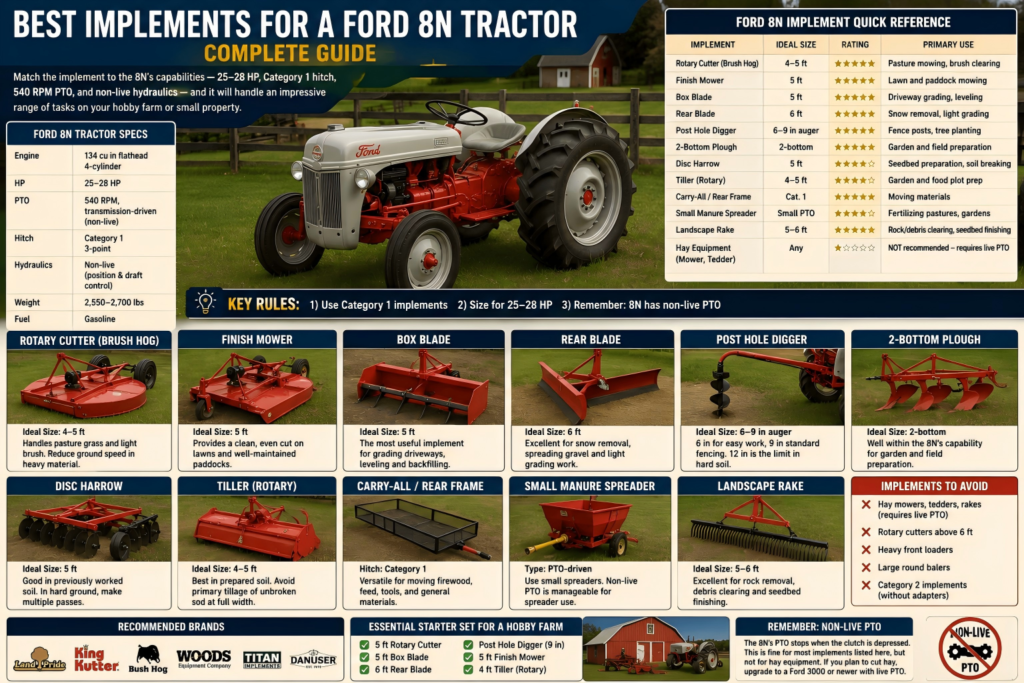
Choosing the best implements for Ford 8N tractor means matching the attachment to what the 8N can actually deliver — 25–28 HP, a Category 1 three-point hitch, transmission-driven 540 RPM PTO, and a non-live hydraulic system. Get the sizing right and the 8N handles an impressive range of tasks for a hobby farm or small property. Get it wrong and you overload the machine, accelerate wear, and get poor results. This guide covers every major implement category with honest size guidance, reliable brand recommendations, and where to source them in 2026.
👉 Check current Ford 8N listings — see available stock and pricing →
Written by: Farmers Equipment editorial team — specialising in classic Ford tractors from the N-Series through the Thousand Series.
Best Implements for Ford 8N — Quick Reference
| Implement | Ideal Size | Rating | Primary Use |
|---|---|---|---|
| Rotary cutter (brush hog) | 4–5 ft | ⭐⭐⭐⭐⭐ | Pasture mowing, brush clearing |
| Finish mower | 5 ft | ⭐⭐⭐⭐⭐ | Lawn and paddock finish mowing |
| Box blade | 5 ft | ⭐⭐⭐⭐⭐ | Driveway grading, levelling |
| Rear blade | 6 ft | ⭐⭐⭐⭐⭐ | Snow removal, light grading |
| Post hole digger | 6–9 inch auger | ⭐⭐⭐⭐⭐ | Fence posts, tree planting |
| 2-bottom plough | 2-bottom | ⭐⭐⭐⭐⭐ | Garden and field preparation |
| Disc harrow | 5 ft | ⭐⭐⭐⭐☆ | Seedbed preparation, soil breaking |
| Tiller (rotary) | 4–5 ft | ⭐⭐⭐⭐☆ | Garden and food plot preparation |
| Carry-all / rear frame | Category 1 | ⭐⭐⭐⭐⭐ | Moving materials around the property |
| Small manure spreader | PTO-driven, small | ⭐⭐⭐⭐☆ | Garden and pasture fertilising |
| Landscape rake | 5–6 ft | ⭐⭐⭐⭐⭐ | Rock and debris clearing, seedbed finishing |
| Hay mower / tedder | Any | ⭐☆☆☆☆ | NOT recommended — requires live PTO |
How to Choose Implements for a Ford 8N
Three rules determine whether an implement is a good match for the Ford 8N:
- Category 1 hitch compatibility — the Ford 8N uses a Category 1 three-point hitch with 7/8 inch (22mm) lower link pins. Any implement designed for Category 1 connects directly. Category 2 implements can be adapted with reducer bushings but check lift height and geometry before assuming compatibility
- 540 RPM PTO sizing — PTO-driven implements on the 8N must be sized for the available HP. A 5 ft rotary cutter at 27 HP is manageable; a 7 ft cutter at 27 HP is overloaded. Keep PTO implement sizing within the ranges in this guide
- Non-live PTO awareness — the 8N’s PTO stops when the clutch is depressed. For most implements this is manageable. For hay mowers, tedders, and rakes it is a hard limitation. Do not buy hay equipment for an 8N
Best Rotary Cutter (Brush Hog) for a Ford 8N
A 4–5 ft rotary cutter is one of the most useful and popular implements on a Ford 8N. At 25–28 HP, the 8N handles standard pasture grass and light brush with a 5 ft cutter running comfortably. Heavy timber and dense brush at the limits of the 5 ft cutter will strain the engine — reduce ground speed in heavy material rather than pushing through it.
Recommended size: 5 ft (60 inch) for most use. 4 ft if you regularly work in tight spaces or very heavy material where a shorter deck provides more control.
Reliable brands:
- Land Pride RCR (RC) Series — well-built commercial-grade cutters with good blade systems and solid gearboxes. The RC1560 (5 ft) is a popular choice for 8N owners
- King Kutter — affordable and widely available. Good value for light to moderate brush use on a hobby farm budget
- Bush Hog — one of the original rotary cutter manufacturers. Reliable, parts widely available, strong dealer network
- Rhino — strong commercial-grade options. Better suited to regular heavy use than the budget-tier options
- Titan Implements — good value for money — a popular choice for buyers who want a solid implement without paying commercial-grade prices
What to avoid: cutters above 6 ft at this HP — they will bog the 8N in anything heavier than light grass. A 5 ft cutter doing the work properly is far better than a 6 ft cutter struggling through it.
Best Finish Mower for a Ford 8N
A 5 ft finish mower delivers a clean, even cut on lawn areas and well-maintained paddocks. The 8N’s Category 1 hitch and 540 PTO run a 5 ft finish mower comfortably at standard operating speeds.
Recommended size: 5 ft (60 inch). A 6 ft finish mower is at the edge of comfortable 8N operation and is better suited to the Ford 3000.
Reliable brands:
- Land Pride FDR (Finish Deck Rotary) Series — excellent build quality, good blade overlap, clean cut in varied conditions
- King Kutter — affordable, widely stocked, good for light regular use
- Woods Equipment — one of the most respected names in finish mowers, strong parts availability
- Befco — well-regarded for consistent cut quality on uneven ground
Key feature to look for: a finish mower with a stiff deck and good roller or wheel support maintains cut height consistency on uneven hobby farm terrain better than a light-gauge deck that flexes.
Best Box Blade for a Ford 8N
A 5 ft box blade is arguably the single most useful implement a hobby farm Ford 8N owner can have. Driveway grading, levelling low spots, backfilling after post holes, cleaning up after earthworks — a box blade does it all and the 8N’s Category 1 hitch and hydraulic draft control handle it exceptionally well.
Recommended size: 5 ft (60 inch) for most hobby farms. A 6 ft box blade is usable on an 8N but heavier than ideal — the hitch lift may strain on a worn hydraulic system.
Reliable brands:
- Land Pride BB (Box Blade) Series — heavy-duty construction, excellent scarifier teeth, widely recommended
- King Kutter — good value for light to moderate grading. The most popular budget box blade for classic Ford owners
- Titan Implements — solid mid-range option with good cutting edge thickness
- Tarter Farm and Ranch — well-built, good dealer support, competitive pricing
What to look for: a box blade with replaceable cutting edges (bottom blade) and scarifier teeth that bolt on individually. Both wear and are cheaper to replace than the whole blade.
Best Post Hole Digger for a Ford 8N
A post hole digger (PHD) is one of the most time-saving implements on a hobby farm and the Ford 8N handles it well in most soil conditions. The key is matching the auger size to the soil — larger augers in harder soil put more torque demand on the PTO and hitch than the 8N can sustain comfortably.
Recommended auger sizes:
- 6 inch — fence post holes in most soil types. Easiest on the machine
- 9 inch — standard fence posts and small tree planting. Comfortable for the 8N in soft to medium ground
- 12 inch — large posts or larger trees. At the limit of comfortable 8N operation in hard or rocky soil — use carefully and reduce speed in difficult ground
Reliable brands:
- Land Pride PHD (Post Hole Digger) Series — heavy-duty gearbox, strong auger flights, good for regular fencing work
- King Kutter — affordable, widely available, adequate for occasional use
- Worksaver — well-regarded for gearbox durability, multiple auger size options
- Danuser — one of the most respected post hole digger manufacturers — commercial grade if you dig frequently
Best Rear Blade for a Ford 8N
A rear blade (angle blade) is one of the most versatile implements on any small tractor. Snow removal, light grading, spreading gravel, cleaning barn floors — a rear blade does multiple jobs and the 8N handles it easily.
Recommended size: 6 ft. Wider than a box blade because the angling function of a rear blade means more coverage per pass without adding significant draft resistance.
Reliable brands:
- King Kutter — the most popular budget rear blade for classic Fords. Adequate for hobby farm use
- Land Pride RB Series — heavier build, replaceable cutting edge, better for regular use
- Titan Implements — solid mid-range option at a competitive price
Best Tiller for a Ford 8N
A rotary tiller (rototiller) is ideal for garden and food plot preparation. On the Ford 8N, keep tiller sizing to 4–5 ft and use the tiller in already-broken or previously worked soil for best results. Primary tillage of unbroken sod with a full-width tiller will push the 8N hard.
Recommended size: 4 ft for gardens, 5 ft for food plots and larger areas. Avoid 6 ft+ tillers on the 8N — too much PTO demand in anything but light soil.
Reliable brands:
- Land Pride RTR (Rotary Tiller) Series — gear-driven tines, heavy-duty gearbox, good for regular use
- King Kutter — affordable for occasional garden tilling
- Woods Equipment TM (Tillers) — well-regarded, consistent tine depth, reliable gearbox
- Brinly — good entry-level option for light garden use
Best Disc Harrow for a Ford 8N
A disc harrow breaks and turns soil ahead of planting and works well on the Ford 8N in previously worked ground. In unbroken or very compacted soil, keep discs small and make multiple passes rather than one heavy pass that bogs the tractor.
Recommended size: 5 ft (single or double offset). A 6 ft disc is usable but pushes the 8N’s HP limits in tough conditions.
Reliable brands:
- Land Pride — solid disc options for light to medium use
- Howse Implements — well-regarded for disc quality and blade sharpness retention
- Great Plains — heavier-duty options if disc work is frequent
Best Cultivator for a Ford 8N
A cultivator is used for weed control in established row crops and gardens. The Ford 8N’s Category 1 hitch and adjustable lift control make it well-suited to cultivation work where precise depth control matters.
Reliable brands:
- Brinly — one of the most popular cultivator options for classic Ford tractors, good Category 1 compatibility
- Herd Seeder / Wil-Rich — row crop cultivators for more serious vegetable or grain production
- Worksaver — good adjustable cultivator options for varied row spacing
Implements to Avoid on a Ford 8N
| Implement | Why to Avoid | Better Alternative |
|---|---|---|
| Hay mower (disc or sickle bar) | Non-live PTO — cutting action stops on clutch depression | Ford 3000 with live PTO |
| Hay tedder or rake | Same non-live PTO limitation | Ford 3000 or above |
| Round baler | Requires loader and sustained HP the 8N cannot provide | Ford 4000 or Ford 5000 |
| Rotary cutter above 6 ft | Exceeds comfortable HP limit — engine bogs in any material | Ford 3000 for 6 ft+ cutters |
| Heavy front loader | Light front axle limits lifting and frequent use | Ford 4000 for regular loader work |
| Category 2 implements (unadapted) | Pin size mismatch — Category 2 pins are 1-1/8 inch, 8N is 7/8 inch | Use Category 1 implements or add adapter bushings |
Where to Buy Implements for a Ford 8N in 2026
Sourcing implement options for a Ford 8N in 2026:
- New from implement dealers — Land Pride, King Kutter, and Titan Implements all have dealer networks across the US. Buying new gives warranty coverage and known condition. Prices vary significantly between dealers — get quotes from multiple sources
- Online retailers — Tractor Supply Company, Rural King, and Northern Tool stock a range of Category 1 implements for direct purchase and in-store pickup. Useful for budget-tier implements that don’t require specialist dealer support
- Used from farm auctions — Category 1 implements from estate sales and farm dispersal auctions are often available at significant discounts. Inspect for worn cutting edges, gearbox condition, and bent frame components before bidding
- Steiner Tractor Parts — stocks implement-related parts and some smaller attachments designed specifically for classic Ford N-Series tractors
- Facebook Marketplace and Craigslist — active markets for used Category 1 implements locally. Best source for value if you can inspect before purchase and avoid shipping costs on heavy items
Essential Starter Implement Set for a Ford 8N Hobby Farm
If you are setting up a Ford 8N for hobby farm use from scratch, this is the implement set that covers the core task list for most properties under 25 acres:
| Implement | New Price Range | Used Price Range | Priority |
|---|---|---|---|
| 5 ft rotary cutter | $800–$1,800 | $300–$700 | ⭐ Essential |
| 5 ft box blade | $600–$1,200 | $200–$500 | ⭐ Essential |
| 6 ft rear blade | $500–$900 | $150–$400 | High |
| Post hole digger (9 inch) | $500–$1,000 | $200–$500 | High |
| 5 ft finish mower | $1,200–$2,500 | $400–$900 | Medium — if lawn areas are a priority |
| 4 ft tiller | $700–$1,400 | $250–$600 | Medium — if garden or food plot work planned |
| Total starter set estimate | $4,100–$8,800 new | $1,500–$3,600 used | — |
A used implement set from farm auctions and Facebook Marketplace can equip a Ford 8N for complete hobby farm use at $1,500–$3,600 — making the total outlay for tractor plus implements in the $4,000–$8,000 range for a fully equipped working setup. That is well below the cost of a single new compact tractor without implements.
Verdict — Best Implements for a Ford 8N
The best implements for a Ford 8N are Category 1, correctly sized for 25–28 HP, and chosen for the non-live PTO limitation that rules out hay equipment. A 5 ft rotary cutter, 5 ft box blade, 6 ft rear blade, and 9 inch post hole digger covers the core hobby farm task list and keeps the 8N working within its capability. Add a finish mower and tiller for a complete setup.
For the full guide to choosing the right Ford tractor for your property see our Best Ford Tractor for a Small Farm guide → — including how the Ford 9N and Ford 3000 compare for different implement needs.
Before purchasing a Ford 8N to run these implements, read our Ford 8N review and Used Ford Tractor Inspection Checklist →
Ford 8N and Ploughing — 2-Bottom and 3-Bottom Plow Guide
Will a Ford 8N Pull a 2-Bottom Plow?
Yes — the Ford 8N was specifically rated and marketed as a 2-plow tractor. Pulling a 2-bottom moldboard plow in prepared or previously worked soil is well within the 8N’s design capability and is one of the primary tasks the machine was built for. The Ferguson hydraulic draft control system on the 8N manages plow depth automatically, making it one of the most capable classic tractors for plowing relative to its HP.
Honest conditions and limitations:
- Soil type matters significantly — 2-bottom plowing in light, previously worked sandy loam: comfortable. 2-bottom in heavy clay or unbroken sod: hard work for the 8N. Reduce to a single-bottom in the toughest conditions
- Plow size matters — a standard 14-inch 2-bottom is the right match. A 16-inch 2-bottom is at the upper limit. Avoid 18-inch or larger moldboards on the 8N
- Ground speed — 2nd gear (approximately 3.3 mph) is the typical working speed for plowing on an 8N. Don’t try to rush it
- The non-live hydraulics help here — the Ferguson draft control automatically adjusts plow depth based on soil resistance, which is exactly the right tool for consistent tillage with moderate HP
What Is a 2-Bottom Plow Used For?
A 2-bottom (2-furrow) moldboard plow turns and inverts soil for primary tillage — breaking ground ahead of planting. Each bottom (blade and share) cuts and turns one furrow of soil; a 2-bottom cuts two furrows per pass. This buries surface residue, crop stubble, and weeds under the turned soil layer, exposing fresh soil above for seedbed preparation. Uses include:
- Breaking new ground for gardens or food plots for the first time
- Annual tillage ahead of planting in established garden areas
- Incorporating cover crops or manure into soil
- Weed control through burial before a season’s growth starts
How Heavy Is a 2-Bottom Plow?
A typical 2-bottom Category 1 moldboard plow weighs approximately 200–400 lbs depending on construction and brand. Older cast-iron Dearborn and Ford-branded plows from the N-Series era typically weigh 250–350 lbs. Modern lighter-construction 2-bottom plows in the 200–280 lb range are well within the Ford 8N’s lift capacity (800–1,000 lbs at the hitch) and are easily handled by the hydraulic system.
How Much HP Do You Need to Pull a 2-Bottom Plow?
General guidance for moldboard plowing HP requirements:
| Plow Configuration | Minimum HP | Recommended HP | Ford 8N Suitability |
|---|---|---|---|
| 1-bottom (single furrow) | 15–20 HP | 20–25 HP | ✅ Excellent |
| 2-bottom (standard 14″) | 20–25 HP | 25–35 HP | ✅ Good — this is the 8N’s rated capacity |
| 2-bottom (16″ bottoms) | 25–30 HP | 30–40 HP | ⚠️ Marginal — heavy soil will strain the 8N |
| 3-bottom (standard 14″) | 35–45 HP | 45–55 HP | ❌ Exceeds 8N capacity |
| 4-bottom | 55–70 HP | 65–80 HP | ❌ Requires Ford 4000–5000 class |
How Many HP for a 3-Bottom Plow?
A 3-bottom moldboard plow requires approximately 35–55 HP at the drawbar depending on soil conditions and bottom size. The Ford 8N at 25–28 HP cannot pull a 3-bottom plow — it is rated as a 2-plow tractor. For 3-bottom plowing, the Ford 3000 (37–47 HP) handles it in moderate soil conditions, and the Ford 4000 (52 HP) handles it comfortably in most conditions.
Why Was the Ford 8N So Popular?
The Ford 8N’s extraordinary commercial success — 524,076 units between 1947 and 1952 — came from a specific combination of features that no competing tractor in its price range offered simultaneously:
- Ferguson three-point hitch with draft control — the system Harry Ferguson developed and Ford licensed automatically maintained implement depth based on soil resistance. This made implements easier to use, more consistent in field performance, and faster to raise and lower than the competing drawbar-and-chain systems. No other affordable tractor offered this
- 4-speed transmission — the step up from the 9N’s 3-speed gave operators a more practical gear range for different tasks. 3rd gear at approximately 4.5 mph became the most useful all-around working speed
- Price and accessibility — at approximately $1,250 in 1947, the 8N was priced to replace a team of horses on farms that could not justify a larger, more expensive tractor. It hit the sweet spot between capability and cost for small and medium farms
- Ford reliability and parts support — Ford’s existing dealer network meant parts and service were accessible nationwide. Unlike speciality brands, the 8N could be serviced almost anywhere
- Mechanical simplicity — the 8N required no specialist knowledge to operate or maintain. A capable owner with basic tools could handle most repairs. This was not true of more complex competing machines
- Timing — post-war American agriculture was expanding rapidly, credit was available, and millions of small farms were mechanising for the first time. The 8N arrived at exactly the right moment
Can You Still Get Parts for a Ford 8N Tractor?
Yes — the Ford 8N has one of the most comprehensive aftermarket parts supplies of any vintage tractor in the world. The combination of 524,076 units produced and 75+ years of continued use has created a permanent, extensive aftermarket:
- Mechanical wear parts (rings, bearings, seals, gaskets, filters) — universally available from multiple suppliers including Steiner Tractor Parts, Yesterday’s Tractors, and major agricultural parts distributors
- Ignition parts — points, condensers, coils, distributors for both front-mount and side-mount configurations are readily available
- Carburetor and fuel system parts — full rebuild kits, replacement carburetors, fuel pump diaphragms all widely stocked
- Sheet metal — hoods, fenders, grilles available in reproduction from multiple suppliers
- Hydraulic and lift cover parts — seals, O-rings, and complete rebuilt lift covers available
- Tyres — 6.00-16 front and 11.2-28 rear tyres in standard sizes readily available from major tyre suppliers
There is essentially no part on a Ford 8N that cannot be sourced today through the aftermarket. This is a genuine and significant ownership advantage over many other vintage tractors where parts scarcity makes maintenance expensive and difficult. For a comprehensive parts source for classic Ford N-Series tractors, Steiner Tractor Parts specialises in N-Series and Thousand Series Ford components. See our Ford 8N for sale →
Ford 8N — Value, Speed, and Capability Quick Reference
How Much Is a Ford 8N Worth Today?
In 2026 by condition: non-running or parts ($500–$1,200), running but rough ($1,200–$2,200), running good working condition ($2,500–$4,000 — most common range), restored driver quality ($4,000–$6,500), show quality restoration ($7,000–$12,000+). For current market pricing, TractorHouse.com lists current Ford 8N sales.
What Is a 1950 Ford 8N Worth?
A 1950 Ford 8N follows the same condition-based pricing — $2,500–$4,000 in good working condition. The 1950 model year straddles the distributor change: front-mount distributor on early production, side-mount introduced at approximately serial 263,844. Side-mount examples are generally preferred on the used market.
What Was the Original Price of a Ford 8N?
Approximately $1,250–$1,325 new in 1947 — equivalent to approximately $16,000–$17,500 in 2026 dollars. A good used 8N at $3,000–$4,000 is significantly cheaper in real terms than the original purchase price.
How Many Ford 8N Tractors Were Made?
524,076 units between 1947 and 1952 — the most produced two-plow tractor in US history. Peak production was 1948–1951 at approximately 98,000–104,000 units per year.
How Fast Will a Ford 8N Go?
Maximum approximately 12–17 mph in 4th gear. Working speeds: 1st ~2.0 mph (heavy tillage), 2nd ~3.3 mph (plowing, heavy implement work), 3rd ~4.5 mph (most field operations), 4th ~12–17 mph (road transport only — not for implement use).
How Much Can a Ford 8N Lift?
Approximately 800–1,000 lbs at the hitch — sufficient for all standard Category 1 implements in the size ranges recommended in this guide. Important: the 8N hydraulic system is non-live — it stops responding when the clutch is depressed. For most implements this is manageable; for hay equipment it is a hard limitation.
Which Is Better — Ford 8N or Ford 9N?
For a working tractor with implements: the 8N is better in every practical dimension — 4-speed transmission (vs 3-speed), position control plus draft control, two separate brake pedals, stronger hydraulics, more HP. The 9N has collector appeal as the original first-year machine. For buying a working implement tractor: buy the 8N.
What Is the Rarest Ford Tractor Ever Built?
Among N-Series: Ford 9N tractors from 1939–1940 with original aluminium hood, grille, and instrument panel — most were replaced with cast iron as production scaled up. Unmodified aluminium-component 9N examples are the most collectible N-Series machines. The Ford FW-60 articulated 4WD (1977–1982, 335 HP) is the rarest large Ford tractor — very low production, built in partnership with Steiger.
Frequently Asked Questions
What are the best implements for a Ford 8N tractor?
The most useful implements for a Ford 8N are a 5 ft rotary cutter, 5 ft box blade, 6 ft rear blade, and 9 inch post hole digger. These cover the core tasks on most hobby farms and small properties within the 8N’s 25–28 HP capability. Add a 5 ft finish mower and 4 ft tiller for a complete setup. Avoid hay equipment — the 8N’s non-live PTO is not suitable for hay mowers or tedders.
What size brush hog for a Ford 8N?
A 5 ft (60 inch) rotary cutter is the ideal size for a Ford 8N. At 25–28 HP, the 8N handles a 5 ft cutter in standard grass and light brush comfortably. A 4 ft cutter is fine for tight spaces or heavier material where less width gives more control. Avoid cutters above 5–6 ft — they exceed the 8N’s comfortable HP range in anything heavier than light grass.
What category hitch does a Ford 8N have?
The Ford 8N has a Category 1 three-point hitch with 7/8 inch (22mm) lower link pins. Any Category 1 implement connects directly. Category 2 implements (1-1/8 inch pins) require adapter bushings to fit Category 1 tractors. Always confirm Category 1 compatibility before purchasing implements for a Ford 8N.
Which brands make reliable implements for a Ford 8N?
The most consistently reliable implement brands for a Ford 8N are Land Pride (rotary cutters, box blades, post hole diggers), King Kutter (budget-tier across all implement types), Bush Hog (rotary cutters), Woods Equipment (finish mowers, tillers), and Titan Implements (mid-range across multiple categories). For commercial-grade post hole diggers, Danuser is particularly well-regarded.
Can a Ford 8N run a hay mower?
No — not effectively. The Ford 8N has a transmission-driven (non-live) PTO that stops every time the clutch is depressed. Hay mowers require continuous PTO action through turns and manoeuvres — a stopping PTO risks blade contact with material and uneven cutting. If you need to cut hay, the Ford 3000 (live PTO) is the appropriate machine.