Yes — a Ford 8N bush hog pairing works well, provided you match the cutter size to the 8N’s capability. At 25–28 HP with a transmission-driven 540 RPM PTO and a Category 1 three-point hitch, the Ford 8N handles a 5 ft rotary cutter comfortably in standard grass and light brush. Push it to a 6 ft cutter in heavy material and you will bog the engine, strain the drivetrain, and get poor results. This guide covers the correct sizing, which brands work best, what material the 8N can and cannot handle, and the one PTO characteristic every 8N brush hog operator needs to understand.
👉 Check current Ford 8N listings — see available stock and pricing →
Written by: Farmers Equipment editorial team — specialising in classic Ford tractors from the N-Series through the Thousand Series.
Ford 8N Bush Hog — The Short Answer
| Cutter Size | Ford 8N Verdict | Conditions |
|---|---|---|
| 4 ft rotary cutter | ✅ Excellent | All conditions — maximum HP reserve |
| 5 ft rotary cutter | ✅ Good — recommended size | Standard grass and light to medium brush |
| 6 ft rotary cutter | ⚠️ At the limit | Light grass only — bogs in heavy material |
| 7 ft rotary cutter | ❌ Too large | Will consistently overload the engine |
| 8 ft rotary cutter | ❌ Avoid | Designed for 50+ HP tractors |
Understanding PTO Horsepower on a Ford 8N
Rotary cutters are rated by the PTO horsepower they require — not the engine horsepower of the tractor. The Ford 8N produces approximately 25–28 HP at the engine but somewhat less at the PTO shaft after drivetrain losses. A general rule of thumb for estimating PTO HP from engine HP on classic tractors is approximately 80–85% — giving the 8N roughly 20–24 PTO HP available at the shaft.
Most 5 ft rotary cutters are rated for a minimum of 18–25 PTO HP. This puts a 5 ft cutter at the comfortable working range of the Ford 8N in standard conditions. In heavy brush or thick material, that margin shrinks — which is why ground speed management matters as much as cutter size on an 8N.
| Tractor | Engine HP | Estimated PTO HP | Recommended Max Cutter |
|---|---|---|---|
| Ford 9N | 23–25 HP | ~19–21 HP | 4–5 ft (light conditions) |
| Ford 8N | 25–28 HP | ~20–24 HP | 5 ft (standard conditions) |
| Ford 3000 | 37–47 HP | ~31–38 HP | 6 ft (most conditions) |
| Ford 4000 | 52–65 HP | ~43–53 HP | 6–7 ft |
| Ford 5000 | 65–75 HP | ~53–61 HP | 7 ft+ |
PTO HP estimated at approximately 82% of engine HP — actual output varies with drivetrain condition and engine tune.
What Material a Ford 8N Can Handle with a Bush Hog
Handles well
- Standard pasture grass — mowing paddocks and fields at a steady pace
- Overgrown lawn areas and rough grass areas up to 18 inches tall
- Light brush and weeds — brambles, briars, tall weeds, light undergrowth
- Small saplings under 1 inch diameter in manageable density
- Previously cut areas being maintained on a regular schedule
At the limit — manageable with care
- Dense tall fescue or thick grass stands — reduce ground speed significantly
- Light cedar or scrub brush in moderate density
- Saplings 1–2 inch diameter, individually — not in dense stands
- Previously neglected pasture being reclaimed for the first time
Beyond the 8N’s comfortable range
- Heavy cedar, sumac, or similar thick-stemmed brush in dense stands
- Saplings above 2 inch diameter or dense sapling stands
- First pass on heavily overgrown land with mixed heavy material
- Timber brush and heavy undergrowth — a Ford 3000 or larger is more appropriate
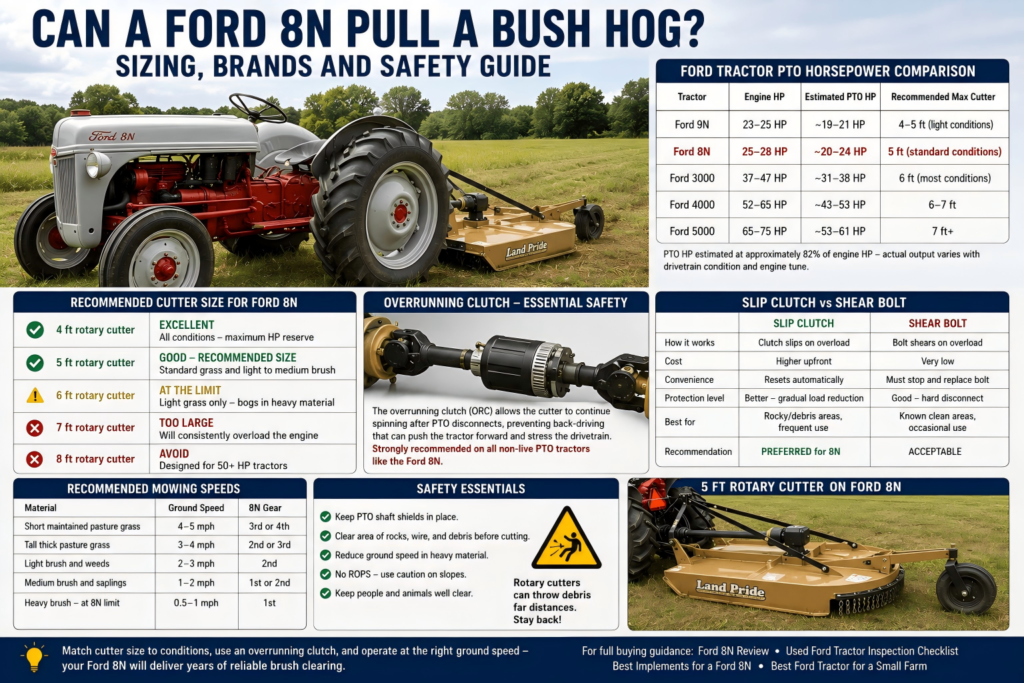
The Overrunning Clutch — Essential Safety Equipment on a Ford 8N
This is the most important safety item in this entire guide and is frequently omitted from generic bush hog articles.
Because the Ford 8N has a transmission-driven PTO, the heavy spinning inertia of a rotary cutter blade — particularly after cutting through heavy material — can continue driving the tractor’s drivetrain forward after the clutch is depressed. This is called back-driving, and it can cause the tractor to move unexpectedly when you intend to stop, and puts reverse torque stress on the PTO and transmission components.
An overrunning clutch (ORC) on the PTO shaft prevents this. The overrunning clutch allows the cutter to continue spinning on its own momentum after the tractor PTO disconnects, without transmitting that rotational force back through the tractor’s drivetrain. It is a one-way clutch — power flows from tractor to cutter, but not from cutter back to tractor.
Why it matters specifically on the Ford 8N:
- Non-live PTO machines like the 8N experience more frequent PTO engagement/disengagement cycles than live PTO tractors — every gear change interrupts PTO drive
- A heavy 5 ft rotary cutter blade has significant rotational inertia — the back-driving force on disconnect is real and measurable
- The 8N’s transmission is over 70 years old — protecting it from reverse torque stress is good practice
What to do: fit an overrunning clutch between the tractor PTO shaft and the cutter’s input shaft. Most quality rotary cutter manufacturers offer an ORC as either standard equipment or an optional add-on. If buying a used cutter, confirm whether one is fitted. If not, they are widely available from implement dealers and cost $50–$150 fitted.
Experienced Ford 8N owners consistently cite the overrunning clutch as one of the most important accessories for rotary cutter use on an N-Series machine.
The Non-Live PTO Factor — What Every 8N Bush Hog Operator Needs to Know
The Ford 8N has a transmission-driven PTO — it stops spinning every time the clutch is depressed. For bush hog use, this is important to understand but is not the limitation it sounds like for most hobby farm mowing:
Why it is manageable for rotary cutters: a brush hog blade assembly has significant flywheel mass — the heavy blade and blade carrier continue spinning for several seconds after the PTO disconnects. During a brief clutch depression for a gear change, the blade typically keeps moving on momentum and resumes immediately when the clutch is released. For standard pasture mowing this works fine in practice.
Where it becomes a concern: in very heavy material where the blade is under constant load, there is less momentum reserve when the PTO stops. Coming to a complete stop in thick brush and re-engaging the PTO under load is harder on the drivetrain than on a live PTO machine. In heavy material, try to avoid stopping mid-pass — back out, clear the deck if needed, and re-enter the material at a manageable pace.
Compare with hay equipment: hay mowers and tedders require genuinely continuous PTO — the non-live PTO on an 8N makes it unsuitable for hay equipment regardless of cutter size. Brush hogging is much more forgiving of brief PTO interruptions than hay work.
Best Bush Hog Brands for a Ford 8N
Land Pride RC (Rotary Cutter) Series
The Land Pride RC1560 (5 ft) is a well-regarded commercial-grade rotary cutter that pairs well with the Ford 8N. Heavy blade carrier, solid gearbox, good blade overlap for consistent cut. The RC series is built for regular use and holds up well to the demands of hobby farm brush clearing. Minimum HP requirement is well within 8N range for the 5 ft model.
Bush Hog Brand Rotary Cutters
Bush Hog — the company that gave the implement its generic name — makes reliable rotary cutters well-matched to the 8N’s HP range. The SQ series and Model 3 are popular choices among classic Ford owners. Genuine Bush Hog parts are widely available through dealer networks.
King Kutter Rotary Cutters
King Kutter offers the most affordable rotary cutters commonly used with classic Ford tractors. Build quality is lighter than Land Pride or Bush Hog — adequate for light to moderate regular use on a hobby farm, but not the first choice for heavy or commercial-intensity cutting. Good value for buyers who mow a few times a season rather than weekly.
Rhino Ag Rotary Cutters
Rhino makes heavier-duty cutters suited to the upper end of what the 8N can manage. The Rhino SE series is a popular choice for buyers who want commercial-grade construction at a mid-range price. Better gearbox ratings than King Kutter, comparable to Land Pride.
Titan Implements
Titan offers competitive mid-range rotary cutters that hit a useful price-quality balance for hobby farm use. Adequate gearbox ratings for 8N use, good blade systems, and competitive pricing through online retailers. A practical choice for buyers who want more than budget-tier quality without paying commercial-grade prices.
Recommended Cutter Weight for a Ford 8N
Cutter weight affects how the three-point hitch handles the implement and how well the blade maintains momentum through varying material. Heavier cutters have more flywheel mass — beneficial on the 8N’s non-live PTO — but also put more demand on the hitch lift system.
| Cutter Width | Recommended Weight Range | Notes |
|---|---|---|
| 4 ft rotary cutter | 400–550 lbs | Well within 8N hitch capacity — maximum HP reserve |
| 5 ft rotary cutter | 500–700 lbs | Ideal range for the 8N — good blade momentum, manageable hitch demand |
| 6 ft rotary cutter | 650–900 lbs | At the upper limit of comfortable 8N hitch lift on a worn hydraulic system |
If the 8N’s hydraulic system is worn — slow to lift or drifting under load — stick to a 5 ft cutter in the 500–650 lb range. A heavy 6 ft cutter on a marginal hydraulic system is asking for hitch failure. See our Used Ford Tractor Inspection Checklist for hydraulic system assessment guidance.
Shear Bolt vs Slip Clutch — Which Is Better for a Ford 8N?
Rotary cutters protect themselves from blade strikes (rocks, stumps) with one of two systems — and the choice matters on a classic tractor where drivetrain repairs are expensive:
| Feature | Shear Bolt | Slip Clutch |
|---|---|---|
| How it works | Bolt shears on overload — disconnects blade | Clutch slips on overload — allows brief overrun |
| Cost | Very low — replacement bolts are cents | Higher upfront — $50–$200 on implement price |
| Convenience | Must stop and replace bolt after each strike | Resets automatically — no stopping required |
| Protection level | Good — hard disconnect on strike | Better — gradual load reduction, less shock |
| Best for | Known clean areas, occasional use | Rocky or debris-heavy areas, frequent use |
| Recommendation for 8N | Acceptable | Preferred — less drivetrain shock on a vintage machine |
Verdict for the Ford 8N: a slip clutch is the better choice. The 8N’s transmission and PTO components are over 70 years old — the smooth load reduction of a slip clutch on rock strikes is gentler on ageing drivetrain components than the hard shock of a shear bolt disconnect.
What to Look for When Buying a Bush Hog for a Ford 8N
- Gearbox HP rating — confirm the gearbox is rated for at least 20–25 HP. Budget cutters sometimes have undersized gearboxes that fail quickly when run at the limits of the tractor’s HP
- Blade carrier weight — a heavier blade carrier provides more flywheel momentum, which matters particularly on the 8N’s non-live PTO. Heavier carriers maintain blade speed better through load variations
- Slip clutch — a slip clutch between the PTO shaft and the cutter gearbox protects the drivetrain when the blade strikes an immovable object (rock, stump, buried debris). On a classic tractor where drivetrain repairs are labour-intensive, a slip clutch is a worthwhile feature
- Skid shoe adjustment — adjustable skid shoes control cutting height. Confirm they are adjustable and in good condition if buying used
- Category 1 hitch compatibility — confirm the cutter uses Category 1 hitch pins (7/8 inch). Most 4–5 ft cutters are Category 1; larger commercial cutters may be Category 2
Recommended Mowing Speeds — Ford 8N with Rotary Cutter
| Material | Recommended Ground Speed | 8N Gear |
|---|---|---|
| Short maintained pasture grass | 4–5 mph | 3rd or 4th gear |
| Tall thick pasture grass | 3–4 mph | 2nd or 3rd gear |
| Light brush and weeds | 2–3 mph | 2nd gear |
| Medium brush and saplings | 1–2 mph | 1st or 2nd gear |
| Heavy brush — at 8N limit | 0.5–1 mph | 1st gear — monitor engine note closely |
The simplest guide: if the engine note drops significantly under load, slow down. The Ford 8N’s flathead engine gives clear audible feedback — a labouring engine note is the signal to reduce speed before the engine stalls or the drivetrain is stressed.
Safe Operating Practices — Ford 8N with a Bush Hog
- Keep the PTO shield in place — the 8N’s exposed PTO shaft is a serious entanglement hazard. Always fit and maintain the PTO shaft shield and cutter input shaft guard. Never work near a spinning unshielded PTO shaft
- Clear the area before cutting — walk the area before the first pass to identify rocks, fence wire, stumps, and buried debris. A rotary cutter blade striking a rock at speed can throw it with serious force
- Manage ground speed in heavy material — if the engine note drops significantly under load, slow down. Running the engine consistently under heavy load at low RPM accelerates wear. The correct response to heavy material is to reduce speed, not to force through it
- No ROPS on the 8N — the Ford 8N was never fitted with a Roll-Over Protective Structure. Exercise particular caution on any sloped ground. A rolling tractor with a rear-mounted cutter is a serious rollover risk on terrain above 15–20 degrees
- Keep bystanders clear — rotary cutters can throw debris significant distances. Keep people and animals well clear of the working area during operation
Where to Find Bush Hogs for Small Tractors in 2026
- New from implement dealers — Land Pride, Bush Hog, and Rhino dealers stock 4–5 ft cutters suitable for the 8N. Buying new gives warranty coverage and known condition
- Tractor Supply Company and Rural King — stock King Kutter and Titan rotary cutters in-store. Good for buyers who want to inspect before purchasing
- Farm auctions and estate sales — used 5 ft rotary cutters appear regularly at farm dispersal auctions, often at $200–$500. Inspect gearbox condition and blade wear before bidding
- Facebook Marketplace and Craigslist — active used markets for rotary cutters. Inspect locally where possible — gearbox condition is the critical check on a used cutter
- Steiner Tractor Parts — stocks replacement parts for N-Series implements and some smaller attachments
Rotary Cutter Maintenance on a Ford 8N
- Check gearbox oil before each season — rotary cutter gearboxes use 90W gear oil. Check the level and condition before the first mow of the season. Milky oil indicates water contamination from outdoor storage
- Grease PTO shaft every 8–10 operating hours — the telescoping PTO shaft has grease fittings that require regular attention. A dry PTO shaft wears rapidly under the torque of brush cutting
- Inspect blades after striking rocks — a blade that hits a rock at speed can be bent or cracked. A damaged blade creates dangerous imbalance — inspect and replace as needed
- Check blade bolts and stump jumper annually — blade attachment bolts and the stump jumper (centre disc) should be torqued to spec annually. Loose hardware under the cutter deck is a serious hazard
- Keep the PTO shaft guard in place — the telescoping guard over the PTO shaft prevents entanglement. Inspect it for cracks or missing sections before each use
- Store with deck raised — storing a rotary cutter with the deck flat on the ground allows moisture ingress into blade housings and promotes corrosion on the cutting edge
Ford 8N Bush Hog vs Ford 3000 Bush Hog — When to Upgrade
If you are regularly frustrated by the 8N’s performance in heavy brush — bogging on slopes, struggling through dense material, or wanting a 6 ft or larger cutter — the Ford 3000 at 37–47 HP is the natural upgrade. The 3000 handles a 6 ft cutter in heavy brush with significant HP in reserve, runs live hydraulics for better implement control, and covers more ground per hour on larger properties.
For standard hobby farm mowing on properties under 25 acres in moderate material — the Ford 8N with a 5 ft cutter remains one of the most cost-effective brush clearing setups available in 2026.
For the full implements guide see our Best Implements for a Ford 8N →
Verdict — Ford 8N Bush Hog
A Ford 8N bush hog setup works well for standard hobby farm brush clearing — provided the cutter is 5 ft or under and the material stays within light to medium brush. The non-live PTO is manageable for rotary cutter use in practice. The 25–28 HP ceiling is the real limit — respect it by matching cutter size and ground speed to conditions, and the 8N handles years of reliable brush clearing on a small property.
For full buying guidance: Ford 8N review · Used Ford Tractor Inspection Checklist · Best Ford Tractor for a Small Farm
Also available: Ford 9N · Ford 4000 · Ford 5000
👉 See current Ford 8N listings — compare available stock and pricing →
Ford 8N PTO Shaft Size, HP, and Larger Cutter Sizing
What Is the PTO Shaft Size on a Ford 8N?
The Ford 8N uses a standard 1-3/8 inch (1.375″) 6-spline PTO shaft at 540 RPM the most common PTO shaft standard in agriculture. This is important because it means:
- Any implement rated for a standard 540 RPM 6-spline PTO shaft fits the 8N directly no adapters required
- The overwhelming majority of 4 7 ft rotary cutters sold in North America are built for this standard
- Replacement PTO shaft components and overrunning clutches are universally available
The 8N has a single rear PTO only no mid-mount PTO. The shaft exits at the rear of the tractor between the lower link arms.
How Do I Know What Size PTO Shaft I Need?
Two variables determine PTO shaft compatibility:
- Shaft diameter and spline count the 1-3/8″ 6-spline is the standard for tractors under approximately 80 HP including the Ford 8N. Larger tractors use 1-3/4″ 20-spline. Always match the implement’s input shaft specification to the tractor’s output shaft
- PTO speed the 8N runs at 540 RPM. Most rotary cutters under 7 ft are designed for 540 RPM. Larger commercial implements may require 1,000 RPM. Confirm the cutter is rated for 540 RPM before purchase
In practical terms for Ford 8N buyers: any rotary cutter labelled “Category 1 / 540 RPM” with a 1-3/8″ 6-spline input shaft fits the 8N directly. This covers virtually all 4 6 ft rotary cutters on the market.
What Is the PTO Horsepower of a Ford 8N?
The Ford 8N produces approximately 20 24 PTO HP at the shaft under normal operating conditions approximately 80 85% of engine HP after drivetrain losses. The Nebraska Tractor Test recorded belt HP (the closest equivalent measure) at approximately 23.2 25.5 HP depending on engine condition and tune. For rotary cutter sizing, 20 24 PTO HP is the working figure. This puts the 8N at the comfortable lower end of a 5 ft cutter’s requirements (most 5 ft cutters specify 18 25 PTO HP minimum) and below the comfortable range for 6 ft cutters (which typically specify 25 35 PTO HP).
Larger Bush Hog Sizing When the 8N Is Not Enough
How Many HP Do You Need for a 7-Foot Bush Hog?
A 7-foot (84 inch) rotary cutter requires approximately 40 55 PTO HP in normal conditions significantly beyond the Ford 8N’s 20 24 PTO HP. Running a 7 ft cutter on an 8N will consistently overload the engine and stress the drivetrain even in light material. The right tractor for a 7 ft cutter:
| Cutter Size | Min PTO HP | Recommended PTO HP | Suitable Classic Ford |
|---|---|---|---|
| 5 ft | 18 20 HP | 20 30 HP | Ford 8N |
| 6 ft | 25 30 HP | 30 40 HP | Ford 3000 |
| 7 ft | 40 45 HP | 45 55 HP | Ford 4000 |
| 8 ft | 50 60 HP | 60 70 HP | Ford 5000 |
| 10 ft | 70 90 HP | 80 100 HP | Ford 6600/7600 or modern utility |
What Size Tractor Do You Need to Pull a 10-Foot Bush Hog?
A 10-foot rotary cutter requires a minimum of 70 90 PTO HP this is commercial or large farm tractor territory. A Ford 8N at 20 24 PTO HP cannot run a 10 ft cutter under any conditions. Even the Ford 5000 at 53 61 PTO HP is marginal for a 10 ft commercial cutter. For 10 ft cutters you need a modern utility tractor in the 90 120 HP class a John Deere 5090E, Massey Ferguson 5711, or equivalent. Browse our John Deere tractors for sale and Massey Ferguson tractors for sale.
Will a Ford 8N Pull a 2-Bottom Plow?
Yes the Ford 8N is rated as a 2-plow tractor. A standard 14-inch 2-bottom moldboard plow in worked or light soil is within design capability. The Ferguson draft control system manages depth automatically, which is precisely the right tool for 2-plow work at moderate HP. Reduce to a single-bottom in very heavy clay or unbroken sod. Avoid 16-inch or larger bottoms in tough conditions. A 3-bottom plow exceeds the 8N’s capacity the Ford 3000 at 37 47 HP handles 3-bottom plowing in moderate soil.
Ford 8N Value and Specifications Quick Reference
How Much Is a Ford 8N Worth Today?
For current market pricing, Steiner Tractor Parts is a leading N-Series parts source. In 2026: non-running or parts ($500 $1,200), running but rough ($1,200 $2,200), running good working condition ($2,500 $4,000 the most common range), restored driver quality ($4,000 $6,500), show quality restoration ($7,000 $12,000+). For current comparables, TractorHouse.com lists active Ford 8N sales.
What Is a 1950 Ford 8N Worth Today?
Same condition-based range $2,500 $4,000 in good working condition. The 1950 model year straddles the front-to-side-mount distributor change at approximately serial 263,844. Side-mount examples are generally preferred; unmodified front-mount originals can attract a small collector premium.
What Was the Original Price of a Ford 8N?
Approximately $1,250 $1,325 new in 1947 equivalent to approximately $16,000 $17,500 in 2026 dollars. A good used 8N at $3,000 $4,000 is significantly cheaper in real terms than the original purchase price.
How Many Ford 8N Tractors Were Made?
524,076 units between 1947 and 1952 the most produced two-plow tractor in US history and the reason parts remain universally available today.
How Fast Will a Ford 8N Go?
Maximum approximately 12 17 mph in 4th gear. Working speeds: 1st ~2.0 mph (heavy tillage), 2nd ~3.3 mph (most brush cutting in heavy material), 3rd ~4.5 mph (standard mowing), 4th for road transport only.
How Much Can a Ford 8N Lift?
Approximately 800 1,000 lbs at the hitch sufficient for all standard Category 1 implements. Note the non-live hydraulics: the hitch stops responding when the clutch is depressed.
Which Is Better Ford 8N or Ford 9N?
For working use: the 8N in every dimension 4-speed vs 3-speed transmission, position plus draft control, two separate brake pedals, more HP, and far more parts available from 524,000 units produced. The 9N has collector appeal as the first-year original. For a working bush hog or implement tractor: buy the 8N.
What Is the Rarest Ford Tractor Ever Built?
Among N-Series: 1939 1940 Ford 9N with original aluminium hood, grille, and instrument panel the most collectible N-Series examples. The Ford FW-60 articulated 4WD (1977 1982, 335 HP, built with Steiger) is the rarest large Ford tractor by production volume. Browse our Ford tractors for sale ->
Frequently Asked Questions
Can a Ford 8N run a bush hog?
Yes — a 5 ft rotary cutter is well within the Ford 8N’s capability in standard grass and light to medium brush. At 25–28 HP with a Category 1 three-point hitch and 540 RPM PTO, the 8N handles standard hobby farm brush clearing reliably. Keep cutter size to 5 ft and manage ground speed in heavy material.
What size bush hog for a Ford 8N?
A 5 ft (60 inch) rotary cutter is the recommended size for a Ford 8N. It operates comfortably within the 8N’s ~20–24 PTO HP range in standard conditions. A 4 ft cutter is fine for tighter spaces or heavier material. Avoid 7 ft and larger cutters — they exceed comfortable operating range for the 8N’s available PTO HP.
Will a Ford 8N bog down with a brush hog?
It depends on the cutter size and material. A properly sized 5 ft cutter in standard grass will not bog the engine. In heavy brush, dense saplings, or thick overgrowth — especially on a 6 ft cutter — the engine will labour. The correct response is to reduce ground speed, not to force through it. If the engine consistently bogs under normal conditions with a 5 ft cutter, inspect the engine and hydraulic system for wear.
Does the Ford 8N have live PTO for a brush hog?
No — the Ford 8N has a transmission-driven (non-live) PTO that stops when the clutch is depressed. For brush hog use this is manageable in practice — the blade’s flywheel mass maintains momentum through brief clutch depressions during gear changes. It becomes more of a concern in very heavy material where blade momentum is reduced. For hay equipment requiring genuinely continuous PTO, the Ford 8N is not appropriate.
What is the minimum HP for a 5 ft bush hog?
Most 5 ft rotary cutters specify a minimum of 18–25 PTO HP. The Ford 8N produces approximately 20–24 PTO HP at the shaft — putting a 5 ft cutter at the comfortable lower end of its working range in standard conditions. In heavy material, that margin reduces, which is why ground speed management matters as much as HP when running a brush hog on an 8N.