Choosing the best commercial mower for lawn business in 2026 depends less on which brand wins spec comparisons and more on where your business actually is. The right machine for a solo operator running 15 residential accounts is different from the right machine for a three-crew operation servicing commercial properties five days a week. Get that match wrong and you’re either overspending on capacity you don’t need or under-buying durability that costs you in the field.
This guide covers the commercial mowers that make the most sense at each stage of a lawn care business — from startup to established operation — and what to prioritise at each step.
Written by: Farmers Equipment editorial team — based on 2024–2026 dealer service trends, manufacturer specifications, and commercial used market data.
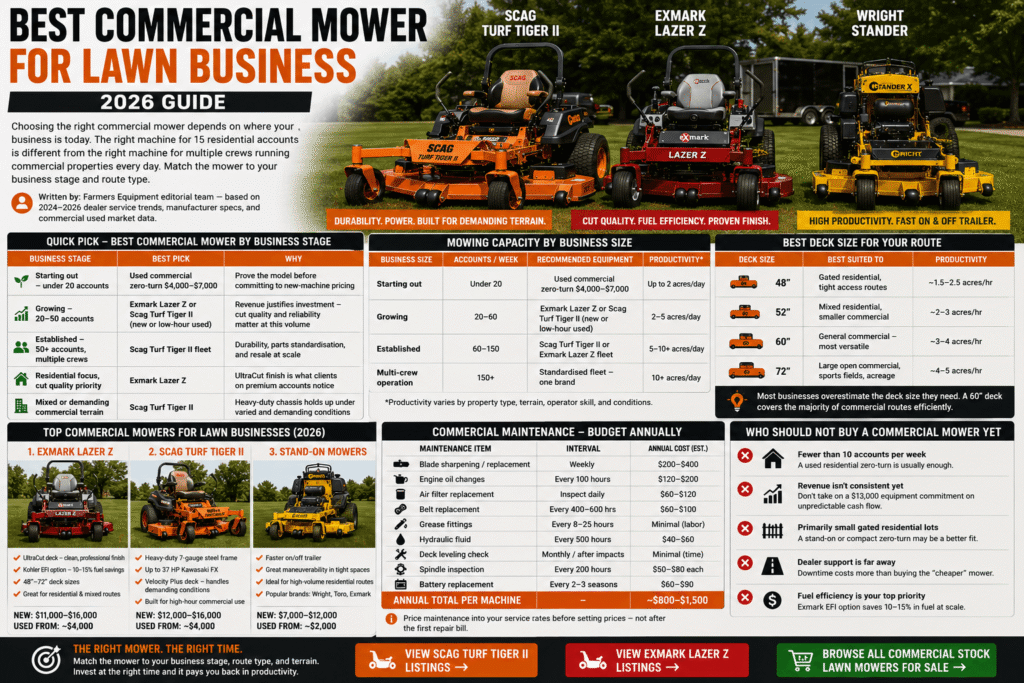
Quick Pick — Best Commercial Mower by Business Stage
| Business Stage | Best Pick | Why |
|---|---|---|
| Starting out — under 20 accounts | Used commercial zero-turn $4,000–$7,000 | Prove the model before committing to new-machine pricing |
| Growing — 20–50 accounts | Exmark Lazer Z or Scag Turf Tiger II (new or low-hour used) | Revenue justifies investment — cut quality and reliability matter at this volume |
| Established — 50+ accounts, multiple crews | Scag Turf Tiger II fleet | Durability, parts standardisation, and resale at scale |
| Residential focus, cut quality priority | Exmark Lazer Z | UltraCut finish is what clients on premium accounts notice |
| Mixed or demanding commercial terrain | Scag Turf Tiger II | Heavy-duty chassis holds up under varied and demanding conditions |
Mowing Capacity by Business Size
| Business Size | Accounts / Week | Recommended Equipment | Priority |
|---|---|---|---|
| Starting out | Under 20 | Used commercial zero-turn $4,000–$7,000 | Low capital risk — prove the model first |
| Growing | 20–60 | Exmark Lazer Z or Scag Turf Tiger II (new or low-hour used) | Reliability and cut quality — downtime costs real money now |
| Established | 60–150 | Scag Turf Tiger II or Exmark Lazer Z fleet | Parts standardisation, crew familiarity, fleet resale value |
| Multi-crew operation | 150+ | Standardised fleet — one brand | Maintenance simplification and dealer relationship matter most |
What Makes a Mower “Commercial Grade”
The term commercial gets applied loosely in marketing. For a lawn business that depends on the machine running daily, the meaningful differences between commercial and residential equipment are:
- Transmission rating: commercial transmissions — Hydro-Gear ZT-5400 and above — are rated for 2,000–3,000+ hours of sustained use. Residential EZT and ZT-2800 units are designed for a fraction of that at daily professional intensity
- Frame construction: commercial machines use heavier-gauge steel designed to absorb the cumulative stress of 6–10 hours per day across varied terrain over multiple seasons
- Engine options: commercial engines from Kawasaki FX and Kohler EFI series are designed for sustained high-output use with longer service intervals than residential-grade alternatives
- Deck engineering: commercial decks — Exmark UltraCut, Scag Velocity Plus — are built for cut quality and discharge consistency at higher ground speeds across varied grass types
- Parts availability and dealer support: commercial machines have dealer networks and parts availability designed for operations where downtime costs real money
The practical test: if you’re running a machine 5+ days per week across multiple properties, a residential machine will show its limits within one to two seasons. The repair and downtime costs at that point typically exceed the savings from the lower purchase price.
Best Commercial Mowers for Lawn Businesses in 2026
1. Exmark Lazer Z — Best for Residential and Mixed-Route Operations
The Exmark Lazer Z is among the most widely used commercial zero-turns in the US professional landscaping market — a position built on the UltraCut deck’s cut finish. For lawn businesses that compete on appearance — where what the property looks like when you’re done is part of the service pitch — the Lazer Z is the machine most commonly recommended by operators who run premium residential accounts.
Available in 48″–72″ configurations with 25–35 HP Kawasaki FX or Kohler EFI engines. The EFI option provides approximately 10–15% fuel savings at commercial hours — meaningful across a fleet over a full season. The 48″ deck option adds flexibility for gated residential properties that larger machines can’t access.
Based on observed listings on TractorHouse across 2024–2026, clean Lazer Z units with documented service history attract consistent demand on the commercial used market — reflecting genuine professional preference.
- Deck: 48″–72″ UltraCut
- Engine: 25–35 HP Kawasaki FX / Kohler EFI
- Best for: Residential routes, cut quality priority, fuel efficiency at scale
- New price: generally $11,000–$16,000
- Used from: ~$4,000 in working condition
👉 Check current Exmark Lazer Z stock and pricing →
2. Scag Turf Tiger II — Best for Demanding Terrain and High-Hour Operations
The Scag Turf Tiger II is the machine operators reach for when durability at extreme hours is the priority. The heavy-duty chassis, Velocity Plus deck, and Kawasaki FX engine options up to 37 HP are designed for crews running full commercial routes on varied and demanding terrain across full commercial seasons.
For lawn businesses covering a high volume of commercial properties — parking lots, municipal grounds, large HOA communities — the Turf Tiger II’s construction holds up under the sustained workload that lighter machines show wear under. Many commercial operations that standardise on one machine brand choose the Scag for parts simplification across a fleet.
- Deck: 52″–72″ Velocity Plus
- Engine: 25–37 HP Kawasaki FX
- Best for: Demanding terrain, high-hour operations, fleet standardisation
- New price: generally $12,000–$16,000
- Used from: ~$4,000 in working condition
👉 Check current Scag Turf Tiger II stock and pricing →
3. Stand-On Mowers — Best for High-Volume Residential Routes
Lawn businesses running 15–25 small to medium residential properties per day often find stand-on mowers — Wright Standers, Toro GrandStand, Exmark Staris — more productive than full-size zero-turns for that route type. Stand-ons load and unload faster, maneuver tighter spaces more easily, and reduce the per-stop overhead time that adds up across a high-volume residential day.
If your route is predominantly smaller residential properties with frequent stops and tight access, a stand-on mower is worth evaluating alongside a zero-turn before buying. For larger properties and commercial sites, a full-size zero-turn remains the more efficient machine.
Other Commercial Mowers Worth Considering
Scag and Exmark dominate the professional market, but several other commercial brands are worth knowing about depending on your route type, dealer access, and budget:
- Ferris ISX 2200 — the standout choice for operators working rough or uneven terrain. The full suspension system reduces operator fatigue significantly on bumpy ground — an advantage no Scag or Exmark at this price matches. Dealer coverage is narrower in some regions, so check before buying
- Toro Z Master — Toro’s commercial line offers strong cut quality and a wide dealer network. The MyRIDE suspension option on select models adds operator comfort competitive with the Ferris. A practical alternative for operators with strong local Toro dealer support
- Hustler Super Z — one of the fastest commercial zero-turns available, with ground speeds above 15 mph on some configurations. Attractive for large-property operations where speed drives productivity. Less common in some dealer markets than Scag or Exmark
- Gravely Pro-Turn — competitive commercial construction at pricing that often undercuts Scag and Exmark new. A reasonable alternative where local Gravely dealer support is strong. Used market is thinner than the major brands
- Kubota ZD Series — diesel-powered commercial zero-turns suited to very high-hour operations where diesel fuel costs and engine longevity are the priority. Higher upfront cost; best suited to established operations with high annual hours
- Wright Stander — the leading stand-on mower for high-volume residential routes. Faster load/unload times, tighter maneuverability, and lower trailer space per machine make it productive on routes with many smaller properties and frequent stops
What Size Deck Does Your Lawn Business Need?
| Deck Size | Best Suited To | Productivity |
|---|---|---|
| 48″ | Gated residential, tight access routes | ~1.5–2.5 acres/hr |
| 52″ | Mixed residential, smaller commercial | ~2–3 acres/hr |
| 60″ | General commercial — the most versatile deck size | ~3–4 acres/hr |
| 72″ | Large open commercial, sports fields, acreage | ~4–5 acres/hr |
Most lawn businesses starting out overestimate the deck size they need. A 60″ deck covers the majority of commercial routes efficiently and is maneuverable enough for most residential work. A 72″ is only worth the reduced maneuverability if a significant portion of your route is large open property.
New vs Used — What’s Right for Your Business Stage
Starting out — buy used
A used commercial machine in the $4,000–$7,000 range is almost always the right call for a solo operator or small crew under 20 accounts. A well-maintained used Exmark Lazer Z or Scag Turf Tiger II at 800–1,500 hours still has significant commercial life remaining — and the lower capital commitment means a cash flow problem with one or two lost accounts doesn’t turn into an equipment debt problem.
Key checks on any used commercial machine: transmission smoothness at both slow and high speed, spindle bearing condition, deck for rust and cracks around anti-scalp wheel mounting points, caster fork wear, engine oil colour, and service history. A machine with dealer service records is worth paying more for.
Growing — new or low-hour used
Once you’re running 25–50 accounts with consistent revenue, the case for new or low-hour used commercial equipment becomes clearer. At that volume, downtime costs real money — a machine in a dealer’s service queue for a week in June is an expensive problem. New machines come with warranty coverage and known condition that reduce that risk.
Established — standardise the fleet
Operations running multiple crews benefit from standardising on one machine brand — shared parts inventory, crews familiar with one platform, and simplified maintenance scheduling. Both Scag and Exmark have dealer networks and parts availability designed to support fleet operations.
Commercial Mower Maintenance — What to Budget
| Item | Interval | Annual cost estimate |
|---|---|---|
| Blade sharpening | Weekly on active routes | $200–$400 (labour or service) |
| Engine oil changes | Every 100 hours | $120–$200 |
| Air filter replacement | Inspect daily, replace as needed | $60–$120 |
| Belt replacement | Every 400–600 hours | $60–$100 per belt |
| Grease fittings | Every 8–25 hours | Minimal — labour is the cost |
| Hydraulic fluid | Every 500 hours | $40–$60 |
| Deck leveling check | Monthly or after impacts | Minimal — time only; unlevel decks show in cut quality immediately |
| Hydro cooling fins cleaning | Every 50 hours | Minimal — clogged fins accelerate hydraulic overheating in summer |
| Tyre pressure check | Weekly | Minimal — uneven pressure affects cut quality and traction |
| Spindle inspection | Every 200 hours | $50–$80 per bearing if replacement needed — catch early |
| Battery replacement | Every 2–3 seasons | $60–$90 — replace proactively before winter storage |
| Annual total per machine | — | ~$800–$1,500 at full commercial hours |
The most common business mistake in lawn care: not pricing maintenance into service rates from day one. Budget $800–$1,500 per commercial machine per year and build it into your overhead before setting prices — not after the first repair bill arrives.
When Does a Commercial Mower Pay for Itself?
A new commercial zero-turn at $13,000 sounds expensive until you look at what it replaces. A commercial machine running at higher ground speeds on a larger deck covers the same properties in less time than a residential machine. If a commercial mower saves one hour per day compared with a lighter alternative — through faster cutting speed, fewer breakdowns, or eliminating mid-route maintenance stops — the productivity gains can recover the additional investment surprisingly quickly. The exact payback depends on your billing rate, labour costs, and route density, but the math generally favours commercial equipment once a business reaches 20–30 consistent accounts.
A real-world scenario: a solo operator billing $45 per lawn at 20 lawns per week who saves one hour per day through a faster, more reliable machine could cover an additional 2–3 lawns per week. At $45 per lawn, that’s $90–$135 in additional weekly revenue — or roughly $4,000–$5,000 per season. Against a $6,000 used commercial machine purchase, that payback period is measurable within the first full season.
The numbers are illustrative — actual results depend on route specifics — but the underlying principle is consistent: underinvesting in equipment at the right business stage costs more in lost productivity than the savings on purchase price.
Dealer Support — Often More Important Than the Machine
Commercial downtime costs more than price differences between machines. Before deciding between Scag and Exmark, check which brand has the stronger dealer presence in your area. Parts availability, warranty turnaround time, and the ability to get a loaner machine during service are all worth asking about before buying. A dealer you can call and get a same-day answer from is worth more than a marginally better spec sheet on a machine serviced three counties away.
For both Scag and Exmark, authorised dealers can be located through the manufacturer’s dealer finder. If regional coverage is significantly stronger for one brand in your area — that should weigh in your decision.
Biggest Mistakes Lawn Businesses Make When Buying Equipment
- Buying the biggest deck available — a 72″ deck on a route of small suburban lots is slower, not faster. Deck size should match the properties you’re actually servicing, not the largest you might encounter. Most general commercial routes run most efficiently on a 60″
- Financing too much equipment too early — a $13,000 equipment payment on 15 accounts is a cash flow risk that a $5,000 used machine doesn’t carry. Buy capacity as the revenue supports it, not ahead of it
- Ignoring dealer support — buying a machine from a brand with weak local dealer presence is a decision that shows up the first time something needs fixing mid-season. Check dealer proximity and service turnaround before buying, not after
- Buying based on horsepower alone — HP is one spec among many. Transmission quality, frame construction, deck engineering, and dealer support all affect real-world performance more than an extra 2–3 HP on paper
- Skipping maintenance budgeting — operators who don’t price commercial maintenance into their service rates before setting prices find out what it costs the hard way. Budget $800–$1,500 per machine per year and price accordingly from day one
- Buying new when used makes more sense — a well-maintained used Exmark Lazer Z or Scag Turf Tiger II at $5,000–$6,000 does the same commercial work as a $13,000 new machine for a business still proving its client base
Who Should NOT Buy a Commercial Mower Yet
- Fewer than 10 accounts per week — a used residential zero-turn handles that volume without the commercial price tag. See our best residential zero-turn guide for that use case
- Revenue isn’t consistent yet — a $13,000 equipment commitment on unpredictable cash flow is a risk. Start used, prove the client base, upgrade when the revenue supports it
- Primarily small gated residential lots — a stand-on mower or compact zero-turn may serve that route type better than a full-size commercial machine
Verdict — Best Commercial Mower for Lawn Business
For most lawn businesses in 2026, the best commercial mower for a lawn business is the one that matches where the business actually is — not where you hope it will be in two years.
Starting out: buy a used Exmark Lazer Z or Scag Turf Tiger II in good condition at $4,000–$7,000 and prove the business model before committing to new-machine pricing. Growing: buy new or low-hour used when consistent revenue justifies the investment. Established: standardise the fleet on one brand for parts and maintenance simplicity.
On the machine itself: Exmark Lazer Z for cut quality and residential accounts. Scag Turf Tiger II for durability on demanding terrain at high hours. Neither is a wrong choice at commercial scale — the business stage and route type determine the right answer more than the spec sheet does.
The best commercial mower for a lawn business is not necessarily the biggest or most expensive — it is the one that matches your current route size, revenue, and long-term growth plans. Investing in the right machine at the right stage of your business almost always delivers better returns than buying maximum capacity on day one.
👉 View Scag Turf Tiger II listings →
👉 View Exmark Lazer Z listings →
Browse all commercial stock: lawn mowers for sale →
Commercial vs Regular Lawn Mower — What Is the Difference?
The term “commercial” is used loosely in marketing — but for a lawn business that depends on daily operation, the meaningful mechanical differences are specific:
| Feature | Regular (Residential) Mower | Commercial Mower |
|---|---|---|
| Warranty | Residential warranty only — voids under commercial use | Commercial warranty — rated for professional daily operation |
| Design life | 400–700 hours total | 2,000–3,000+ hours |
| Transmission | Hydro-Gear EZT or ZT-2800 — residential rated | Hydro-Gear ZT-5400 or commercial pumps — sustained daily use |
| Frame | Residential tubular or stamped steel | Heavy-gauge welded commercial steel |
| Spindles | Sealed bearings — replace when worn | Greasable — serviced on schedule, significantly longer life |
| Engine | Residential Kawasaki or Kohler | Kawasaki FX Series or Kohler Command EFI — commercial rated |
| Fuel tank | 3–3.5 gallons | 9–13 gallons — full commercial day without refuelling |
| Weight | 575–680 lbs | 1,000–1,450 lbs |
| New price | $2,600–$4,000 | $10,000–$17,000+ |
| Practical test | 5+ days per week daily professional use: shows wear within 1–2 seasons | Designed to run 5+ days per week for 6–10+ seasons |
Is a Commercial Mower Worth It?
Yes — once the business reaches 15–20 consistent accounts. Before that threshold, a used residential zero-turn handles the volume without the commercial price tag. At 15–20+ accounts running 5 days per week, the reliability difference becomes a real operating advantage — a residential machine pushed into commercial use typically shows significant wear within one to two seasons, with repair costs that erode the initial purchase price savings. The commercial machine’s 2,000–3,000+ hour design life, commercial warranty, and greasable spindles deliver a lower total cost of ownership at commercial hours — not a higher one.
Top 5 Commercial Lawn Mowers for 2026
| Rank | Machine | Best For | New Price | Why It Makes the List |
|---|---|---|---|---|
| 1 | Exmark Lazer Z | Cut quality — premium residential and mixed commercial accounts | ~$11,000–$16,000 | UltraCut deck — consistently rated the best commercial cut finish. Most widely used commercial zero-turn in US professional landscaping |
| 2 | Scag Turf Tiger II | Durability — demanding terrain and high-hour commercial operations | ~$12,000–$17,000 | 7-gauge steel frame, 37 HP ceiling, 2,000–3,000+ hour design life. The machine operators choose when downtime is not an option |
| 3 | Ferris ISX 2200 | Rough or uneven terrain — suspension comfort priority | ~$10,000–$14,000 | Full suspension system reduces operator fatigue significantly on bumpy terrain — the standout feature no Scag or Exmark at this price matches |
| 4 | Toro Z Master Commercial | Mixed commercial routes with strong Toro dealer access | ~$9,000–$14,000 | Strong cut quality, wide dealer network, MyRIDE suspension available. Best alternative to Exmark for operators with strong local Toro support |
| 5 | Hustler Super Z | Large open property operations where speed drives productivity | ~$10,000–$15,000 | One of the fastest commercial zero-turns — 15+ mph on select configurations. Best for large acreage routes where ground speed is the primary productivity driver |
What Is the Most Reliable Commercial Mower Brand?
| Class | Most Reliable Brand | Why |
|---|---|---|
| Commercial zero-turn | Scag / Exmark (tied) | Both engineered for 2,000–3,000+ hours of professional daily use with commercial warranties. Dealer network strength in your region often determines which is the better practical choice |
| Commercial stand-on | Wright / Toro GrandStand | Wright Stander has the longest stand-on commercial track record; Toro GrandStand benefits from the Toro dealer network |
| Residential zero-turn | Toro / John Deere (tied) | Strongest residential service networks — most consistent owner satisfaction in independent surveys |
| Overall brand consistency | Exmark | Toro/Exmark combined dealer network provides strong national parts availability — a practical advantage when parts are needed mid-season |
What Is the Most Dependable Lawn Mower Brand?
In professional landscaping surveys and dealer service data: Exmark and Scag consistently top commercial dependability rankings — both engineered specifically for the daily professional use conditions that other brands’ commercial warranties don’t cover. For residential: Toro and John Deere lead owner satisfaction surveys. The most dependable brand in any class is also the one with the strongest dealer support in your specific region — a machine from a brand with a local dealer who answers the phone is more dependable in practice than a marginally better-spec machine with a dealer three counties away.
What Is the Best Lawn Mower According to Consumer Reports?
For full commercial specs and warranty terms see Scag.com and Exmark.com. Consumer Reports evaluates primarily residential zero-turns and riding mowers in their subscriber testing — commercial machines like the Scag Turf Tiger II and Exmark Lazer Z are outside their typical residential test scope. In Consumer Reports residential zero-turn and riding mower reliability surveys, John Deere and Toro consistently rank at the top of owner-reported reliability for the under-$5,000 residential class. For commercial-grade machines, professional landscaper surveys and trade publications are the more relevant source — and in those, Scag and Exmark lead consistently.
What Is the World’s Best Lawn Mower?
No single answer covers all uses, but by category:
| Category | World’s Best | Why |
|---|---|---|
| Commercial cut quality | Exmark Lazer Z (UltraCut deck) | Most consistently rated commercial cut finish in professional landscaping surveys |
| Commercial durability | Scag Turf Tiger II | 7-gauge steel, 37 HP ceiling, longest commercial design life at full daily professional use |
| Residential zero-turn | Toro TimeCutter with MyRIDE / John Deere Z300 Series | Consistently top residential owner satisfaction. Toro leads on comfort; JD leads on resale |
| Autonomous / robotic | Husqvarna Automower 450XH | Most capable residential robotic mower — handles complex terrain up to 1.25 acres autonomously |
| Diesel commercial | Kubota ZD326 | Best diesel-powered commercial zero-turn for operations where diesel fuel costs and extreme hours are the priority |
What Is the Most Expensive Lawn Mower in the World?
In the production zero-turn class: large commercial diesel zero-turns at the top of the Kubota ZD range and the Scag Sabre Tooth Tiger in maximum configuration can reach $20,000–$25,000+ new from dealers. Beyond the zero-turn category, professional turf maintenance equipment scales significantly higher — professional reel mowers for golf courses and sports fields can reach $50,000–$200,000+ for multi-gang units. The Ransomes GP series and Jacobsen Tri-King used on professional sports fields represent the top end of production turf maintenance equipment pricing. Custom and novelty machines aside, the most expensive practical commercial lawn maintenance machines are multi-gang reel mowers used on golf fairways and professional sports pitches.
What Is the Rolls-Royce of Lawn Mowers?
In the commercial zero-turn category: Scag and Exmark are the consistent answers — engineered for decades of professional daily use at standards no residential machine approaches. Between the two: Scag is more often cited for raw construction quality and durability at extreme hours; Exmark for cut finish refinement on premium ornamental turf. Our Scag Turf Tiger II at $17,800 represents the commercial ceiling for most operations. Beyond zero-turns, the Husqvarna Automower 450XH is considered the premium residential product in the autonomous mower category. In the broader grounds maintenance world, Wiedemann and Jacobsen are the Rolls-Royce equivalents for professional sports turf — a different market entirely from commercial lawn care.
Which Lawn Mower Is Considered the Best Quality?
For commercial quality specifically: the Exmark Lazer Z and Scag Turf Tiger II are the industry benchmark. For residential quality: the Toro TimeCutter with MyRIDE and John Deere Z345R consistently receive the highest owner quality ratings in independent surveys. Quality in a lawn mower is not a single dimension — cut finish quality (Exmark leads), build quality and longevity (Scag leads), and operator comfort quality (Toro leads with MyRIDE) are all different things, and different machines lead on different metrics.
Frequently Asked Questions
What is the best commercial mower for a lawn business?
For most lawn businesses, the Exmark Lazer Z or Scag Turf Tiger II are the two most practical commercial zero-turns in 2026. Exmark leads on cut quality for premium residential accounts. Scag leads on durability for demanding terrain and high-hour operations. For starting operators, a used commercial machine in good condition at $4,000–$7,000 is the most practical entry point before committing to new-machine pricing.
Should I buy new or used commercial equipment for my lawn business?
For a starting operator under 20 accounts, used is almost always the right call — lower capital commitment and proven commercial capability. For an established operation with consistent revenue above 30–50 accounts, new or low-hour used makes more sense — warranty coverage and known condition reduce downtime risk when the machine is carrying real revenue.
What size deck do I need for a commercial lawn business?
For most general-purpose commercial routes, 60″ is the most practical primary deck size — productive on open properties and maneuverable enough for most commercial spaces. 52″ suits mixed residential routes with tighter access. 72″ is efficient on large open properties but reduces maneuverability on smaller lots. Most crews run 60″ as their primary with a smaller machine for gated or tight-access properties.
How much does commercial mower maintenance cost per year?
Budget $800–$1,500 per commercial machine per year at full commercial hours — covering blade changes, engine oil at 100 hours, belt replacement at 400–600 hours, hydraulic fluid at 500 hours, and incidental repairs. Price this into your service rates before setting prices, not after the first major repair bill.
Is it worth buying a commercial mower for a small lawn business?
For fewer than 10 accounts per week, a used residential zero-turn typically handles the volume without the commercial price commitment. Commercial equipment starts making economic sense when you’re running 15–20+ accounts consistently and the durability and daily reliability of commercial machines becomes a real operating advantage over residential alternatives.