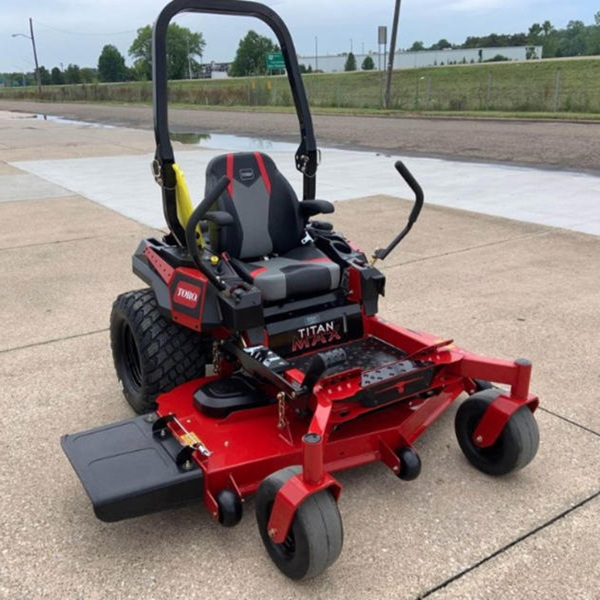
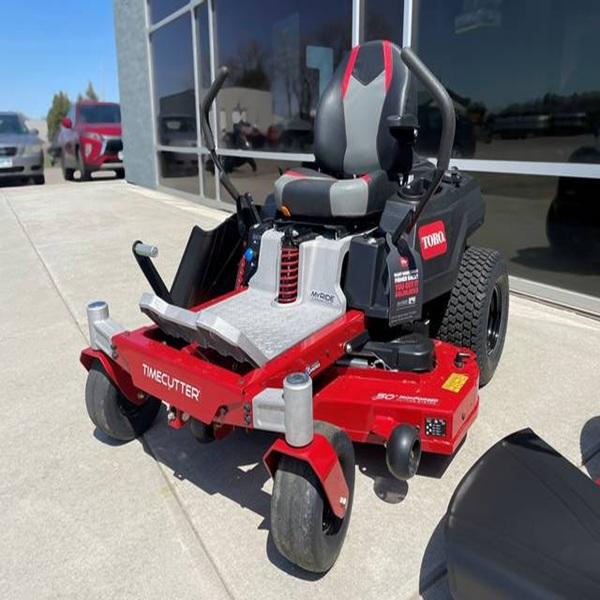
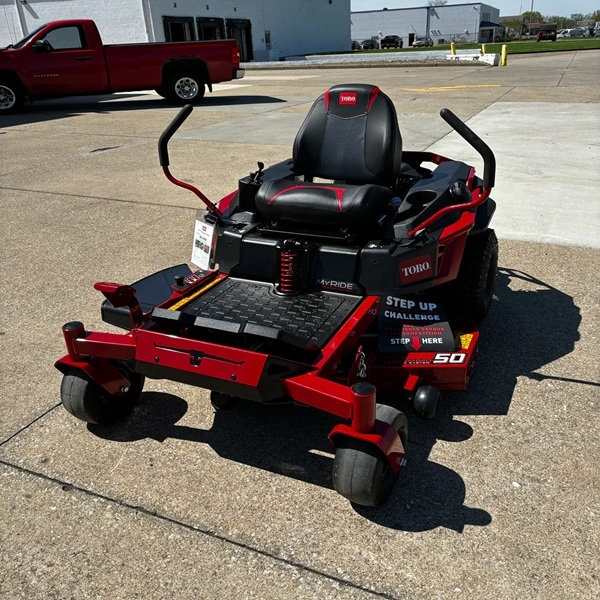
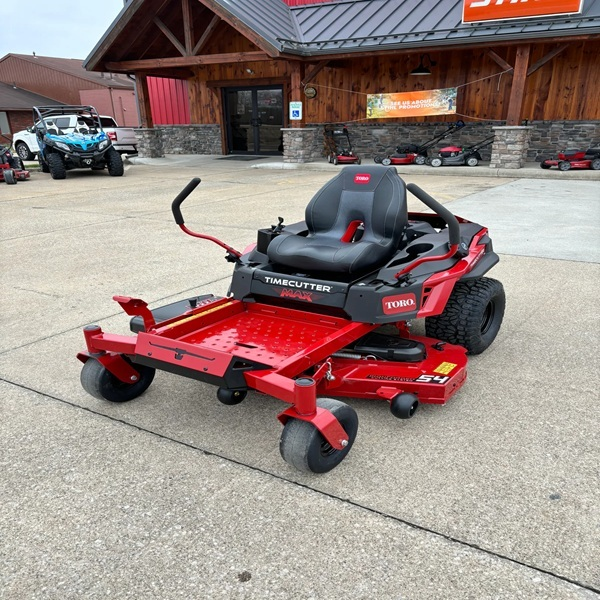
Toro TimeCutter For Sale — $3,500, Zero-Turn Mower, 42–75″ Deck
The Toro TimeCutter for sale at Farmers Equipment is priced at $3,500 — one of the most reliable residential zero-turn mowers on the market. 22–24.5 HP engine, 42–75″ deck options, dual hydrostatic transmission, and Toro’s exclusive MyRIDE suspension system for reduced operator fatigue. Best suited to 1–3 acre properties. Worldwide shipping available.
👉 Contact us to confirm current stock, deck size, and shipping quote →
Toro TimeCutter — Full Specifications
| Specification | Details |
|---|---|
| Engine options | Kawasaki FR651V or Kohler 7000 Series — 22–24.5 HP |
| Cutting deck options | 42″, 50″, 60″, 75″ |
| Cutting height | 1.5″–4.5″ (adjustable) |
| Ground speed | 7 mph forward / 3 mph reverse |
| Transmission | Dual hydrostatic — maintenance-free |
| Suspension | MyRIDE full-body suspension (select models) |
| Speed control | Smart Speed — 3 ground speed range settings |
| Fuel tank | 3 gallons |
| Weight | ~575–650 lbs depending on deck |
| Turning radius | Zero-turn |
| Warranty (new) | 3-year limited residential warranty |
| Price at Farmers Equipment | $3,500 — worldwide shipping available |
Is the Toro TimeCutter a Good Mower?
Yes — the TimeCutter has been one of the top-rated residential zero-turns for over a decade, consistently earning strong owner satisfaction scores. Three reasons it earns that position:
- MyRIDE suspension — Toro’s exclusive full-body suspension system isolates the operator from ground vibration. No other residential zero-turn at this price point offers equivalent operator comfort. For anyone mowing more than an hour per session, this is a meaningful practical advantage
- Smart Speed control — three ground speed range settings let operators limit top speed near obstacles or on slopes, then open up for efficient straight-line mowing. Makes the machine safer and more controllable for first-time zero-turn operators
- Proven reliability — a decade-plus as a residential bestseller with wide Toro dealer and parts support across the US. Kawasaki and Kohler engines used in the TimeCutter are among the most reliably serviced small engines in the market
The honest limitation: the TimeCutter is a residential machine. It is not rated for commercial daily use and its deck construction reflects that. For buyers running a lawn care business, see our Exmark Lazer Z at $11,299 or Scag Turf Tiger II at $17,800.
How Many Hours Will a Toro TimeCutter Last?
A well-maintained Toro TimeCutter should provide 400–700 hours of reliable residential operation — approximately 8–14 years at typical residential use rates of 50 hours per year.
| Hours | Assessment | What to Expect |
|---|---|---|
| Under 100 hours | Like new — very low use | Full productive life remaining |
| 100–250 hours | Low to mid — excellent used buy | Standard inspection — check belts and deck |
| 250–400 hours | Mid — solid if maintained | Check hydrostatic transmission smoothness, blade condition |
| 400–600 hours | Mid-to-high — viable with history | Budget for belts, blades, possible carb service |
| 600–700 hours | High — end of typical residential life | Price should reflect remaining life — budget for maintenance |
| 700+ hours | Very high | Full inspection required — near end of residential design life |
Is 700 Hours a Lot for a Zero-Turn Mower?
For a residential zero-turn like the TimeCutter — yes, 700 hours is at the upper end of expected design life. At 50 residential hours per year, 700 hours represents approximately 14 years of use. A 700-hour TimeCutter can still function but expect significant maintenance needs — belts, blades, hydrostatic fluid, and potentially carburetor work. Price should reflect this significantly. For comparison, commercial zero-turns (Scag, Exmark) are engineered for 2,000–3,000+ hours.
Is 400 Hours a Lot for a Zero-Turn Mower?
For a residential zero-turn — mid-to-high. 400 hours at residential rates represents approximately 8 years of use. A well-maintained TimeCutter at 400 hours is past the midpoint of its expected residential life but still has useful mowing ahead. Key checks: belt condition, hydrostatic transmission engagement, and blade wear. Budget for near-term maintenance and price accordingly when buying used.
Is 200 Hours on a Zero-Turn Mower a Lot?
No — 200 hours is low-to-mid for a residential zero-turn. At typical residential use, 200 hours represents approximately 4 years. A well-maintained TimeCutter at 200 hours should have significant productive life remaining. Still worth checking belt condition and hydrostatic fluid — but 200-hour machines are generally good used buys when the maintenance history is documented.
Toro TimeCutter vs TimeCutter Max — What Is the Difference?
| Feature | Toro TimeCutter | Toro TimeCutter Max |
|---|---|---|
| Series position | Standard residential | Premium residential |
| Engine HP | 22–24.5 HP | 24.5–26 HP |
| Deck sizes | 42″–75″ | 50″–75″ |
| Deck construction | Stamped steel | Fabricated steel — heavier, more durable |
| MyRIDE suspension | Available on select models | Standard on all Max models |
| Smart Speed | Standard | Standard |
| Seat | High-back with armrests | Premium seat — more adjustment |
| New price | ~$2,600–$3,500 | ~$3,500–$5,000 |
| Best for | Standard 1–3 acre residential use | Higher-hour users, larger yards, buyers wanting fabricated deck |
| Verdict | Right machine for most residential buyers | Worth the premium for 3+ acre yards or more demanding use |
For most buyers with a 1–3 acre residential yard — the standard TimeCutter at $3,500 is sufficient. The TimeCutter Max earns its premium on larger properties where the fabricated deck and higher HP are put to regular use.
Toro vs John Deere Zero-Turn — Which Is Better?
| Factor | Toro TimeCutter | John Deere Z300 Series |
|---|---|---|
| Engine | Kawasaki or Kohler — 22–24.5 HP | Kawasaki or Kohler — 22–24 HP |
| Suspension | MyRIDE (select models) — best in class | Standard — no suspension option |
| Deck size options | 42″–75″ | 42″–54″ |
| Speed control | Smart Speed — 3 range settings | Standard speed control |
| Dealer network | Strong — wide Toro network | Largest — John Deere has most dealers |
| Resale value | Good | Very strong — JD premium holds best |
| Price at Farmers Equipment | $3,500 | $3,399 |
| Best for | Operator comfort, deck flexibility, suspension | Resale value, dealer access, brand trust |
For independent used zero-turn pricing, TractorHouse.com lists current sales. The honest verdict: Toro wins on operator comfort (MyRIDE) and deck size flexibility. John Deere wins on resale value and dealer network. At near-identical prices, the deciding factor is whether MyRIDE suspension matters to you — if you mow for more than an hour at a time, it does.
Toro vs Craftsman Zero-Turn — Which Is Better?
Toro is the stronger machine. Craftsman zero-turns (sold through Lowe’s, made by Husqvarna under licence) are budget-positioned alternatives — lower purchase price but lighter construction, less refined controls, and more limited dealer support. For buyers on a tight budget, Craftsman delivers basic zero-turn function. For buyers who want proven reliability, operator comfort (MyRIDE), and brand-backed service support — Toro is the superior choice at comparable or slightly higher pricing.
What Zero-Turns to Stay Away From?
Honest assessment of zero-turn brands and models to approach with caution:
- Generic import brands / white-label zero-turns — sold through discount retailers, often with no dealer support network. Parts availability is the primary risk
- Residential zero-turns used for commercial work — any residential machine (including the TimeCutter) pushed into daily commercial use will wear out significantly faster than its rated design life. Not a brand problem — a spec mismatch
- Older Cub Cadet RZT models — earlier generation CVT-based zero-turns that earned a poor reliability reputation. Current Cub Cadet XT1 is a different and better machine, but older RZT units are worth avoiding
- Any zero-turn without service history on the used market — hours without maintenance records tell you very little about actual condition
Best Toro Zero-Turn — Full Model Guide
| Model | Deck | Key Feature | Best For |
|---|---|---|---|
| TimeCutter 42″ | 42″ | Most compact | Under 1 acre, tight storage |
| TimeCutter 50″ | 50″ | Best-selling configuration | 1–2 acres — best balance |
| TimeCutter 50″ MyRIDE | 50″ | Full-body suspension | 1–2 acres, comfort priority |
| TimeCutter 60″ | 60″ | Wider deck — faster coverage | 2–3 acres |
| TimeCutter 75″ | 75″ | Largest residential deck | 3–5 acres |
| TimeCutter Max 54″ | 54″ | Fabricated deck, MyRIDE standard | Heavier use, 2–3 acres |
| TimeCutter Max 60″ | 60″ | Fabricated deck, high HP | Large residential / light semi-commercial |
Which Zero-Turn Mower Has the Highest Rating?
According to Consumer Reports zero-turn reliability data, in independent owner surveys and consumer reviews for residential zero-turns in the $2,500–$4,000 class: the Toro TimeCutter with MyRIDE and the John Deere Z345R consistently rank highest for overall owner satisfaction. The Toro wins on comfort; the John Deere wins on resale and brand trust. The Husqvarna Z254 ranks strongly for value per dollar. For commercial zero-turns, Exmark and Scag lead reliability surveys by a significant margin over residential machines.
Toro TimeCutter vs Competitors
| Factor | Toro TimeCutter | Husqvarna Z254 | Ariens IKON XD |
|---|---|---|---|
| Deck options | 42″–75″ | 54″ | 42″–52″ |
| Engine HP | 22–24.5 HP | 26 HP | 23–25 HP |
| Suspension | MyRIDE available | None | None |
| Speed control | Smart Speed (3 settings) | Standard | Standard |
| Price | $3,500 | $3,599 | $3,699 |
| Best for | Comfort, flexibility, proven brand | Max HP in class | Best value spec |
Also browse: John Deere Z300 at $3,399 · Cub Cadet XT1 at $3,000 · Full lawn mower range →
👉 Contact us to confirm current stock, deck size available, and arrange shipping →
Frequently Asked Questions: Toro TimeCutter For Sale
How much does a Toro TimeCutter cost?
$3,500 at Farmers Equipment. New TimeCutter models retail at approximately $2,600–$3,500 for standard models and $3,500–$5,000 for TimeCutter Max configurations. Used TimeCutters in good condition typically trade for $1,200–$2,400 depending on age, hours, and condition.
Is the Toro TimeCutter a good mower?
Yes — consistently one of the top-rated residential zero-turns for over a decade. The MyRIDE suspension system is the standout feature — unique in the residential zero-turn class at this price. Smart Speed control makes it one of the most beginner-friendly zero-turns available. Reliable Kawasaki or Kohler engine with wide US service support.
How many hours is a Toro TimeCutter good for?
400–700 hours with proper maintenance — approximately 8–14 years at typical residential use of 50 hours per year. Maintenance history predicts condition more accurately than hours alone. A well-maintained 400-hour TimeCutter outperforms a neglected 200-hour one.
Is 700 hours a lot for a zero-turn mower?
For a residential zero-turn — yes, 700 hours is at the upper end of expected design life. Budget for significant maintenance and price accordingly. Commercial zero-turns (Scag, Exmark) are engineered for 2,000–3,000+ hours and are a better choice for high-hour use.
Is 400 hours a lot for a zero-turn mower?
For a residential zero-turn — mid-to-high. Represents approximately 8 years at 50 hours per year. Still viable used buy at the right price with documented service history. Check belt condition, hydrostatic engagement, and blade wear before purchase.
Is 200 hours on a zero-turn mower a lot?
No — 200 hours is low-to-mid for a residential zero-turn. Approximately 4 years at typical residential use. A well-maintained TimeCutter at 200 hours should have significant productive life remaining and is generally a good used buy.
What is the difference between a Toro TimeCutter and TimeCutter Max?
The TimeCutter Max has a fabricated steel deck (vs stamped on the standard TimeCutter), higher HP ceiling (24.5–26 HP vs 22–24.5 HP), MyRIDE suspension standard on all models (vs select models on standard), and a premium seat. New price range: $3,500–$5,000 vs $2,600–$3,500 for the standard. Worth the premium for larger yards or more demanding use; the standard TimeCutter is sufficient for most 1–3 acre residential properties.
Which is better — Toro or John Deere zero-turn?
Toro wins on operator comfort (MyRIDE suspension) and deck flexibility. John Deere wins on resale value and dealer network density. At near-identical prices ($3,399–$3,500), the deciding factor is whether the MyRIDE suspension matters for your use — for mowing sessions over an hour, it does.
Which is better — Toro or Craftsman zero-turn?
Toro is the stronger machine. Craftsman zero-turns are budget alternatives with lighter construction and more limited dealer support. For buyers wanting proven reliability, MyRIDE comfort, and brand-backed service — Toro is the clear choice.
What zero-turns should I stay away from?
Generic import/white-label zero-turns with no dealer support; residential machines used for commercial work; older Cub Cadet RZT models (early CVT-based generation); and any used zero-turn without documented service history. The last point applies regardless of brand — hours without maintenance records are unreliable condition indicators.
Jason M –
The Toro TimeCutter has made weekend mowing much easier. The zero turn steering is especially useful around our trees and fence lines.