The Scag Turf Tiger II vs Exmark Lazer Z debate is one of the most consistent arguments in professional landscaping — and the honest answer is that both sides are right. These are the two most widely used commercial zero-turn mowers in the US professional market, and they’ve earned those positions for different reasons. The Exmark Lazer Z leads on cut quality and finish. The Scag Turf Tiger II leads on frame durability and construction under the hardest daily use. Neither is the objectively better machine — the right one depends on what your operation demands.
Based on 2024–2026 dealer service trends, commercial used market data, and manufacturer specifications.
👉 Check current Scag Turf Tiger II stock and pricing →
At a Glance — Scag Turf Tiger II vs Exmark Lazer Z
| If you… | Buy |
|---|---|
| Want the best cut quality and finish | Exmark Lazer Z |
| Want maximum frame durability at extreme hours | Scag Turf Tiger II |
| Run mostly residential and ornamental routes | Exmark Lazer Z |
| Cut rough or demanding commercial properties | Scag Turf Tiger II |
| Want better fuel economy across a fleet | Exmark Lazer Z (Kohler EFI) |
| Need maximum HP for heavy commercial turf | Scag Turf Tiger II (37 HP) |
Quick Specs — Scag Turf Tiger II vs Exmark Lazer Z
| Spec | Scag Turf Tiger II | Exmark Lazer Z |
|---|---|---|
| Deck options | 52″, 61″, 72″ | 48″, 52″, 60″, 72″ |
| Engine HP | 25–37 HP Kawasaki FX | 25–35 HP Kawasaki FX / Kohler EFI |
| Deck system | Velocity Plus™ | UltraCut™ |
| Transmission | Hydro-Gear commercial grade | Hydro-Gear ZT-5400 |
| Fuel injection option | Not standard | Kohler EFI available |
| Frame construction | Heavier gauge — 7-gauge steel | Heavy gauge commercial |
| Operator suspension | None standard | Suspension seat available |
| Warranty (new) | 2-year commercial | 2-year commercial |
| New price | generally $12,000–$16,000 | generally $11,000–$16,000 |
| Used from | ~$4,000 in working condition | ~$4,000 in working condition |
| Max ground speed | ~12 mph | ~11–12 mph |
Productivity estimates by deck size
| Deck size | Typical productivity | Best suited to |
|---|---|---|
| 48″ | ~1.5–2.5 acres/hr | Tight residential, gated properties |
| 52″ | ~2–3 acres/hr | Mixed residential and small commercial |
| 60″ | ~3–4 acres/hr | Best all-around commercial deck size |
| 72″ | ~4–5 acres/hr | Open acreage, sports fields, large commercial |
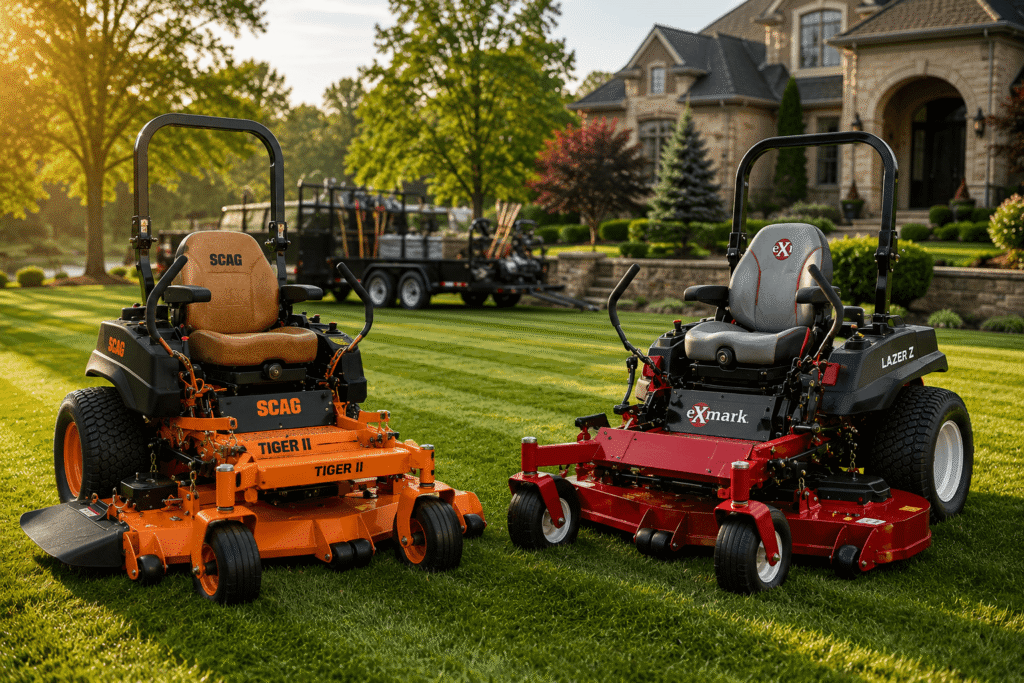
Where the Scag Turf Tiger II Wins
Frame construction — built for the hardest daily use
The Scag Turf Tiger II is built around a 7-gauge steel frame — heavier than most commercial competitors. This isn’t marketing language: operators who run machines 8–10 hours per day across varied terrain, curb impacts, and the sustained vibration of a full commercial season notice the difference in how the Turf Tiger holds up over years of operation. Weld points stay tight longer. Frame flex under load is minimised. The machine simply feels more planted under hard use.
The most consistent feedback from operators who’ve run both the Turf Tiger II and Lazer Z: at extreme hours and the hardest commercial use, the Scag holds up marginally better. On normal professional routes at moderate intensity, the difference is less pronounced — both machines are built well beyond residential use standards.
If frame longevity at extreme hours is your primary concern — the Turf Tiger II is the right machine.
Engine range — up to 37 HP
The Turf Tiger II offers engine options up to 37 HP Kawasaki FX — the highest available in this comparison. For operators cutting heavy commercial turf, thick grass, or running larger 72″ decks at speed, the additional HP provides meaningful headroom. The Exmark Lazer Z tops out at 35 HP in its standard configurations.
Velocity Plus™ deck — strong in varied conditions
The Velocity Plus deck is engineered to handle heavy, wet, and varied grass conditions with consistent discharge and minimal clumping. On commercial routes with inconsistent grass types and conditions, this deck performs reliably. Where it sits relative to the Exmark UltraCut: slightly below on premium ornamental turf finish, comparable on standard commercial grass.
Where the Exmark Lazer Z Wins
Cut quality — UltraCut™ is the standard other decks are compared to
The Exmark Lazer Z‘s UltraCut deck is frequently cited by professional operators as the reason Exmark is among the most widely used commercial zero-turns in the US professional market. The deck produces a finish that clients on high-end residential and ornamental commercial accounts consistently notice — a cleaner stripe, a more uniform cut height, and less visible grass tear at commercial speeds. Landscapers who compete on cut appearance tend to run Exmark for this reason specifically.
Most common feedback from operators who prioritise finish: the UltraCut deck is the one they’d buy again. Many commercial operators regard it as the standard other decks are compared against — though the Scag Velocity Plus performs closely on standard commercial grass.
Kohler EFI option — real fuel savings at scale
The Exmark Lazer Z is available with a Kohler EFI (electronic fuel injection) engine — an option not available on most Scag Turf Tiger II configurations. At commercial use rates, EFI provides approximately 10–15% fuel savings over carburetted equivalents. Across a full season running multiple machines, that represents meaningful operating cost reduction. For lawn care companies running fleets, the EFI option pays for its premium relatively quickly.
48″ deck option — flexibility on smaller properties
The Lazer Z starts at 48″ — the Turf Tiger II starts at 52″. For operations that include smaller residential lots where maneuverability matters, the 48″ Lazer Z provides a configuration the Turf Tiger II doesn’t. Most commercial operators run 60″ as their primary, but the 48″ option adds flexibility for mixed-route operations.
👉 View Exmark Lazer Z — commercial stock and pricing →
Head-to-Head — Scag Turf Tiger II vs Exmark Lazer Z
| Factor | Winner | Why |
|---|---|---|
| Cut quality / finish | ✅ Exmark Lazer Z | UltraCut deck — the standard in professional finish |
| Frame durability | ✅ Scag Turf Tiger II | 7-gauge steel — holds up better at extreme hours |
| Max engine HP | ✅ Scag Turf Tiger II | 37 HP vs 35 HP — meaningful for heavy commercial use |
| Fuel injection option | ✅ Exmark Lazer Z | Kohler EFI — 10–15% fuel savings at scale |
| Deck size flexibility | ✅ Exmark Lazer Z | 48″–72″ vs 52″–72″ — more configuration options |
| Varied grass conditions | ✅ Scag Turf Tiger II | Velocity Plus handles heavy/wet grass more consistently |
| Used market demand | Draw | Both hold value well with documented service history |
| Warranty | Draw | Both 2-year commercial |
| Operator comfort options | ✅ Exmark Lazer Z | Suspension seat available — Turf Tiger II has no standard option |
Ownership Costs — What to Budget Annually
| Item | Scag Turf Tiger II | Exmark Lazer Z |
|---|---|---|
| Blade set (weekly sharpening) | $40–$70 per set | $40–$70 per set |
| Engine oil (every 100 hrs) | $20–$30 per change | $20–$30 per change |
| Drive belt (every 400–600 hrs) | $60–$100 | $60–$100 |
| Spindle bearings (as needed) | $50–$80 each | $50–$80 each |
| Hydraulic fluid (every 500 hrs) | $40–$60 | $40–$60 |
| Annual maintenance budget | ~$800–$1,500 | ~$800–$1,500 |
Running costs are broadly comparable between the two machines. The Exmark EFI option reduces fuel cost by approximately 10–15% annually — a meaningful saving at commercial hours that partially offsets the slightly higher purchase price on EFI-equipped configurations.
Dealer Support — Check Before You Buy
Dealer proximity often determines downtime more than machine quality. A Scag or Exmark sitting in a service queue for two weeks during peak season is a more expensive problem than paying a premium for the brand with the closest dealer. Before committing to either machine, compare the distance to your nearest authorised dealer, parts availability from stock, and typical turnaround time for warranty repairs.
Both Scag and Exmark have strong national dealer networks — but regional coverage varies. In some markets, one brand has significantly better local support than the other. That local reality should weigh in your decision as much as the spec sheet does.
New vs Used — Commercial Buying Strategy
New Turf Tiger II and Lazer Z units run generally $11,000–$16,000 depending on deck and engine configuration. For established operations running multiple machines, buying new makes sense — full warranty, clean history, and known condition from day one. For solo operators or small crews proving the business model, the used commercial market is the more practical entry point.
Based on observed listings on TractorHouse across 2024–2026, both machines hold value well with documented service history. Clean used examples at 800–1,200 hours list in the $6,000–$9,000 range — machines at 1,500–2,000 hours in working condition list from $4,000. A machine with dealer service records is worth paying significantly more for — the service history tells you how it was treated, which matters far more than age.
Which Deck Size Should You Buy?
Deck size is a separate decision from brand — and buying the wrong size for your route type costs productivity every day. Most commercial operators land on 60″ as their primary deck for general-purpose routes. Here’s how to think about it:
- 48″ (Exmark only) — tight residential properties, gated yards, routes where maneuverability matters more than coverage width
- 52″ — mixed residential and small commercial routes with some obstacles; the most maneuverable full-commercial deck size on both machines
- 60″ — the best all-around commercial deck size for most operations. Productive on open properties, still maneuverable in most commercial spaces. The most common primary deck size among professional crews
- 72″ — large open commercial properties, sports fields, acreage. Maximum productivity but difficult on smaller lots and tight access points. Only practical if a significant portion of your route justifies it
Who Should Buy the Scag Turf Tiger II
- ✅ Running machines 8–10 hours per day on demanding routes
- ✅ Durability and frame longevity at high hours is the primary concern
- ✅ Heavy, wet, or varied grass conditions are a regular part of your routes
- ✅ Want maximum HP — 37 HP Kawasaki FX for the heaviest commercial use
- ✅ Keeping the machine for 3,000+ hours and want the most durable platform
Who Should Buy the Exmark Lazer Z
- ✅ Cut quality and finish matters — competing on appearance on high-end accounts
- ✅ Want the Kohler EFI option for fuel savings across a fleet
- ✅ Mixed routes including smaller properties where 48″ deck is useful
- ✅ Operator comfort is a consideration — suspension seat option available
- ✅ Want the most widely used commercial zero-turn with the strongest professional support network
Verdict — Scag Turf Tiger II vs Exmark Lazer Z
The Scag Turf Tiger II vs Exmark Lazer Z decision is genuinely one of the closer calls in commercial equipment. Both are proven professional machines that will handle everything a commercial landscaping operation demands.
Buy the Exmark Lazer Z if cut quality is how you compete and fuel efficiency at scale matters. Buy the Scag Turf Tiger II if you run machines at the extreme end of commercial use and want the heaviest construction available in this class.
For deeper reviews: Is the Scag Turf Tiger II Worth It? · Is the Exmark Lazer Z Worth It? · Best Commercial Zero-Turn for Landscaping · Best Commercial Mower for a Lawn Business
👉 View Scag Turf Tiger II listings →
👉 View Exmark Lazer Z listings →
What Are the Different Levels of Scag Mowers?
Scag builds a clearly tiered commercial range — from prosumer entry to maximum-duty commercial:
| Model | Level | Best For | New Price Range |
|---|---|---|---|
| Scag Liberty Z | Prosumer / residential-commercial entry | Large residential and light commercial properties | ~$5,000–$7,000 |
| Scag Tiger Cat II | Mid commercial | Smaller commercial properties, tighter routes | ~$9,000–$13,000 |
| Scag Cheetah II | Speed-focused commercial | Large open properties — fastest Scag at 16 mph | ~$11,000–$16,000 |
| Scag Turf Tiger II | Flagship commercial | Full commercial landscaping — best overall durability | ~$12,000–$17,000 |
| Scag V-Ride II | Stand-on commercial | Medium commercial routes — operator prefers standing | ~$8,000–$11,000 |
| Scag Sabre Tooth Tiger | Ultra-heavy commercial | Largest open acreage, sports fields — 72″ only | ~$18,000–$22,000+ |
The Turf Tiger II is Scag’s flagship zero-turn for most commercial operations — the right balance of durability, deck options, and engine range for professional daily use. See our Scag Turf Tiger II listing at $17,800 →
What Is the Best Scag Engine?
Across the Scag range, the Kawasaki FX Series is the engine of choice — used on the Turf Tiger II, Tiger Cat II, and Cheetah II. The FX Series is widely regarded as the most reliable commercial small engine in the zero-turn market. For specific deck sizes on the Turf Tiger II: the FX850V (27 HP) is the most popular for 61″ decks — best balance of power and fuel consumption. The FX1000V (35 HP) is the right choice for 72″ decks at full commercial load.
Common Problems with Scag Mowers
| Problem | Models Affected | Prevention |
|---|---|---|
| Spindle bearing wear from deferred greasing | All Scag commercial models | Grease spindles every 8–25 hours — most preventable issue on the range |
| Drive belt wear | All models — routine consumable | Budget for replacement every 400–600 hours. Inspect weekly during season |
| Hydraulic fluid degradation | All models — most commonly deferred maintenance | Change hydraulic fluid every ~500 hours per manufacturer schedule |
| Air filter neglect in dusty conditions | All models — accelerates engine wear faster than any other single factor | Check air filter weekly during commercial season — replace when visibly dirty |
| Deck weld cracking from impact | Commercial decks — annual inspection required | Inspect deck welds annually — address hairline cracks immediately before they propagate |
| Kawasaki FX carburetor gumming | Carbureted FX models stored without fuel stabiliser | Use fuel stabiliser during storage, fresh fuel at season start |
What Is the Average Life Expectancy of a Scag Mower?
Commercial Scag mowers (Turf Tiger II, Tiger Cat II, Cheetah II) are designed for 2,000–3,000+ hours of productive commercial operation with consistent maintenance. At typical commercial use of 300–500 hours per season, that represents 6–10+ years of professional daily use. Well-maintained Turf Tiger II units reaching 2,500+ hours are common in active commercial fleets. The maintenance record — specifically spindle greasing intervals, hydraulic fluid changes, and air filter service — predicts longevity more accurately than any other variable. The Liberty Z prosumer model has a shorter design life of approximately 1,000–1,500 hours, reflecting its lighter construction.
What Mower Has the Best Cut Quality?
| Class | Best Cut Quality | Reason |
|---|---|---|
| Commercial zero-turn | Exmark Lazer Z (UltraCut™ deck) | Consistently rated the benchmark for commercial finish quality — clean stripe, uniform cut height, minimal grass tear at speed |
| Commercial runner-up | Scag Turf Tiger II (Velocity Plus™) | Excellent in heavy and varied conditions — slightly below UltraCut on premium ornamental finish |
| Residential zero-turn | John Deere Z300 Series | Stamped deck tuned for residential finish — consistent on maintained turf |
| Residential value | Husqvarna Z254 | 54″ fabricated deck, 26 HP — best residential finish per dollar |
For professional landscapers competing on appearance, the Exmark Lazer Z at $11,299 is the consistent choice. The UltraCut deck is the reason most operators who switch to Exmark cite for the decision — client-visible striping and finish improvement on high-end accounts.
What Is the Most Reliable Mower Brand?
| Class | Most Reliable Brand | Notes |
|---|---|---|
| Commercial zero-turn | Exmark / Scag (tied) | Both engineered for 2,000–3,000+ hours — industry standard for commercial durability. Local dealer strength often determines which is the better choice in practice |
| Residential zero-turn | Toro / John Deere (tied) | Strongest residential service networks — most consistent owner satisfaction in independent surveys |
| Residential riding mower | John Deere | Largest dealer network — reliability perception reinforced by service accessibility |
| Compact tractor / larger property | Kubota / John Deere (tied) | Diesel engine longevity and dealer access both strong |
What Are the Top 5 Best Lawn Mowers?
By class and use case — not a single ranked list, because no single mower is right for every situation:
- Exmark Lazer Z — $11,299 — best commercial zero-turn for cut quality. The machine most professional lawn care businesses choose when finish matters
- Scag Turf Tiger II — $17,800 — best commercial zero-turn for raw durability. Built for the hardest daily professional use
- Ariens IKON XD — $3,699 — best residential zero-turn for hardware value. Fabricated deck and ZT-2800 transmission outspec every competitor at this price
- Toro TimeCutter — $3,500 — best residential zero-turn for operator comfort. MyRIDE suspension is unique in the residential class
- Cub Cadet XT1 — $3,000 — best riding mower for hills. Rear-wheel drive and traditional steering on slopes where zero-turns lose traction
What Is the Rolls-Royce of Lawn Mowers?
In commercial zero-turns: Scag and Exmark are the consistent answers — both engineered for decades of daily professional use at standards no residential machine approaches. Between the two, Scag is more often cited for raw construction quality; Exmark for finish refinement. The Scag Turf Tiger II at $17,800 represents the top of what most commercial operations need. Above that, the Scag Sabre Tooth Tiger and Exmark Lazer Z X-Series represent the absolute ceiling of the commercial zero-turn category. In the broader equipment world, Fendt holds the equivalent position in European tractors — see our Fendt tractors for sale.
What Zero-Turn Mowers to Avoid?
- Generic import / white-label zero-turns — sold through discount retailers with no dealer support network. Parts availability is the primary risk when something breaks mid-season
- Residential machines used for commercial work — any residential zero-turn (Husqvarna Z254, Toro TimeCutter, Ariens IKON XD) used for daily commercial routes will wear out in a fraction of its residential design life. Spec mismatch, not brand failure
- Older Cub Cadet RZT series — CVT-based early generation zero-turns with a documented poor reliability reputation. Current Cub Cadet XT1 riding mower is a different and better machine
- Any used zero-turn without service history — hours without maintenance records tell you almost nothing about actual condition. The service record matters more than the hour count on any brand
- Heavily discounted “new” stock more than 2–3 years old — seals, belts, and fuel system components age even on unrun machines. Deep discounts on old-model-year new stock sometimes reflect this
Frequently Asked Questions
Is the Scag Turf Tiger II better than the Exmark Lazer Z?
For durability under the hardest daily commercial use — yes, marginally. The 7-gauge steel frame and Velocity Plus deck hold up well at extreme hours and in demanding conditions. For cut quality and finish — no. The Exmark UltraCut deck produces a finish that most professional operators regard as the standard in the commercial segment. Neither is objectively better — the right machine depends on what your operation prioritises.
What is the difference between the Scag Velocity Plus and Exmark UltraCut deck?
The Velocity Plus is engineered for consistent discharge and performance in heavy, wet, or varied grass conditions — designed to handle demanding material without clumping. The UltraCut is engineered for cut finish quality — producing a cleaner, more uniform cut on standard commercial and ornamental turf at speed. On standard commercial grass, both perform well. On premium ornamental turf where appearance is critical, the UltraCut finish is generally preferred.
How many hours will a Scag Turf Tiger II or Exmark Lazer Z last?
Both machines are engineered for 2,000–3,000+ hours with consistent maintenance. At commercial use rates of 6–8 hours per day, that represents several years of daily operation. Maintenance consistency — engine oil at 100 hours, spindle greasing on schedule, blade changes weekly, hydraulic fluid at 500 hours — is the biggest variable in actual lifespan for both machines.
Which has better resale — Scag Turf Tiger II or Exmark Lazer Z?
Both hold value well with documented service history. Based on observed listings on TractorHouse across 2024–2026, clean examples of both machines at 800–1,200 hours list in the $6,000–$9,000 range. Neither dominates the other on resale — service history and condition are far more significant variables than brand in the commercial used market.
Is the Kohler EFI worth it on the Exmark Lazer Z?
Yes — for operators running machines at commercial hours. EFI provides approximately 10–15% fuel savings over carburetted equivalents at sustained commercial use. Across a full season on multiple machines, that represents real operating cost reduction. The EFI premium at purchase typically pays back within 1–2 seasons at full commercial hours. For low-hour occasional use, the payback period extends and the standard carburetted option is sufficient.