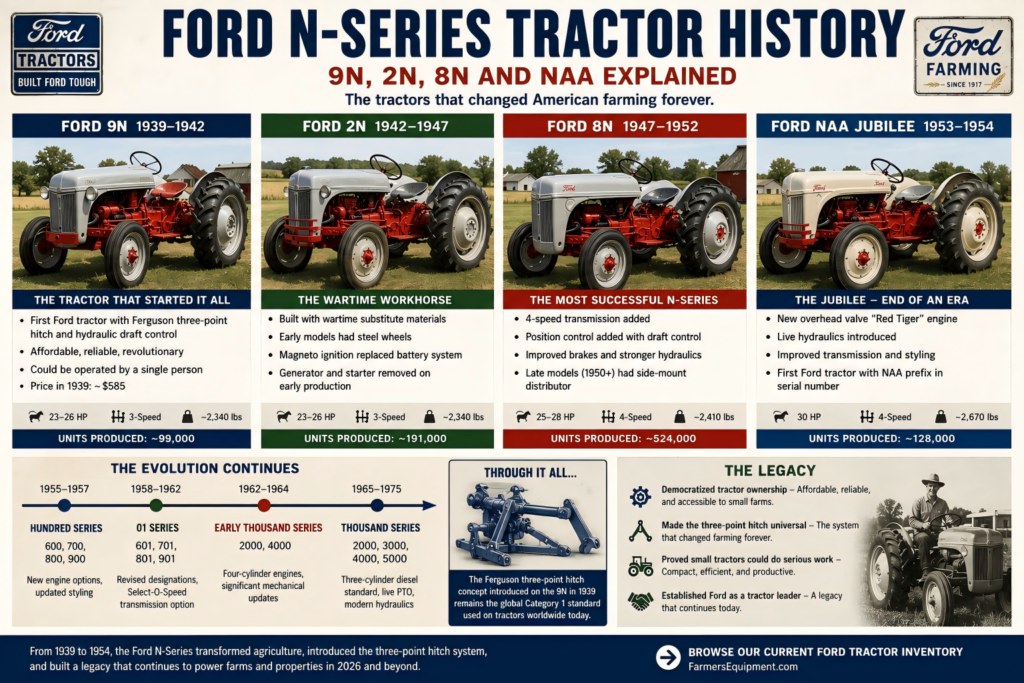
The Ford N-Series tractor history spans fifteen years and four distinct models — the 9N, 2N, 8N, and NAA Jubilee — that together transformed American farming and introduced the three-point hitch system that remains the global standard today. Understanding what changed between each model, why those changes were made, and what they mean for buyers in 2026 is essential context for anyone working with or purchasing a classic Ford tractor.
👉 Browse our current Ford tractor inventory →
Written by: Farmers Equipment editorial team — specialising in classic Ford tractors from the N-Series through the Thousand Series.
Ford N-Series Tractor History — Overview Timeline
| Model | Years | Units Produced | Key Change from Previous |
|---|---|---|---|
| Ford 9N | 1939–1942 | ~99,000 | First model — introduced Ferguson three-point hitch system |
| Ford 2N | 1942–1947 | ~191,000 | Wartime substitute materials — magneto ignition, steel wheels |
| Ford 8N | 1947–1952 | ~524,000 | 4-speed transmission, position control, side distributor (late models) |
| Ford NAA (Jubilee) | 1953–1954 | ~128,000 | New overhead valve engine — broke from N-Series flathead design |
The Ford 9N — Where It All Started (1939–1942)
The Ford 9N was introduced in June 1939 at a demonstration on Henry Ford’s Fair Lane estate in Dearborn, Michigan. It was the product of a handshake agreement between Henry Ford and Harry Ferguson — one of the most consequential partnerships in agricultural history. Ferguson brought his three-point hitch system and hydraulic draft control. Ford brought manufacturing scale and distribution. The result was a tractor that cost less than $600 and could be operated by a single person — a genuine revolution in farm mechanisation.
The 9N’s Ferguson three-point hitch used hydraulic draft control to automatically maintain consistent implement depth regardless of terrain — a feature that had never been available on a mass-market tractor at this price. It made the tractor dramatically more productive and far safer to operate than the chain-and-cable hitching systems it replaced.
Ford 9N Key Specifications
| Spec | Detail |
|---|---|
| Engine | 4-cylinder flathead, 119.7 cu in |
| HP | ~23–26 HP |
| Transmission | 3-speed manual |
| Hitch | Ferguson three-point, Category 1 |
| Electrical | 6-volt |
| Weight | ~2,340 lbs |
| Original price (1939) | ~$585 |
Production ended in 1942 when the US entered World War II and materials were redirected to the war effort. Approximately 99,000 units were built across four model years. See current Ford 9N listings →
The Ford 2N — The Wartime Tractor (1942–1947)
The Ford 2N was not a new tractor — it was a Ford 9N built with wartime substitute materials. The US War Production Board restricted the use of rubber and electrical components for civilian machinery, which forced Ford to make several changes:
- Steel wheels replaced rubber tyres on early production (rubber was restored in 1944 as restrictions eased)
- Magneto ignition replaced the battery ignition system on early models — making the tractor independent of the electrical system but requiring a hand-crank start
- Generator and starter were eliminated on early 2N production
The mechanical heart of the 2N was identical to the 9N — same flathead engine, same 3-speed transmission, same Ferguson hydraulic system. The serial number sequence continued directly from the 9N without a break (starting at 105,375), which is why distinguishing a late 9N from an early 2N requires checking the physical features rather than just the serial number.
As wartime restrictions eased in 1944 and 1945, rubber tyres, starter motors, and generators were progressively restored. By 1946–1947 production, the 2N was effectively indistinguishable from the late 9N in most respects.
Approximately 191,000 units were produced across five years — the 2N kept American farming running through the war years when new equipment was otherwise unobtainable.
The Ford-Ferguson Split — Why the 8N Looked Different
The handshake agreement between Henry Ford and Harry Ferguson had no written contract — and when Henry Ford died in 1947 and his grandson Henry Ford II took control of the company, the agreement collapsed. Ferguson sued Ford for patent infringement and damages, initiating one of the largest civil suits in US history at the time.
Ford needed to develop a new tractor that avoided Ferguson’s patents on specific implementations of the three-point hitch and draft control system. The key patents Ferguson held covered:
- Draft control — the automatic depth-sensing system that adjusted implement depth based on soil resistance
- Position control — the ability to set a fixed implement height independent of ground conditions
- Specific hydraulic control valve design — the mechanism that translated draft sensing into hydraulic lift commands
While the fundamental three-point hitch concept was not patentable, Ford had to redesign the control system on the 8N to work around Ferguson’s specific implementations. The lawsuit was eventually settled out of court in 1952 for approximately $9.25 million — one of the largest civil settlements in US history at the time.
The split had lasting consequences for the market: Ferguson went on to produce the TE20 and TO-20 in competition with Ford, and the rivalry between the Ford and Ferguson lines shaped the tractor market through the 1950s and beyond.
The Ford 8N — The Most Successful Classic Ford (1947–1952)
The Ford 8N was introduced in July 1947 — the same month Henry Ford II took over the company and terminated the Ferguson agreement. It restarted the serial number sequence at 1 and introduced several meaningful improvements over the 9N/2N:
What Changed on the Ford 8N
- 4-speed transmission replaced the 9N’s 3-speed — giving operators more flexibility across different work types and terrain
- Position control added alongside draft control — allowing the operator to set a fixed implement height rather than relying solely on draft sensing
- Improved brakes — larger brake drums improved stopping performance and independent braking for sharp turns
- Stronger hydraulic system — increased hydraulic pump capacity improved lift performance
- Redesigned hood and sheet metal — the 8N’s appearance was updated, though the fundamental silhouette remained similar to the 9N
The Distributor Change — Mid-Production
Ford made a significant running change to the 8N during production. Early 8N units (serial 1 through approximately 263,843, produced 1947 through early 1950) used a front-mount distributor. Later units (serial 263,844 onward, late 1950 through 1952) switched to a side-mount distributor. The side-mount distributor is generally considered easier to service and adjust. This change affects ignition parts ordering and timing procedure — always confirm which distributor your specific 8N carries before purchasing ignition components.
Ford 8N Key Specifications
| Spec | Detail |
|---|---|
| Engine | 4-cylinder flathead, 119.7 cu in |
| HP | ~25–28 HP |
| Transmission | 4-speed manual |
| PTO | Transmission-driven 540 RPM (not live PTO) |
| Hydraulic system | Ferguson three-point system (non-live) |
| Electrical | 6-volt (many converted to 12-volt) |
| Weight | ~2,410 lbs |
| Total produced | ~524,000 units |
The 8N became the best-selling two-plow tractor in US history. Its combination of the Ferguson hydraulic system, improved transmission, and accessible price made it the machine of choice for small and medium farms across America through the early 1950s. See current Ford 8N listings →
The Ford NAA (Jubilee) — End of the N-Series Era (1953–1954)
The Ford NAA — known as the Jubilee — was introduced in 1953 to mark Ford’s 50th anniversary in the tractor business. It represented the end of the N-Series lineage in a fundamental way: the Jubilee abandoned the flathead engine that had powered every Ford tractor since 1939 and introduced a new overhead valve (OHV) engine.
What Changed on the NAA
- New overhead valve engine — the Red Tiger 134 cu in OHV engine replaced the flathead. The OHV design runs cooler, breathes better, and is more efficient than the flathead it replaced
- Live hydraulics introduced — the NAA was the first Ford tractor with a truly live hydraulic pump that operated independently of the transmission and clutch. This was a significant practical improvement over the N-Series non-live system
- Improved transmission — 4-speed with improved gear ratios
- NAA prefix in serial number — the first Ford tractor with a letter prefix in the serial number, making identification straightforward
- Updated styling — the Jubilee’s hood and sheet metal were updated to a more modern profile
The NAA is not parts-compatible with the N-Series in most respects — the different engine, hydraulic system, and improved components mean N-Series parts generally do not interchange with the Jubilee. Buyers who own an NAA should source parts specifically for that model rather than assuming N-Series compatibility.
Approximately 128,000 units were produced in two model years before Ford moved to the Thousand Series (3000, 4000, 5000) in 1955. Full NAA production specifications are documented at TractorData.com →
How the N-Series Changed American Farming
The Ford N-Series impact on American agriculture between 1939 and 1954 is difficult to overstate:
- Democratised tractor ownership — at under $600 in 1939, the 9N was affordable to small farms that could not justify a larger, more expensive machine. The price dropped the barrier to mechanisation by an order of magnitude
- Made the three-point hitch universal — the Ferguson system implemented on the 9N eventually became the global Category 1 standard. Every three-point hitch tractor produced anywhere in the world today traces its lineage to the Ferguson-Ford agreement of 1939
- Proved that small tractors could do serious work — before the N-Series, the prevailing view in American agriculture was that larger was always better. The N-Series demonstrated that a compact, lightweight tractor with intelligent hydraulic implement control could outperform much heavier machines on most farm tasks
- Established Ford as a tractor manufacturer — despite Henry Ford’s earlier Fordson tractor (1917–1928), it was the N-Series that established Ford’s long-term presence in the tractor market that continued through the New Holland acquisition decades later
N-Series vs Thousand Series — What Came Next
After the NAA Jubilee, Ford’s tractor line evolved through several distinct series before arriving at the familiar Thousand Series:
| Years | Series | Models | Key Change |
|---|---|---|---|
| 1955–1957 | Hundred Series | 600, 700, 800, 900 | New engine options, updated styling from NAA |
| 1958–1962 | 01 Series | 601, 701, 801, 901 | Revised designations, Select-O-Speed transmission option |
| 1962–1964 | Early Thousand Series | 2000, 4000 | Four-cylinder engines, significant mechanical updates |
| 1965–1975 | Thousand Series | 2000, 3000, 4000, 5000 | Three-cylinder diesel standard, live PTO, modern hydraulics |
Throughout all these transitions, the fundamental Ferguson three-point hitch concept introduced on the 9N in 1939 remained at the core of every machine. The Category 1 hitch standard it established is still used on tractors worldwide today.
For buyers considering a Thousand Series machine: Ford 3000 · Ford 4000 · Ford 5000
Why the Ford N-Series Still Matters in 2026
Even though the newest Ford 8N is now over 70 years old, the N-Series remains one of the most commonly restored and actively used vintage tractor families in North America. Several factors explain why:
- Unmatched aftermarket parts support — the 8N’s 524,000-unit production run created a parts ecosystem that has never dried up. In 2026, virtually every mechanical component is still available new from multiple suppliers
- Simple mechanics — the flathead engine, 4-speed transmission, and hydraulic system are among the most DIY-friendly of any tractor ever built. No electronics, no specialist tools, no dealer dependency for most maintenance
- Universal implement compatibility — the Category 1 three-point hitch introduced on the 9N in 1939 is now the global standard. Every Category 1 implement built anywhere in the world over the past 80 years connects directly to a classic Ford N-Series tractor
- Accessible pricing — a good working Ford 8N remains available for $2,500–$4,500, making it one of the most affordable entry points into tractor ownership for hobby farms and small properties
- Strong community — the Ford 8N and 9N have one of the largest and most active online enthusiast communities of any classic tractor, providing free advice, parts sourcing help, and restoration guidance
Which N-Series Ford Should You Buy in 2026?
| Model | Best For | Main Advantage | Main Limitation |
|---|---|---|---|
| Ford 9N | Collectors, light use, historical interest | First model — collector appeal, simpler 3-speed | Lower HP, 3-speed only, fewer parts than 8N |
| Ford 2N | Collectors — particularly wartime examples | Historical significance, original wartime features | Early models with steel wheels and magneto are restoration projects |
| Ford 8N | Working tractor — best all-round N-Series | Most parts available, 4-speed, best used market | No power steering, non-live PTO, 27 HP limit |
| Ford NAA | Buyers who want OHV engine and live hydraulics | Better engine, live hydraulics — most capable N-era Ford | Not parts-compatible with N-Series, less common |
For most buyers who want a working classic Ford tractor, the Ford 8N is the practical choice — widest parts availability, best used market, and the most capable of the true N-Series machines. For collectors interested in the earliest Ford tractor history, the Ford 9N is the more historically significant machine.
Before purchasing any classic Ford, read our Used Ford Tractor Inspection Checklist → and confirm the model year using our Ford Tractor Serial Numbers guide →
The Legacy of the Ford N-Series
The influence of the Ford N-Series on modern agriculture is not historical — it is structural. The Category 1 three-point hitch system introduced on the Ford 9N in 1939 is still the global standard for compact and utility tractor implement attachment. Every time a farmer attaches a box blade, rotary cutter, or tiller to a tractor anywhere in the world, they are using a system whose fundamental design traces directly to the Ferguson-Ford agreement of 1939.
The N-Series also proved that small, affordable, mechanically simple tractors could replace both animal power and larger machines on most farm tasks — a principle that shaped the entire compact tractor market that followed, from the Japanese imports of the 1960s and 1970s to the modern sub-compact tractors popular with hobby farmers today.
Historical production figures referenced from Ford Motor Company archives, Nebraska Tractor Test Laboratory records, and TractorData.com. Specification data cross-referenced with original Ford operator manuals.
How to Identify Ford N-Series Tractors
Identifying which N-Series Ford you have — and what year it was built — requires checking the serial number plate and several physical features. The serial number alone is not always sufficient because the 9N and 2N serial sequences overlap in the same range.
How to Tell an 8N from a 9N Tractor
| Feature | Ford 9N / 2N | Ford 8N |
|---|---|---|
| Serial number prefix | No prefix — number only (e.g. 9N12345 on plate, or just 12345) | Starts with 8N (e.g. 8N12345) |
| Transmission | 3-speed | 4-speed — shift pattern on top of gearbox |
| Hydraulic control | Draft control only | Draft control + position control (two levers) |
| Distributor location | Front of engine | Front (early) or side (late — serial 263,844+) |
| Hood decals | “Ford” script only | “Ford 8N” on hood sides |
| Brake pedals | One pedal on left | Two separate brake pedals |
| HP (approximate) | ~23–26 HP | ~25–28 HP |
| Production years | 9N: 1939–1942 / 2N: 1942–1947 | 1947–1952 |
The fastest visual identification: count the gears. A 3-speed gearbox means 9N or 2N. A 4-speed means 8N. The brake pedal configuration confirms it — one left-side pedal on 9N/2N, two separate pedals on 8N.
What Is the Difference Between a Ford 2N and Ford 8N?
The 2N and 8N look similar at a glance but differ significantly in specification. The 2N used the same 3-speed transmission and draft-control-only hydraulics as the 9N. The 8N introduced a 4-speed transmission, position control alongside draft control, improved brakes with two separate pedals, and a stronger hydraulic system. The 8N is the more capable working tractor in almost every practical situation — the 2N’s main appeal is historical (particularly early wartime examples with steel wheels and magneto).
How to Identify the Year of a Ford 8N Tractor
The Ford 8N serial number identifies the production year. Serial numbers ran sequentially from 1 (1947) to 524,076 (1952):
| Year | Serial Number Range (approximate) | Key Identifier |
|---|---|---|
| 1947 | 8N1 – 8N37,908 | Front distributor, original hood script |
| 1948 | 8N37,909 – 8N141,369 | Front distributor |
| 1949 | 8N141,370 – 8N245,636 | Front distributor |
| 1950 | 8N245,637 – 8N343,592 | Side distributor introduced mid-year (~263,844) |
| 1951 | 8N343,593 – 8N442,034 | Side distributor standard |
| 1952 | 8N442,035 – 8N524,076 | Final production year |
The serial number plate is located on the engine block, visible from the left side of the tractor. For complete serial number documentation, TractorData.com lists full year-by-year production ranges for all classic Ford models.
How Much Is a Ford 8N Worth Today?
Ford 8N values in 2026 vary significantly by condition:
| Condition | Price Range | Description |
|---|---|---|
| Non-running / parts | $500–$1,200 | Engine issues, seized, or incomplete |
| Running — rough | $1,200–$2,200 | Runs and drives but needs work — worn tyres, leaks, cosmetic issues |
| Running — good working condition | $2,500–$4,000 | Good mechanical condition, works as expected — most used market examples |
| Restored — driver quality | $4,000–$6,500 | Repainted, mechanically rebuilt, new tyres — shows well and works reliably |
| Fully restored — show quality | $7,000–$12,000+ | Concours or near-concours restoration — correct colours, correct decals, original specifications |
The most common price range for a working Ford 8N in honest used condition is $2,500–$4,000. Factors that push the price up: recent engine work with receipts, new tyres, side-mount distributor conversion, and documented restoration. Factors that push the price down: blue exhaust smoke (worn rings), hydraulic drift (worn lift cover), cracked or dry-rotted tyres, missing or incorrect parts.
What Is a Ford Jubilee Tractor Worth?
The Ford NAA Jubilee trades at a slight premium over the 8N in most markets due to its overhead valve engine, live hydraulics, and lower production volume (~128,000 units vs ~524,000 for the 8N). Typical 2026 price ranges: running/working condition $3,000–$5,500; restored driver quality $5,500–$8,500; show quality restoration $9,000–$15,000+. The Jubilee’s live hydraulics make it practically more capable than any N-Series machine for most work applications.
What Is the Rarest Ford Tractor Ever Built?
Several Ford tractor models and variants are considered genuinely rare:
- Ford 9N with aluminum hood and grille (1939–1940) — the earliest 9N production used aluminium for the hood, grille, and instrument panel. These were replaced with cast iron as production ramped up. Original aluminium-hooded 9N tractors in unrestored condition are among the most collectible N-Series examples
- Ford 2N with original steel wheels and magneto (1942–1944) — wartime production with unrestored steel wheels and original magneto ignition are uncommon survivors. Most have been converted to rubber tyres and battery ignition
- Ford 6000 Commander (1961–1967) — Ford’s first 6-cylinder tractor with a Select-O-Speed transmission, produced in relatively low numbers and plagued by transmission problems at launch. Well-sorted examples are uncommon
- Ford FW Series (1977–1982) — Ford’s largest 4WD articulated tractors, produced in partnership with Steiger. Very large, very rare, and highly collectible in restored condition
For the N-Series specifically: original, unrestored, fully correct early 9N examples with aluminium components intact are the rarest and most valuable of the N-Series family.
What Was the Biggest Ford Tractor Ever Made?
The largest tractors to carry the Ford name were the Ford FW Series — articulated 4WD machines produced between 1977 and 1982 in partnership with Steiger Manufacturing. The FW-60 at the top of the range produced 335 HP and weighed over 30,000 lbs. These were among the largest agricultural tractors available from any manufacturer at the time.
Within the more familiar utility tractor range, the Ford TW-35 (1983–1990) produced 170 HP and was the largest conventional (non-articulated) tractor in Ford’s mainstream range before the New Holland era.
What Was Ford’s Last Tractor?
Ford’s tractor division was sold to Fiat in 1991, which merged it with New Holland to create New Holland Agriculture. The last tractors to carry the Ford name were produced in the early 1990s before the New Holland branding was fully transitioned. The Ford 8340 and 8240 Series (1991–1993) were among the final models badged as Ford before the complete transition to New Holland. Ford has not manufactured tractors since the New Holland acquisition — the brand name lives on only in the used market for pre-1991 machines.
What Is Considered the Best Ford Tractor Ever Made?
For independent used Ford tractor pricing, TractorHouse.com lists current sales across all models. Opinion divides by era and purpose, but three models consistently appear in discussions of the best Ford tractor ever built:
| Model | Claim to “Best” | Era |
|---|---|---|
| Ford 8N | Most produced, most parts available, most practical classic Ford — the machine that defined the category | 1947–1952 |
| Ford 4000 (Thousand Series) | Best balance of power, reliability, and practicality in the classic utility range — 3-cylinder diesel, live PTO, manageable size | 1965–1975 |
| Ford 5000 | Most powerful Thousand Series — 65 HP, strong hydraulics, still widely used on working farms today | 1965–1975 |
The Ford 8N is most often cited as the most famous and most significant Ford tractor — not necessarily the most capable, but the machine that proved the concept and set the template for everything that followed. For a working utility tractor, the Ford 4000 and Ford 5000 are more capable machines for real farm work.
Which is Better — 8N or 9N Ford Tractor?
For a working tractor: the 8N is better in almost every practical way. 4-speed transmission (vs 3-speed), position control hydraulics (vs draft control only), two separate brake pedals (vs one), stronger hydraulic system, and slightly more HP. The 9N has collector appeal as the original and historical significance as the first Ferguson system Ford — but if you need a machine that works, buy the 8N.
How Much HP Does a Ford 8N Have?
The Ford 8N produces approximately 25–28 HP at the belt (Nebraska Tractor Test figures). PTO HP is approximately 20–23 HP. These figures vary slightly by production year and engine condition. The 8N is rated as a 2-plow tractor — appropriate for implements sized to that capacity. Running oversized implements (3-bottom ploughs, large brush hogs) consistently overloads the engine and accelerates wear.
What Is the Most Famous Ford Tractor?
The Ford 8N — the best-selling two-plow tractor in US history with over 524,000 units produced. Its combination of the Ferguson three-point hitch, 4-speed transmission, and accessible price made it the dominant small farm tractor of the late 1940s and early 1950s. The 8N is also the most widely restored and collected classic tractor in North America — its parts availability, mechanical simplicity, and historical significance ensure it remains the most recognised Ford tractor name in 2026.
What Is Considered the Best Tractor of All Time?
No single answer — depends heavily on era, purpose, and market. The most commonly cited candidates:
| Tractor | Case For |
|---|---|
| Ford 8N | Most produced classic tractor, introduced the three-point hitch standard, transformed small farm mechanisation |
| Massey Ferguson 35 / 135 | Most widely used utility tractor globally through the 1960s–1980s — built in largest numbers of any utility model worldwide |
| John Deere 4020 | Most beloved American row-crop tractor — introduced power shift transmission, defined John Deere’s golden era |
| Fendt Vario series | Introduced the continuously variable transmission to mainstream agriculture — highest engineering standard in modern tractors |
| Fordson Model F | First mass-produced tractor (1917) — made tractor ownership possible for ordinary farmers |
In terms of historical impact on global agriculture: the Ford 9N/8N (introduced the three-point hitch standard) and the Fordson Model F (first mass-produced tractor) are the two most significant single models. See our Massey Ferguson tractors for sale and Fendt tractors for sale.
Which Ford Engine Lasts the Longest — and Which to Avoid?
Which Ford Engine Lasts the Longest?
In the tractor context: the Ford 3-cylinder diesel engines used in the Thousand Series (3000, 4000) have a strong reputation for longevity — simple design, robust bottom end, and widespread parts availability. These engines routinely reach 5,000–8,000+ hours with consistent maintenance on well-maintained working tractors. The Ford 8N flathead is also remarkably durable when properly maintained and not overloaded — many examples are still running on original or once-rebuilt engines after 70+ years.
Which Ford Engine to Stay Away From?
- Ford 6000 Select-O-Speed transmission (not the engine specifically) — the 6-cylinder engine in the 6000 is sound; the Select-O-Speed 10-speed transmission that came with it was notoriously problematic at launch and expensive to rebuild. Avoid 6000 tractors where the transmission has not been addressed
- Any N-Series engine that has been run with neglected oil or overloaded — the flathead design is not the problem; deferred maintenance is. Blue smoke at temperature and low compression are the warning signs on any N-Series engine regardless of hours
- High-compression modified 8N engines without supporting cooling upgrades — some aftermarket modifications increase compression on the flathead to compensate for low HP. Without cooling system upgrades, these run hot and shorten engine life
Frequently Asked Questions
What is the Ford N-Series tractor?
The Ford N-Series refers to the family of Ford tractors produced between 1939 and 1952 — the 9N (1939–1942), 2N (1942–1947), and 8N (1947–1952). They share a common flathead engine design, the Ferguson three-point hitch system, and a similar overall layout. The NAA Jubilee (1953–1954) is sometimes included in the N-Series lineage though it introduced a new OHV engine and live hydraulics.
What is the difference between the Ford 9N and 8N?
The Ford 8N improved on the 9N in three key areas: 4-speed transmission (vs 3-speed), position control added alongside draft control, and improved brakes. The 8N also has slightly more HP (~27 vs ~25) and a stronger hydraulic system. For a working tractor, the 8N is the more capable machine in almost every practical situation.
Why is the Ford 8N so popular?
The Ford 8N is the most produced classic Ford tractor — over 524,000 units built between 1947 and 1952. That production volume created the broadest parts availability of any classic tractor on the market. Combined with mechanical simplicity, the Ferguson three-point hitch, and an accessible price on the used market, the 8N remains the most practical classic tractor for small farm and hobby farm use in 2026.
What is the Ford NAA Jubilee tractor?
The Ford NAA Jubilee was produced in 1953 and 1954 to mark Ford’s 50th anniversary in the tractor business. It introduced a new overhead valve engine (the Red Tiger), live hydraulics, and updated styling — ending the flathead N-Series design lineage. The NAA is not parts-compatible with the 9N/8N and should be treated as a separate model for parts sourcing purposes.
When did Ford stop making the N-Series tractor?
The true N-Series (flathead engine, non-live hydraulics) ended with the Ford 8N in 1952. The NAA Jubilee followed in 1953–1954 with a new engine and live hydraulics. Ford then moved to the Hundred Series in 1955 and later the Thousand Series (3000, 4000, 5000) in the 1960s — all of which retained the three-point hitch but with progressively more modern mechanicals.