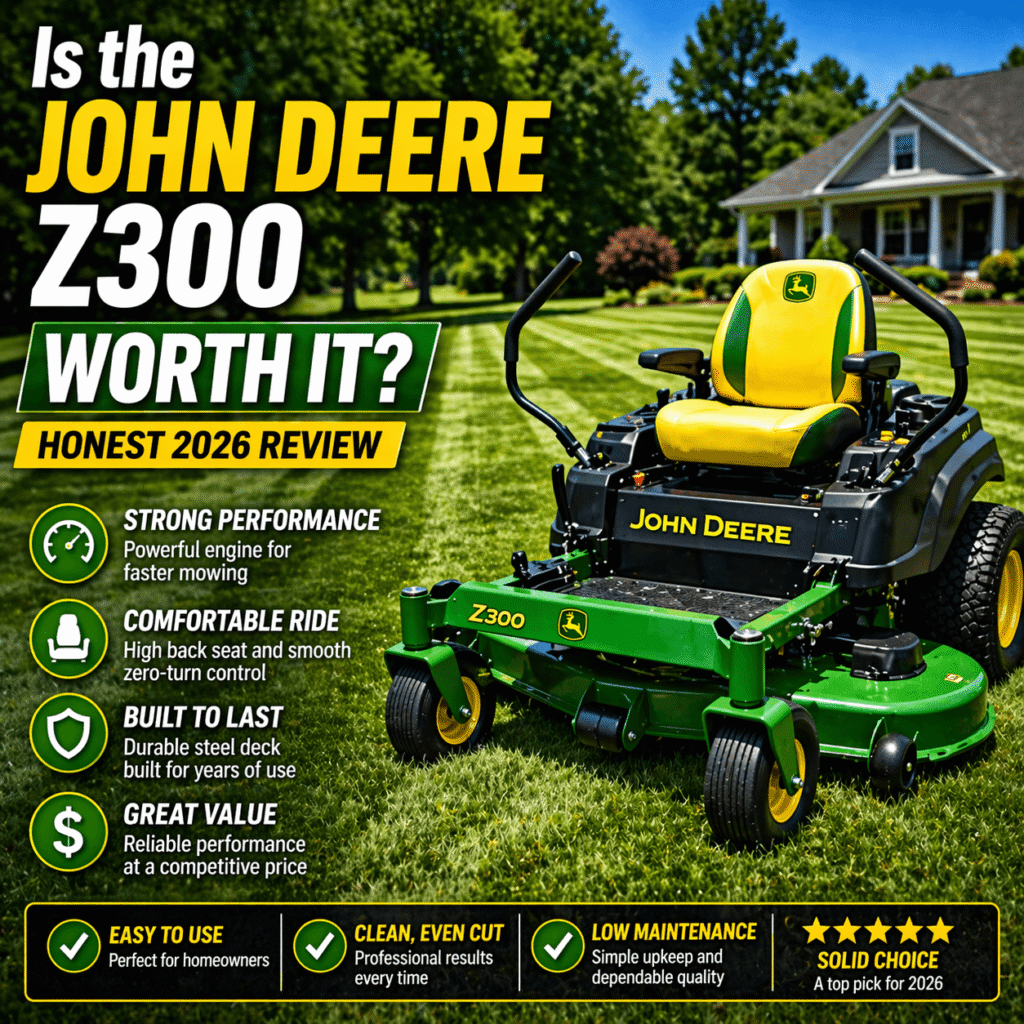
The John Deere Z300 is one of the most recommended residential zero-turn mowers — and one of the most misunderstood. Is the John Deere Z300 worth it in 2026? For buyers who value cut quality, resale value, and dealer support — yes. For buyers chasing the strongest transmission or the lowest price — it’s the wrong machine. The Z300 costs more than most residential competitors and doesn’t have the drivetrain of the Ariens IKON XD. What it does have is the strongest resale in its class, one of the cleanest cutting decks available, and a dealer network that makes ownership easier than most alternatives.
We’ve sold enough Z300s to know who leaves happy and who wishes they’d bought something else. Here’s the honest version.
John Deere Z300 Pros and Cons
| ✅ Pros | ⚠️ Cons |
|---|---|
| Best resale value in residential zero-turn class | Higher new price than Husqvarna and Ariens alternatives |
| Accel Deep™ deck — consistently clean cut finish | EZT transmission lighter than ZT-2800 systems |
| Widest dealer network nationally | Not suited to regular towing or attachments |
| Strong parts availability and service access | No suspension option — standard seat only |
| 3-year bumper-to-bumper residential warranty | Overkill price for buyers who don’t care about resale |
Quick Comparison — Z300 vs Alternatives
| Model | Best For | Key Advantage |
|---|---|---|
| John Deere Z300 Series | Resale + cut quality | Strongest residuals in residential class |
| Husqvarna Z254 | Cutting performance | 26 HP Kohler + lower new price |
| Ariens IKON XD | Drivetrain durability | ZT-2800 — stronger under sustained load |
| Toro TimeCutter | Operator comfort | MyRIDE suspension — nothing comparable |
John Deere Z300 Series — Quick Specs
| Spec | Detail |
|---|---|
| Deck options | 42″, 48″, 54″ Accel Deep™ |
| Engine | 22–25 HP Kawasaki or Briggs & Stratton |
| Transmission | Hydro-Gear EZT (residential grade) |
| Ground speed | Up to 7 mph |
| Warranty | 3-year/300-hour bumper-to-bumper |
| New price | $3,200–$4,200 |
| Used from | ~$2,500 (clean, 2–4 years old) |
The John Deere Z300 Series is John Deere’s residential zero-turn lineup — available in 42″, 48″, and 54″ Accel Deep™ deck configurations with 22–25 HP engines. It sits above the entry-level E100 riding mowers and below the commercial ZTrak lineup. For most residential buyers, it’s the machine that costs more than the alternatives and justifies that premium through resale value, cut quality, and dealer access rather than outright mechanical superiority.
New price: $3,200–$4,200 depending on configuration. Used: typically $2,500–$3,500 for a clean 2–4 year old example. Across 2024–2026 listings on TractorHouse, clean Z300 units under 300 hours with service history consistently list at 60–70% of original MSRP — versus 45–60% typically seen for Husqvarna, Toro, and Ariens machines at the same age and hours.
The most common complaint we see: buyers who try to mow 4+ acres regularly with an EZT transmission. It’s not built for that workload — and when the machine starts showing wear early, it’s almost always because someone pushed it past its residential design limits. The most common positive surprise: how easy the machine is to service and how well it holds its price when it’s time to sell.
John Deere Z300 Pros — What It Does Well
Accel Deep™ deck — genuinely better cut quality
The Accel Deep™ deck is the feature that most owners mention when asked what they like about the Z300. The deeper deck chamber creates stronger airflow that lifts grass before cutting — producing a cleaner, more consistent finish than most residential alternatives, particularly at higher ground speeds. On a well-maintained residential lawn, the difference between Z300 cut quality and a standard fabricated deck is visible. It’s not dramatic, but buyers who care about how the lawn looks after — not just how fast it’s done — notice it.
Resale value — the clearest competitive advantage
Among the strongest resale values in the residential zero-turn segment. A clean Z300 at 3–4 years with documented service history sells quickly and commands a premium. For buyers who plan to upgrade in a few years, the higher purchase price typically pays back at resale — making the Z300 as much a financial decision as a mowing one.
Dealer network and parts access
John Deere’s dealer network is the widest of any equipment brand nationally. For residential buyers, this means warranty work is straightforward, parts are stocked locally, and you’re not waiting weeks for a replacement spindle in peak mowing season. The Kohler and Kawasaki engines used across the Z300 lineup are both independently serviced platforms — independent shops know them, which keeps maintenance costs competitive.
3-year bumper-to-bumper warranty
The Z300 comes with a 3-year/300-hour bumper-to-bumper residential warranty — one of the stronger warranties in the residential segment. On a machine at this price point, that coverage matters.
John Deere Z300 Problems — What It Doesn’t Do Well
EZT transmission — the main mechanical limitation
The Hydro-Gear EZT handles normal weekly residential mowing well — it’s the same unit found on most competitors in this price range. Where it falls short: sustained heavy load, regular towing, or properties above 4 acres mowed multiple times per week. The Ariens IKON XD’s ZT-2800 is the stronger drivetrain for those use cases. For standard residential use this limitation rarely surfaces.
No suspension option
The Z300 runs a standard seat with no suspension system. On smooth, well-maintained residential turf this isn’t a problem. On properties with any undulation or bumpy terrain, sessions over 45–60 minutes show it. The Toro TimeCutter’s MyRIDE suspension is the clear winner for operator comfort — if that’s your priority, the Z300 isn’t the right machine.
Price premium over competitors
At $3,200–$4,200 new, the Z300 is $400–$1,000 more than the Husqvarna Z254 and Ariens IKON XD for comparable configurations. The premium is justified by resale and cut quality — for buyers who plan to keep the machine indefinitely and don’t prioritise either, those alternatives are the better value purchase.
What Goes Wrong — Real Ownership Costs
- Drive belt ($30–$60 part) — expected after 3–5 years of regular use. Straightforward DIY replacement; dealer labour adds $80–$120
- Deck spindle bearings ($40–$70 each) — shows up after 200–300 hours as grinding or vibration from the deck. Catch it early — a spun bearing that damages the spindle housing is a significantly more expensive repair
- Battery ($60–$90) — stock batteries typically last 2–4 seasons. Replace proactively on machines stored through winter
- Blade sets ($25–$50) — sharpen or replace once per season. The Accel Deep™ deck produces its best cut with sharp blades — quality drops noticeably when blades are dull
Budget $100–$200 per year for routine maintenance. Nothing unusual for a machine in this category — and consistent maintenance is what keeps the used value high when it’s time to sell.
John Deere Z300 vs Husqvarna Z254, Ariens IKON XD, and Toro TimeCutter
| Model | Transmission | Suspension | Best For | Resale |
|---|---|---|---|---|
| John Deere Z300 | EZT | None | Cut quality + resale | ⭐⭐⭐⭐⭐ |
| Ariens IKON XD | ZT-2800 | None | Drivetrain durability | ⭐⭐⭐ |
| Toro TimeCutter | EZT | MyRIDE available | Operator comfort | ⭐⭐⭐ |
| Husqvarna Z254 | EZT | None | HP + lower price | ⭐⭐⭐ |
Z300 vs Husqvarna Z254: the Z254 has more HP (26 vs 22–25) and costs less new. The Z300 has better cut quality and stronger resale. Keeping it long-term — Z254. Selling in 3–5 years — Z300 typically pays back the difference. Full comparison: Husqvarna Z254 vs Toro TimeCutter →
Z300 vs Ariens IKON XD: the IKON XD has a stronger ZT-2800 transmission and costs less. The Z300 has better resale and a finer cut finish. Heavy use or frequent mowing — IKON XD. Cut quality and resale — Z300.
Z300 vs Toro TimeCutter: the TimeCutter wins on comfort (MyRIDE) and deck range. The Z300 wins on cut quality and resale. Long mowing sessions — TimeCutter. Investment value — Z300.
Who Should Buy the John Deere Z300
- ✅ Plan to sell or upgrade in 3–5 years — resale is the Z300’s clearest advantage
- ✅ Care about cut finish quality — Accel Deep™ deck produces the best residential cut in this class
- ✅ Want the widest dealer and parts network nationally
- ✅ Mowing 1–4 acres on a standard residential schedule
- ✅ Buying used — clean Z300s at 2–4 years are among the best used residential purchases available
Who Should Skip It
- ❌ Want the strongest transmission — choose the Ariens IKON XD
- ❌ Mow for 60+ minutes and want operator comfort — choose the Toro TimeCutter with MyRIDE
- ❌ Want the lowest new price — choose the Husqvarna Z254
- ❌ Plan to keep the machine indefinitely and don’t care about resale — the premium is harder to justify
- ❌ Hilly yard above 15° — choose the Cub Cadet XT1
Best by Scenario
| Your Situation | Verdict |
|---|---|
| Buying new, plan to resell in 3–5 years | ✅ Z300 — buy it |
| Buying used, want best value | ✅ Z300 used — strong market, predictable pricing |
| Want maximum HP and lower price | ⚠️ Husqvarna Z254 is the better choice |
| Mow 4–5 acres frequently | ⚠️ Ariens IKON XD — stronger transmission |
| Comfort priority, long sessions | ⚠️ Toro TimeCutter with MyRIDE |
| Commercial daily use | ❌ Look at Scag or Exmark |
New vs Used — What’s the Right Call?
Buying new
At $3,200–$4,200 new, the Z300 is the most expensive residential zero-turn on this list. The 3-year warranty and resale advantage justify that premium for buyers who plan to upgrade. Keeping it indefinitely? The Ariens IKON XD or Husqvarna Z254 offer better value per dollar at purchase.
Buying used
A used Z300 in good condition is one of the stronger purchases in the residential mower market. Sellers price them accordingly — but you’re also buying a machine that was maintained because the owner knew it was worth maintaining. Key checks: deck condition, belt wear, spindle bearing smoothness, and service history. A machine with dealer service stamps is worth more and worth paying for.
Verdict — Is the John Deere Z300 Worth It?
Is the John Deere Z300 worth it? Yes — for the right buyer. If you care about cut quality, plan to sell in a few years, and want the easiest ownership experience in the residential segment, the Z300 earns its premium. The Accel Deep™ deck, national dealer coverage, and the strongest resale in the class make it the machine that holds up both in the yard and on the used market.
Blunt close: if you’re mowing under 4 acres and care about resale — buy it. If you’re mowing harder or longer than that, don’t. It’s the wrong machine for that workload, and the Ariens IKON XD or a used commercial machine will serve you better.
See current listings: John Deere Z300 — new and used available
Frequently Asked Questions
Is the John Deere Z300 a good mower?
Yes — for residential use on 1–4 acres it’s one of the strongest options in its class. The Accel Deep™ deck produces a cleaner cut finish than most residential alternatives, the dealer network is the widest nationally, and the resale value is the best in the segment. The main limitations are the EZT transmission under heavy load and the price premium over competitors.
How long does the John Deere Z300 last?
A well-maintained Z300 commonly reaches 500–1,000+ hours before needing significant work — though actual lifespan varies significantly with maintenance consistency. Belt changes on schedule, keeping the deck clean, and not pushing the machine beyond its residential design limits are the biggest factors.
What are common John Deere Z300 problems?
The most common issues are drive belt wear after 3–5 years of regular use, deck spindle bearing wear after 200–300 hours, and battery failure on machines stored without a trickle charger through winter. These are routine residential mower maintenance items — not specific Z300 defects.
Is the John Deere Z300 worth the extra money over the Husqvarna Z254?
Depends on what you value. The Z254 has more HP (26 vs 22–25) and costs $400–$1,000 less new. The Z300 has a better cut finish and significantly stronger resale. If you’re keeping the machine — Z254 is better value. If you’re selling in 3–5 years — the Z300 typically pays back the price difference at resale.
What is the best alternative to the John Deere Z300?
The Ariens IKON XD for buyers who want a stronger drivetrain at a lower price. The Toro TimeCutter for buyers who want operator comfort. The Husqvarna Z254 for buyers who want maximum HP at the lowest new price. Each covers a different priority that the Z300 doesn’t lead on.