Is Toro TimeCutter worth it in 2026? For most residential buyers — yes. But the TimeCutter is not the right machine for everyone, and this review explains exactly who should buy it and who should look elsewhere. If you’re choosing between comfort and long-term durability, most reviews don’t explain that trade-off clearly. This one does.
We’ve sold a lot of TimeCutters. The buyers who come back happy bought it for the right reasons. The ones who didn’t usually needed more transmission durability or a higher HP ceiling — and this review explains exactly where that line is.
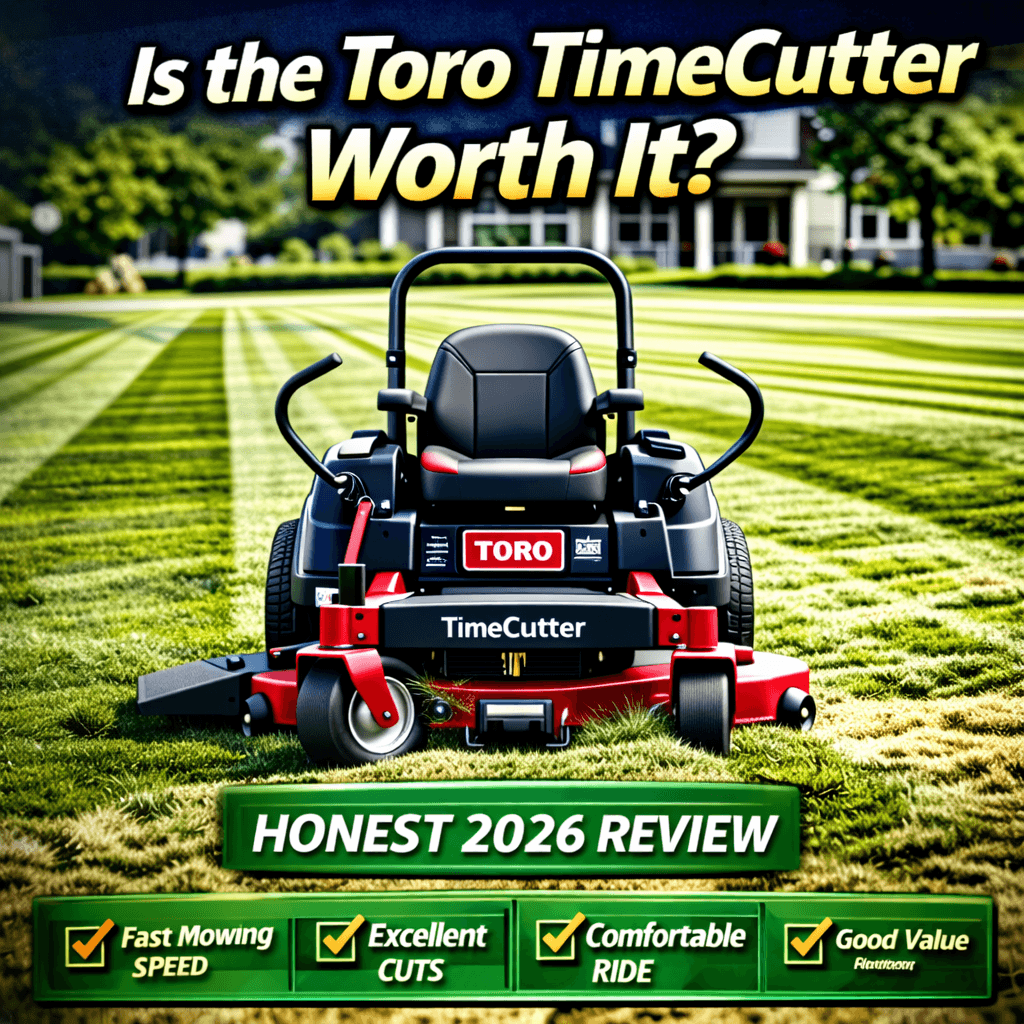
Toro TimeCutter Pros and Cons
| ✅ Pros | ⚠️ Cons |
|---|---|
| MyRIDE suspension — best operator comfort in class | EZT transmission limits heavy use and towing |
| Wide deck range (42″–75″) — fits any residential yard | MyRIDE costs $200–$400 extra — not standard |
| Smart Speed system — safer for beginners | Lower HP (22–24.5) than Husqvarna Z254 (26 HP) |
| Strong used market — predictable pricing | Not suited to rough terrain or sustained towing |
| 3-year residential warranty | Resale not as strong as John Deere Z300 Series |
| Model | Best For | Key Advantage |
|---|---|---|
| Toro TimeCutter | Comfort + flexibility | MyRIDE suspension — only option in this class |
| Husqvarna Z254 | Cutting performance | 26 HP Kohler + fabricated 54″ deck |
| Ariens IKON XD | Heavy-duty use | ZT-2800 transmission — stronger drivetrain |
| John Deere Z300 Series | Resale value | Strongest residuals in residential zero-turn class |
What the Toro TimeCutter Actually Is
The Toro TimeCutter is manufactured by The Toro Company — a US brand with over 100 years in outdoor power equipment. It’s a residential zero-turn available in 42″–75″ deck configurations with 22–24.5 HP Kawasaki or Kohler engines. The standout feature across the lineup is the MyRIDE full-body suspension system, available on select models — the one feature that genuinely differentiates this machine from most competitors at the same price.
New price: $2,600–$3,500 depending on deck size and whether you opt for MyRIDE. Used: typically $1,800–$2,400 for a clean 2–4 year old example in good condition.
Toro TimeCutter Pros — What It Does Well
MyRIDE suspension — the real differentiator
The MyRIDE system is a full-body suspension platform that isolates the operator from ground vibration and bumps during mowing. On a smooth suburban lawn the difference is subtle. On anything with minor undulations, uneven turf, or hard ground, the difference after 45–60 minutes of mowing is genuinely noticeable. Buyers who mow for an hour or more and have had back issues consistently rate this as the feature they’d pay for again.
No other machine in the $2,600–$3,500 residential range offers a comparable suspension system. The Husqvarna Z254 and Ariens IKON XD both run standard seats with no suspension — which is fine for shorter sessions but shows up on longer ones.
Deck size flexibility
The 42″–75″ range is the widest of any residential zero-turn brand at this price point. Most buyers land on the 50″ for 1–2 acre properties — it’s the sweet spot. But having the option to go up to 60″ or 75″ for larger properties, or down to 42″ for tighter yards, means the TimeCutter fits more situations than a single-deck machine like the Z254.
Smart Speed control
The three-speed Smart Speed system lets operators set a maximum ground speed — useful for new users learning zero-turn steering, and genuinely helpful when mowing near flower beds or obstacles where control matters more than speed. Most zero-turns are full speed or nothing. This one lets you dial it back deliberately.
Proven long-term reliability
The TimeCutter has been a residential bestseller for over a decade. Based on used market listing volume on platforms like TractorHouse, these machines show up regularly with documented service history — which reflects a machine that owners maintain and keep running, not one they give up on. The Kawasaki FR651V and Kohler 7000 Series engines used across the lineup are both widely serviced platforms.
What the TimeCutter Doesn’t Do Well
Base transmission is lighter than competitors
This is the most important limitation to understand. Base TimeCutter models use a dual hydrostatic EZT transmission — a non-serviceable, maintenance-free unit that works well for normal weekly residential mowing. What it doesn’t handle as well: towing attachments, rough or heavily sloped terrain under sustained use, or being pushed hard several days a week. For that kind of use, the Ariens IKON XD’s ZT-2800 transmission is a meaningful step up. For normal once-a-week homeowner use, the EZT is fine.
HP is lower than the Husqvarna Z254
The base TimeCutter runs 22–24.5 HP versus the Z254’s 26 HP Kohler. In thick or overgrown grass this gap shows — the Z254 pushes through without slowing down where the TimeCutter can bog slightly under heavy load. For well-maintained residential grass in normal conditions, it’s not a meaningful difference day to day.
MyRIDE is not standard
The feature that makes the TimeCutter stand out costs extra. The base models without MyRIDE are solid machines, but they lose the one competitive advantage that makes the TimeCutter clearly better than the Z254. If you’re buying a TimeCutter, budget for the MyRIDE model — otherwise you’re paying TimeCutter prices for a machine that competes directly with the Z254 on less favorable terms.
Toro TimeCutter Problems — What Owners Actually Report
No machine is problem-free. The most consistent issues we see on TimeCutters in the 3–6 year range:
- Drive belt wear — the most common maintenance item. Expected after 3–5 years of regular use. A $30–$60 part and a DIY-friendly job for most owners
- EZT transmission responsiveness — older machines can feel sluggish. A fluid change (not technically required but effective) noticeably tightens response on high-hour machines
- Battery failure — stock batteries typically last 2–4 seasons. Replace proactively; don’t wait until it fails mid-mow
- MyRIDE spring wear — on suspension-equipped models, the springs and dampers are generally reliable but worth inspecting on any used purchase with significant hours
None of these are dealbreakers — they’re routine residential mower maintenance. Budget $100–$200 per year for a regularly-used TimeCutter and you won’t be surprised.
Is the Toro TimeCutter Reliable?
Yes — consistently. The TimeCutter has been a US residential bestseller for over a decade, and based on used listing volume on platforms like TractorHouse, these machines show up regularly with documented service history and multiple seasons of use. That reflects machines owners maintain and keep running, not ones they give up on. The Kawasaki FR651V and Kohler 7000 Series engines used across the lineup are both widely serviced platforms with strong long-term track records.
Toro TimeCutter vs Husqvarna Z254, Ariens IKON XD, and John Deere Z300
The Toro TimeCutter vs Husqvarna Z254 is the comparison most buyers end up making. Short version: TimeCutter wins on comfort (MyRIDE) and deck flexibility; Z254 wins on HP (26 vs 22–24.5) and cut quality in variable terrain. Full breakdown: Toro TimeCutter vs Husqvarna Z254 →
Against the Ariens IKON XD: stronger ZT-2800 transmission and heavier construction. The TimeCutter wins on comfort and deck range. For heavy frequent mowing, IKON XD is the better machine. For normal weekly use, TimeCutter holds up fine.
Against the John Deere Z300 Series: John Deere wins on resale. TimeCutter wins on comfort features at a lower price. Keeping it indefinitely? TimeCutter is better value. Selling in 3–4 years? Buy the John Deere.
For how these compare across yard sizes: best zero-turn mower for residential use →
Is the MyRIDE Worth the Extra Cost?
Yes — if you mow for 45+ minutes regularly. The price difference between a base TimeCutter and a MyRIDE model is typically $200–$400 new. If you mow once a week through a 30-week season, that’s 30 sessions per year. At an hour per session, you’re spending 30 hours per year on that machine. The suspension pays for itself in comfort fairly quickly at that usage level.
If you mow a small yard in 25–30 minutes and feel fine after, the base model is sufficient. Don’t pay for MyRIDE if you won’t use it.
Real Buyer Patterns — Who Actually Buys This Machine
Based on what we see across sales and used market activity:
- The comfort upgrader — buyer who’s had a standard zero-turn or riding mower for 3–5 years and is done with back pain after mowing. The MyRIDE is the primary purchase driver. These buyers rarely regret it.
- The first-time zero-turn buyer — attracted by the Smart Speed system which lets them learn at a controlled pace. These buyers appreciate having three speed settings before committing to full zero-turn operation.
- The deck-size optimiser — buyer with an irregular property that doesn’t fit a single deck size well. The 42″–75″ range gives them genuine flexibility most competitors don’t offer.
- The occasional regret — buyer who needed to tow a cart or mow rough terrain regularly. The EZT transmission shows its limits in these situations and they eventually wish they’d bought the Ariens IKON XD instead.
The pattern is consistent: buyers who research the MyRIDE feature specifically and buy for that reason are the most satisfied long-term. Buyers who bought on price or general reputation and didn’t specifically need the suspension are more likely to feel neutral about the purchase.
Buying new
At $2,600–$3,500 new, the TimeCutter is competitive for what you get. The 3-year residential warranty covers all major components. If you want MyRIDE and the full warranty from day one, buying new is straightforward.
Buying used
A used TimeCutter 50″ in good condition at $1,800–$2,400 is one of the better value purchases in the residential mower market. These machines are durable and the used supply is healthy. Key checks: belt condition, EZT transmission smoothness at both slow and high speed, MyRIDE suspension function on equipped models, and blade/deck condition. Check current used market pricing on TractorHouse before negotiating — the 50″ MyRIDE models command a premium that reflects genuine demand.
Who Should NOT Buy the Toro TimeCutter
- Heavy weekly use or towing — the base EZT transmission isn’t built for it. Choose the Ariens IKON XD with the ZT-2800 drivetrain instead
- Maximum cutting power in thick grass — the 22–24.5 HP ceiling shows under sustained load. Choose the Husqvarna Z254 with its 26 HP Kohler engine
- Resale is your priority — the John Deere Z300 Series holds approximately 60–70% of new value at 3–4 years. TimeCutter resale is decent but not at that level
- Hilly yard above 15° — no zero-turn handles steep slopes safely. Look at the Cub Cadet XT1 riding mower instead
- Yard under 0.5 acres — overkill at this scale. A self-propelled walk-behind is more practical and significantly cheaper
Best by Scenario
| Your Situation | Verdict |
|---|---|
| 1–3 acres, mow 60+ min, comfort matters | ✅ TimeCutter with MyRIDE — buy it |
| 1–3 acres, flat, want maximum cutting speed | ⚠️ Z254 may suit you better |
| Mow frequently or need to tow | ⚠️ Consider Ariens IKON XD instead |
| Care mainly about resale value | ⚠️ John Deere Z300 holds value better |
| Hilly yard above 15° | ❌ Neither — use a rear-wheel drive riding mower |
| First-time zero-turn buyer | ✅ TimeCutter — Smart Speed makes learning easier |
Verdict — Is Toro TimeCutter Worth It?
So is Toro TimeCutter worth it? For most residential buyers — yes. If your yard is 1–3 acres with standard terrain and you mow for 45+ minutes, the TimeCutter with MyRIDE is one of the best residential zero-turns available in 2026. No competitor at this price offers comparable suspension. The deck flexibility and Smart Speed system add genuine value on top of that.
The cases where it’s not the right call: you need a stronger transmission for heavy use, you want the highest HP for thick grass, or you care more about resale than features. Those situations point to the IKON XD, Z254, or John Deere Z300 respectively.
See current listings: Toro TimeCutter — new and used available
Frequently Asked Questions
Is the Toro TimeCutter a good mower?
Yes — for residential use on 1–3 acres it’s one of the stronger options in its price range. The MyRIDE suspension is the standout feature and the deck range (42″–75″) covers more situations than most single-deck alternatives. For heavy daily use or tough terrain, a machine with a stronger transmission like the Ariens IKON XD is a better fit.
How long does the Toro TimeCutter last?
A well-maintained TimeCutter typically runs 500–1,000+ hours before needing significant work. The actual lifespan depends heavily on maintenance consistency — particularly belt changes, keeping the deck clear, and not pushing the machine beyond its residential design limits.
What are common Toro TimeCutter problems?
The most common issues are drive belt wear (expected after 3–5 years of regular use), EZT transmission responsiveness on older machines (improved significantly by a fluid change), and battery failure on machines stored through winter without a trickle charger. None of these are unusual for a residential mower — they’re routine maintenance items.
Is the Toro TimeCutter MyRIDE worth it?
Yes — if you mow for 45+ minutes regularly. The $200–$400 premium over base models pays back quickly in comfort over a full mowing season. If you mow a small yard in 25–30 minutes and feel fine after, the base model is sufficient.
How does the Toro TimeCutter compare to the Husqvarna Z254?
The TimeCutter wins on operator comfort (MyRIDE), deck size flexibility (42″–75″), and ground speed (7 mph vs 6.5 mph). The Z254 wins on engine power (26 HP vs 22–24.5 HP) and cut quality on variable terrain.