Is Cub Cadet XT1 worth it in 2026? For buyers with hilly yards — yes, it’s one of the stronger residential riding mowers available at this price. It’s not the fastest, it won’t win on cut quality compared to a John Deere, and it’s not built for large flat acreage. But for 0.5–2 acres with real slopes, the rear-wheel drive platform and stable handling make it the machine most buyers in that situation should be looking at. This review covers where it earns that recommendation and where it doesn’t.
Based on dealer feedback, manufacturer specs, and used market data from 2024–2026.
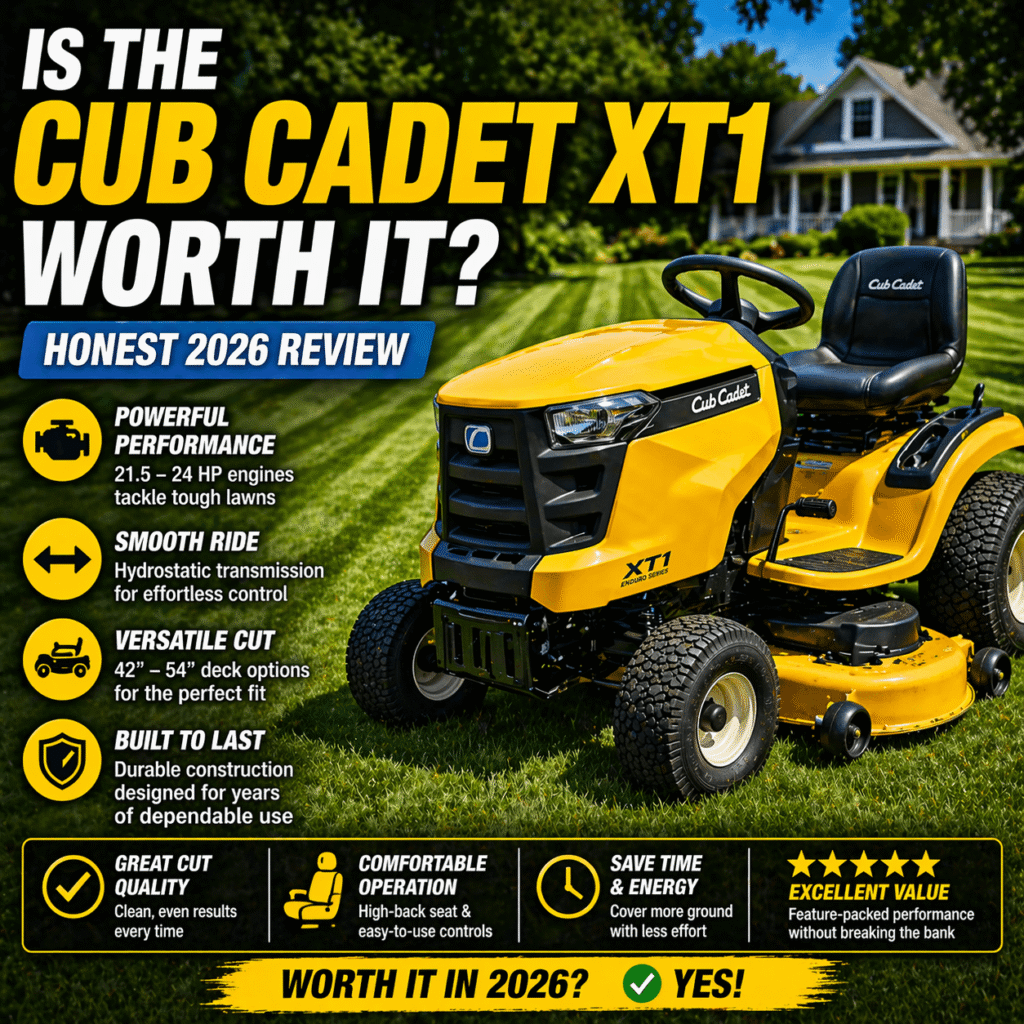
Cub Cadet XT1 Pros and Cons
| ✅ Pros | ⚠️ Cons |
|---|---|
| Rear-wheel drive — best traction on slopes | Slower than zero-turns on flat sections |
| Stable up to 15° — rated for hilly terrain | Cut quality below John Deere at same price |
| 42″–50″ deck range suits residential properties | Resale weaker than John Deere brand |
| Hydrostatic transmission — smooth on hills | Not designed for large flat acreage |
| Strong parts availability via MTD network | Deck stamped not fabricated on base models |
| Competitive price vs John Deere E100 | Wider dealer presence needed in some regions |
Quick Comparison — XT1 vs Alternatives
| Model | Best For | Key Advantage | Weakness |
|---|---|---|---|
| Cub Cadet XT1 | Hilly yards up to 15° | Rear-wheel drive stability | Slower on flat |
| John Deere E100 | Flat to gentle slopes | Resale + cut quality | Not rated for steep hills |
| Husqvarna Z254 | Flat 1–3 acres | Speed + cutting performance | Not safe above 10–15° |
| Toro TimeCutter | Flat residential | MyRIDE comfort | Not for slopes |
What the Cub Cadet XT1 Actually Is
The Cub Cadet XT1 is part of the XT1 Enduro Series from Cub Cadet — manufactured by MTD Products, one of the largest outdoor power equipment companies in the US. It’s a residential lawn tractor available in 42″, 46″, and 50″ deck configurations with 18–24 HP Kohler or Kawasaki engines and a hydrostatic transmission.
New price: $1,800–$2,800 depending on deck size and engine. Used: typically $1,200–$1,800 for a clean 2–4 year old example. It sits below the John Deere E100 on resale but competes on features and is the stronger machine for hilly terrain.
Cub Cadet XT1 Pros — What It Does Well
Rear-wheel drive on hills — the main reason to buy it
The XT1’s rear-wheel drive system is the feature that separates it from front-wheel drive alternatives on hilly terrain. Rear-wheel drive pushes the machine uphill maintaining traction on climbs — front-wheel drive machines lose grip as weight shifts rearward on a slope. If your mower loses traction halfway up a hill and you need to stop, that’s exactly where front-wheel drive machines struggle. The XT1 handles slopes up to 15° reliably under normal conditions — wet grass or steep lateral angles above that threshold are a different matter.
Bottom line: if hills are the reason you’re buying, the XT1’s rear-wheel drive is the right answer at this price.
Hydrostatic transmission — smooth on slopes
The hydrostatic transmission handles hill starts and speed modulation smoothly — no gear shifting required on terrain where both hands should stay on the wheel. This is a meaningful practical advantage on hilly properties where frequent speed adjustments are part of every mowing session.
Deck size options — 42″ to 50″
The 42″ and 46″ configurations are the most practical for hilly residential properties — narrower decks are easier to control on slopes with obstacles. The 50″ is more efficient on larger open hilly properties but less maneuverable in tight terrain. Most buyers on hilly yards under 1.5 acres land on the 42″ or 46″.
Parts availability via MTD network
MTD’s parts network covers most of the US — belts, blades, spindles, and filters are widely stocked. Not quite as broad as John Deere’s network but sufficient for most regions without long lead times.
Cub Cadet XT1 Problems — What It Doesn’t Do Well
Cut quality below John Deere at similar price
The base XT1 runs a stamped deck on entry configurations — not fabricated steel. On a well-maintained flat lawn, cut quality is adequate. On varied terrain it shows more inconsistency than the John Deere Accel Deep™ deck or a fabricated alternative. Buyers who care primarily about how the lawn looks after should look at the John Deere E100 Series instead — better cut finish, stronger resale, at a similar price point.
Slower than zero-turns on flat sections
If your property is a mix of flat and hilly terrain, the XT1 will be slower than a zero-turn on the flat sections. That’s the honest tradeoff for slope stability. Buyers with mostly flat yards and only minor slopes should consider whether a zero-turn with basic slope capability — like the Husqvarna Z254 — is more efficient for their actual terrain.
Resale weaker than John Deere
Cub Cadet holds its value decently on the used market but doesn’t command the premium that John Deere does. A used XT1 at 3–4 years typically lists at $1,200–$1,500 in good condition. A comparable John Deere E100 at the same age lists $200–$400 higher. Not a dealbreaker — but worth knowing if resale matters.
What Goes Wrong — Real Ownership Costs
The most common issues we see on XT1s in the 3–6 year range:
- Drive belt ($25–$50 part) — expected after 3–5 years of regular use. Straightforward DIY replacement; hilly terrain accelerates belt wear slightly compared to flat-yard use
- Deck blade wear ($20–$40 per set) — sharpen or replace once per season. Stamped decks show wear faster than fabricated alternatives under regular use
- Battery ($50–$80) — stock batteries typically last 2–4 seasons. Replace proactively on machines stored through winter without a trickle charger
- Tyre wear — rear tyres on a machine used on hills wear faster than flat-yard use. Worth checking tread depth annually — worn rear tyres directly affect slope traction, which is the XT1’s main job
Budget $100–$200 per year for routine maintenance. Tyre and belt wear are slightly accelerated on hilly properties compared to flat use — factor that in if your slopes are significant.
Is Cub Cadet XT1 Worth It New vs Used?
Buying new
At $1,800–$2,800 new, the XT1 is competitively priced against the John Deere E100 and offers more slope capability for the money. The hydrostatic transmission and rear-wheel drive at this price point are genuinely good value. If hills are your reason for buying and you want a full warranty from day one, new makes sense.
Buying used
A used XT1 in good condition at $1,200–$1,500 is solid value. Key checks on used machines: rear tyre tread (worn tyres on a hill mower are a safety issue, not just a performance one), belt condition, transmission smoothness on both uphill and downhill operation, and deck condition. Check current used pricing on TractorHouse before negotiating — regional availability varies.
Who Should Buy the Cub Cadet XT1
- ✅ Hilly yard with slopes up to 15° — this is what it’s built for
- ✅ 0.5–2 acres of mixed flat and hilly terrain
- ✅ Upgrading from a front-wheel drive mower that struggles on slopes
- ✅ Want hydrostatic transmission for smooth hill operation
- ✅ Buying used — strong value at $1,200–$1,500 in good condition
Who Should Skip It
- ❌ Flat yard, no real hills — a zero-turn is faster. See the Husqvarna Z254 or Toro TimeCutter
- ❌ Cut quality is your priority — the John Deere E100 has a better deck finish at a similar price
- ❌ Slopes above 15° — no riding mower is appropriate. Use a self-propelled walk-behind
- ❌ Yard over 2–3 acres — the XT1 is not efficient on large properties
- ❌ Resale is a priority — the John Deere E100 holds its value better
Verdict — Is the Cub Cadet XT1 Worth It?
Is the Cub Cadet XT1 worth it? Yes — for the right buyer. If your yard has real slopes up to 15° and you’ve been struggling with traction or stability on a less capable machine, the XT1 is the straightforward fix at a price that doesn’t require a commercial machine. The rear-wheel drive platform, hydrostatic transmission, and stable handling on grades make it the most practical residential option for hilly terrain at this price point.
If your yard is flat, buy a zero-turn. If cut quality matters more than slope capability, buy the John Deere E100. But for hilly terrain — the XT1 earns its recommendation.
See current listings: Cub Cadet XT1 — new and used available
Frequently Asked Questions
Is the Cub Cadet XT1 good for hills?
Yes — the XT1 is one of the most practical residential riding mowers for hilly terrain. The rear-wheel drive system maintains traction on slopes up to 15°, and the hydrostatic transmission handles hill starts and speed changes smoothly. It’s the machine we’d recommend first for most residential hilly yards under 2 acres.
How long does the Cub Cadet XT1 last?
A well-maintained XT1 commonly reaches 500–800+ hours before needing significant work — actual lifespan varies with maintenance consistency and terrain. Hilly use accelerates belt and tyre wear slightly compared to flat-yard operation. Consistent maintenance is the biggest factor in longevity.
What are common Cub Cadet XT1 problems?
The most common issues are drive belt wear (expected after 3–5 years), rear tyre wear on machines used frequently on slopes, and battery failure on machines stored through winter without a trickle charger. On hilly properties, check rear tyre tread annually — worn tyres affect traction on the XT1’s most important use case.
How does the Cub Cadet XT1 compare to the John Deere E100?
The XT1 is the stronger choice for hilly terrain — rear-wheel drive, rated to 15° slopes. The John Deere E100 has better cut quality, stronger resale, and the widest dealer network nationally — but is designed primarily for flat yards. For flat or gently sloped yards, the E100 is the better machine. For genuinely hilly terrain, the XT1 handles slopes more reliably.
Is the Cub Cadet XT1 worth buying used?
Yes — a clean used XT1 at $1,200–$1,500 represents good value. Key checks: rear tyre tread, belt condition, and transmission smoothness on uphill operation. Worn rear tyres on a hill mower are a safety issue, not just a performance concern — always check tread before purchasing used.