For most residential yards, the best riding lawn mower for hills in 2026 is not a zero-turn. Zero-turn mowers lose traction on slopes above 10–15° and can slide or tip on steeper grades — they’re fast on flat ground, but a poor fit for hilly terrain. If your yard has real slopes, you need a rear-wheel drive riding mower built for that terrain. This guide is based on dealer feedback, manufacturer specs, and used market data from 2024–2026.
For most buyers with hilly properties, the Cub Cadet XT1 is the strongest all-round choice — rear-wheel drive, stable up to 15° slopes, and available in 42″–50″ configurations that handle most residential terrain. This guide covers the XT1 in depth, when other machines make more sense, and what to avoid.
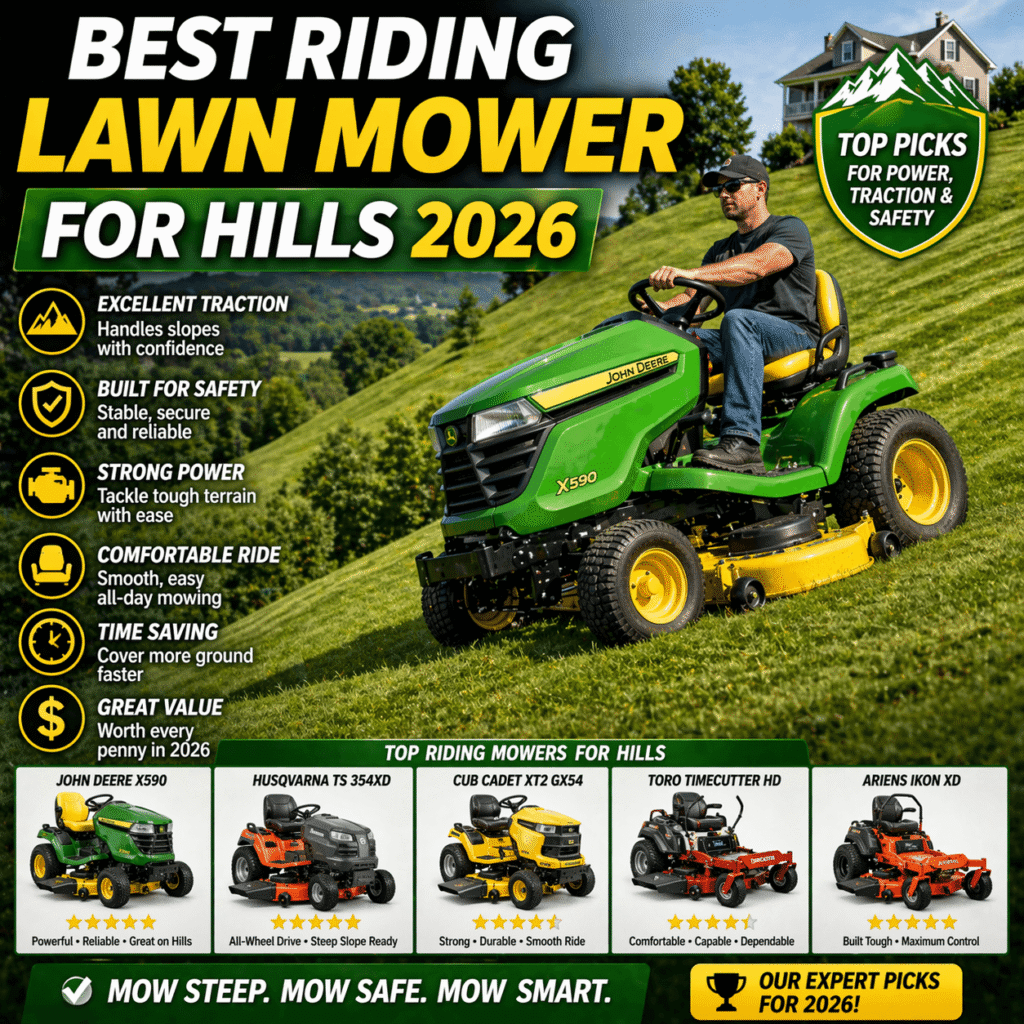
Quick Pick — Best Riding Lawn Mower for Hills by Situation
| Situation | Best Pick | Why |
|---|---|---|
| Standard hilly residential yard (up to 15°) | Cub Cadet XT1 | Rear-wheel drive, stable, 42″–50″ deck |
| Smaller hilly yard, tight spaces | John Deere E100 Series | Lighter, easier to maneuver on slopes |
| Steep slopes above 15° | Self-propelled walk-behind | Ride-on mowers not recommended above 15° |
| Large hilly property (3+ acres) | Cub Cadet XT1 50″ | Wider deck, more efficient on large hilly terrain |
Why Zero Turns Are the Wrong Mower for Slopes
Zero-turn mowers are designed for flat, open ground. On slopes they have two problems: the rear-wheel independent motor system loses traction unpredictably above 10–15° — particularly on wet grass — and the high centre of gravity increases lateral tip risk on steeper grades. If your yard has genuine hills, a rear-wheel drive riding mower is the right machine. The Cub Cadet XT1 is the most practical option in that category for most residential buyers.
Best Riding Lawn Mower for Hills — Top Picks for Hilly Terrain in 2026
🥇 1. Cub Cadet XT1 — Best Overall for Hilly Yards
The Cub Cadet XT1 is manufactured by Cub Cadet — part of the MTD Products family, one of the largest outdoor power equipment manufacturers in the US. Based on dealer feedback and used market demand, the XT1 is among the most widely recommended residential riding mowers for hilly terrain — rear-wheel drive for traction on slopes, a low centre of gravity compared to zero-turns, and a stable platform on grades up to 15°.
The XT1 comes in 42″, 46″, and 50″ deck configurations with 18–24 HP engines. For most hilly residential yards, the 42″ or 46″ is the better choice — the wider the deck, the more challenging it is to maintain control on slopes. The hydrostatic transmission handles hill starts and speed modulation on slopes smoothly — no gear shifting required on terrain where you need both hands on the wheel.
Main limitation: slower than a zero-turn on flat sections of the same yard. If your property is a mix of flat and hilly terrain, expect the flat sections to take longer than they would with a zero-turn. That’s the tradeoff for stability on the slopes.
- Deck: 42″, 46″, 50″
- Engine: 18–24 HP Kohler or Kawasaki
- Drive: Rear-wheel drive
- Best for: Slopes up to 15°, 0.5–2 acres
- New price: ~$1,800–$2,800
- Used from: ~$1,800
Bottom line: the XT1 is the right machine for most hilly residential yards under 2 acres. For a full breakdown of how it performs on slopes, ownership costs, and what to check on used units — see our full Cub Cadet XT1 review →
👉 Check availability before peak season — used XT1 units move fast in spring: compare used vs new Cub Cadet XT1 listings →
🥈 2. John Deere E100 Series — Best for Smaller Hilly Yards
For smaller hilly properties under 1 acre where tight maneuverability matters as much as stability, the John Deere E100 Series is worth considering alongside the XT1. The E100 is lighter than the XT1 — which is an advantage on slopes where machine weight affects traction and turf damage. The 42″–48″ deck options handle typical residential terrain, and John Deere’s dealer network makes service straightforward.
The honest limitation: the E100 is designed primarily for flat yards. It handles gentle slopes well but is not rated or recommended for the steeper grades the XT1 handles. For genuinely hilly yards, the XT1’s rear-wheel drive and slope stability make it the stronger choice. The E100 is the better pick when the hills are moderate and the yard is small. For a full review see Is the John Deere E100 Worth It?
- Deck: 42″–48″
- Engine: 17.5–20 HP
- Best for: Gentle slopes, under 1 acre
- New price: ~$1,700–$2,200
- Used from: ~$1,500
Bottom line: the E100 works for gentle slopes — not steep hilly terrain.
👉 See current John Deere E100 stock — new and used →
Cub Cadet XT1 vs John Deere E100 — Which Is the Better Lawn Tractor for Hills?
| Factor | Cub Cadet XT1 | John Deere E100 |
|---|---|---|
| Drive system | Rear-wheel drive ✅ | Rear-wheel drive ✅ |
| Slope stability | Up to 15° — rated for hills | Gentle slopes — primarily flat |
| Deck range | 42″–50″ | 42″–48″ |
| Best yard size | 0.5–2 acres hilly | Under 1 acre, moderate slopes |
| New price | $1,800–$2,800 | $1,700–$2,200 |
| Resale | Moderate | Strong (John Deere brand premium) |
| Verdict for hills | ✅ Stronger choice for hilly terrain | ⚠️ Fine for gentle slopes only |
Riding Mower vs Zero-Turn vs Walk-Behind — Which Is Safest for Hills?
| Machine Type | Safe Slope Range | Best For |
|---|---|---|
| Rear-wheel drive riding mower (XT1) | Up to 15° | Hilly residential yards, 0.5–2 acres |
| Zero-turn mower | Up to 10–15° (marginal) | Flat yards — not recommended for hills |
| Self-propelled walk-behind | Up to 20°+ | Steep slopes, small hilly properties |
| Commercial stand-on | Up to 15°+ (better stability) | Larger hilly properties, professional use |
Bottom line: for most residential hilly terrain, a rear-wheel drive riding mower is the safest and most practical choice. Zero-turns are not the right machine for most hilly terrain — the traction and stability limitations are real above 10–15°.
- Rear-wheel drive: front-wheel drive riding mowers lose traction climbing slopes — rear-wheel drive pushes the machine uphill rather than pulling it. If your mower loses traction halfway up a hill and you need to stop, that’s exactly where front-wheel drive machines struggle — the rear wheels spin freely while the front has no grip to hold position. Rear-wheel drive is the single most important feature for hilly terrain
- Low centre of gravity: machines with a lower profile are more stable on lateral slopes. Avoid high-seat or tall-frame machines on hilly ground
- Hydrostatic transmission: allows smooth speed control on slopes without gear changes — important when both hands need to be on the wheel
- Deck size matched to terrain: narrower decks are more maneuverable on hilly terrain with obstacles. A 42″ deck is easier to control on a slope than a 54″ deck
- Manufacturer slope rating: always check before buying — operating above the rated slope is a safety risk regardless of machine
Key Specs for a Riding Lawn Mower for Hills — What Actually Matters
When shopping for the best mower for slopes, these specs matter more than HP or brand name:
- Rear-wheel drive: pushes the machine uphill rather than pulling it. If your mower loses traction halfway up a hill and you need to stop, that’s exactly where front-wheel drive machines fail — the rear wheels spin freely with no grip to hold position. This is the single most important spec for a lawn tractor for hills.
- Low centre of gravity: machines with a lower profile are more stable on lateral slopes. Avoid tall-frame machines on hilly ground
- Hydrostatic transmission: smooth speed control on slopes without gear changes — essential when both hands need to stay on the wheel
- Deck size matched to terrain: a 42″ deck is easier to control on a slope than a 54″ one. Narrower is safer on hilly terrain with obstacles
- Manufacturer slope rating: always check — operating above the rated slope is a safety risk regardless of machine type
Slope Safety — What the Numbers Mean
| Slope Angle | Grade | Safe Machine Type |
|---|---|---|
| Under 10° | Under 18% | Any riding mower or zero-turn |
| 10°–15° | 18%–27% | Rear-wheel drive riding mower (XT1, E100) |
| 15°–20° | 27%–36% | Self-propelled walk-behind only |
| Above 20° | Above 36% | Walk-behind with blade brake — no ride-on machine |
Most residential zero-turns are not recommended above 10–15°. The Cub Cadet XT1 handles up to 15° reliably. Above that, no ride-on machine is a safe choice — a self-propelled walk-behind with a blade brake clutch is the appropriate tool.
Best Riding Mower for Hills — New vs Used
Both the Cub Cadet XT1 and John Deere E100 hold up well on the used market. A used XT1 in good condition at 2–4 years old is one of the better value purchases in the residential riding mower category — these machines are durable and the used supply is consistent. Key checks on used machines: deck condition (particularly on hilly properties where the deck can take more damage from terrain), transmission smoothness on both uphill and downhill operation, and tyre condition — worn tyres on a hilly yard are a genuine safety issue.
Current used market pricing on platforms like TractorHouse shows clean XT1 units consistently available in the $1,200–$1,800 range at 2–4 years old — strong value for a machine in this category.
Also Worth Considering — Higher-End Alternatives for Difficult Terrain
For buyers with larger or more challenging hilly properties, two categories are worth knowing about:
- Stand-on mowers — commercial stand-on machines from brands like Toro and Scag handle slopes better than most residential ride-on mowers. The lower centre of gravity and operator weight distribution improve stability on grades. They’re more expensive ($5,000–$10,000 new) and designed for professional use — but for buyers who’ve exhausted residential options on difficult terrain, they’re worth exploring
- Commercial zero-turns on moderate slopes — commercial machines like the Scag Turf Tiger II handle slopes better than residential zero-turns due to their heavier frame and wider stance. They’re still not recommended above 15°, but they’re more composed on moderate slopes than a residential machine
For most residential hilly yards, the XT1 is sufficient. The commercial options above become relevant when the terrain is genuinely challenging or the property is large enough that a residential machine’s limitations become a daily frustration. See our best zero-turn mower for residential use guide if your yard is mostly flat with occasional slopes.
- Slopes above 15° — no riding mower is rated for this. A self-propelled walk-behind is the only appropriate machine
- Flat yards with no real hills — a zero-turn is faster and more efficient. The Husqvarna Z254 or Toro TimeCutter are the better choices for flat terrain
- Yards over 3 acres — a riding mower on a large hilly property takes a long time. A commercial machine built for varied terrain is a more practical long-term solution
Verdict — Best Riding Lawn Mower for Hills in 2026
For most hilly residential yards, the Cub Cadet XT1 is the machine that handles hilly terrain safely and efficiently — rear-wheel drive, stable up to 15°, and available in deck sizes suited to residential properties. For smaller yards with gentler slopes, the John Deere E100 is a capable alternative. For anything above 15°, step off the riding mower and use a walk-behind.
Check current availability before peak mowing season — used XT1 units move quickly in spring: compare used vs new Cub Cadet XT1 listings →
Frequently Asked Questions
What is the safest mower for steep hills?
For slopes up to 15°, a rear-wheel drive riding mower like the Cub Cadet XT1 is the safest ride-on option. Above 15°, a self-propelled walk-behind with a blade brake clutch is the appropriate machine — no ride-on mower is recommended above that grade. The most important safety features are rear-wheel drive, a low centre of gravity, and a hydrostatic transmission that allows smooth speed control without gear changes.
Can you mow sideways on a slope with a riding mower?
Mowing across a slope (sideways) is more dangerous than mowing up and down — the risk of lateral tipping is higher. Most manufacturers recommend mowing up and down slopes rather than across them on ride-on machines. On slopes above 10°, mowing sideways on any riding mower increases tip risk significantly. Walk-behind mowers are safer for sideways mowing on steeper terrain.
What is the best mower for uneven ground and hills?
For uneven ground combined with hills, the Cub Cadet XT1 handles the combination well — the hydrostatic transmission manages speed on slopes, and the deck can handle minor terrain variation. For very rough or uneven ground (ruts, bumps, significant terrain changes), a walk-behind mower gives you more control and is safer than any ride-on machine on unpredictable terrain.
What is the best riding lawn mower for hills?
The Cub Cadet XT1 is one of the most commonly recommended riding mowers for hilly yards — rear-wheel drive, stable up to 15° slopes, and available in 42″–50″ deck configurations suited to most residential properties. For smaller yards with gentler slopes, the John Deere E100 is a capable alternative at a lower price point.
Can a zero-turn mower handle hills?
Zero-turns handle gentle slopes up to about 10–15° on most residential terrain. Above that, traction becomes unpredictable and the risk of sliding or tipping increases — particularly on wet grass. Most manufacturers do not recommend zero-turns above 15°. For genuinely hilly yards, a rear-wheel drive riding mower is the safer choice.
What slope is too steep for a riding mower?
Most residential riding mowers are rated to 15° (a 27% grade). Above that, the risk of tipping or losing control increases significantly. Slopes above 20° should be mowed with a self-propelled walk-behind mower — no ride-on machine is appropriate at that grade.
Is rear-wheel drive better for hills?
Yes — rear-wheel drive pushes the machine uphill maintaining traction on climbs. Front-wheel drive loses grip as weight shifts rearward on a slope. For hilly terrain it’s the most important spec to look for.
How do I know if my yard is too steep for a riding mower?
A slope of 15° feels steep when walking — about the angle of a fairly aggressive driveway incline. If you feel yourself leaning noticeably when walking the slope, it’s likely at or above the safe limit for a riding mower. When in doubt, use a level or a slope measuring app to check the grade before operating any ride-on machine.