Knowing what can you do with a towable backhoe before buying one is the most important research you can do — because the answer determines whether a $1,500–$3,500 towable backhoe is exactly what you need or whether a different machine serves you better. A towable backhoe handles fence posts, drainage trenching, water line installation, septic system trenching, tree planting, irrigation channels, and small pond work in soft to moderate soil. It reaches 6–9 ft depth, tows behind a pickup or ATV, and deploys in minutes. This guide covers every realistic use case, the correct soil conditions for each, and where the machine reaches its limits.
👉 See our current towable backhoe listings — from $1,500 →
Written by: Farmers Equipment editorial team.
Typical Towable Backhoe Specifications
| Specification | Typical Range |
|---|---|
| Max dig depth | 6–9 ft (entry-level: 5–6 ft) |
| Max reach | 8–11 ft from pivot |
| Dump height | 5–6 ft |
| Bucket width (standard) | 9–12 inches |
| Engine power | 8–15 HP gasoline |
| Operating weight | 850–1,500 lbs |
| Tow speed (road) | Model-dependent — check manufacturer spec; most suitable for 25–45 mph max |
| Tow hitch | Standard 2-inch ball hitch |
| Stabiliser legs | 2 — manual or hydraulic depending on model |
| Setup time on site | 5–10 minutes |
| Hydraulic system | Open centre — gear pump on most models |
| Starting price (new) | From $1,500 |
Towable Backhoe Uses — Quick Reference
| Use Case | Depth Required | Towable Backhoe | Best Soil Conditions |
|---|---|---|---|
| Fence post holes | 2–4 ft | ✅ Excellent | Any — including moderate clay |
| Shallow drainage trenching | 2–4 ft | ✅ Excellent | Soft to moderate |
| Deep drainage trenching | 5–7 ft | ✅ Good | Soft to moderate — slower in clay |
| Water line installation | 3–5 ft | ✅ Excellent | Most conditions |
| Irrigation channel digging | 2–4 ft | ✅ Excellent | Soft to moderate |
| Septic system trenching | 4–8 ft | ✅ Good | Soft to moderate soil |
| Electrical conduit trenching | 2–3 ft | ✅ Excellent | Most conditions |
| Tree planting (large trees) | 3–5 ft | ✅ Excellent | Most conditions |
| Stump removal | 2–4 ft around stump | ⚠️ Partial — dig around, not pull | Soft to moderate |
| Small pond or stock tank | 4–7 ft | ⚠️ Capable — slow for large volumes | Soft to moderate |
| Retaining wall footings | 2–4 ft | ✅ Good | Soft to moderate |
| Building foundation | 8–14 ft | ❌ Too deep for most models | N/A — depth limitation |
| Rock excavation | Any | ❌ Not suitable | N/A — machine not rated for rock |
| Large-volume earthmoving | Any | ❌ Too slow — wrong machine | N/A — volume limitation |
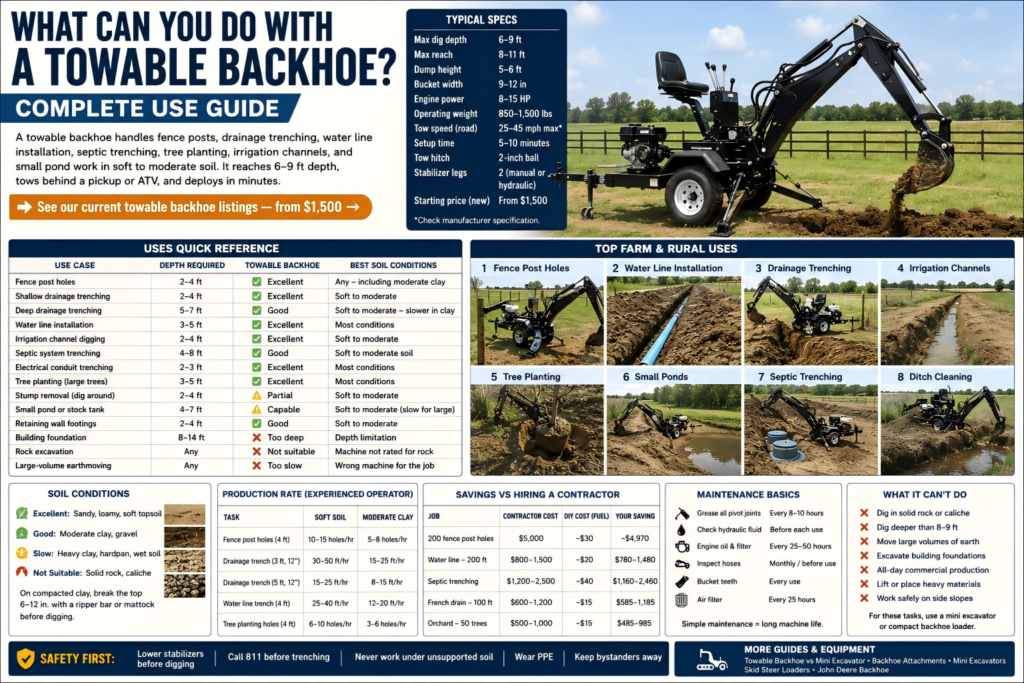
Farm and Agricultural Uses
1. Fence Post Holes
This is the single most common use case for a towable backhoe on a farm — and the one where the return on investment is most obvious. Driving fence posts by hand or with a manual post driver takes hours per line. A contractor with an auger charges $15–$40 per post. A towable backhoe digs a clean hole to exact depth in 2–5 minutes per post, at whatever spacing and depth your fence design requires.
- Typical depth: 2–4 ft depending on post length and frost line depth
- Soil conditions: handles soft to moderate soil — slows in heavy clay but still functional
- Time per hole: 2–5 minutes including positioning
- Break-even vs contractor: 60–100 posts typically covers the machine purchase price
Operator note: most first-time owners underestimate how much positioning time affects productivity. The digging itself is fast — but moving the machine, lowering the stabiliser legs, and levelling for the next hole often accounts for 30–40% of total job time. Experienced operators develop a rhythm that reduces this significantly, but factor it into your time estimates on the first few jobs.
2. Water Line Installation
Running a water line from a well to a barn, trough, or outbuilding requires a trench below the frost line — typically 3–5 ft in most US climates. A towable backhoe digs this trench efficiently in soft to moderate soil. For a 200 ft water line at 4 ft depth, expect 3–5 hours of digging in reasonable ground conditions.
- Typical depth: 3–5 ft (varies by climate and frost line)
- Soil conditions: most conditions — slower in heavy clay
- Advantage over contractor: you control timing — dig when pipe and fittings are on hand, not when the contractor is available
3. Drainage Management
Poor drainage is one of the most common small farm problems — wet paddocks, flooded laneways, standing water near buildings. A towable backhoe digs French drains, catch basins, drainage channels, and outlet trenches efficiently in the 2–6 ft depth range that most agricultural drainage requires.
- French drain installation: dig trench, lay perforated pipe and gravel, backfill — towable backhoe handles all three stages of the digging
- Surface drainage channels: shallow swales and channels at 1–3 ft depth are fast work for a towable backhoe
- Depth capability: handles the 3–6 ft depth most agricultural drainage requires
4. Irrigation Channel Digging
Installing irrigation channels or burying irrigation supply lines requires consistent trenching at 2–4 ft depth — well within the towable backhoe’s capability. For a small farm with multiple irrigation zones, the towable backhoe makes the installation practical as a DIY project rather than a contractor job.
5. Tree Planting and Orchard Work
Planting large trees, fruit trees, or establishing an orchard requires holes larger and deeper than any manual tool handles efficiently. A towable backhoe digs a 3 ft diameter, 4 ft deep planting hole in 5–10 minutes. For an orchard of 50 trees, that is a half-day project versus multiple days by hand.
- Hole size: dig diameter slightly larger than root ball — typically 2–4 ft
- Depth: 3–5 ft for most trees
- Volume advantage: the bucket loosens surrounding soil as it digs — easier for roots to establish than hand-dug or augered holes in harder ground
6. Stock Pond and Water Feature Digging
A small stock pond or wildlife pond is achievable with a towable backhoe — with realistic expectations about time. A 20 x 15 x 5 ft pond requires moving significant soil volume, which is slow work for a light towable machine. Expect 1–3 days for a small pond in soft soil. For a larger pond exceeding 30 x 20 ft, a mini excavator or hired contractor is more practical.
Rural Property and Landscaping Uses
Clay soil tip: on compacted clay, many owners find it easier to remove the first 6–12 inches of surface material with a ripper bar or mattock before beginning excavation with the backhoe. This breaks the crust and significantly speeds up the first bucket passes.
7. Septic System Trenching
Residential septic systems typically require trenches at 4–8 ft depth — within the capability of most towable backhoes in soft to moderate soil. This is a significant use case: a contractor with a machine charges $800–$2,500 for septic trenching on a standard residential system. A towable backhoe owner handles this themselves.
- Depth required: 4–8 ft for most residential septic drain fields
- Soil conditions: critical — soft to moderate soil is necessary. Hard clay or rock significantly slows or prevents adequate digging at this depth
- Permit note: septic system installation typically requires permits and inspection — check local requirements before digging
8. Electrical Conduit Trenching
Running power to a barn, shop, outbuilding, or gate requires burying electrical conduit — typically 18–24 inches deep for residential wiring, deeper for direct-burial cable. This is easy work for a towable backhoe at any depth within its range.
9. Retaining Wall and Foundation Footings
Small retaining walls, garden walls, and outbuilding footings require trenches at 2–4 ft depth. A towable backhoe handles this efficiently — the bucket width (10–12 inches standard) suits the footing width required for most small structures. For building foundations requiring 8 ft or more depth, the towable backhoe reaches its limit.
10. Stump Removal
A towable backhoe can dig around a stump to expose the root system — which then allows cutting the roots with a chainsaw or axe. It cannot pull a stump directly without risk of tipping the machine. The correct approach: dig a trench around the stump perimeter, cut the lateral roots exposed by digging, then lever or cut the taproot. This works well for stumps up to 18–24 inches in diameter. Larger stumps require a stump grinder or dedicated removal equipment.
11. Ditch Clearing and Maintenance
Road ditches and farm boundary ditches fill with sediment and vegetation over years. Periodic cleaning with a towable backhoe — scraping the ditch bottom and sides — restores drainage without the expense of a contractor. This is one of the ongoing maintenance tasks where owning the machine pays back year after year.
Towable Backhoe vs Mini Excavator — Job Suitability
| Job | Towable Backhoe | Mini Excavator |
|---|---|---|
| Fence post holes | ⭐⭐⭐⭐⭐ | ⭐⭐⭐⭐⭐ |
| Shallow drainage (under 4 ft) | ⭐⭐⭐⭐⭐ | ⭐⭐⭐⭐⭐ |
| Deep drainage (5–8 ft) | ⭐⭐⭐⭐ | ⭐⭐⭐⭐⭐ |
| Water line installation | ⭐⭐⭐⭐⭐ | ⭐⭐⭐⭐⭐ |
| Septic trenching — soft soil | ⭐⭐⭐⭐ | ⭐⭐⭐⭐⭐ |
| Septic trenching — clay | ⭐⭐ | ⭐⭐⭐⭐⭐ |
| Tree planting | ⭐⭐⭐⭐⭐ | ⭐⭐⭐⭐⭐ |
| Pond digging (small) | ⭐⭐⭐ | ⭐⭐⭐⭐⭐ |
| Rock excavation | ❌ | ⭐⭐⭐ |
| Large volume earthmoving | ⭐ | ⭐⭐⭐⭐ |
| Portability / ease of transport | ⭐⭐⭐⭐⭐ | ⭐⭐ |
| Cost to own | ⭐⭐⭐⭐⭐ | ⭐⭐ |
| Speed / production rate | ⭐⭐ | ⭐⭐⭐⭐⭐ |
For a deeper comparison: Towable Backhoe vs Mini Excavator — full guide →
What a Towable Backhoe Cannot Do
Understanding the limitations is as important as knowing the capabilities. For independent specification data on specific models, TractorData.com lists manufacturer specs without commercial bias.
| Task | Why Not | What to Use Instead |
|---|---|---|
| Digging in solid rock | Bucket and machine not rated for rock breakout — damage risk | Hydraulic breaker on excavator; blasting |
| Depths beyond 8–9 ft | Maximum arm reach — most models top out at 7.5–9 ft | Mini excavator or compact backhoe loader |
| Large-volume earthmoving | Small bucket and light weight limits cubic yards per hour | Excavator, dozer, or loader |
| Building foundations (deep) | Depth limitation — most residential foundations need 8–10 ft | Full-size backhoe or excavator |
| All-day commercial digging | Built for intermittent use — not rated for contractor schedules | Mini excavator or compact backhoe loader |
| Lifting and placing material | Not designed for lifting loads — bucket only | Telehandler, front loader, or crane |
| Sloped or unstable ground | Stabiliser legs require reasonably level surface to operate safely | Mini excavator with rubber tracks |
Soil Conditions — What the Towable Backhoe Handles
| Soil Type | Performance | Notes |
|---|---|---|
| Sandy / loamy soil | ✅ Excellent — fastest digging | Maximum production rate — easy bucket penetration |
| Soft topsoil | ✅ Excellent | Ideal conditions — same as sandy |
| Moderate clay | ✅ Good — slower than sandy | Functional but requires more passes per bucket depth |
| Heavy / dense clay | ⚠️ Slow — limited productivity | Machine works but output per hour is significantly reduced |
| Caliche or hardpan | ⚠️ Very slow — often not practical | Consider renting a heavier machine for this soil type |
| Solid rock | ❌ Not suitable | Do not attempt — bucket damage and safety risk |
| Wet / saturated soil | ⚠️ Possible but messy | Machine can dig but spoil management and stability are harder |
| Gravel | ✅ Good | Looser gravel digs easily; compacted gravel slows production |
How Much Can a Towable Backhoe Save You?
| Job | Typical Contractor Cost | DIY With Towable Backhoe | Saving |
|---|---|---|---|
| 200 fence post holes at $25/hole | $5,000 | ~$30 fuel | ~$4,970 |
| Water line — 200 ft trench at 4 ft depth | $800–$1,500 | ~$20 fuel | $780–$1,480 |
| Septic drain field trenching | $1,200–$2,500 | ~$40 fuel | $1,160–$2,460 |
| French drain — 100 ft at 3 ft depth | $600–$1,200 | ~$15 fuel | $585–$1,185 |
| Orchard planting — 50 tree holes | $500–$1,000 | ~$15 fuel | $485–$985 |
A towable backhoe at $2,500 pays for itself during a single fencing project on most rural properties. After that, every job it handles is money staying in your pocket. Over five years of farm use — drainage maintenance, fence line extensions, irrigation installation — the cumulative saving against contractor rates typically reaches $15,000–$30,000 on a working small farm.
How Much Can a Towable Backhoe Dig Per Hour?
Production rate depends heavily on soil conditions, depth, and operator experience:
| Task | Soft Soil | Moderate Clay |
|---|---|---|
| Fence post holes (4 ft deep) | 10–15 holes/hr | 5–8 holes/hr |
| Drainage trench (3 ft deep, 12 in wide) | 30–50 ft/hr | 15–25 ft/hr |
| Drainage trench (5 ft deep, 12 in wide) | 15–25 ft/hr | 8–15 ft/hr |
| Water line trench (4 ft deep) | 25–40 ft/hr | 12–20 ft/hr |
| Tree planting holes (4 ft deep) | 6–10 holes/hr | 3–6 holes/hr |
These are estimates for an experienced operator. A first-time operator will typically achieve 50–70% of these rates until comfortable with positioning, depth control, and boom management.
Routine Maintenance — What Ownership Involves
A towable backhoe is one of the simpler machines to maintain — no complex electronics, straightforward gasoline engine, and standard hydraulics. What ownership requires:
| Maintenance Item | Interval | Notes |
|---|---|---|
| Grease all pivot pins and joints | Every 8–10 hours of use | Most important maintenance item — neglect causes rapid wear at boom, dipper, and bucket pivots |
| Check hydraulic fluid level | Before each use | Low fluid causes pump damage — 30-second check every time |
| Inspect hydraulic hoses | Monthly or before each use | Look for cracking, bulging, or weeping — hose failure under pressure is a safety hazard |
| Engine oil and filter | Every 25–50 hours or as per engine manual | Small gasoline engines are sensitive to oil neglect — change on schedule |
| Air filter | Every 25 hours in dusty conditions | Clogged air filter causes engine power loss and accelerated wear |
| Bucket teeth inspection | Every use | Worn teeth dramatically reduce digging efficiency — replacements are inexpensive |
| Wheel bearings | Annually or before long tows | Check for play and repack if needed before highway towing |
| Tow hitch and safety chain | Before every tow | Confirm ball mount is tight and safety chain is attached |
Common Beginner Mistakes
Most problems first-time towable backhoe owners encounter are avoidable:
- Digging before stabilisers are fully deployed — the machine must be level and stable on both stabiliser legs before digging begins. Operating with one leg not fully extended causes tipping risk and puts lateral stress on the frame
- Towing too fast — most towable backhoes are rated for lower road speeds than a standard trailer. Check the manufacturer’s maximum tow speed — exceeding it damages wheel bearings and the hitch
- Trying to pry or lever rocks with the boom — using the boom arm to lever against buried rocks damages the arm, cylinder, and frame. The machine digs — it does not pry
- Using the boom to pull stumps — attempting to pull a stump by hooking the bucket and lifting puts forces on the machine far beyond its design rating. Dig around the stump and cut the roots — do not try to pull
- Digging on side slopes — the stabiliser leg system requires near-level ground. Operating on significant side slopes is unsafe — reposition the machine to level ground before digging
- Overloading the bucket — taking maximum bucket fills on every pass in heavy material strains the hydraulics and engine. Half-bucket passes in dense material are faster overall than fighting the machine with full buckets that stall the hydraulic system
- Skipping greasing — the most common cause of early pivot wear. Set a reminder to grease every 8–10 hours of use and it takes 10 minutes. Neglect it and pivot bushings wear out in a fraction of their expected life
Who Should Not Buy a Towable Backhoe
Being direct about who this machine is wrong for is as useful as listing what it does well:
- You routinely dig deeper than 8–9 ft — building foundations, deep drainage in cold climates, or utility work at depth requires a mini excavator or full backhoe loader
- Your soil is rock or solid caliche — a towable backhoe’s bucket and engine are not rated for consistent rock excavation. Attempting it damages the machine and produces minimal output
- You need to move large volumes of earth — hundreds of cubic yards for ponds, site levelling, or large earthworks is slow and inefficient work for a light towable unit
- You dig commercially every day — towable backhoes are built for intermittent use. Daily contractor schedules accelerate wear beyond what the machine is rated for
- You need to load material into dump trucks — the towable backhoe’s dump height and reach do not extend high enough to load a standard dump truck. Excavators and backhoe loaders are designed for this
- You only need one or two jobs done — renting a mini excavator for $300–$600/day is cheaper than purchasing a machine for a task that won’t recur. Buy only when the work repeats regularly
If more than one of these applies to your situation — rent a mini excavator for the specific job, or see our excavator listings for ownership options.
Verdict — What Can You Do With a Towable Backhoe?
A towable backhoe covers the full range of excavation tasks that rural property owners, small farmers, and landscapers encounter regularly — fence posts, drainage, water lines, septic trenching, tree planting, irrigation channels, and ditch maintenance — at 6–9 ft depth in soft to moderate soil. It costs $1,500–$3,500, tows behind a vehicle you already own, and pays for itself quickly against contractor rates for recurring work.
What it cannot do is equally clear: rock excavation, depths beyond 9 ft, large-volume earthmoving, and all-day commercial production. For those tasks, a heavier machine is required. But for the recurring jobs on a small farm or rural property — the answer is yes, a towable backhoe handles them.
Related guides: Is a Towable Backhoe Worth It? · Towable Backhoe vs Mini Excavator →
Also available: Mini Backhoe from $5,000 · Excavators · Backhoe Attachments · John Deere Backhoe · Skid Steer Loaders →
👉 See current towable backhoe listings — from $1,500 →
Frequently Asked Questions
What can you use a towable backhoe for?
The main uses: fence post holes, drainage trenching (2–7 ft depth), water line installation, irrigation channel digging, septic system trenching, electrical conduit burial, large tree planting, small pond excavation, retaining wall footings, stump removal preparation, and ditch clearing and maintenance. All of these are achievable in soft to moderate soil within the machine’s 6–9 ft depth range.
Can a towable backhoe dig a pond?
Yes — a small stock pond or wildlife pond of 20 x 15 ft or less is achievable with a towable backhoe in soft to moderate soil. Expect 1–3 days of digging for a small pond. For larger ponds exceeding 30 x 20 ft, a mini excavator or hired contractor completes the job in a fraction of the time. Volume earthmoving is where the towable backhoe’s production rate becomes the limiting factor.
Can a towable backhoe dig through clay?
Yes in moderate clay — the machine is functional but produces significantly fewer feet per hour than in sandy or loamy soil. In heavy or dense clay, productivity drops considerably and some operators find the towable backhoe impractical for sustained clay digging. In solid caliche or hardpan, consider renting a heavier machine — the towable backhoe’s engine and breakout force are too limited for efficient work in these conditions.
How deep can a towable backhoe dig?
Most towable backhoes dig to 6–9 ft maximum depth, with typical models reaching 7–8 ft. Entry-level machines (Harbor Freight / Central Machinery) typically reach 5–6 ft. For work consistently requiring more than 9 ft — building foundations, deep drainage in certain climates — a mini excavator or compact backhoe loader is required.
Is a towable backhoe good for septic systems?
Yes — in soft to moderate soil, a towable backhoe reaches the 4–8 ft depth most residential septic systems require and handles standard drain field trenching efficiently. Soil conditions are critical: hard clay or rocky ground significantly reduces effectiveness at this depth. Always check local permit requirements before digging for a septic system — most jurisdictions require permits and inspection regardless of who performs the excavation.