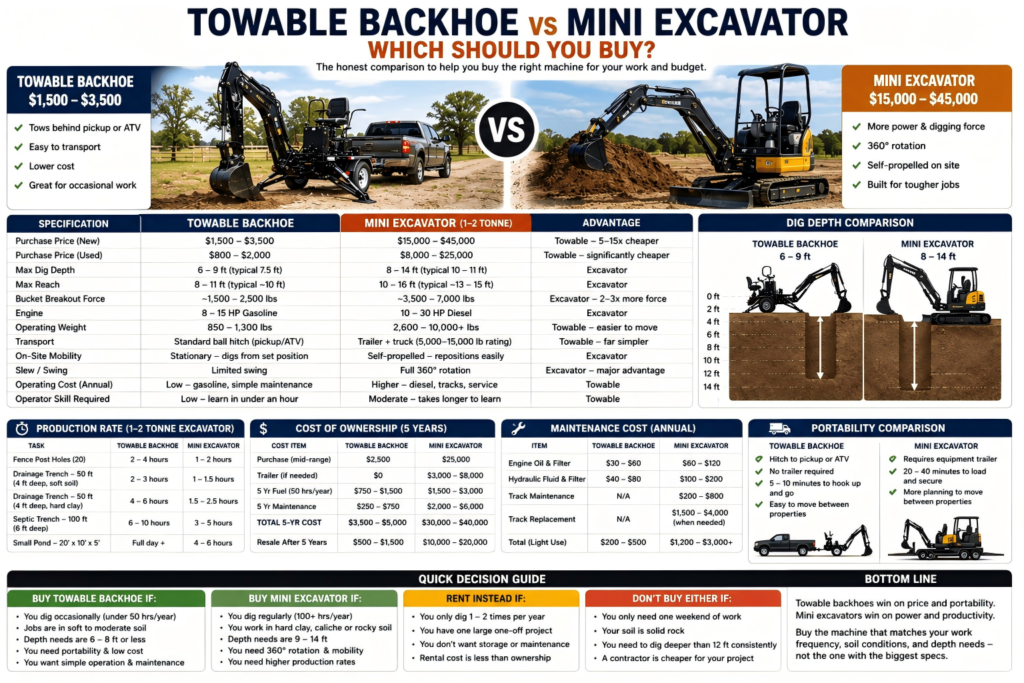
The towable backhoe vs mini excavator comparison comes down to one question: how much do you actually dig, and in what conditions? A towable backhoe costs $1,500–$3,500, tows behind a pickup, and handles occasional farm and property jobs in moderate soil. A mini excavator costs $15,000–$45,000, requires a rated trailer to move, and outperforms the towable in every measurable digging metric. The gap in capability is real — but so is the gap in price. This guide tells you which machine your actual work justifies.
👉 See our towable backhoe listings — from $1,500 →
Written by: Farmers Equipment editorial team.
Towable Backhoe vs Mini Excavator — Quick Decision
Buy the towable backhoe if: you dig occasionally — fence posts, drainage, water lines, tree planting — in soft to moderate soil, and the $15,000+ price of a mini excavator cannot be justified by your digging frequency.
Buy the mini excavator if: you dig regularly, in hard clay or rock, need more than 9 ft depth, want self-propelled mobility on site, or need the production rate to make commercial or large-scale jobs viable.
Full Specification Comparison
| Specification | Towable Backhoe | Mini Excavator | Advantage |
|---|---|---|---|
| Purchase price (new) | $1,500–$3,500 | $15,000–$45,000 | Towable — 5–15x cheaper |
| Purchase price (used) | $800–$2,000 | $8,000–$25,000 | Towable — significantly cheaper |
| Engine | 8–15 HP gasoline | 10–30 HP diesel | Excavator — more power and torque |
| Max dig depth | 6–9 ft (typical 7.5 ft) | 8–14 ft (typical 10–11 ft on 1–2 tonne) | Excavator — greater depth |
| Max reach | 8–11 ft (typical ~10 ft) | 10–16 ft (typical ~13–15 ft on 1–2 tonne) | Excavator — longer arm reach |
| Dump height | ~5–6 ft | ~7–9 ft | Excavator — loads higher into trucks |
| Bucket breakout force | ~1,500–2,500 lbs | ~3,500–7,000 lbs (1–2 tonne class) | Excavator — 2–3x more force |
| Digging force (arm) | Lower — limited by engine and pump size | Higher — significantly more tear-out force | Excavator |
| Hard clay performance | Slow — reduced productivity | Good — handles clay well | Excavator |
| Rock performance | Very limited | Better — especially with rock bucket or breaker | Excavator |
| Operating weight | 850–1,300 lbs | 2,600–10,000+ lbs | Towable — easier to move |
| Transport requirement | Standard ball hitch — pickup or ATV | Rated trailer + truck (5,000–15,000 lb rating) | Towable — far simpler |
| On-site mobility | Stationary — digs from set position | Self-propelled — repositions without unhitching | Excavator |
| Slew/swing | Limited boom swing — position relative to machine fixed | Full 360° rotation | Excavator — major practical advantage |
| Operating cost (annual) | Low — gasoline, simple maintenance | Higher — diesel, track maintenance, service costs | Towable |
| Operator skill required | Low — most operators comfortable in under an hour | Moderate — controls more complex, takes longer to learn | Towable |
| Compact site access | Good — lower profile and narrower | Varies — compact models (1–2 tonne) fit tight spaces well | Towable for very tight access |
The 360° Rotation Difference — More Important Than It Looks
For independent specification data on both machine types, TractorData.com provides manufacturer specs without commercial bias. The mini excavator’s full 360° upper body rotation is a practical advantage that buyers often underestimate until they use both machines. With a towable backhoe, the bucket returns material directly behind the machine — you must either move the machine or dump material into a pile beside the trench and deal with it separately. A mini excavator rotates to place spoil anywhere in a full circle around the machine — spoil to the side, load directly into a truck positioned next to the excavator, or reach across an obstacle without moving.
For trenching work — drainage lines, water pipes, septic systems — this makes the mini excavator meaningfully faster and more convenient on a real job site. For isolated hole-digging tasks like fence posts or tree planting, where material placement matters less, the towable backhoe’s fixed-position limitation is less significant.
Cost Comparison — Full Ownership
| Cost Item | Towable Backhoe | Mini Excavator |
|---|---|---|
| Purchase price (new mid-range) | $2,500 | $25,000 |
| Transport — trailer required | $0 — uses existing ball hitch | $3,000–$8,000 (trailer) if not owned |
| Annual fuel (50 hrs use) | ~$150–$300 (gasoline) | ~$300–$600 (diesel) |
| Annual maintenance | $50–$150 | $400–$1,200 (tracks, filters, hydraulic service) |
| 5-year total cost of ownership | ~$3,500–$5,000 | ~$30,000–$40,000 |
| Resale value after 5 years | Low — $500–$1,500 | Moderate — $10,000–$20,000 |
The 5-year total cost difference is approximately $25,000–$35,000. To justify a mini excavator over a towable backhoe on purely financial grounds, that cost gap needs to be recovered through either saved contractor fees or rental income from the machine. At $800–$1,500 per day for excavator rental rates, a machine that generates revenue or displaces frequent rental costs can close the gap — for a private property owner who digs a few times per year, it rarely does.
Production Rate — How Much Faster Is a Mini Excavator?
| Task | Towable Backhoe | Mini Excavator (1–2 tonne) |
|---|---|---|
| Fence post holes (20 posts) | 2–4 hours | 1–2 hours |
| Drainage trench — 50 ft at 4 ft depth, soft soil | 2–3 hours | 1–1.5 hours |
| Drainage trench — 50 ft at 4 ft depth, hard clay | 4–6 hours | 1.5–2.5 hours |
| Septic trench — 100 ft at 6 ft depth | 6–10 hours | 3–5 hours |
| Small pond — 20 x 10 x 5 ft | Full day + | 4–6 hours |
The mini excavator is approximately 2–3x faster than a towable backhoe on most tasks, and the gap widens in harder material. For a private property owner doing 20 hours of digging per year, the time difference is real but not overwhelming. For a contractor or farm doing 200+ hours of digging per season, that production rate difference translates directly into money.
Maintenance Comparison — Annual Costs
| Maintenance Item | Towable Backhoe | Mini Excavator (1–2 tonne) |
|---|---|---|
| Engine oil and filter | $30–$60 annually | $60–$120 annually (diesel) |
| Hydraulic fluid and filter | $40–$80 | $100–$200 |
| Track maintenance | N/A — wheeled | $200–$800/year (tension, pad wear) |
| Track replacement (when needed) | N/A | $1,500–$4,000 per set |
| Greasing pivot points | DIY — 30 min, minimal cost | DIY — more points, similar time |
| Air filter | $10–$20 | $20–$50 |
| Fuel filter | $10–$20 | $20–$40 |
| Insurance (annual estimate) | $100–$300 | $500–$1,500 |
| Storage requirements | Minimal — fits in standard barn or shed | Requires more floor space — plan for covered storage |
| Estimated annual total (light use) | $200–$500 | $1,200–$3,000+ |
Track maintenance is the hidden cost most mini excavator buyers underestimate. Rubber tracks on a 1–2 tonne machine cost $1,500–$4,000 to replace — and on a regularly used machine they wear faster than most buyers expect. For a private property owner using the machine 50 hours per year, tracks may last 5–10 years. For a contractor using it 500+ hours per year, track replacement can be an annual cost.
Which Is Better for Specific Jobs?
| Job Type | Better Machine | Why |
|---|---|---|
| Fence post holes — soft soil | Towable backhoe | Adequate capability at far lower cost |
| Fence post holes — hard clay | Mini excavator | Better breakout force in hard ground |
| Shallow drainage — soft soil (4 ft or less) | Towable backhoe | Within capability — good value choice |
| Deep drainage — 7–10 ft | Mini excavator | Towable often can’t reach required depth |
| Water line installation — 3–5 ft | Towable backhoe | Easily within capability for this depth |
| Septic system — soft soil | Towable backhoe | Reaches 6–8 ft needed in most soils |
| Septic system — hard clay | Mini excavator | Speed and force advantage significant |
| Pond digging | Mini excavator | Volume and production rate far superior |
| Tree planting holes | Towable backhoe | Perfectly suited — easy and cost-effective |
| Building foundation | Mini excavator | Depth, volume, and precision required |
| Rock breaking | Mini excavator | Towable backhoe not suitable — excavator with breaker attachment |
| Occasional rural property maintenance | Towable backhoe | Overkill to buy mini excavator for occasional use |
| Regular contractor/commercial use | Mini excavator | Production rate and versatility justify the cost |
Portability — The Towable Backhoe’s Strongest Advantage
The portability difference between a towable backhoe and a mini excavator is larger than most buyers anticipate before they own one:
| Factor | Towable Backhoe | Mini Excavator |
|---|---|---|
| Transport vehicle | Standard pickup, ATV, or UTV with ball hitch | Truck rated for 5,000–15,000 lbs + trailer |
| Trailer required | No | Yes — equipment trailer $3,000–$8,000 if not owned |
| Time to load and transport | 5–10 minutes — hitch and go | 20–40 minutes — drive on trailer, strap down, check |
| Moving between properties | Daily — no friction | Requires planning — trailer, load/unload time |
| Rural track / soft ground access | Good — lightweight | Limited on soft ground — tracks can sink or damage |
For a rural property owner or small farmer who needs to move between paddocks, fence lines, or multiple properties regularly — the towable backhoe’s ability to hitch to a pickup and go in five minutes is a genuine daily advantage. The mini excavator requires equipment trailer logistics for every move.
Should You Buy or Rent Instead?
Before buying either machine, consider whether renting makes more financial sense for your actual usage:
| Your Situation | Best Option | Why |
|---|---|---|
| One or two digging jobs per year | Rent mini excavator | $300–$600/day rental is cheaper than owning any machine for occasional use |
| 5–15 digging jobs per year in soft soil | Buy towable backhoe | Pays for itself quickly — no scheduling around rental availability |
| Regular digging in hard clay or at depth | Buy mini excavator | Rental costs accumulate — ownership justified by frequency and ground conditions |
| One large one-off project (pond, foundation) | Hire contractor | Day rate for contractor + excavator is often cheaper than buying a machine for one job |
| Mixed use — some soft, some hard ground | Buy towable + rent mini when needed | Own for routine jobs, rent for the hard jobs that arise occasionally |
The rental break-even: a towable backhoe at $2,500 breaks even against contractor rates after approximately 2–3 jobs that would otherwise cost $800–$1,500 each. A mini excavator at $25,000 breaks even against rental at $500/day after approximately 50 rental days — which takes most private owners 5–10 years to accumulate.
How Many Jobs Per Year Justifies Each Option?
| Digging Jobs Per Year | Best Choice | Reasoning |
|---|---|---|
| 1–2 jobs | Rent or hire contractor | Purchase cost of any machine exceeds what rental or contractor costs |
| 3–8 jobs (soft soil) | Towable backhoe | Pays for itself quickly — no rental logistics or contractor scheduling |
| 3–8 jobs (hard clay) | Rent mini excavator for hard jobs | Towable struggles — rent when ground conditions require it |
| 10–30 jobs (mixed conditions) | Towable + rent mini when needed | Own the everyday machine, rent the specialist when required |
| 40–100+ jobs (any conditions) | Mini excavator | Frequency and versatility justify the investment |
| Commercial / contractor use | Mini excavator | Revenue generated covers cost; production rate matters at this volume |
Who Should Buy the Towable Backhoe
- ✅ Rural property owners who dig fewer than 50 hours per year
- ✅ Small farms needing occasional fence post, drainage, and water line work
- ✅ Buyers without a tractor who want standalone digging capability
- ✅ Anyone working on soft to moderate soil where the towable’s power is adequate
- ✅ Buyers where portability between multiple small sites is a regular requirement
- ✅ Budget-conscious buyers for whom the $15,000+ mini excavator gap cannot be justified
👉 See towable backhoe listings — from $1,500 →
Who Should Buy the Mini Excavator
- ✅ Contractors or farms digging 100+ hours per season
- ✅ Anyone digging consistently in hard clay, caliche, or rocky ground
- ✅ Jobs regularly requiring more than 9 ft depth
- ✅ Large volume earthmoving — ponds, foundations, land clearing
- ✅ Buyers who need 360° rotation and self-propelled on-site mobility
- ✅ Commercial operators where machine revenue justifies the investment
Who Should Not Buy Either Machine
- You only need one weekend of digging — renting a mini excavator for $300–$600 is cheaper than owning any machine. Buy only when the recurrence justifies the investment
- Your soil is solid rock — neither machine is the right tool for rock. A hydraulic breaker attachment on a larger excavator, or blasting, is required. Both machines will damage their buckets and produce negligible output in hard rock
- You need to dig deeper than 12 ft consistently — both machines reach their depth limits. A full-size backhoe loader or large excavator is required for deep foundation work
- A contractor is cheaper for your specific job — for one-off large projects (ponds, large foundations, significant site clearing), a contractor with the right machine often completes the job faster and cheaper than any machine you could rent or buy for occasional use
Verdict — Towable Backhoe vs Mini Excavator
The towable backhoe vs mini excavator decision is not about which machine is better — it is about which machine is right for the actual frequency, depth, and ground conditions of your digging work.
If you dig occasionally on a rural property or small farm in workable soil — the towable backhoe at $1,500–$3,500 is the right machine. It handles the tasks you need, tows behind the vehicle you already own, and pays for itself quickly against contractor rates. Spending $25,000+ on a mini excavator for 20–40 hours of digging per year is not a rational investment regardless of how much better the excavator performs.
If you dig regularly, in hard ground, at depth, or need commercial production rates — the mini excavator earns its price through time saved, harder material handled, and greater versatility on the job site. The 360° rotation alone changes how you work on every digging task.
For more buying guidance: Is a Towable Backhoe Worth It? · Mini Backhoe from $5,000 · John Deere Backhoe from $8,000 · Backhoe Attachments · Skid Steer Loaders · Case Backhoe →
👉 See current towable backhoe listings — from $1,500 →
Frequently Asked Questions
Is a towable backhoe better than a mini excavator?
A mini excavator is the stronger digging machine in every objective measure — more power, greater depth, 360° rotation, self-propelled, and better in hard material. A towable backhoe is better on price ($1,500–$3,500 vs $15,000–$45,000) and portability (tows behind a pickup vs requires a rated trailer). The towable backhoe is the right choice for occasional digging in workable soil; the mini excavator is right for regular use, hard ground, or commercial production.
How deep can a mini excavator dig vs a towable backhoe?
Most towable backhoes dig to 6–9 ft. Mini excavators in the 1–3 tonne range typically dig to 8–12 ft, with larger models reaching 14 ft. If your work consistently requires more than 9 ft depth — foundation footings, deep drainage, or large septic systems — a mini excavator is required. For most farm and rural property tasks at 4–8 ft depth, a towable backhoe reaches adequately in workable soil.
Can a towable backhoe dig in clay?
Yes — in moderate clay conditions, a towable backhoe is functional but significantly slower than a mini excavator. In very hard clay or dense caliche, the towable backhoe’s lighter weight and smaller engine limit productivity considerably. If your soil is consistently heavy clay, a mini excavator or compact backhoe loader handles it far more efficiently.
What is the cheapest alternative to a mini excavator?
A towable backhoe at $1,500–$3,500 is the most affordable alternative for buyers who need occasional digging capability without the mini excavator’s investment. A 3-point backhoe attachment ($2,000–$5,000) is the alternative for buyers who already own a compatible tractor. For buyers willing to rent rather than own, mini excavator rental rates are typically $300–$600 per day — renting makes financial sense for occasional use rather than purchasing a machine that will sit idle most of the year.
How much does a mini excavator cost vs a towable backhoe?
New towable backhoe: $1,500–$3,500. New mini excavator (1–3 tonne): $15,000–$45,000. Used towable backhoe: $800–$2,000. Used mini excavator: $8,000–$25,000. The gap is significant at every condition tier. Factor in the trailer cost ($3,000–$8,000 if not owned) for the mini excavator — that adds to the true purchase cost.