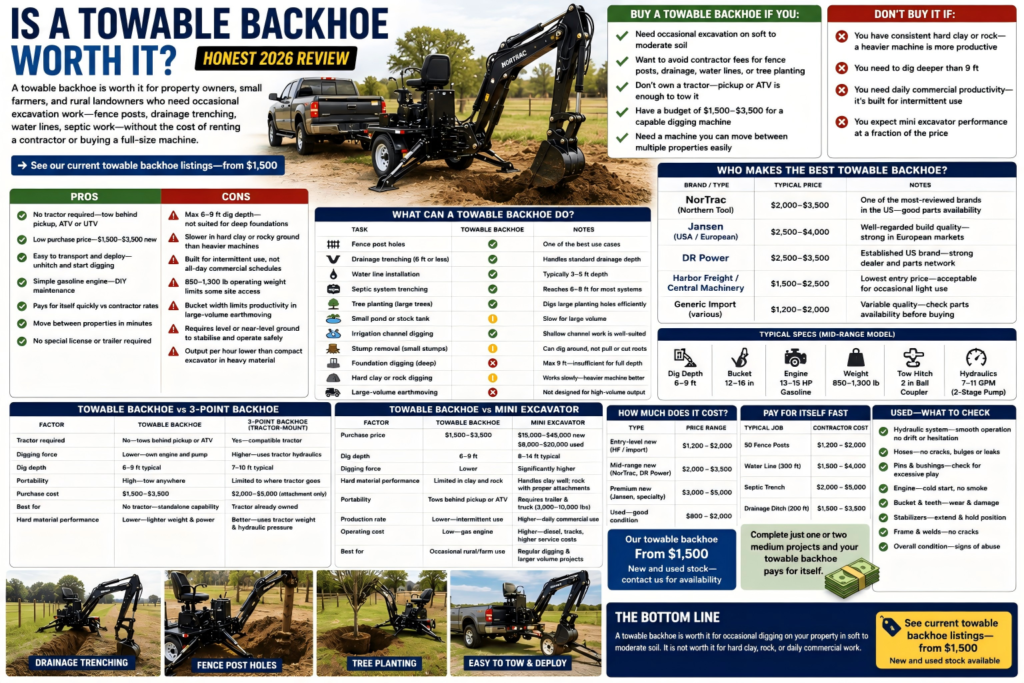
A towable backhoe worth it for property owners, small farmers, and rural landowners who need occasional excavation work — fence posts, drainage trenching, water lines, septic work — without the cost of renting a contractor or buying a full-size machine. At $1,500–$3,500 new, a towable backhoe reaches 6–9 ft depth, tows behind a pickup or ATV, and pays for itself after a few jobs that would otherwise cost $800–$2,000 each in contractor fees. It is not worth it for hard clay, rock, or jobs requiring more than 9 ft depth — for those, a mini excavator or compact backhoe loader is the right machine. This guide gives you the honest case for both sides.
👉 See our current towable backhoe listings — from $1,500 →
Written by: Farmers Equipment editorial team.
Buy a towable backhoe if you:
✅ Need occasional excavation on soft to moderate soil
✅ Want to avoid contractor fees for fence posts, drainage, water lines, or tree planting
✅ Don’t own a tractor — a pickup or ATV is enough to tow it
✅ Have a budget of $1,500–$3,500 for a capable digging machine
✅ Need a machine you can move between multiple properties easily
❌ Don’t buy it for consistent hard clay or rock — a heavier machine is more productive
❌ Don’t buy it for jobs requiring more than 9 ft depth
❌ Don’t buy it for daily commercial digging — it’s built for intermittent use
Towable Backhoe — Pros and Cons
| ✅ Pros | ⚠️ Cons |
|---|---|
| No tractor required — tows behind pickup, ATV, or UTV | Max 6–9 ft dig depth — not suited for deep foundations |
| Low purchase price — $1,500–$3,500 new | Slower in hard clay or rocky ground than heavier machines |
| Easy to transport and deploy — unhitch and start digging | Built for intermittent use, not all-day commercial schedules |
| Simple gasoline engine — DIY maintenance | 850–1,300 lb operating weight limits some site access |
| Pays for itself quickly vs contractor rates | Bucket width limits productivity in large-volume earthmoving |
| Move between properties in minutes | Requires level or near-level ground to stabilise and operate safely |
| No special licence or trailer required | Output per hour lower than compact excavator in heavy material |
Are Towable Backhoes Any Good?
Yes — within their design envelope. A towable backhoe is genuinely capable for the jobs it was designed for: fence post holes, drainage trenches, water line installation, septic system trenching in reasonable soil, pond digging, and tree planting. Owners who use them for these tasks consistently report satisfaction and note the machine pays for itself quickly against what contractor rates would cost for the same work.
The complaints come from buyers who push the machine beyond what it was designed for — digging in consistent hard clay or rock, expecting all-day commercial productivity, or needing depths beyond 9 ft. These limitations are not manufacturing defects; they reflect the machine’s weight class and power range. The key question is whether your work falls within its capability range.
Owner experience from buyers who purchased for small farm and rural property use is consistently positive. For independent specification data on towable backhoe models, TractorData.com provides manufacturer specs without commercial bias. Common feedback: easy to learn in under an hour, straightforward maintenance, and the portability — tow it behind a pickup, deploy in minutes, move to the next job — is a genuine practical advantage that a fixed-location or self-propelled machine can’t match.
What Can a Towable Backhoe Do?
| Task | Towable Backhoe | Notes |
|---|---|---|
| Fence post holes | ✅ Excellent | One of the best use cases — fast, precise depth control |
| Drainage trenching (6 ft or less) | ✅ Excellent | Handles standard drainage depth in soft to moderate soil |
| Water line installation | ✅ Good | Typically 3–5 ft depth — well within capability |
| Septic system trenching | ✅ Good | Reaches 6–8 ft needed for most residential septic work |
| Tree planting (large trees) | ✅ Good | Digs large planting holes efficiently |
| Small pond or stock tank | ✅ Capable | Slow for large volume — works well for small ponds |
| Irrigation channel digging | ✅ Good | Shallow channel work is well-suited |
| Stump removal (small stumps) | ⚠️ Partial | Can dig around stumps but not pull or cut roots |
| Foundation digging (deep) | ❌ Not suitable | Max 9 ft — insufficient for full foundation depth |
| Hard clay or rock digging | ⚠️ Limited | Works slowly — heavier machine more productive |
| Large-volume earthmoving | ❌ Not designed for | Bucket size and weight class limits volume output per hour |
Who Makes the Best Towable Backhoe?
The towable backhoe market includes several established brands alongside a large number of import machines at varying quality levels:
| Brand / Type | Typical Price | Notes |
|---|---|---|
| NorTrac (Northern Tool) | $2,000–$3,500 | One of the most-reviewed towable backhoe brands in the US — commonly compared by buyers. Known for reasonable parts availability |
| Jansen (USA / European) | $2,500–$4,000 | Well-regarded build quality — stronger reputation in European markets |
| DR Power | $2,500–$3,500 | Established US brand — strong dealer and parts network |
| Harbor Freight / Central Machinery | $1,500–$2,500 | Lowest entry price — acceptable for occasional light use; parts and support more limited than established brands |
| Generic import (various) | $1,200–$2,000 | Variable quality — check parts availability before buying; service support often limited |
Which brand is best? For buyers prioritising reliability and parts availability over lowest price — NorTrac, Jansen, and DR Power are the consistently recommended choices among experienced users. For occasional light use where lowest entry cost is the priority — a Central Machinery or comparable machine performs adequately. Avoid unknown import brands with no US parts support for anything other than the most occasional use.
How Deep Does a Towable Backhoe Dig?
Most towable backhoes dig to 6–9 ft (1.8–2.7m) depth. The specific depth depends on the model — entry-level machines typically reach 6–7 ft, while more capable models reach 8–9 ft. The Harbor Freight / Central Machinery model commonly searched by buyers digs to approximately 5–6 ft — shallower than mid-range models. Confirm the exact digging depth specification for the specific model before purchasing if your jobs require maximum depth.
For work regularly requiring more than 9 ft, a towable backhoe reaches its limit — a mini backhoe or compact excavator is the appropriate choice for deeper consistent work. We also stock backhoe attachments for tractor owners →
Towable Backhoe vs 3-Point Backhoe — Which Is Better?
| Factor | Towable Backhoe | 3-Point Backhoe (Tractor-Mount) |
|---|---|---|
| Tractor required | No — tows behind pickup or ATV | Yes — compatible tractor with 3-point hitch and hydraulics |
| Digging force | Lower — own engine and pump | Higher — uses tractor engine and hydraulic output |
| Dig depth | 6–9 ft typical | 7–10 ft typical on compact tractors |
| Portability | High — tow anywhere with a ball hitch | Limited to where the tractor can travel |
| Purchase cost | $1,500–$3,500 | $2,000–$5,000 for attachment (tractor not included) |
| Best for | No tractor owned — standalone digging capability | Tractor already owned — adds backhoe function to existing machine |
| Hard material performance | Lower — lighter weight and power | Better — uses tractor weight and hydraulic pressure |
Are 3-point backhoes any good? Yes — a 3-point backhoe is generally the stronger digger if you already own a compatible tractor. The tractor’s engine, weight, and hydraulics provide more digging force and better performance in hard ground than a towable unit’s independent engine. The towable backhoe wins only on portability and not requiring a host tractor. If you already own a tractor with a 3-point hitch, the 3-point attachment is usually the better digging tool; if you don’t own a tractor, the towable backhoe is the practical alternative.
Towable Backhoe vs Mini Excavator
| Factor | Towable Backhoe | Mini Excavator |
|---|---|---|
| Purchase price | $1,500–$3,500 | $15,000–$45,000 new; $8,000–$20,000 used |
| Dig depth | 6–9 ft | 8–14 ft typical |
| Digging force | Lower | Significantly higher |
| Hard material performance | Limited in clay and rock | Handles clay well; struggles with rock without attachments |
| Portability | Tows behind pickup or ATV | Requires trailer and truck rated for 3,000–10,000 lbs |
| Manoeuvrability on site | Stationary — digs from one position | Self-propelled — can reposition without unhitching |
| Production rate | Lower — suited for intermittent use | Higher — suited for daily commercial use |
| Operating cost | Low — simple gasoline engine | Higher — diesel engine, track maintenance, higher service costs |
| Best for | Occasional rural/farm jobs on soft to moderate soil | Regular digging, larger volume, harder material |
The honest verdict: a mini excavator is a better digger in every objective measure — more power, more depth, better in hard material, self-propelled. The towable backhoe wins only on price and portability. If your excavation needs are occasional and the soil is workable, the $1,500–$3,500 towable backhoe is a rational purchase. If you dig regularly, in hard ground, or need consistent daily output, the mini excavator earns its significantly higher price.
How Much Does a Towable Backhoe Cost?
| Type | Price Range | Notes |
|---|---|---|
| Entry-level new (Harbor Freight / import) | $1,200–$2,000 | Basic capability — occasional light use |
| Mid-range new (NorTrac, DR Power) | $2,000–$3,500 | Better build quality, more reliable parts support |
| Premium new (Jansen, specialty) | $3,000–$5,000 | Best build quality and longest service life |
| Used — good working condition | $800–$2,000 | Best value for buyers who inspect before purchasing |
| Our towable backhoe | From $1,500 | New and used stock — contact us for current availability |
The break-even calculation is straightforward: a single drainage trench or septic job that would cost $1,500–$2,500 from a contractor pays for the machine. Fence post drilling across a property of any size — typically $15–$40 per post by contractor — covers the purchase price in one project for most rural buyers.
What to Check Before Buying a Used Towable Backhoe
- Hydraulic system — operate all functions (boom, dipper, bucket, stabilisers) and confirm smooth, full-range movement with no hesitation or drift
- Hose condition — inspect all hydraulic hoses for cracking, bulging, or weeping. Hose replacement runs $60–$200 per hose — factor into offer price
- Pivot pins and bushings — check all arm joints for excessive play. Worn pins cause sloppy bucket control and expensive rebuilds
- Engine start cold — confirm cold start without excessive cranking or smoke
- Bucket and teeth condition — worn or damaged teeth reduce digging efficiency; replacements are inexpensive but confirm before pricing
- Stabiliser legs — extend both fully and confirm they hold position without sinking
- Frame and welds — inspect for cracks around high-stress areas: boom base, dipper joint, stabiliser mounts
Verdict — Is a Towable Backhoe Worth It?
A towable backhoe is worth it for the right buyer — and genuinely not worth it for the wrong one. The right buyer is a rural property owner, small farmer, or landscaper who needs occasional excavation in soft to moderate soil, doesn’t own a tractor, and wants to avoid contractor fees for jobs that recur every season. At $1,500–$3,500, it pays for itself in one or two contractor-avoided jobs and continues to pay back for years of occasional use.
The wrong buyer is anyone who needs to dig in consistent hard clay or rock, requires daily commercial output, needs more than 9 ft depth, or compares it to a mini excavator and expects the same performance. The towable backhoe does not compete with heavier machines on output — it competes on price, portability, and total cost of ownership for the buyer who genuinely only needs occasional digging.
If you fall in the first category — it is worth buying. If you fall in the second — look at our mini backhoe from $5,000, John Deere backhoe from $8,000, or full backhoe loader range →
Also available: Excavators for Sale · Skid Steer Loaders · Backhoe Attachments →
👉 See current towable backhoe listings — from $1,500. New and used stock available →
Frequently Asked Questions
Are towable backhoes any good?
Yes — for their intended use. Towable backhoes are genuinely capable for fence posts, drainage trenching, water line installation, septic trenching, and tree planting in soft to moderate soil. They reach 6–9 ft depth, tow behind a standard pickup or ATV, and cost $1,500–$3,500 — a fraction of contractor costs for recurring excavation jobs. They are not suited for consistent hard clay or rock, daily commercial use, or depths beyond 9 ft.
Who makes the best towable backhoe?
NorTrac (Northern Tool), DR Power, and Jansen are the consistently recommended brands among experienced buyers. NorTrac is the most widely reviewed in the US market and has reasonable parts availability. DR Power has a strong dealer network. Jansen is well-regarded for build quality. Harbor Freight / Central Machinery is the lowest-cost option — acceptable for occasional light use but with more limited parts and service support than the established brands.
How deep does a Harbor Freight towable backhoe dig?
The Harbor Freight / Central Machinery towable backhoe typically digs to approximately 5–6 ft depth — shallower than mid-range models which reach 7–9 ft. For most fence post and shallow drainage work this is adequate. For septic system trenching or jobs requiring 7–9 ft, a mid-range model from NorTrac or DR Power reaches greater depth.
Are 3-point backhoes worth it?
Yes — if you already own a compatible tractor. A 3-point backhoe attachment uses the tractor’s engine, weight, and hydraulics for more digging force and better hard-ground performance than a towable unit’s independent engine. Cost is $2,000–$5,000 for the attachment only. If you don’t own a tractor, the towable backhoe is the practical alternative — no host vehicle beyond a pickup or ATV required.
Is a towable backhoe better than a mini excavator?
A mini excavator is the better digger — more power, greater depth, better in hard material, self-propelled. A towable backhoe wins only on price ($1,500–$3,500 vs $15,000–$45,000 new) and portability (tows behind a pickup vs requires a rated trailer). For occasional digging in workable soil, the towable backhoe is a rational choice. For regular digging, hard material, or commercial output requirements, the mini excavator earns its significantly higher price.