Small backhoe vs mini backhoe — and whether to add a tractor backhoe attachment instead — is one of the most common equipment questions farmers, landscapers, and contractors face. When it comes to digging, trenching, and hauling on a farm, these are the three options that come up most often. Each handles similar work, but they differ significantly in price, ease of use, and flexibility.
If you’re a small contractor, farmer, or landscaper, making the right choice can save you hundreds of hours of labor and thousands of dollars. Here, we compare the pros and cons of tractor attachments and small backhoe loaders so you can figure out which one fits your needs best.
Looking for available machines? Browse our current Mini Backhoe for Sale listings to compare models and pricing.
What Is a Small Backhoe Loader?
A small backhoe loader is a smaller version of the standard backhoe loader — essentially a two-in-one machine with:
- A front loader bucket for lifting, loading, and hauling material
- A rear backhoe arm for digging trenches, foundations, and holes
Typical features:
- Digging depth: 8–12 feet
- Weight: 6,000–12,000 lbs
- Engine power: 40–75 HP
- Typical used models often sell between $15,000 and $35,000, while new compact backhoe loaders from major manufacturers generally cost considerably more depending on configuration
Typical used-market prices vary by brand, age, condition, and included attachments — many new compact backhoe loaders from major manufacturers run considerably higher.
Small backhoe loaders are built for farms, construction companies, and landscape businesses that need serious performance in a compact package.
What Is a Tractor Backhoe Attachment?
A tractor backhoe attachment is an aftermarket unit mounted on the rear of a tractor. Instead of buying a standalone backhoe loader, you add a backhoe arm to your existing tractor.
Standard specifications:
- Digging depth: 6–10 feet (depends on tractor size)
- Weight: 1,000–2,000 lbs (added to tractor weight)
- Engine power: Depends on tractor, usually 25–60 HP
- Price range: $3,500–$7,000 (attachment only)
These are typical prices for standard aftermarket attachments — premium or brand-specific models can exceed this range.
Tractor backhoe attachments are ideal for farmers who already own a tractor and want affordable digging power without a second machine.
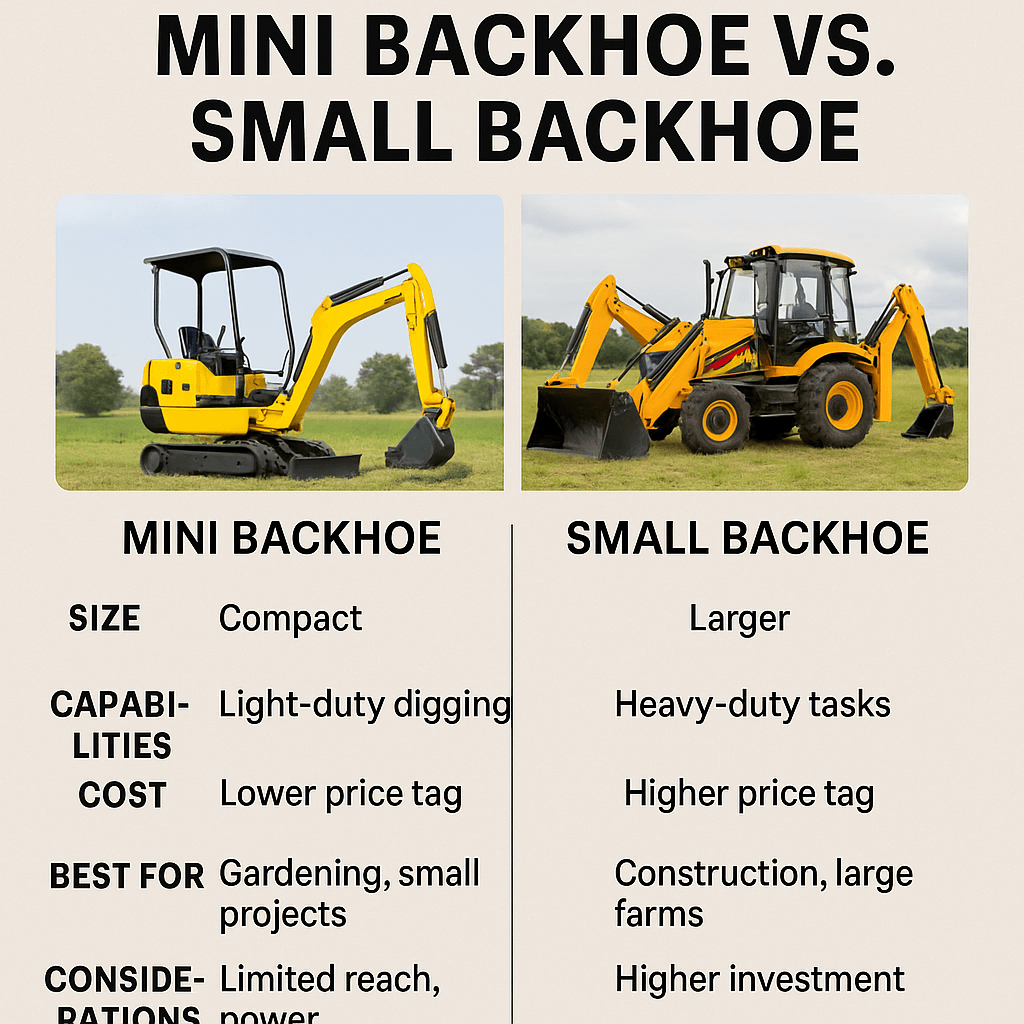
Which Backhoe Tier Is Right for You? A Quick Comparison
| Tier | Digging Depth | Weight | Typical Price | Best For |
|---|---|---|---|---|
| Miniature Backhoe | 3–6 feet | 1,000–1,500 lbs | $2,000–$8,000 | Hobby farms, DIY, light landscaping |
| Mini Backhoe Loader | 5–10 feet | 2,500–8,000 lbs | $5,000–$50,000+ | Small to medium farms |
| Small Backhoe Loader | 8–12 feet | 6,000–12,000 lbs | $15,000–$35,000 | Farms, contractors, landscaping companies |
This page focuses on the Small Backhoe Loader tier, including a full small backhoe vs mini backhoe breakdown further down. For smaller, lighter-duty options, see our Miniature Backhoe guide or our Mini Backhoe Loader buying guide.
Small Backhoe Loader vs. Tractor Attachment: Key Comparison
| Feature | Small Backhoe Loader | Tractor Backhoe Attachment |
|---|---|---|
| Cost | $15,000–$35,000 | $3,500–$7,000 |
| Power | Independent hydraulics, more powerful | Relies on tractor hydraulics |
| Versatility | Digging + lifting/hauling | Mainly digging only |
| Maneuverability | Designed for job sites | Limited by tractor design |
| Transport | Towable but heavier | Lighter and easier to move |
| Best For | Farms, contractors, landscaping companies | Farmers with existing tractors |
Small Backhoe vs Mini Backhoe
Another common question in the small backhoe vs mini backhoe decision: instead of a tractor attachment, should you go with a mini backhoe instead of a small backhoe loader? Both are standalone machines, but they sit at different points on the size and price spectrum.
| Feature | Mini Backhoe | Small Backhoe Loader |
|---|---|---|
| Size | Extremely compact, ideal for small areas | A bit bigger, still smaller than full-size backhoes |
| Price | $5,000–$15,000 used; $15,000–$50,000+ new | $15,000–$35,000 |
| Digging Depth | 5–10 feet | 8–12 feet |
| Power | Moderate — farm & landscaping work | More powerful — light construction |
| Transport | Easy to tow behind small trailers | Needs a bigger trailer or truck |
| Best For | Small farms, homeowners | Commercial farms, contractors |
Choose a Mini Backhoe if:
- You’re working with a tighter budget
- You need equipment for light farm or landscaping jobs
- You want a machine that’s easy to store and transport
- You don’t need deep excavation capability
Choose a Small Backhoe Loader if:
- You’re handling larger projects (construction, commercial landscaping)
- Your budget supports a higher upfront cost
- You need more digging capacity
- You’ll be doing a significant amount of commercial or daily work
For full mini backhoe pricing, models, and features, see our Mini Backhoe Loader Buying Guide. Whichever way you lean in the small backhoe vs mini backhoe decision, matching the machine to your actual job size will save you money in the long run.
Pros and Cons of Small Backhoe Loaders
Before diving deeper into the small backhoe vs mini backhoe question, here’s a closer look at what a small backhoe loader specifically brings to the table.
Pros:
- Self-contained machine — dig, lift, and haul in one package
- Independent hydraulics, more powerful than tractor attachments
- Commercial-grade performance for daily farm or job site use
- Better resale value — retains value longer
Cons:
- Higher initial cost
- Heavier — requires a larger trailer to tow
- More complex machine, higher maintenance expense
Pros and Cons of Tractor Backhoe Attachments
Pros:
- Affordable — a fraction of the cost of a small backhoe loader
- Lightweight and easier to tow
- Convenient — makes use of a tractor you already own
- Well-suited to occasional or periodic digging needs
Cons:
- Less powerful — draws on the tractor’s existing hydraulics
- The attachment itself provides digging capability only; any front-loader capability depends on whether the tractor is already equipped with a loader
- Heavy or prolonged digging can place additional stress on a tractor’s frame and hydraulic system, particularly if the attachment is not properly matched to the tractor or installed with the manufacturer’s recommended subframe
- Depreciates faster than a standalone loader
Farmers commonly use backhoes for irrigation, drainage, and utility projects. For more digging technique discussion from other owners, see the TractorByNet backhoe forums.
Which One Is Better for Farms?
- Small farms: A tractor backhoe attachment is usually enough for planting, fencing, and irrigation work.
- Medium farms: A small backhoe loader offers more versatility for continuous, regular use.
- Large farms or contractors: A small backhoe loader is the better fit for daily heavy-duty operations.
If your farm involves regular hauling and digging, a small backhoe loader tends to pay off in the long run. If you rarely dig, a tractor attachment is the cheaper, more convenient choice. If portability across multiple sites matters more than raw power, also consider a towable backhoe as a third option.
Costs Compared Over 5 Years
| Expense | Small Backhoe Loader | Tractor Backhoe Attachment |
|---|---|---|
| Initial Purchase | $15,000 | $5,000 |
| Fuel & Maintenance (5 yrs) | $5,000 | $3,000 |
| Resale Value | –$7,000 | –$1,500 |
| Net 5-Year Cost | $13,000 | $6,500 |
Illustrative example only. Ownership costs vary significantly depending on purchase price, annual operating hours, maintenance practices, fuel prices, and resale conditions. Contact us for current pricing on specific models. These estimates assume moderate annual use and are intended for comparison purposes only.
While attachments are cheaper to purchase upfront, a small backhoe loader tends to hold more of its value and can be the better long-term investment for frequent users.
Explore more in our farm equipment category for tools that complement land preparation.
When a Dedicated Small Backhoe Loader Makes More Sense
A dedicated small backhoe loader is often the better choice when digging is a regular part of your work rather than an occasional task. Contractors, municipalities, landscape companies, and larger farms typically benefit from faster cycle times, stronger hydraulic performance, and the ability to switch quickly between loading and excavation without relying on another tractor.
If your machine will spend several days each week trenching, loading gravel, clearing drainage ditches, or preparing foundations, investing in a dedicated loader can improve productivity and reduce downtime. For heavier excavation needs beyond what a backhoe loader can handle, also browse our compact excavation equipment. And if you’re still narrowing down your overall equipment strategy, our Tractor Buying Guide covers the broader decision-making process.
Inspection Checklist Before Buying a Used Small Backhoe Loader
- Inspect hydraulic cylinders for leaks
- Check loader pins and bushings for wear
- Test all hydraulic functions through their full range
- Inspect tires for uneven wear
- Review maintenance records and documented service history
- Look for weld repairs on the boom, which can indicate prior damage
- Verify hour meter accuracy against overall wear and condition
- Start the engine cold to check starting performance
Buying Tips for Each Option
If Buying a Small Backhoe Loader:
- Check the hydraulics and joints for leaks
- Review service history, if the unit is used
- Test the front loader and backhoe arm before buying
- Look for established brands like Kubota, John Deere, or Case
If Buying a Tractor Backhoe Attachment:
- Confirm your tractor has sufficient HP and hydraulic flow
- Verify the attachment fits your tractor’s frame
- Inspect used units for cracks and worn cylinders
- Find a dealer who can support you with replacement parts
Real-World Examples
Here’s how the small backhoe vs mini backhoe vs tractor attachment decision plays out for three real types of buyers:
Farmer A (small farm, 10 acres): Bought a $5,000 tractor backhoe attachment. Uses it for fencing and irrigation trenching a few times a year — saved money by not buying a full standalone machine.
Farmer B (medium farm, 50 acres): Bought a small backhoe loader for $18,000. Uses it weekly for fencing, irrigation, hauling compost, and small construction jobs. Farmer B estimated that reduced rental expenses and labor savings allowed the machine to pay for itself in under two years.
Contractor C (landscaping contractor): Needed daily-use equipment for trenching, digging ponds, and moving dirt. A tractor attachment wouldn’t have delivered enough power, so a small backhoe loader was the right call.
Frequently Asked Questions
Q1: Which is more cost-effective in the long run?
In the small backhoe vs mini backhoe vs attachment comparison, attachments cost less upfront, but standalone loaders tend to hold their value better and last longer, often making them the stronger long-term investment for frequent users.
Q2: Will a tractor attachment dig as deep as a backhoe loader?
Usually not — most attachments max out around 8–10 feet, while dedicated loaders can dig deeper.
Q3: Do I need a license to operate one?
No license is typically needed for farm use. Contractors may need local permits depending on the job and jurisdiction.
Q4: Can I use both on the same farm?
Yes — some farmers use a tractor attachment for small, occasional jobs and a small backhoe loader for larger or more frequent digging.
Q5: Are tractor attachments hard on tractors?
Frequent heavy digging can put real strain on a tractor’s frame and hydraulics over time, so occasional use is generally a better fit than daily commercial-level digging.
Q6: Which holds resale value better?
Small backhoe loaders, especially from established brands, generally retain more of their value than attachments.
Q7: Can attachments be removed easily?
Yes — most tractor backhoe attachments can be removed in about 15–30 minutes.
Q8: Which is more effective for fencing work?
Both can get the job done, but loaders are often faster when paired with an auger attachment.
Q9: Are small backhoe loaders fuel-efficient?
Yes, particularly compact models in the 40–50 HP range.
Q10: Which is better for a beginner?
Tractor attachments are generally easier to learn on, while backhoe loaders offer more versatility once an operator is comfortable.
Last Words – Which One Should You Pick?
The small backhoe vs mini backhoe vs tractor attachment decision comes down to your budget, how often you’ll use it, and the size of your operation.
If you already own a tractor and only need occasional light digging, a backhoe attachment is the more wallet-friendly option. If you need a versatile standalone machine to dig, lift, and haul on a weekly basis, comparing a small backhoe against a mini backhoe will help you land on the right size — and either one is a stronger long-term investment than an attachment for frequent, heavier use.
Ready to make your choice? Start today by browsing our Mini Backhoe for Sale listings and find the right solution for your farm or business.