Mini backhoe uses span farms, landscaping projects, and residential construction, since these machines combine digging and material-handling capability in a compact package that can access areas larger equipment often can’t reach. A mini backhoe doesn’t need to be as large as a typical backhoe loader to still be powerful enough for a wide range of tasks.
From trenching to clearing land, a mini backhoe can replace hours of manual labor and save you thousands in rental costs. In this guide, we’ll walk through the top 5 applications of a mini backhoe, how they play out in real-world use, and answer the most common questions customers ask before buying.
Ready to purchase? See our Mini Backhoe for Sale listings.
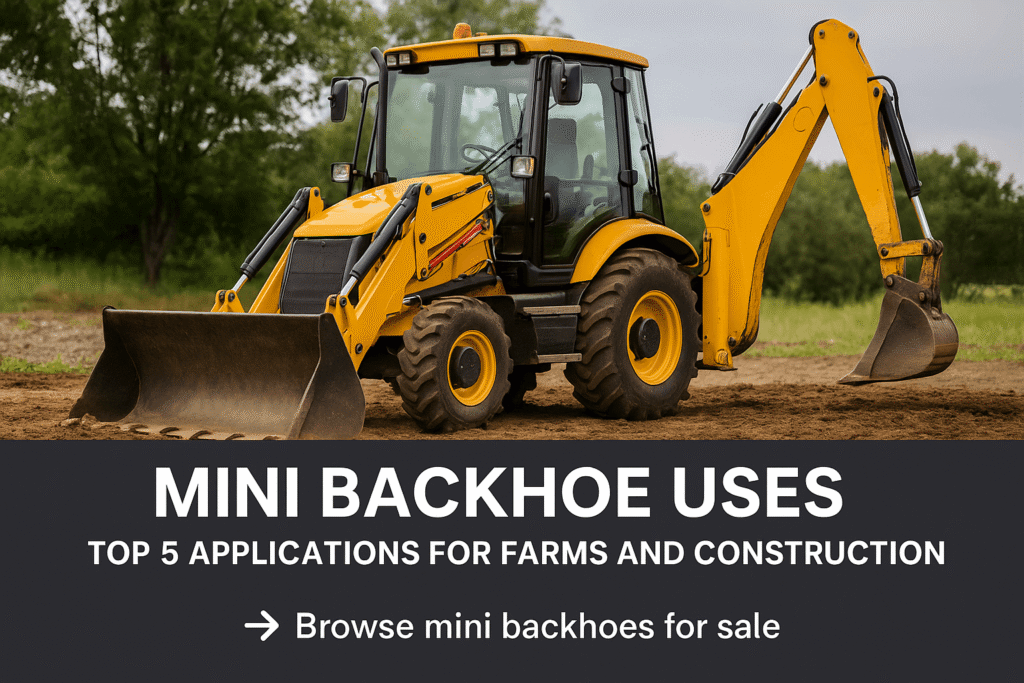
Quick Summary: Where Mini Backhoes Get Used
| Use | Farm | Construction |
|---|---|---|
| Trenching | ✓ | ✓ |
| Landscaping | ✓ | ✓ |
| Material Handling | ✓ | ✓ |
| Post Holes & Foundations | ✓ | ✓ |
| Demolition & Cleanup | ✓ | ✓ |
1. Trenching and Utility Work
Trenching is probably the most common use for mini backhoes. Contractors and farmers regularly need trenches for essential utilities, and a mini backhoe makes quick work of it.
Farm Applications:
- Installing irrigation pipes for crops
- Installing drainage systems to manage water runoff
- Running small water lines to barns and cattle pens
Construction Applications:
- Digging trenches for sewer and water pipes
- Digging trenches for electrical cable runs
- Preparing foundations for retaining walls or small structures
Case Example: On smaller properties, a mini backhoe can reduce irrigation trenching from days of manual digging to a weekend project, depending on soil conditions and trench length.
Learn more about compatible equipment in our tractor attachments guide.
2. Landscaping and Land Preparation
Mini backhoes are a favorite landscaping tool because they can grade, lift, and dig with ease.
Farm Landscaping Uses:
- Preparing soil for orchard or vineyard planting
- Digging ornamental ponds or farm tanks
- Removing stumps, rocks, and brush
Construction Landscaping Uses:
- Leveling residential yards for sod installation
- Preparing land for concrete driveways or patios
- Resurfacing commercial properties for curb appeal
Case Example: A landscape contractor can excavate a 6-foot-deep garden pond with a mini backhoe, haul out the spoil, and grade the site — all in a single day.
For more owner discussion on landscaping applications, see the TractorByNet forums.
3. Material Handling – Soil, Gravel, and Compost
Material handling is another major use case. With its loader bucket, a mini backhoe performs many of the same functions as a small loader, moving heavy loads with ease.
Farm Applications:
- Hauling compost and manure across fields
- Moving feed bags or hay bales between barns
- Moving soil for raised beds or planting
Construction Applications:
- Loading gravel, sand, or dirt into a truck
- Hauling concrete blocks or demolition rubble
- Transferring building materials around a job site
This dual-use functionality — digger plus loader in one machine — is why the mini backhoe is one of the most cost-effective investments for both farms and construction sites. For current market reference, see listings at MachineryTrader.
4. Digging Post Holes and Small Foundations
Precision digging is another strong use case for mini backhoes, from post holes to small foundations.
Farm Applications:
- Digging fence post holes
- Planting fruit trees and vineyard posts
- Digging compost or silage pits
Construction Applications:
- Building foundations for garages or sheds
- Installing septic tanks or drainage pits
- Excavating retaining wall footings
Tip: An auger attachment on a mini backhoe can drill dozens of fence post holes in minutes rather than hours of hand digging.
See compatible tractor attachments here.
5. Demolition and Site Cleanup
Demolition and cleanup rounds out the most practical mini backhoe applications.
Farm Applications:
- Demolishing small barns or sheds
- Removing old posts and fencing
- Removing large tree stumps
Construction Examples:
- Breaking up small concrete pads
- Clearing construction debris from job sites
- Removing general waste material
Because of their size and mobility, mini backhoes are ideal for residential work where full-sized excavators are simply too large to maneuver.
Bonus Mini Backhoe Uses
Mini backhoes are more versatile than many people realize. Owners also use them for:
- Snow removal with a blade attachment
- Ditching along rural roads
- Building farm enclosures and animal pens
- Backyard landscaping, patio, and pond projects
Why Farmers and Contractors Choose Mini Backhoes
- Affordable — quality used models can often be found under $8,000, depending on age, condition, and brand
- Multi-Tasking — handles several jobs with one machine
- Lower Operating Costs — smaller engines mean less fuel and often lower repair costs than larger equipment
- Beginner-Friendly — easy for new operators to learn
Check out our Mini Backhoe for Sale listings today.
Pros and Cons of Mini Backhoe Uses
Pros:
- Multi-purpose: dig, load, lift, and tow
- Lower upfront cost than full-size equipment
- Easy to relocate on a trailer
- Well-suited to small building sites and farms
Cons:
- Shallow dig depth (typically 5–8 feet)
- Not sufficient for heavy commercial construction
- May require frequent attachment swapping depending on the job
Frequently Asked Questions
Q1: What are the most common mini backhoe uses?
Trenching, landscaping, material handling, small foundation digging, and site cleanup.
Q2: How much does a mini backhoe cost?
Used models typically run $5,000–$15,000, while new models range from about $10,000 for imported entry-level machines up to $50,000+ for established brands.
Q3: Will mini backhoes ever replace larger backhoes?
Not for heavy commercial work — but they’re excellent for small- to medium-sized jobs.
Q4: How deep can a mini backhoe dig?
Most dig 5–8 feet.
Q5: Are mini backhoes useful on farms?
Yes — they’re well-suited to irrigation, fencing, and material handling work.
Q6: Can mini backhoes handle landscaping work?
Yes — compact enough for backyards, yet powerful enough for pond digging or grading.
Q7: Are mini backhoes easy to transport?
Yes — many compact models are light enough to be transported on an appropriately rated equipment trailer, though towing requirements vary by machine weight, which can range from around 2,500 to 8,000 lbs depending on the model.
Q8: Do mini backhoes hold resale value?
Well-maintained units from brands like Kubota, John Deere, and Mahindra tend to hold resale value well.
Q9: Are mini backhoes suited for daily use?
Yes — with proper maintenance, they hold up well as daily workhorses for farm or light construction work.
Q10: Are mini backhoes easy for new operators to learn?
Yes — most operators pick up the basic controls within a few hours.
Final Considerations – Why Mini Backhoe Uses Matter
Now that you understand the range of mini backhoe uses, it’s easy to see why this small machine is so essential. On farms, it supports irrigation, fencing, and hauling. On construction sites, it handles trenching, foundations, and cleanup.
For small farmers, landscapers, and construction workers, the mini backhoe is often the most affordable, versatile, and easy-to-maintain machine on the market.
Looking to invest? Visit our Mini Backhoe for Sale page and discover affordable options today.