Getting the Ford 8N oil type and capacity right is one of the most fundamental maintenance tasks on a classic Ford — and one of the most searched, because the 8N has two separate lubrication systems that are easy to confuse. The engine oil and the transmission/hydraulic fluid are different products, filled in different locations, and wrong fluid in the wrong system causes real damage. This guide covers both systems completely: what to use, how much, where to put it, which brands work, and what to use in cold weather.
👉 Check current Ford 8N listings — see available stock and pricing →
Written by: Farmers Equipment editorial team — specialising in classic Ford tractors from the N-Series through the Thousand Series.
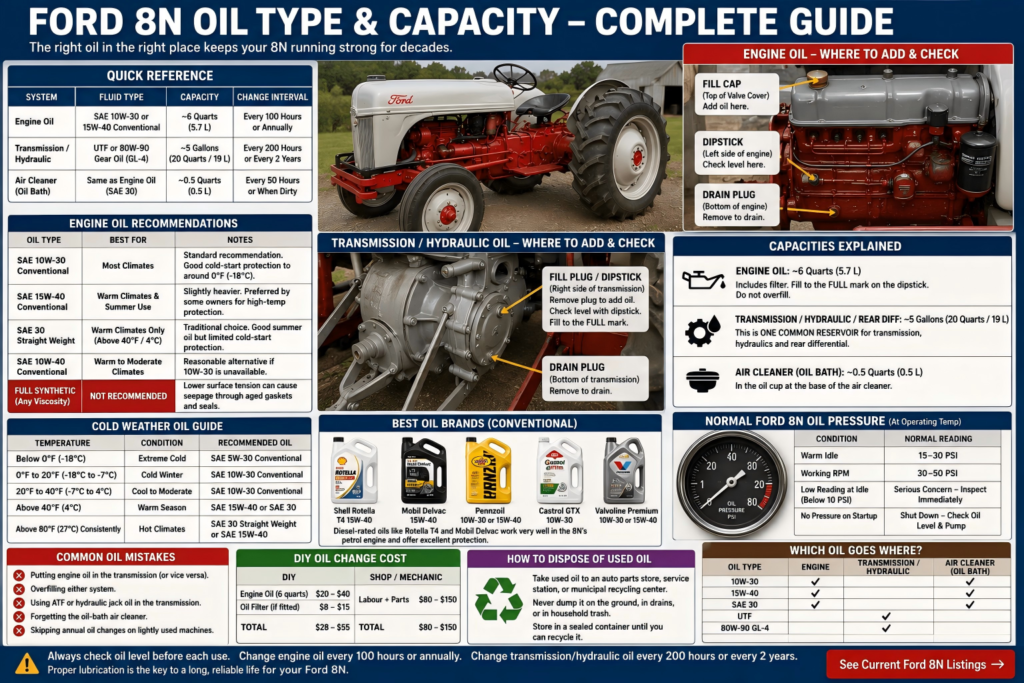
Ford 8N Oil Type and Capacity — Quick Reference
| System | Fluid Type | Capacity | Change Interval |
|---|---|---|---|
| Engine oil | SAE 10W-30 or 15W-40 conventional | ~6 quarts (5.7 L) | Every 100 hours or annually |
| Transmission / hydraulic | UTF or 80W-90 gear oil | ~6 quarts (5.7 L) | Every 200 hours or every 2 years |
| Air cleaner (oil bath) | Same as engine oil (SAE 30) | ~0.5 quarts | Every 50 hours or when dirty |
Ford 8N Engine Oil — Type and Recommendations
What oil should I use in a Ford 8N tractor?
The Ford 8N flathead engine runs comfortably on modern multi-viscosity motor oils. The correct choice depends on your climate and how the machine is stored:
| Oil Type | Best For | Notes |
|---|---|---|
| SAE 10W-30 conventional | Most climates — the standard recommendation | Good cold-start protection to around 0°F (-18°C) |
| SAE 15W-40 conventional | Warm climates and regular summer use | Slightly heavier — preferred by some owners for high-temperature operation |
| SAE 30 straight weight | Warm climates only (above 40°F / 4°C) | Traditional choice — good summer oil but limited cold-start protection |
| SAE 10W-40 conventional | Warm to moderate climates | Reasonable alternative if 10W-30 is unavailable |
| Full synthetic (any viscosity) | Not recommended on classic Fords | Lower surface tension can cause seepage through aged gaskets and seals |
The clearest guidance: use SAE 10W-30 conventional motor oil in most conditions. It provides adequate viscosity across a wide temperature range, is widely available, and is compatible with the 8N’s flathead engine and its older gaskets and seals.
Why not full synthetic on a Ford 8N?
Full synthetic oils have lower surface tension than conventional oils — a property that improves their lubrication characteristics in modern engines with precision-machined tight tolerances and modern seals. In a 70-year-old engine with older gasket materials and worn seals, that same low surface tension allows the oil to seep through paths that conventional oil would not penetrate. The result is increased external oil leaks from gaskets and seals that were not leaking before the synthetic was used. Semi-synthetic or conventional is the right choice for the Ford 8N.
How Many Quarts of Oil Does a Ford 8N Take?
The Ford 8N engine holds approximately 6 quarts (5.7 litres) including the oil filter.
Important: after draining and refilling, add oil in increments and check the dipstick rather than assuming the full 6 quarts are required. The amount needed after a drain depends on how completely the old oil drained and whether the filter was replaced. Always fill to the full mark on the dipstick — not above it.
Where to Put Oil in a Ford 8N
Engine oil fill location
The engine oil fill cap is located on top of the valve cover — the wide flat cover on the top of the engine. It is marked or easily identifiable as the oil fill point. Remove the cap and pour oil in slowly, checking the dipstick regularly as you fill.
Engine oil dipstick location
The dipstick is on the left side of the engine block, below the valve cover. Pull it out, wipe it clean, reinsert fully, and pull again to get an accurate reading. Check the oil level when the tractor is on level ground and the engine has been off for at least a few minutes.
Engine oil drain location
The drain plug is on the bottom of the engine block. Place a drain pan of at least 6-quart capacity beneath it before removing the plug. The oil will drain hot and fast — use gloves.
Ford 8N Oil Filter
The Ford 8N was originally equipped with a bypass-style canister oil filter rather than a modern full-flow spin-on filter. In the bypass system, only a portion of the oil passes through the filter on each cycle — it provides some filtration but is less effective than a full-flow filter. Many tractors have since been converted to aftermarket spin-on full-flow filter systems using adapter kits.
If your 8N has a spin-on filter adapter: replace the filter at every oil change. Standard automotive spin-on filters that fit the adapter are widely available — confirm the thread size and dimensions from the adapter manufacturer’s specifications.
If your 8N still has the original bypass canister filter: service it per the original schedule and consider a full-flow conversion — kits are available from suppliers like Steiner Tractor Parts for $60–$120 and improve filtration meaningfully.
Best Oil Brands for a Ford 8N Tractor
Any quality conventional motor oil from a reputable brand in the correct viscosity is suitable for a Ford 8N. Brands that consistently appear in classic Ford owner communities:
| Brand | Recommended Product | Notes |
|---|---|---|
| Shell Rotella T4 | 15W-40 conventional | One of the most commonly recommended oils for classic Ford tractors — widely available, diesel-rated, good additive package |
| Mobil Delvac | 15W-40 conventional | Another diesel-grade conventional widely used in classic tractor engines — good high-temperature protection |
| Pennzoil Conventional | 10W-30 or 15W-40 | Reliable conventional option at widely available pricing |
| Castrol GTX | 10W-30 conventional | Long-established conventional motor oil — works well in the 8N engine |
| Valvoline Premium Conventional | 10W-30 or 15W-40 | Good conventional option — readily available at auto parts stores |
Note on diesel-rated oils: Shell Rotella T4 and Mobil Delvac are diesel engine oils by classification, but they work extremely well in the Ford 8N’s petrol flathead engine. The higher detergent and additive package in diesel-rated oils is beneficial for an older engine that may not have been maintained perfectly. Many experienced Ford 8N owners specifically recommend Rotella T4 15W-40 as their oil of choice.
What about ZDDP (Zinc) in Ford 8N oil?
ZDDP (zinc dialkyldithiophosphate) is an anti-wear additive found in motor oils that protects metal surfaces under high-pressure contact — particularly flat-tappet valve trains. Some classic engine owners specifically seek out high-ZDDP oils for older machines.
The Ford 8N’s flathead engine does not place the same extreme demands on valve train lubrication as high-performance overhead-valve engines — the flathead design has a simpler valve mechanism with lower contact pressures. Most quality modern conventional oils provide adequate ZDDP levels for normal Ford 8N use. However, if you prefer oils with specifically elevated ZDDP content, Shell Rotella T4 15W-40 is a diesel-rated conventional oil that maintains higher ZDDP levels than many passenger car oils — another reason it is frequently recommended for classic Ford tractors.
Specialty classic-engine oils (such as Valvoline VR1 Racing Oil or Brad Penn) also contain elevated ZDDP and are used by some classic Ford owners who want maximum additive protection. Follow the manufacturer’s recommendations for these products.
Ford 8N Oil in Cold Weather
What viscosity for a Ford 8N in cold weather?
| Season / Climate | Temperature | Recommended Oil |
|---|---|---|
| Extreme cold | Below 0°F (-18°C) | SAE 5W-30 conventional — lowest pour point |
| Cold winter | 0°F to 20°F (-18°C to -7°C) | SAE 10W-30 conventional — at its lower limit |
| Cool to moderate | 20°F to 40°F (-7°C to 4°C) | SAE 10W-30 conventional — the standard recommendation |
| Warm season | Above 40°F (4°C) | SAE 15W-40 or SAE 30 — preferred by many owners |
| Hot climates | Above 80°F (27°C) consistently | SAE 30 straight weight or SAE 15W-40 — better high-temp protection |
Cold weather starting tip: if the Ford 8N is difficult to start in cold weather, the issue is almost always the ignition system (weak points, worn condenser, old plugs) or the carburetor — not the oil viscosity. Address the ignition system before assuming oil weight is the cold-start problem. See our complete Ford 8N Maintenance Schedule for ignition service guidance.
Normal Ford 8N Oil Pressure
The Ford 8N is equipped with an oil pressure gauge on the dashboard. Understanding what normal readings look like helps catch problems early:
| Condition | Normal Reading | Action if Different |
|---|---|---|
| Cold start (first few seconds) | Gauge should move quickly on startup | No movement within 10 seconds — shut down immediately |
| Cold idle (after startup) | Higher than warm — 40–60 PSI range typical | Very low reading at cold idle — investigate before running |
| Warm idle (operating temperature) | Approximately 15–30 PSI at idle | Below 10 PSI at warm idle — serious concern, do not run |
| Operating RPM (working speed) | 30–50 PSI at working RPM | Gauge fluctuating wildly — check sending unit and gauge first |
When to be concerned: a slow pressure build on cold startup, low pressure at warm idle (below 10 PSI), or a gauge that reads zero at operating RPM all indicate engine wear or oil pump issues. The most common false alarm is a faulty oil pressure sending unit or gauge — check the sending unit before assuming engine failure. A mechanical oil pressure gauge temporarily substituted for the original is the definitive diagnostic tool.
Ford 8N Transmission and Hydraulic Oil
What oil goes in the Ford 8N transmission?
The Ford 8N uses a shared sump for the transmission, rear axle, and three-point hitch hydraulic system — all three systems share the same fluid reservoir. This is a common source of confusion for new 8N owners who assume the transmission and hydraulic system are separate.
Recommended transmission/hydraulic fluid:
| Fluid | Recommendation | Notes |
|---|---|---|
| Universal Tractor Fluid (UTF) | ✅ Recommended — modern standard | Formulated for combined transmission/hydraulic systems — best all-round choice |
| 80W-90 GL-4 gear oil | ✅ Acceptable — original specification | Original Ford specification — still used by many classic Ford owners |
| Straight motor oil (any weight) | ❌ Do not use | Not rated for gear lubrication — will not protect transmission properly |
| ATF (automatic transmission fluid) | ❌ Do not use alone | Not compatible with the 8N’s gear system — causes transmission wear |
| Hydraulic jack oil | ❌ Do not use | Not suitable for gear lubrication |
How much transmission fluid does a Ford 8N take?
Approximately 6 quarts (5.7 litres) in the combined sump. The fill point is on the right side of the transmission housing — a plug or cap that is removed to add fluid. The dipstick for checking level is in the same area. Always check the dipstick and fill to the indicated level rather than adding a fixed amount.
What oil goes in the Ford 8N rear differential?
The rear differential is part of the shared sump on the Ford 8N — there is no separate differential fluid. The same UTF or 80W-90 that lubricates the transmission also lubricates the rear axle gears. Fill through the transmission fill point and check the level with the transmission dipstick.
Ford 8N Air Cleaner Oil
The Ford 8N uses an oil-bath air cleaner — a pre-paper-filter system that uses an oil reservoir to trap airborne debris. It requires its own oil service:
- Use the same weight as the engine oil — SAE 30 or 10W-30
- Capacity: approximately half a quart in the oil cup at the base of the air cleaner
- Service interval: every 50 operating hours, or more frequently in dusty conditions
- How to service: remove the oil cup at the base of the air cleaner body, pour out the old oil (it will be dark and dirty), rinse the cup with diesel or solvent, dry, and refill to the marked line with fresh engine oil
5 Common Ford 8N Oil Mistakes
- Adding transmission fluid to the engine, or engine oil to the transmission sump — the two systems use different fluids and have separate fill points. Confirm which filler cap you are opening before pouring anything
- Overfilling the engine — oil above the full mark on the dipstick foams under the crankshaft and loses its lubricating properties. Always fill to the dipstick mark, not beyond it
- Using ATF or hydraulic jack oil in the transmission sump — ATF alone and hydraulic jack oil are not rated for gear lubrication. They will not protect the transmission gears and can cause accelerated wear
- Forgetting the oil-bath air cleaner — the air cleaner oil cup needs servicing every 50 hours. Dirty, debris-laden oil provides no filtration and allows abrasive particles directly into the engine
- Skipping annual oil changes on lightly used machines — oil degrades chemically over time regardless of hours used. A tractor used only 20 hours in a year still needs its oil changed annually — old oil becomes acidic and damages bearings during long storage periods
How Much Does a Ford 8N Oil Change Cost?
| Approach | Item | Cost |
|---|---|---|
| DIY | Engine oil (6 quarts conventional) | $20–$40 |
| Oil filter (if fitted) | $8–$15 | |
| DIY total | $28–$55 | |
| Shop / mechanic | Labour + parts | $80–$150 |
| Shop total estimate | $80–$150 |
How to Dispose of Used Ford 8N Oil
Used motor oil and gear oil must be disposed of properly — do not pour down drains, onto ground, or into household waste:
- Auto parts stores — AutoZone, O’Reilly, Advance Auto, and most independent stores accept used oil at no charge. Call ahead to confirm they take gear oil as well as motor oil
- Municipal recycling centres — most local authority recycling centres have used oil collection points. Check your local authority website for locations and accepted oil types
- Service stations — many service stations accept used oil for recycling
Store used oil in a sealed container (the original oil bottle works well) until you can take it in. Never mix used oil with other fluids — contaminated oil is harder to recycle and may be refused.
Ford 8N Oil Change — Step by Step
- Warm the engine for 5 minutes — warm oil flows out more completely than cold oil. Do not run until fully hot — warm is sufficient
- Place a drain pan with at least 6-quart capacity under the engine drain plug
- Remove the drain plug — located on the bottom of the engine block. Use the correct size wrench and expect hot oil to flow quickly
- Allow to drain fully — 10–15 minutes minimum. Tilting the tractor slightly to the drain side helps complete the drain
- Replace the drain plug — do not overtighten. Snug plus a quarter turn is sufficient on these older engine blocks
- Replace the oil filter if one is fitted — apply a thin film of fresh oil to the gasket before installing
- Add fresh oil through the valve cover fill cap — add 5 quarts, then check the dipstick. Add incrementally until the dipstick reads full. Do not overfill
- Run the engine for 2 minutes and check for leaks at the drain plug and filter. Recheck the dipstick level after shutdown and top up if needed
Verdict — Ford 8N Oil Type and Capacity
The Ford 8N oil type and capacity answer is straightforward once you understand the two separate systems: the engine takes approximately 6 quarts of SAE 10W-30 or 15W-40 conventional motor oil, changed every 100 hours or annually. The transmission/hydraulic sump takes approximately 6 quarts of UTF or 80W-90 gear oil, changed every 200 hours or every 2 years. Get these two systems right and the 8N’s drivetrain runs reliably for decades.
For the full maintenance schedule including grease fittings, ignition service, and winter storage: Ford 8N Maintenance Schedule →
For full buying guidance: Ford 8N review · Used Ford Tractor Inspection Checklist →
Also available: Ford 9N · Ford 3000 · Ford 4000 · Ford 5000
👉 See current Ford 8N listings →
Ford 8N Oil — Additional Questions Answered
What Type of Oil Filter Is Compatible with a 1950 Ford 8N?
The 1950 Ford 8N was produced without a modern full-flow spin-on oil filter as original equipment — the same bypass canister filter system applies to all 8N production years (1947–1952), including 1950 examples. The 1950 model year is notable for the mid-year distributor change (front-mount to side-mount at approximately serial 8N263,844) but the oil filtration system was unchanged throughout 8N production.
If your 1950 Ford 8N has had a spin-on filter adapter fitted by a previous owner — which is very common — the correct replacement filter depends on the adapter brand and thread specification rather than the tractor’s original spec. Common spin-on adapter systems use Fram PH3614, Wix 51334, or equivalent filters. Check the adapter manufacturer’s documentation or measure the thread to confirm the correct filter. If unsure, an N-Series parts specialist can identify the adapter from a description or photo.
What Kind of Oil Goes in the Ford 8N Rear End?
The Ford 8N rear differential is not a separate system — it shares the same combined sump as the transmission and hydraulic system. There is one fluid reservoir for all three. The correct fluid is Universal Tractor Fluid (UTF) or 80W-90 GL-4 gear oil — the same fluid specified for the transmission. Fill through the transmission fill point; the rear axle gears are lubricated by the same fluid that lubricates the transmission gears and powers the hydraulic system.
Do not add a separate rear differential fluid — there is no separate fill point or drain plug for the rear axle on the Ford 8N. The combined sump fill and drain covers everything.
What Type of Gear Oil for a Ford 8N?
80W-90 GL-4 gear oil is the original Ford specification for the combined transmission/hydraulic sump and remains acceptable today. Modern Universal Tractor Fluid (UTF) is the preferred modern alternative — it is purpose-formulated for combined transmission/hydraulic systems and typically performs better than straight gear oil in the hydraulic functions of the system. Important: use GL-4 rated gear oil, not GL-5. GL-5 oils contain additives that can damage the brass and bronze components in the Ford 8N’s transmission synchronisers and hydraulic system.
Hydraulic Fluid Questions — Ford 8N and 9N
What Type of Hydraulic Fluid for a Ford 9N Tractor?
The Ford 9N uses the same combined transmission/hydraulic sump as the Ford 8N — same system, same fluid specification. Use Universal Tractor Fluid (UTF) or 80W-90 GL-4 gear oil in the 9N transmission/hydraulic sump. The capacity is approximately the same as the 8N at 6 quarts. The 9N has no separate hydraulic reservoir — transmission, rear axle, and three-point hitch all share one sump.
Does It Matter Which Hydraulic Oil I Use in a Ford 8N?
Yes — significantly. The Ford 8N’s combined sump must simultaneously:
- Lubricate transmission gears under load (requires EP gear lubrication additives)
- Lubricate wet clutch surfaces in the transmission (requires specific friction modifiers)
- Power the Ferguson hydraulic three-point hitch system (requires hydraulic properties)
- Lubricate the rear axle gears (requires gear oil properties)
No single-purpose fluid — pure hydraulic oil, motor oil, ATF alone, or gear oil alone — is formulated to handle all four roles simultaneously. Universal Tractor Fluid (UTF) is specifically engineered for this combined application. Using the wrong fluid causes real problems: motor oil in the sump causes clutch chatter and gear wear; plain hydraulic oil causes gear scoring; ATF alone causes wet clutch friction issues. UTF covers all bases correctly.
Can I Run 80W-90 Instead of 75W-90 in a Ford 8N?
Yes — and for the Ford 8N specifically, 80W-90 is the correct specification, not 75W-90. The 80W-90 GL-4 is the original Ford 8N transmission specification. 75W-90 is a modern synthetic gear oil more commonly used in automotive differentials — it has better cold-weather flow properties but is not the specified fluid and synthetic formulations can cause compatibility issues with the 8N’s aged seals. If 80W-90 GL-4 is what you have and UTF is what is specified — either is acceptable in the Ford 8N sump. 75W-90 can work in a pinch but is not the specified fluid for this application.
To summarise:
- 80W-90 GL-4 — correct original specification ✅
- UTF (Universal Tractor Fluid) — preferred modern alternative ✅
- 75W-90 GL-5 synthetic — not recommended — GL-5 rating and synthetic formulation both present compatibility risks ⚠️
Ford 8N Value and Capability — Quick Reference
What Is a Ford 8N Worth Today?
In 2026: non-running or parts ($500–$1,200), running but rough ($1,200–$2,200), running good working condition ($2,500–$4,000 — most common range), restored driver quality ($4,000–$6,500), show quality restoration ($7,000–$12,000+). For current comparables, TractorHouse.com lists active Ford 8N sales with condition detail.
How Much Is a 1950 Ford 8N Worth?
Same condition-based pricing as the general 8N market — $2,500–$4,000 in good working condition. The 1950 model year straddles the distributor change: side-mount distributor examples (from approximately serial 8N263,844) are generally preferred over front-mount originals on the used market. Unmodified front-mount 1950 examples in original condition can attract a small collector premium.
What Is the Hydraulic Lift Capacity of a Ford 8N?
Approximately 800–1,000 lbs at the hitch link pins — sufficient for all standard Category 1 implements the 8N was designed to operate (5 ft box blade, 5 ft rotary cutter, 5 ft tiller, 2-bottom plow). The hydraulic system is non-live — it stops responding when the clutch is depressed. For most hobby farm implements this is manageable; for hay equipment requiring continuous hydraulic response it is a practical limitation. See our complete best implements for Ford 8N guide →
Which Is Better — Ford 8N or Ford 9N?
For a working tractor: the 8N in every practical dimension. 4-speed transmission (vs 9N’s 3-speed), position control plus draft control (vs draft control only), two separate brake pedals (vs single), more HP (25–28 vs 23–26), and far more parts available from 524,076 units produced vs approximately 100,000 9N units. The 9N’s collector appeal as the original first-year machine makes it more valuable to collectors; the 8N is the better working machine. For oil maintenance purposes: both use the same fluid specifications — everything in this guide applies equally to the 9N. Browse our Ford 8N for sale and Ford 9N for sale →
Frequently Asked Questions
What type of oil does a Ford 8N tractor take?
SAE 10W-30 or 15W-40 conventional motor oil for the engine. SAE 30 straight weight is also used in warm climates. Avoid full synthetic — lower surface tension can cause seepage through older gaskets and seals. Shell Rotella T4 15W-40 and Mobil Delvac 15W-40 are frequently recommended by classic Ford owners.
How many quarts of oil does a Ford 8N hold?
Approximately 6 quarts (5.7 litres) including the filter for the engine. The transmission/hydraulic sump also holds approximately 6 quarts — these are two separate systems filled at different locations. Total fluid capacity across both systems is approximately 12 quarts.
What oil goes in a Ford 8N transmission?
Universal Tractor Fluid (UTF) is the modern standard recommendation for the Ford 8N’s combined transmission/hydraulic sump. 80W-90 GL-4 gear oil is the original specification. Do not use straight motor oil, ATF alone, or hydraulic jack oil — the shared sump requires fluid rated for both gear lubrication and hydraulic system operation.
Where do you add oil to a Ford 8N tractor?
Engine oil: through the fill cap on top of the valve cover (the flat cover on top of the engine). Transmission/hydraulic fluid: through the fill point on the right side of the transmission housing. These are two separate fill points — confirm which system you are filling before adding fluid.
What oil filter does a Ford 8N take?
The original Ford 8N was not equipped with a full-flow oil filter. Many machines have had aftermarket spin-on filter adapters fitted — if your 8N has a filter, confirm the adapter manufacturer and thread specification to select the correct replacement. If no filter is fitted, oil change intervals are more critical. Full-flow filter adapter kits are available for $60–$120 from classic Ford parts suppliers.