Ford 8N engine problems are almost always traceable to one of a handful of well-understood causes — and most are fixable with basic tools, widely available parts, and a service manual. The 8N’s flathead engine is one of the most mechanically transparent tractor engines ever built. When something goes wrong, it tells you clearly. This guide covers every common engine problem on the Ford 8N: the symptom, the most likely cause, how to diagnose it, and what it costs to fix.
👉 Check current Ford 8N listings — see available stock and pricing →
Written by: Farmers Equipment editorial team — specialising in classic Ford tractors from the N-Series through the Thousand Series.
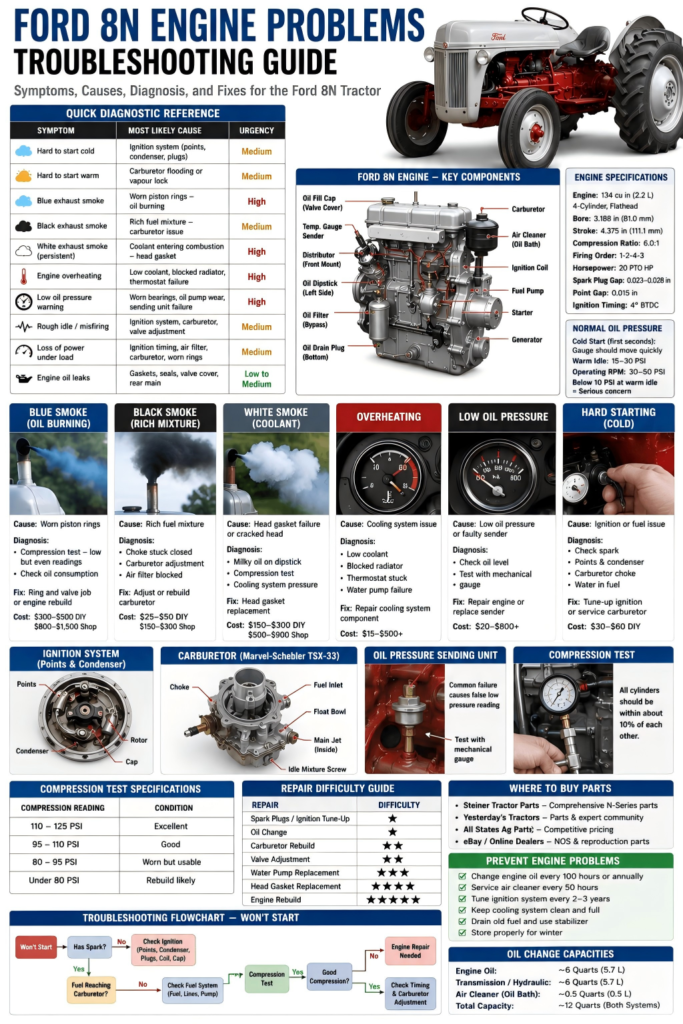
Ford 8N Engine Problems — Quick Diagnostic Reference
| Symptom | Most Likely Cause | Urgency |
|---|---|---|
| Hard to start cold | Ignition system (points, condenser, plugs) | Medium — service ignition |
| Hard to start warm | Carburetor flooding or vapour lock | Medium — inspect carburettor |
| Blue exhaust smoke | Worn piston rings — oil burning | High — engine wear |
| Black exhaust smoke | Rich fuel mixture — carburettor issue | Medium — adjust/rebuild carburettor |
| White exhaust smoke (persistent) | Coolant entering combustion — head gasket | High — stop and inspect |
| Engine overheating | Low coolant, blocked radiator, thermostat failure | High — stop immediately |
| Low oil pressure warning | Worn bearings, oil pump wear, sending unit failure | High — stop immediately if confirmed |
| Rough idle / misfiring | Ignition system, carburettor, valve adjustment | Medium |
| Loss of power under load | Ignition timing, air filter, carburettor, worn rings | Medium |
| Engine oil leaks | Gaskets, seals, valve cover, rear main | Low to Medium — monitor and repair |
| Knocking from bottom end | Rod or main bearing wear | Critical — stop immediately |
| Runs but lacks power | Ignition timing retarded, carburettor lean, air leak | Medium |
Hard Starting — Cold
Difficulty starting a Ford 8N from cold is the most common complaint among owners and the most frequently misdiagnosed. Before assuming a major mechanical problem, work through the ignition system first — it is responsible for the majority of cold-starting issues on the 8N.
Most likely causes (in order of probability)
- Worn or incorrectly gapped points — the points-and-condenser ignition system requires periodic adjustment. Points that have worn or drifted out of gap specification produce a weak spark that struggles to fire a cold engine. Check and set gap to 0.015 inch (0.38mm)
- Failed condenser — a failing condenser causes weak spark, misfiring, and hard starting. Replace with the points as a set — they are cheap ($5–$12) and always replaced together
- Old or fouled spark plugs — plugs that have been in service for several years accumulate carbon deposits and may not fire reliably in cold conditions. Replace all four and set gap to 0.023–0.028 inch
- Carburetor choke not functioning — the choke enriches the mixture for cold starting. A stuck-open or damaged choke makes cold starting very difficult. Inspect and clean the choke mechanism
- Water in the fuel — condensation in the fuel tank over winter or from stored fuel is a common problem. Drain the carburettor float bowl and inspect for water (visible as droplets or a cloudy layer at the bottom)
What it costs: a complete ignition tune-up (points, condenser, plugs, cap, rotor) costs $30–$60 in parts and is the single most cost-effective maintenance action for cold-start problems.
Hard Starting — Warm
A Ford 8N that starts fine cold but is difficult to restart when warm usually points to the carburettor or fuel system rather than the ignition.
Most likely causes
- Carburetor flooding — a worn needle and seat allows fuel to continue flowing into the float bowl when the engine is off, flooding the intake. The engine is then flooded when trying to restart warm. Rebuilding the carburettor with a fresh needle and seat solves this — rebuild kits cost $25–$50
- Vapour lock — in hot conditions, fuel in the lines between the tank and carburettor can vaporise, blocking fuel delivery. Wrapping the fuel line near the engine with heat shield tape helps prevent this on machines that regularly experience it
- Percolation — fuel in the carburettor bowl boils from engine heat after shutdown, causing a rich flooding condition when trying to restart. Waiting 10–15 minutes before restarting often resolves this — if it is a persistent problem, a heat shield between the exhaust manifold and carburettor helps
Blue Exhaust Smoke — Oil Burning
Blue smoke from the exhaust at operating temperature — not the brief white smoke normal on a cold start — indicates oil is entering the combustion chamber and burning with the fuel. On the Ford 8N, this almost always indicates worn piston rings.
Diagnosis
The key diagnostic check is a compression test. Pull all four plugs and test compression on each cylinder. Readings should be consistent across all four cylinders — ideally within about 10% of each other. A cylinder significantly lower than the others (or all cylinders low) indicates ring wear. A compression test takes 15 minutes with a basic tester available at any auto parts store.
What causes it
The most common cause of ring wear on Ford 8N engines is not high hours — it is sitting with old, degraded oil in the sump. Oil that has broken down over time loses its protective film strength, allowing metal-to-metal contact at the ring surfaces. A machine that sat for years without oil changes typically shows ring wear symptoms regardless of how few hours it actually ran.
What it costs
| Repair | DIY | Shop |
|---|---|---|
| Ring and valve job (top end rebuild) | $300–$500 parts + significant skill | $800–$1,500 |
| Full engine rebuild | $500–$800 parts | $1,500–$2,500 |
Before rebuilding: if compression is low but consistent across all cylinders and the machine is otherwise running reasonably — an engine with worn rings that holds consistent compression may have years of useful life left at reduced efficiency. Many owners run a worn but consistent 8N engine for hobby farm use rather than rebuilding. The decision depends on how the machine is used and how low the compression has dropped.
Black Exhaust Smoke
Black smoke indicates a rich fuel mixture — too much fuel relative to air entering the engine. On the Ford 8N, this almost always traces to the carburettor.
Most likely causes
- Stuck choke — a choke stuck in the closed or partially closed position richens the mixture constantly. Inspect and free the choke mechanism
- Carburettor main jet too large or incorrectly adjusted — the fuel mixture screw and main jet control the air/fuel ratio. An over-rich setting produces black smoke and poor fuel economy
- Stuck or faulty float — a float that is stuck low or has a hole (filling with fuel and sinking) causes the needle and seat to remain open, flooding the engine continuously
- Blocked air filter — a severely blocked oil-bath air cleaner restricts airflow, effectively richening the mixture. Service the air cleaner before adjusting the carburettor
White Exhaust Smoke (Persistent)
Brief white smoke on a cold start is normal — water vapour condensing in the exhaust system. Persistent white smoke at operating temperature indicates coolant entering the combustion chamber. This is a serious symptom that requires immediate diagnosis.
Most likely causes
- Head gasket failure — the most common cause. A blown head gasket between a water jacket and cylinder allows coolant to be drawn into the combustion chamber. Confirm by checking the oil — coolant contamination in oil appears as a milky or chocolate-coloured emulsion on the dipstick
- Cracked cylinder head — less common but more serious. A crack in the head casting near a water passage allows the same symptom. Requires head removal to confirm
Do not continue running the engine with persistent white smoke and milky oil. Coolant contamination in the oil rapidly destroys bearing surfaces. Stop, diagnose, and repair before the next start.
Head gasket replacement cost: $150–$300 DIY parts, $500–$900 shop.
Engine Overheating
The Ford 8N’s temperature gauge should sit comfortably in the normal range during operation. A gauge climbing toward the red or a machine running noticeably hot has one of several causes — work through them in order of ease:
| Cause | How to Check | Fix |
|---|---|---|
| Low coolant level | Check coolant level in radiator when cold | Top up with 50/50 antifreeze mix — find leak source |
| Blocked radiator exterior | Inspect fins for debris, seed chaff, grass | Blow out with compressed air from inside out |
| Thermostat failure (stuck closed) | Cold engine warms normally then overheats quickly | Replace thermostat — $15–$30 part |
| Water pump failure | Coolant not circulating — overheats at idle | Replace water pump — $50–$120 part, $150–$300 shop |
| Blocked radiator internally | External clean doesn’t help, coolant flow weak | Radiator flush or re-core — $150–$500 |
| Ignition timing retarded | Engine runs hot at all speeds, lacks power | Check and set ignition timing to specification |
| Head gasket failure | Overheating with white smoke and milky oil | Head gasket replacement — $500–$900 shop |
Never open the radiator cap on a hot Ford 8N. The cooling system is pressurised — opening a hot cap causes a steam and coolant burst that causes severe burns. Allow the engine to cool completely before opening the radiator.
Low Oil Pressure
A low or zero oil pressure reading on the gauge after startup is the most urgent warning sign the Ford 8N can give. The response depends on confirming whether the gauge reading reflects actual low pressure or a failed sending unit.
Diagnose before panicking
The oil pressure sending unit and gauge are the most common cause of low pressure readings on classic Fords — not actual low engine oil pressure. A failed sending unit or corroded wire connection produces a zero or low reading even when actual oil pressure is normal. Substitute a mechanical test gauge directly at the sending unit port before assuming engine problems.
If actual oil pressure is confirmed low
- Check oil level first — low oil level is the simplest and most commonly overlooked cause
- Oil pump wear — the oil pump in a high-hour engine may have worn enough to reduce output pressure at idle. Most noticeable as pressure that is adequate at operating RPM but low or marginal at warm idle
- Main bearing wear — worn main bearings allow oil to leak past the bearing clearances faster than the pump can pressurise the system. Confirmed by a bottom-end knock accompanying low pressure — if knocking is present, stop immediately
Engine Knocking
Knocking from the Ford 8N engine falls into two categories with very different implications:
| Knock Type | Sound | Likely Cause | Action |
|---|---|---|---|
| Top-end tick | Light, regular ticking at idle — increases with RPM | Valve clearance or worn rocker arms | Check and adjust valve clearance |
| Pre-ignition ping | Metallic pinging under load | Ignition timing too advanced or low-octane fuel | Check ignition timing, use fresh fuel |
| Rod knock | Deep, rhythmic knock — worst at warm idle, may decrease at high RPM | Worn connecting rod bearing | Stop immediately — internal repair required |
| Main bearing knock | Deep, slower knock — present at all speeds | Worn main bearing | Stop immediately — engine rebuild required |
A light top-end tick is acceptable and common on a well-used 8N. A deep bottom-end knock is not — it indicates bearing failure and continued operation will destroy the engine rapidly.
Common Ford 8N Oil Leaks
Oil seepage on a 70-year-old machine is expected. Active drips are a different matter. Common leak sources on the Ford 8N:
- Valve cover gasket — the most common minor leak. Cork gasket hardens and shrinks with age. Replacement gasket costs $8–$15 and installation is straightforward
- Rear main seal — the seal at the rear of the crankshaft where it exits the engine block. Leaks here show as oil dripping from under the engine at the bell housing. Replacement requires removing the engine or at minimum the clutch assembly — $50–$100 parts, $300–$600 shop
- Front timing cover gasket — seeps from the front of the engine around the timing cover. Less common than rear main but visible as oil on the front of the engine below the timing cover
- Head gasket (oil side) — a head gasket can leak oil externally without also leaking coolant. Look for oil seeping from the join between the head and block on the sides of the engine
- Oil pressure sending unit — the fitting where the sending unit screws into the block can develop seepage. Often fixable with thread sealant or a new sending unit
When to Rebuild vs When to Run It
A common decision for Ford 8N owners who discover engine wear:
| Finding | Rebuild Now? | Reasoning |
|---|---|---|
| Blue smoke but consistent compression | Not necessarily | Consistent compression means even wear — machine may have years of light-duty use remaining |
| One cylinder significantly low compression | Yes — address soon | Uneven wear damages the engine faster and causes rough running |
| Bottom-end knock | Yes — immediately | Bearing failure causes catastrophic damage quickly if ignored |
| Milky oil (coolant contamination) | Yes — head gasket first | Do not run with coolant in oil — bearing destruction is rapid |
| Minor oil seepage, no other symptoms | No | Monitor and repair gaskets at convenience — not urgent |
| Low power but good compression | No — check ignition/carb first | Most power loss on 8N is ignition or fuel system, not engine wear |
Repair Costs — Ford 8N Engine
| Repair | DIY Parts Cost | Shop Total |
|---|---|---|
| Ignition tune-up (points, plugs, condenser) | $30–$60 | $80–$150 |
| Carburetor rebuild | $25–$50 kit | $150–$300 |
| Head gasket replacement | $80–$150 parts | $500–$900 |
| Valve cover gasket | $8–$15 | $60–$120 |
| Rear main seal | $30–$60 parts | $300–$600 |
| Thermostat replacement | $15–$30 | $80–$150 |
| Water pump replacement | $50–$120 parts | $150–$300 |
| Ring and valve job (top end) | $300–$500 parts | $800–$1,500 |
| Full engine rebuild | $500–$800 parts | $1,500–$2,500 |
Where to Find Parts for Ford 8N Engine Repairs
- Steiner Tractor Parts — comprehensive N-Series engine parts catalogue including gasket sets, ignition kits, carburettor rebuild kits, and cooling system components
- Yesterday’s Tractors — parts listings and active community forum with specific Ford 8N engine repair guidance
- All States Ag Parts — competitive pricing on common wear items including pistons, rings, valves, and gaskets
- eBay — NOS (new old stock) and reproduction parts including hard-to-find items such as original carburettors and distributor components
Verdict — Ford 8N Engine Problems
The most important thing to understand about Ford 8N engine problems is that they are almost always caused by neglect rather than inherent mechanical weakness. A well-maintained 8N with regular oil changes, annual ignition service, and consistent cooling system attention runs reliably for decades. The problems that show up on high-hour machines — worn rings, bearing wear, head gasket failure — are almost universally traceable to periods of deferred maintenance or improper storage rather than the design of the engine itself.
Before buying any Ford 8N, read our Used Ford Tractor Inspection Checklist to identify these issues before purchase. For keeping one running: Ford 8N Maintenance Schedule · Ford 8N Oil Type and Capacity · Full Ford 8N review →
Compare with other models: Ford 9N · Ford 3000 · Ford 4000 · Ford 5000
👉 See current Ford 8N listings →
Ford 8N Engine What It Is and How It Works
What Engine Does a Ford 8N Have?
The Ford 8N uses a 4-cylinder flathead (side-valve) gasoline engine with the following specifications:
| Specification | Detail |
|---|---|
| Engine type | 4-cylinder flathead (side-valve) gasoline |
| Displacement | 119.7 cubic inches (1.96 litres) |
| Bore x stroke | 3.187″ x 3.75″ |
| Compression ratio | 6.0:1 (original) some rebuilt to 7.5:1 |
| Governed RPM | 2,000 RPM |
| HP at belt | ~25 28 HP |
| Fuel | Regular gasoline low compression engine runs fine on regular octane |
| Cooling | Liquid cooled |
| Ignition | Points-and-condenser front-mount distributor (1947 mid 1950) or side-mount (mid 1950 1952) |
The flathead design with valves mounted in the engine block rather than the cylinder head is what makes the 8N engine so mechanically accessible. There are no rocker arms to adjust, no overhead camshaft, and no complex valve train above the combustion chamber. This simplicity is the primary reason so many Ford 8N engines are still running 75+ years after manufacture. For oil type and capacity for this engine, see our Ford 8N oil type and capacity guide ->
Which Old Ford Tractor Is Considered the Best to Buy?
By use case:
| Use Case | Best Old Ford Tractor | Why |
|---|---|---|
| Hobby farm under 25 acres | Ford 8N | Best parts availability, most practical N-Series, handles standard hobby farm tasks reliably |
| Small farm needing live PTO | Ford 3000 (diesel) | Live PTO for hay equipment, 37 47 HP, 3-cylinder diesel, strong aftermarket |
| Farm needing regular loader use | Ford 4000 (diesel) | Heavier frame, live PTO, 52 65 HP the most capable classic Ford utility tractor |
| Larger farm 50+ acres | Ford 5000 (diesel) | Most HP in classic range at 65 75 HP, still actively farmed |
| Collector / historical significance | Ford 9N | First year, introduced three-point hitch most historically important N-Series |
For most buyers entering the classic Ford market: start with the Ford 8N. The combination of parts availability, known repair procedures, and working capability makes it the lowest-risk classic Ford purchase. The 8N’s flathead engine is easier to diagnose and repair than any other classic tractor engine including the Thousand Series diesel. Browse our Ford tractors for sale ->
Ford 8N and 9N Comparison and Quick Reference
Which Is Better Ford 8N or 9N?
For a working tractor: the 8N is better in every practical dimension:
- Transmission: 4-speed (8N) vs 3-speed (9N) the extra gear is genuinely useful
- Hydraulics: position control plus draft control (8N) vs draft control only (9N)
- Brakes: two separate pedals (8N) vs single pedal (9N) meaningfully safer
- HP: 25 28 HP (8N) vs 23 26 HP (9N)
- Parts: 524,076 units (8N) vs ~100,000 (9N) far more 8N parts in the aftermarket
The 9N has collector appeal as the original first-year machine particularly 1939 1940 examples with original aluminium components. For an engine repair or working tractor purchase: buy the 8N.
How Much Horsepower Does a Ford 8N Have?
Approximately 25 28 HP at the belt the Nebraska Tractor Test recorded 23.2 25.5 HP at the belt depending on engine condition. PTO HP approximately 20 24 HP. For implement sizing, use 20 24 PTO HP as the working figure comfortable for 5 ft implements, at the limit for 6 ft cutters.
How Many HP Is a Ford 9N?
Approximately 23 26 HP at the belt slightly less than the 8N. Nebraska Test recorded approximately 23.1 HP at the belt. PTO HP approximately 20 22 HP. The 9N’s 3-speed transmission also limits working speed options compared to the 8N’s 4-speed.
How Fast Will a Ford 8N Go?
Maximum approximately 12 17 mph in 4th gear. Working speeds: 1st ~2.0 mph (heavy tillage), 2nd ~3.3 mph (standard field work), 3rd ~4.5 mph (most implement work the most-used working gear), 4th for road transport only.
How Fast Does a Ford 9N Tractor Go?
Maximum approximately 12 14 mph in 3rd gear. Working speeds: 1st ~2.0 mph, 2nd ~3.5 4.5 mph, 3rd for road transport. Fewer speed options than the 8N’s 4-speed most 9N field work is done in 2nd gear.
How Much Can a Ford 8N Lift?
For compression testing specs and more, TractorData.com maintains the full Nebraska Test record. Approximately 800 1,000 lbs at the hitch link pins sufficient for all standard Category 1 implements. Note: non-live hydraulics the hitch stops responding when the clutch is depressed.
How Many Ford 8N Tractors Were Made?
524,076 units between 1947 and 1952 the most produced two-plow tractor in US history. For current used market pricing, TractorHouse.com lists active Ford 8N sales. The high production volume is the direct reason parts remain universally available today.
How Much Is a Ford 8N Worth Today?
In 2026: non-running or parts ($500 $1,200), running but rough ($1,200 $2,200), running good working condition ($2,500 $4,000 most common), restored driver quality ($4,000 $6,500), show quality ($7,000 $12,000+).
How Much Is a Ford 9N Worth?
Running good working condition: $2,000 $3,500. Non-running or rough: $400 $1,500. Restored driver quality: $3,500 $6,000. 1939 1940 aluminium-component originals in unmodified condition: $6,000 $15,000+. The 9N typically trades slightly below equivalent 8N examples due to fewer parts and lower working specification.
Was the Ford 8N a Good Tractor?
Yes unambiguously. 524,076 units produced between 1947 and 1952, and hundreds of thousands still in active working use 75+ years later. The Ferguson three-point hitch, 4-speed transmission, dual brake pedals, and mechanical simplicity made it the best affordable farm tractor of its era. The engine troubleshooting guide above exists precisely because the machine is still widely used not because it has fundamental reliability problems. Browse our Ford 8N for sale ->
What Is Considered the Greatest Tractor Ever Made?
By historical impact: the Ford 9N (1939) introduced the Ferguson three-point hitch and draft control that became the global standard for implement attachment, still used on every tractor built today. By US market longevity: the Ford 8N most produced two-plow tractor in US history, still the most widely owned classic tractor in North America. By global farm use: the Massey Ferguson 135 still actively farmed worldwide after 50+ years. Each is greatest on a different dimension.
What Is the Best Oil to Use in a Ford 8N Engine?
Conventional SAE 10W-30 or 15W-40 motor oil avoid full synthetic on aged gaskets. For the combined transmission/hydraulic sump: Universal Tractor Fluid (UTF) or 80W-90 GL-4 gear oil. For full detail on engine and hydraulic fluid specifications and capacities, see our dedicated Ford 8N oil type and capacity guide ->
Frequently Asked Questions
What are the most common Ford 8N engine problems?
The most common Ford 8N engine problems are: worn piston rings causing blue exhaust smoke and oil consumption (usually from sitting with old oil), ignition system deterioration causing hard starting and rough running, carburetor issues causing flooding or poor mixture, head gasket failure (shown by milky oil and white smoke), and oil leaks from the valve cover and rear main seal. Most are preventable with regular maintenance.
Why is my Ford 8N hard to start?
Hard starting on a Ford 8N is almost always the ignition system — worn points, a failing condenser, or old spark plugs. Start with a complete ignition tune-up (points, condenser, plugs, cap, rotor) before investigating further. If ignition is fresh and starting is still difficult cold, inspect the carburetor choke mechanism and check for water in the fuel.
Why is my Ford 8N blowing blue smoke?
Blue smoke at operating temperature indicates oil burning — worn piston rings allowing oil into the combustion chamber. Confirm with a compression test: consistent low readings across all cylinders indicate ring wear. The most common cause is not high hours but sitting with old, degraded oil. If compression is low but even, the machine may still be serviceable for light use — an uneven reading with one very low cylinder needs addressing sooner.
Why is my Ford 8N overheating?
Start with the simplest checks first: coolant level, then blocked radiator fins (clean with compressed air), then thermostat (cheap and easy to replace). If those don’t resolve it, check water pump flow and inspect for head gasket failure (white smoke and milky oil). Never open the radiator cap on a hot engine.
How do I know if my Ford 8N engine needs a rebuild?
Key indicators: blue smoke combined with significantly low compression on a compression test, a deep bottom-end knock at warm idle, coolant contamination in the oil (milky appearance on dipstick), or consistently low oil pressure confirmed with a mechanical test gauge. A light top-end tick and minor oil seepage are normal on a well-used machine and don’t indicate a rebuild is needed.