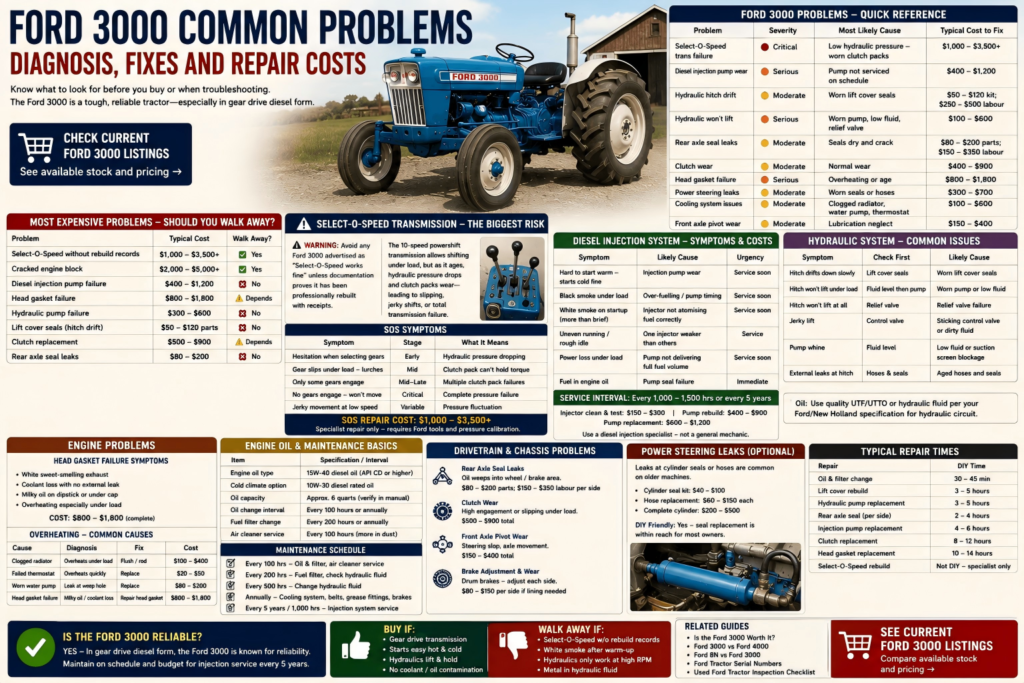
Ford 3000 common problems fall into four main categories: the Select-O-Speed transmission (the most serious risk on any Thousand Series Ford), the diesel injection system, hydraulic system wear, and general engine and drivetrain maintenance items that accumulate on machines now 50–60 years old. The Ford 3000 has a strong reliability reputation in gear drive diesel form — the problems covered in this guide are the exceptions rather than the rule, but knowing what to watch for is essential before buying or when diagnosing a machine you already own.
👉 Check current Ford 3000 listings — see available stock and pricing →
Written by: Farmers Equipment editorial team — specialising in classic Ford tractors from the N-Series through the Thousand Series.
Ford 3000 Problems — Quick Reference
| Problem | Severity | Most Likely Cause | Typical Cost to Fix |
|---|---|---|---|
| Select-O-Speed transmission failure | 🔴 Critical | Hydraulic pressure loss in SOS circuit — worn clutch packs | $1,000–$3,500+ rebuild |
| Diesel injection pump wear | 🟠 Serious | Normal wear — injection pump not serviced on schedule | $400–$1,200 rebuild or replace |
| Hydraulic hitch drift | 🟡 Moderate | Worn lift cover seals | $50–$120 kit; $250–$500 with labour |
| Hydraulic hitch won’t lift | 🟠 Serious | Worn pump, low fluid, relief valve | $100–$600 depending on cause |
| Rear axle seal leaks | 🟡 Moderate | Age — seals dry and crack over time | $80–$200 parts; $150–$350 with labour |
| Clutch wear | 🟡 Moderate | Normal wear — high-engagement point or slipping under load | $400–$900 parts + labour |
| Head gasket failure | 🟠 Serious | Overheating, age, or previous cooling system neglect | $400–$900 parts; $800–$1,800 with labour |
| Power steering leaks | 🟡 Moderate | Cylinder end seals or hose deterioration | $150–$400 parts; $300–$700 with labour |
| Cooling system issues | 🟡 Moderate | Clogged radiator, worn water pump, failed thermostat | $100–$600 depending on cause |
| Front axle pivot wear | 🟡 Moderate | Lubrication neglect over decades | $150–$400 parts |
Most Expensive Ford 3000 Problems — Should You Walk Away?
| Problem | Typical Cost | Walk Away? |
|---|---|---|
| Select-O-Speed without rebuild records | $1,000–$3,500+ | ✅ Yes — unless deeply discounted and budgeted |
| Cracked engine block | $2,000–$5,000+ | ✅ Yes — not economical to repair on a classic tractor |
| Diesel injection pump failure | $400–$1,200 | ❌ No — predictable cost, well-supported repair |
| Head gasket failure | $800–$1,800 | ⚠️ Depends — investigate cause first. Cooling neglect may mean more is wrong |
| Hydraulic pump failure | $300–$600 | ❌ No — factor into offer price and repair |
| Lift cover seals (hitch drift) | $50–$120 parts | ❌ No — routine repair, negotiate price down |
| Clutch replacement | $500–$900 | ⚠️ Depends — factor into offer; not a reason to walk |
| Rear axle seal leaks | $80–$200 | ❌ No — expected on a machine this age |
Problem 1 — Select-O-Speed Transmission
The Select-O-Speed (SOS) is the single most important problem to understand before buying or diagnosing a Ford 3000. It is not a minor issue — it is a fundamental design and reliability risk that makes any SOS-equipped machine a materially different purchase proposition from a gear drive machine.
⚠️ Warning: Avoid any Ford 3000 advertised as “Select-O-Speed works fine” unless documentation proves it has been professionally rebuilt with receipts. A SOS that “works fine” at idle or light load can fail completely under farm load within hours of purchase.
What is the Select-O-Speed?
The Select-O-Speed is a 10-speed hydraulically-controlled powershift transmission offered as an option on the Ford 3000 and other Thousand Series tractors. It allows gear changes under load without using the clutch — a genuine practical advantage in theory. In practice, the hydraulic clutch packs that engage each gear are precision components that require hydraulic pressure within tight tolerances to function correctly. As the system ages, seals deteriorate, clutch packs wear, and pressure drops — leading to progressively unreliable shifting, gear slippage, and eventually complete transmission failure.
Select-O-Speed symptoms
| Symptom | Stage | What It Means |
|---|---|---|
| Hesitation when selecting gears | Early | Hydraulic pressure dropping — seals beginning to fail |
| Gear slips under load — tractor lurches | Mid | Clutch pack unable to hold torque under farm load |
| Only some gears engage | Mid-late | Multiple clutch pack failures — partial function only |
| No gears engage — machine won’t move | Critical | Complete hydraulic pressure failure in SOS circuit |
| Jerky movement at low speed | Variable | Pressure fluctuation — clutch packs engaging inconsistently |
Select-O-Speed repair cost
A Select-O-Speed rebuild by a specialist who knows the system costs $1,000–$3,500 depending on how many clutch packs need replacement and whether the hydraulic pump serving the SOS circuit requires attention. This is not a DIY repair — the SOS requires specialist knowledge, the correct Ford service tools, and precise hydraulic pressure calibration after rebuild. Many general mechanics decline to rebuild it.
The buying rule: avoid any Ford 3000 with a Select-O-Speed transmission unless it has a documented professional rebuild with receipts. A SOS machine priced at the same level as a gear drive machine is not a bargain — it is a liability. A discounted SOS machine is only a viable purchase if you have budgeted $1,000–$3,500 for the transmission work.
Problem 2 — Diesel Injection System
The Ford 3000’s 3-cylinder diesel uses a mechanical fuel injection system that requires periodic professional service. Parts and rebuild kits are available from suppliers including Steiner Tractor Parts. This is not unique to the Ford 3000 — all classic diesel tractors have the same requirement — but it is the maintenance item most commonly deferred by owners who are unfamiliar with diesel engines.
Injection system symptoms
| Symptom | Likely Cause | Urgency |
|---|---|---|
| Hard to start when warm — starts cold fine | Injection pump wear — reduced pressure when warm | Service soon |
| Black smoke under load | Over-fuelling — worn injectors or pump timing | Service soon |
| White smoke on startup (more than brief) | Injector not atomising fuel correctly | Service soon |
| Uneven running / rough idle | One injector weaker than others — fuel imbalance | Service |
| Power loss under load | Injection pump not delivering full fuel volume | Service soon |
| Fuel in engine oil | Injection pump seal failure — serious contamination | Immediate |
Injection service cost and interval
- Service interval: every 1,000–1,500 hours or every 5 years, whichever comes first — or when symptoms appear
- Injector cleaning and flow test: $150–$300
- Injection pump rebuild: $400–$900
- Injection pump replacement (remanufactured): $600–$1,200
- Who should do this work: a diesel injection specialist or experienced classic tractor mechanic — not a general shop unfamiliar with vintage diesel systems
Owners who budget for injection service on a regular schedule report very few unexpected problems with the Ford 3000 diesel. The engine itself is mechanically robust — the injection system is the primary service item.
Problem 3 — Hydraulic System
The Ford 3000 uses independent live hydraulics — a separate hydraulic pump circuit from the transmission. Common hydraulic problems on the 3000:
Hydraulic hitch drift
The implement slowly sinks under load or when the engine is off. Almost always caused by worn lift cover seals on machines of this age. A lift cover rebuild kit ($50–$120) and 3–4 hours of work resolves the majority of drift complaints.
Hitch won’t lift under load
Raises unloaded but fails under implement weight. Check fluid level first. If fluid is correct, confirm pump output pressure — worn pump is the most common cause on high-hour machines. Relief valve failure can also cause sudden total lift failure.
Hydraulic symptom quick reference
| Symptom | Check First | Likely Cause |
|---|---|---|
| Hitch drifts down slowly | Lift cover seals | Worn lift cover seal kit — most common 3000 hydraulic complaint |
| Hitch won’t lift under load | Fluid level then pump | Worn hydraulic pump or low fluid |
| Hitch won’t lift at all | Relief valve | Relief valve failure — test alongside pump output |
| Jerky lift | Control valve | Sticking control valve or contaminated fluid |
| Pump whine | Fluid level | Low fluid or suction filter blockage |
| External oil leaks at hitch | Hose and seal condition | Aged hoses and external seals — common at this machine age |
Hydraulic fluid for the Ford 3000
The Ford 3000 hydraulic system uses a separate hydraulic pump and circuit from the transmission — unlike the Ford 9N which shares fluid. Check your specific machine’s configuration and service manual for the correct hydraulic fluid specification. Most Ford 3000 machines use a quality UTF/UTTO or hydraulic fluid meeting Ford New Holland specifications for the hydraulic circuit.
Problem 4 — Engine Problems
Head Gasket Failure
Head gasket failure on the Ford 3000 3-cylinder diesel is more common than it should be — usually the result of a previous overheating episode or deferred cooling system maintenance. Symptoms:
- White sweet-smelling exhaust (coolant burning)
- Coolant loss with no visible external leak
- Milky oil on the dipstick or under the oil cap
- Overheating — especially under load
Cost: $400–$900 parts (head gasket set, head bolts, coolant); $800–$1,800 total with professional labour including head machining if required.
Overheating
Overheating on the Ford 3000 typically traces to one of four causes:
| Cause | Diagnosis | Fix | Cost |
|---|---|---|---|
| Clogged radiator | Overheats under sustained load; normal at idle | Radiator flush or rodding — professional clean if heavily clogged | $100–$400 |
| Failed thermostat | Overheats quickly — thermostat stuck closed | Thermostat replacement | $20–$50 part |
| Worn water pump | Coolant leak at water pump weep hole; overheating | Water pump replacement | $80–$200 part + labour |
| Head gasket failure | Overheating + milky oil or coolant loss | Head gasket replacement | $800–$1,800 complete |
Oil Consumption and Leaks
Moderate oil consumption and external leaks are expected on Ford 3000 machines of this age. Common leak points: rocker cover gasket, front and rear crankshaft seals, and the timing cover. None of these are structurally serious — budget for seal replacement as part of ownership rather than treating them as failure events.
What Engine Oil Does a Ford 3000 Use?
| Item | Specification |
|---|---|
| Engine oil type | 15W-40 diesel engine oil (API CD or higher) — most common recommendation for the 3-cylinder diesel |
| Alternative for cold climates | 10W-30 diesel rated oil — better cold weather starting |
| Engine oil capacity | Approximately 6 quarts — verify against your specific year service manual |
| Oil change interval | Every 100 hours or annually, whichever comes first |
| Fuel filter change | Every 200 hours or annually |
| Air cleaner service | Every 100 hours in dusty conditions — more frequently in heavy dust |
Ford 3000 Maintenance Schedule
| Interval | Service Item |
|---|---|
| Every 100 hours | Engine oil and filter change |
| Every 100 hours | Air cleaner service (more frequently in dusty conditions) |
| Every 200 hours | Fuel filter replacement |
| Every 200 hours | Hydraulic fluid check and top-up |
| Every 500 hours | Hydraulic fluid change |
| Annually | Cooling system inspection — hoses, thermostat, coolant condition |
| Annually | Belt inspection and adjustment |
| Annually | Grease all fittings — front axle pivot, steering, lift arms |
| Every 5 years / 1,000 hrs | Diesel injection system professional service |
| As needed | Brake adjustment — inspect annually |
| As needed | Tyre pressure check — before each use |
Problem 5 — Drivetrain and Chassis
Rear Axle Seal Leaks
Nearly universal on Ford 3000 machines that have not had recent seal work. Oil weeps from the inner rear axle seal onto the rear wheel and brake drum area. Not immediately catastrophic but will contaminate brake linings if left unaddressed. Rear axle seals: $40–$80 per side in parts; $150–$350 per side with labour.
Clutch Wear
The Ford 3000 clutch wears progressively — symptoms are a high engagement point (pedal nearly released before clutch bites) or slipping under heavy PTO load. A clutch kit (disc, pressure plate, pilot and throw-out bearings) costs $200–$400. Labour for clutch replacement on a Ford 3000 typically runs $300–$600, as the tractor must be split to access the clutch.
Front Axle Pivot Wear
Steering slop and front axle movement under cornering on high-hour machines indicates front axle pivot bushing wear. A common finding on machines that have not had regular greasing of the front axle pivot. Pivot kit: $80–$200; labour varies but typically $200–$400 including related steering component inspection.
Brake Adjustment and Wear
Ford 3000 brakes are drum type, individually adjustable on each rear wheel — useful for steering on soft ground, but the independent adjustment means one side often wears or adjusts unevenly. Inspect and adjust at every service. Brake lining replacement: $80–$150 per side in parts.
Problem 6 — Power Steering Leaks
Power steering was optional on the Ford 3000 — machines equipped with it commonly develop leaks at the cylinder end seals and hose connections on machines of this age. Symptoms: power steering fluid puddles under the front axle area, heavy or inconsistent steering effort, visible fluid on the power steering cylinder.
- Cylinder end seal kit: $40–$100
- Hose replacement: $60–$150 per hose
- Complete power steering cylinder replacement: $200–$500
- DIY friendly: yes — cylinder seal replacement is within the reach of a mechanically confident owner with basic tools
Typical Repair Times — Ford 3000
| Repair | DIY Time | Notes |
|---|---|---|
| Engine oil and filter change | 30–45 min | Straightforward — no specialist knowledge |
| Fuel filter replacement | 30 min | Easy DIY on most 3000 configurations |
| Lift cover rebuild (hitch drift) | 3–5 hours | Moderate — requires careful seal installation |
| Hydraulic pump replacement | 3–5 hours | Access is more involved than on N-Series |
| Injection pump replacement | 4–6 hours | Requires specialist — not a DIY repair |
| Rear axle seal replacement | 2–4 hours per side | Requires axle removal — moderate DIY |
| Clutch replacement | 8–12 hours | Requires splitting the tractor — experienced DIY only |
| Head gasket replacement | 10–14 hours | Requires head removal and likely machining — professional recommended |
| Select-O-Speed rebuild | Not DIY | Specialist only — requires Ford special tools and hydraulic calibration |
Is the Ford 3000 Reliable?
Yes — in gear drive diesel form, the Ford 3000 has an excellent reliability record. The problems in this guide are maintenance items and wear issues that accumulate on 50–60 year old machines, not fundamental design flaws in the gear drive diesel configuration. Owners who maintain regular oil changes, fuel filter changes, and air cleaner service, and who budget for injection system service every 5 years, report very few unexpected failures.
The reliability reputation changes entirely for the Select-O-Speed variant — the SOS is a fundamentally troubled transmission design that makes the machine a higher-risk proposition regardless of how well the rest of the tractor has been maintained.
The Ford 3000 verdict on reliability: buy gear drive diesel, maintain on schedule, budget for injection service — and it will run reliably for decades more.
Normal Age-Related Issues vs Serious Problems
| Normal / Expected at This Age | Serious — Investigate Before Buying |
|---|---|
| Rear axle seal leaks | Select-O-Speed with no rebuild records |
| Hydraulic hitch drift (lift cover seals) | Milky oil or coolant in engine oil (head gasket) |
| Power steering hose leaks | White smoke after warm-up (injection or head gasket) |
| Front axle pivot wear | Hydraulics only work at very high RPM (severe pump wear) |
| Brake adjustment needed | Metal particles in hydraulic fluid |
| Minor oil seepage at gaskets | Black smoke under load that doesn’t clear (injection failure) |
| Clutch engagement point high | Cracked engine block or cracked head |
| Coolant hose softening | Fuel contamination in engine oil |
Most buyers encounter one or more items from the left column — these are expected maintenance on a 50–60 year old tractor and should be factored into the offer price, not used as a reason to walk away. The right column items require investigation before purchase and may change the buying decision entirely.
What to Check When Buying a Ford 3000
- Confirm gear drive before anything else — the transmission type determines whether this is a straightforward purchase or a significant risk
- Cold and warm start behaviour — a diesel that starts well cold but struggles warm has injection system wear
- Hydraulic hitch under load — raise a heavy implement and confirm it holds without drifting for 10+ minutes
- Rear axle areas — look for oil on the rear wheels and brake drums indicating axle seal leaks
- Clutch engagement point — confirm normal engagement without slipping under drive load
- Exhaust smoke colour — brief white smoke on cold startup is normal; black smoke under load or persistent white smoke indicates injection issues
- Coolant condition — check for milky appearance indicating head gasket leakage into the cooling system
See our complete Used Ford Tractor Inspection Checklist →
Verdict — Ford 3000 Common Problems
The Ford 3000 common problems in gear drive diesel form are manageable — wear items that accumulate on machines this age and are fixed with affordable parts and basic mechanical skill. The Select-O-Speed transmission is in a different category: it is a serious risk that changes the entire ownership proposition. Avoid it unless the repair history is fully documented.
For a machine that has been maintained and is in gear drive diesel configuration, the Ford 3000’s problem list is shorter than most buyers expect — and shorter than many modern tractors of equivalent capability.
Related guides: Is the Ford 3000 Worth It? · Ford 8N vs Ford 3000 · Ford 3000 vs Ford 4000 · Ford Tractor Serial Numbers →
Also available: Ford 8N · Ford 9N · Ford 4000 · Ford 5000
👉 See current Ford 3000 listings →
Frequently Asked Questions
What are the common problems with a Ford 3000 tractor?
The six most common: Select-O-Speed transmission failure (critical — avoid without documented rebuild), diesel injection pump wear requiring professional service every 5 years, hydraulic hitch drift from worn lift cover seals, rear axle seal leaks, clutch wear, and head gasket failure from previous overheating. In gear drive diesel form, most of these are predictable maintenance items rather than unexpected failures.
Is the Ford 3000 reliable?
Yes — the gear drive diesel Ford 3000 has an excellent reliability reputation across six decades of farm use. The Select-O-Speed variant is significantly less reliable — the SOS transmission is a serious known issue. In gear drive form, owners who maintain regular service schedules and budget for diesel injection service every 5 years report very few unexpected problems.
What engine oil does a Ford 3000 use?
15W-40 diesel engine oil (API CD or higher) is the standard recommendation for the Ford 3000 3-cylinder diesel. 10W-30 diesel rated oil is an alternative for cold climates. Change every 100 hours or annually. Capacity is approximately 6 quarts — verify against your specific year service manual.
What is the most common Ford 3000 hydraulic problem?
Hitch drift — the implement slowly sinks under load. Almost always caused by worn lift cover seals on machines of this age. A lift cover rebuild kit ($50–$120) resolves the majority of drift complaints. Confirm hydraulic fluid level first, then inspect and rebuild the lift cover if drift is confirmed.
How much does it cost to fix a Ford 3000 transmission?
If gear drive: no rebuild is typically needed unless gears are damaged — the gear drive is mechanically robust. If Select-O-Speed: a professional rebuild costs $1,000–$3,500 depending on the extent of clutch pack wear. This is specialist work — most general mechanics decline to rebuild the SOS. Always confirm transmission type before purchasing.