A Ford tractor 3-point hitch not working is one of the most common service calls on classic Ford tractors — and most problems trace to one of six causes that can be diagnosed with basic tools in under an hour. Whether the hitch won’t lift, won’t lower, drifts under load, or operates erratically, each symptom points to a specific part of the hydraulic system. This guide covers every Ford 3-point hitch problem systematically, starting with the simplest checks and working through to component-level diagnosis, for both the N-Series (8N, 9N) and Thousand Series (3000, 4000, 5000).
👉 Browse our current Ford tractor inventory →
Written by: Farmers Equipment editorial team — specialising in classic Ford tractors from the N-Series through the Thousand Series.
Quick Symptom Reference — Ford Tractor 3-Point Hitch
| Symptom | Check First | Most Likely Cause | Section |
|---|---|---|---|
| Hitch won’t lift at all | Fluid level | Low fluid, relief valve, pump failure | Section 1 |
| Hitch lifts slowly or weakly | Fluid level then pump | Worn pump, blocked suction screen | Section 1 |
| Hitch lifts unloaded but not under implement | Pump pressure | Worn pump — insufficient pressure under load | Section 1 |
| Hitch won’t lower | Control lever position | Stuck lowering valve, position control setting | Section 2 |
| Hitch lowers too slowly | Drop rate valve | Drop rate valve closed too far | Section 2 |
| Hitch drifts down under load | Lift cover seals | Worn lift cover seals or check ball failure | Section 3 |
| Hitch drifts up on its own | Draft control setting | Draft control set too sensitive | Section 3 |
| Jerky or erratic operation | Control valve | Sticking control valve, contaminated fluid | Section 4 |
| Hitch raises but won’t hold position | Lift cover seals | Worn seals or control valve | Section 3 |
| One lower link higher than the other | Top link and levelling box | Adjustment — not a hydraulic fault | Section 5 |
Before Any Diagnosis — Check These First
Before opening any hydraulic component, confirm these basics — they resolve a meaningful percentage of hitch complaints:
- Hydraulic fluid level — check the transmission/hydraulic dipstick. Low fluid is the most common and easiest-to-fix cause of hitch problems on both N-Series and Thousand Series machines
- Control lever position — confirm the draft control or position control lever is in the correct position. A lever left in the down or float position causes the hitch to not hold or not lift correctly
- Drop rate valve (Thousand Series) — the drop rate adjustment screw controls how quickly the hitch lowers. Turned too far in (closed), the hitch will not lower at all. This is a frequently overlooked cause of “won’t lower” complaints
- PTO and implement connection — confirm the implement is not mechanically preventing movement. A binding top link or seized implement attachment point can prevent normal hitch travel
- Fluid condition — milky or foamy fluid indicates water contamination; dark or burnt-smelling fluid indicates overheating or neglect. Either condition requires a drain and refill before further diagnosis
Section 1 — Hitch Won’t Lift or Lifts Weakly
Diagnosis steps in order
| Step | Check | If Problem Found |
|---|---|---|
| 1 | Fluid level — dipstick or sight glass | Top up with correct UTTO/UTF fluid and retest |
| 2 | Suction screen — remove and inspect for blockage | Clean screen, refill with fresh fluid, retest |
| 3 | Relief valve — does hitch lift unloaded but not under implement? | Test relief valve pressure — replace if stuck open or set too low |
| 4 | Pump output — hitch lifts unloaded but fails under implement weight at any throttle | Worn pump — rebuild or replace |
| 5 | Pump output at high RPM — does hitch lift under load only at high throttle? | Marginal pump — plan rebuild, avoid maximum-load use |
| 6 | Internal leakage — raise hitch fully, remove inspection cover, look for fluid streaming back through system while held | Worn lift cylinder seals or control valve — lift cover rebuild |
N-Series vs Thousand Series — Pump location and access
| Model | Pump Type | Access |
|---|---|---|
| Ford 9N / 8N | Gear pump — driven from transmission, shared sump | Inside transmission case — requires partial disassembly to access |
| Ford 3000 / 4000 / 5000 | Independent live hydraulic pump — separate circuit | Externally accessible on most configurations — easier to remove |
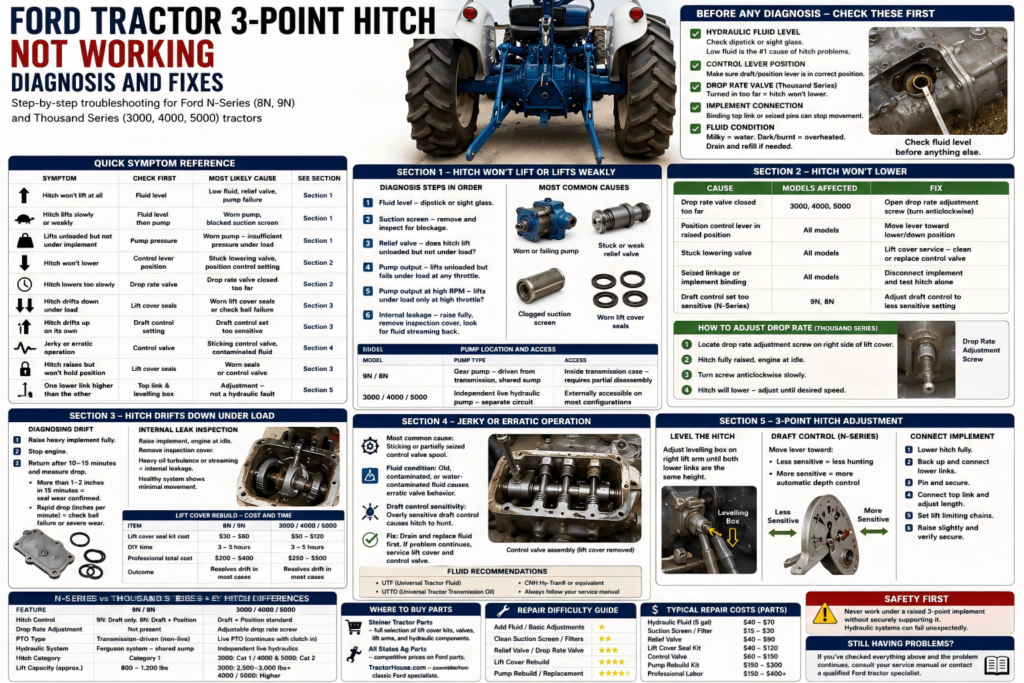
Section 2 — Hitch Won’t Lower
A hitch that raises but won’t lower is a different problem from a hitch that won’t lift — and the diagnosis is usually simpler:
Most common causes
| Cause | Models Affected | Fix |
|---|---|---|
| Drop rate valve closed too far | Ford 3000, 4000, 5000 (Thousand Series) | Open the drop rate adjustment screw — turn anticlockwise in small increments and test |
| Position control lever in raised position | Ford 8N, 3000, 4000, 5000 | Move position control lever toward the lower/down position |
| Stuck lowering valve or spool | All models | Lift cover service — clean or replace control valve |
| Seized linkage — implement physically preventing lowering | All models | Disconnect implement and test hitch movement alone; inspect top link and lower link pins |
| Draft control set so sensitive hitch re-raises before reaching ground | Ford 9N, 8N (draft control only) | Adjust draft control sensitivity — turn toward less sensitive setting |
How to adjust the drop rate on Ford Thousand Series
- Locate the drop rate adjustment screw — typically a slotted screw on the right side of the lift cover assembly
- With the hitch fully raised and engine at idle, slowly turn the screw anticlockwise (open)
- The hitch should begin to lower — continue adjusting until the desired lowering speed is achieved
- Set the drop rate to allow controlled lowering under implement weight — not so fast the implement drops suddenly, not so slow it takes excessive time
Section 3 — Hitch Drifts Down Under Load
Hitch drift — the implement slowly sinking when the hitch is set to the raised position — is the single most common Ford tractor hitch complaint. The cause is almost always worn lift cover seals on machines of this age:
Diagnosing drift vs leak
- Raise a heavy implement fully
- Stop the engine
- Return after 10–15 minutes and measure how far the implement has dropped
- More than 1–2 inches of drop in 15 minutes confirms seal wear in the lift cover
- Rapid drop (several inches in under a minute) suggests check ball failure or more serious seal damage
Internal leak inspection
- Raise a heavy implement and leave engine running at idle
- Remove the side inspection cover on the transmission/hydraulic sump
- Observe fluid movement inside — heavy oil turbulence or visible streaming when the hitch is in the held position confirms internal leakage through worn seals
- A healthy system shows minimal internal fluid movement when the hitch is stationary at raised position
Lift cover rebuild — cost and time
| Item | Ford 8N / 9N | Ford 3000 / 4000 / 5000 |
|---|---|---|
| Lift cover seal kit cost | $30–$60 | $50–$120 |
| DIY time | 3–5 hours | 3–5 hours |
| Professional total cost | $200–$400 | $250–$500 |
| Outcome | Resolves drift in most cases | Resolves drift in most cases |
Section 4 — Jerky or Erratic Hitch Operation
A hitch that surges, overshoots its position, or operates inconsistently is almost always a control valve problem or a fluid condition issue:
- Most common cause: sticking or partially seized control valve spool — the valve is not opening and closing smoothly through its travel
- Fluid condition: old, contaminated, or water-contaminated fluid causes erratic valve behaviour — a fluid change resolves some cases without further work
- Draft control sensitivity: on N-Series machines with draft-only control, an overly sensitive draft control setting causes the hitch to hunt up and down continuously in response to soil resistance. Adjusting the draft control sensitivity resolves this without any disassembly
- Fix: drain and replace fluid first — if erratic operation continues, lift cover service including control valve cleaning or replacement
Section 5 — 3-Point Hitch Adjustment
How to level the hitch (one lower link higher than the other)
Uneven lower links — one side higher than the other — is an adjustment issue, not a hydraulic fault:
- With an implement attached and the hitch at working height, observe which lower link is high
- Locate the levelling box or levelling crank on the right-hand lift arm — this adjusts the relative height of the right lower link
- Turn the levelling box to raise or lower the right link until both links are at the same height
- The top link length also affects implement angle — adjust the top link to set the implement pitch (front-to-back angle) as required by the implement manufacturer
How to adjust draft control sensitivity (N-Series)
The Ford 8N and 9N use draft control to automatically maintain consistent implement depth in the soil. If the hitch hunts up and down, or raises too aggressively on hard ground:
- Locate the draft control lever — the rearmost lever on the right side of the seat on the 8N (only lever on the 9N)
- For less hunting: move the lever toward the less sensitive (position control) direction
- For more automatic depth correction: move toward the more sensitive (draft control) direction
- The correct setting varies by implement and soil conditions — there is no single correct position
How to connect an implement to a 3-point hitch
- Lower the hitch fully before approaching the implement
- Back the tractor slowly until the lower link ends align with the implement’s lower hitch pins
- Insert and pin both lower link connections — confirm locking clips are engaged on both sides
- Connect the top link to the implement’s top hitch point — adjust top link length until the implement is at the correct pitch
- Set the lift limiting chains (if fitted) to prevent excessive lateral swing of the lower links during transport
- Raise the hitch slightly and confirm the implement is secure before moving
N-Series vs Thousand Series — Key Hitch Differences
| Feature | Ford 9N / 8N | Ford 3000 / 4000 / 5000 |
|---|---|---|
| Hitch control | 9N: draft control only. 8N: draft + position control | Draft + position control standard |
| Drop rate adjustment | Not present | Adjustable drop rate screw on lift cover |
| PTO type | Transmission-driven (non-live) — stops when clutch depressed | Live PTO — continues when clutch depressed |
| Hydraulic system | Ferguson system — shared with transmission sump | Independent live hydraulics — separate pump circuit |
| Hitch category | Category 1 | Category 1 (3000) / Category 2 (4000, 5000) |
| Lift capacity | ~800–1,200 lbs | 3000: ~2,500–3,000 lbs; 4000/5000: higher |
Where to Buy Ford 3-Point Hitch Parts
- Steiner Tractor Parts — comprehensive catalogue covering lift cover kits, control valves, lift arms, and lower link components for both N-Series and Thousand Series
- All States Ag Parts — competitive pricing on lift cover seal kits and hydraulic components for all classic Ford models
- TractorHouse — useful for sourcing rebuilt lift covers and hydraulic assemblies from classic Ford specialists
Related repair guides: Ford 9N Hydraulic System Problems · Ford 3000 Common Problems →
Verdict — Ford Tractor 3-Point Hitch Not Working
A Ford tractor 3-point hitch not working almost always traces to one of a small number of predictable causes — most of which are fixable with a rebuild kit, a fluid change, or a control adjustment. Start with the simplest checks first: fluid level, control lever position, and drop rate valve. If those are correct, move to internal diagnosis. The Ferguson hydraulic system on the N-Series and the independent live hydraulics on the Thousand Series were both designed to be field-serviceable — and after decades of aftermarket support, every component needed to restore correct hitch function is available and affordable.
Model-specific guides: Ford 8N · Ford 9N · Ford 3000 · Ford 4000 · Ford 5000 →
Before buying any classic Ford: Used Ford Tractor Inspection Checklist →
👉 See current Ford tractor listings →
Frequently Asked Questions
Why won’t my Ford tractor 3-point hitch lift?
Check fluid level first — low fluid is the most common cause. If fluid is correct, check the suction screen for blockage, then test pump output by raising an implement unloaded versus under load. A hitch that lifts unloaded but fails under an implement indicates worn pump or internal seal leakage. A hitch that won’t lift at all despite normal pump noise may have a stuck-open relief valve — test alongside pump output and internal leakage before replacing the relief valve alone.
Why won’t my Ford tractor 3-point hitch lower?
On Thousand Series Fords (3000, 4000, 5000): check the drop rate adjustment screw first — turned too far closed, the hitch will not lower at all. On all models: confirm the position control lever is not set to the fully raised position. If both are correct, the lowering valve or control spool may be stuck — lift cover service required. On N-Series machines, overly sensitive draft control can cause the hitch to re-raise before reaching the ground — adjust draft control sensitivity.
Why does my Ford tractor hitch drift down under load?
Hitch drift on classic Ford tractors is almost always worn lift cover seals. Raise a heavy implement, stop the engine, and check after 15 minutes — more than 1–2 inches of drop confirms seal wear. A lift cover rebuild kit ($30–$120 depending on model) resolves the majority of drift complaints. Rapid drop (several inches per minute) indicates check ball failure or more serious internal seal damage.
How do I adjust the 3-point hitch on a Ford tractor?
For levelling (one link higher than the other): adjust the levelling box on the right lift arm until both lower links are at equal height. For top link angle: adjust top link length to set the implement at the correct front-to-back pitch. For draft control sensitivity on N-Series: adjust the draft control lever toward less sensitive to reduce hunting, more sensitive for greater automatic depth correction. For drop rate on Thousand Series: adjust the drop rate screw on the lift cover to control lowering speed.
What PSI do Ford tractor hydraulics run at?
Hydraulic system pressure varies by model and configuration. The Ferguson system on the Ford 9N and 8N operates at lower pressures than the independent live hydraulics on the Thousand Series. Exact specifications should be verified against the service manual for the specific model — a pressure test using a hydraulic gauge connected to the system test port will confirm whether the pump is producing correct output for your specific machine. Pressure testing is the most reliable diagnostic for weak-lift complaints once fluid level and suction screen have been confirmed correct.