The Ford 3000 vs Ford 4000 comparison comes up whenever a buyer needs more than a Ford 8N can offer but isn’t sure how much more tractor they actually need. Both machines share the same basic architecture — live PTO, independent live hydraulics, gear drive transmission, and diesel options — but the 4000 delivers meaningfully more horsepower, a heavier frame, and better loader capability at a higher purchase price. This guide makes the choice clear by focusing on what actually differs between them and what those differences mean for your specific work.
👉 Browse our current Ford tractor inventory →
Written by: Farmers Equipment editorial team — specialising in classic Ford tractors from the N-Series through the Thousand Series.
Ford 3000 vs Ford 4000 — Quick Decision
Buy the Ford 3000 if: your farm is 25–50 acres, your implements are sized for 37–47 HP, you don’t need frequent heavy loader work, and you want to save $1,500–$3,000 on the purchase price.
Buy the Ford 4000 if: you use a front loader regularly, your farm is 40–75 acres with heavier work, you run implements consistently at the 3000’s HP limit, or you need the 4000’s heavier frame stability under sustained load.
Ford 3000 vs Ford 4000 — Full Specification Comparison
| Specification | Ford 3000 | Ford 4000 | Advantage |
|---|---|---|---|
| Production years | 1965–1975 | 1962–1975 | — |
| Engine | 3-cylinder diesel, 158 cu in | 3-cylinder diesel (or 4-cyl early), 175+ cu in | 4000 — more displacement |
| HP | ~37–47 HP | ~52–65 HP | 4000 — significant advantage |
| Transmission | 8-speed gear drive (or SOS — avoid) | 8-speed gear drive (or SOS — avoid) | Equal |
| PTO | Live 540 RPM | Live 540 RPM | Equal |
| Hydraulics | Independent live | Independent live | Equal |
| Hitch | Category 1 | Category 1 / Category 2 | 4000 — Category 2 option for heavier implements |
| Weight | ~3,600–3,900 lbs | ~4,400–4,800 lbs | 4000 — better stability under load |
| Power steering | Optional | Optional (more common) | 4000 — more likely to have it fitted |
| Loader capacity | ~1,000–1,500 lbs | ~1,500–2,500 lbs | 4000 — substantially more capable |
| Parts availability | Good — well-supported | Good — well-supported | Equal |
| Purchase price (good condition) | $4,500–$8,000 | $6,000–$10,000 | 3000 — lower entry cost |
| Annual maintenance | $200–$450 | $300–$600 | 3000 — lower running cost |
What Is the Difference Between a Ford 3000 and Ford 4000?
The Ford 3000 and 4000 share the same fundamental design — both are Thousand Series Ford tractors with live PTO, live hydraulics, and 8-speed gear drive transmissions. The differences are meaningful but not architectural:
Horsepower — the primary difference
The Ford 4000 produces 52–65 HP versus the Ford 3000’s 37–47 HP. That 15–20 HP gap is a 30–40% increase in available power. It matters when you are regularly working at or near the 3000’s limits — heavy brush with a 6 ft cutter, 3-bottom ploughing, sustained loader cycles, or larger disc harrows in tough ground. For work comfortably within the 3000’s range, the extra HP sits unused.
Frame weight — the loader difference
The Ford 4000 weighs approximately 800–900 lbs more than the 3000. That additional weight is structural — the 4000’s heavier frame handles loader forces more comfortably over sustained use. Owners who use a front loader daily consistently note that the 4000 is more stable under load and less prone to front axle wear than the lighter 3000 under equivalent loader use.
Hitch category — implement compatibility
The Ford 3000 uses Category 1 three-point hitch. Many Ford 4000 configurations use Category 2 (1-1/8 inch pins) which allows direct connection to heavier implements designed for that standard. If you plan to run implements rated for Category 2, the 4000 avoids the need for adapter bushings.
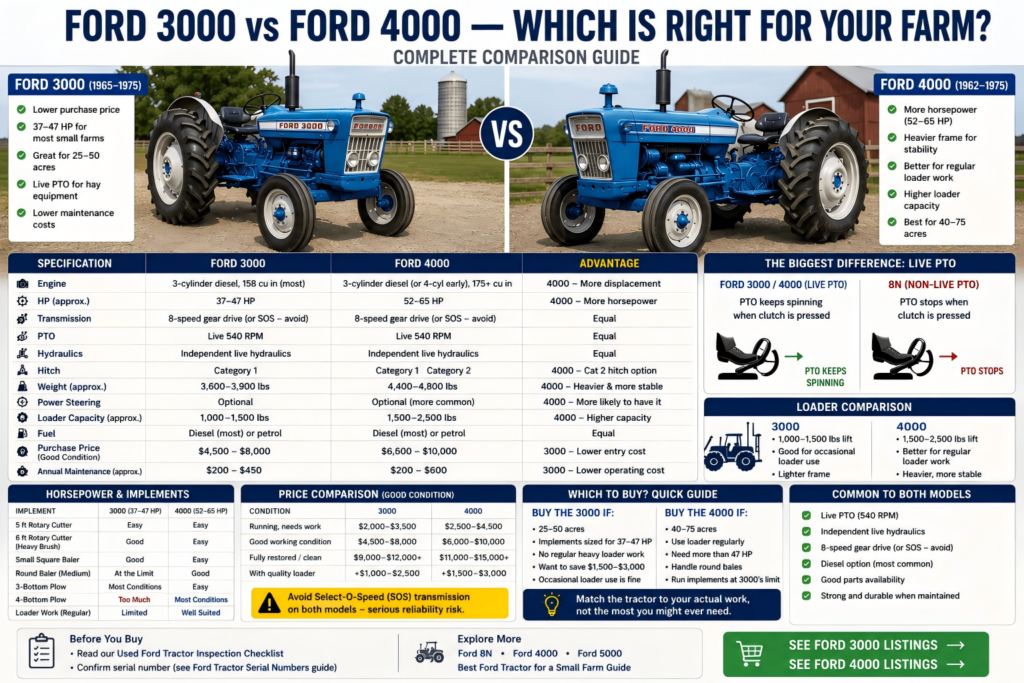
Horsepower Comparison — What the Numbers Mean in the Field
| Task | Ford 3000 (37–47 HP) | Ford 4000 (52–65 HP) |
|---|---|---|
| 5 ft rotary cutter, standard brush | ✅ Easy | ✅ Easy — significant reserve |
| 6 ft rotary cutter, heavy brush | ✅ Comfortable | ✅ Easy |
| 7 ft rotary cutter, dense material | ⚠️ At the limit | ✅ Comfortable |
| Small square baler | ✅ Works well | ✅ Easy |
| Large square baler | ⚠️ At the limit | ✅ Works well |
| Round baler (small) | ✅ Capable | ✅ Easy |
| Round baler (medium-large) | ⚠️ Pushing limits | ✅ Comfortable |
| 3-bottom plough | ✅ Most conditions | ✅ Easy |
| 4-bottom plough | ❌ Too much load | ✅ Most conditions |
| 6–7 ft disc harrow | ✅ Good in worked soil | ✅ Good in most conditions |
| Front loader (moderate use) | ⚠️ Possible, limited by frame | ✅ Well suited |
| Front loader (regular heavy use) | ❌ Not recommended | ✅ Designed for it |
Is a Ford 3000 the Same as a Ford 4000?
No — they are distinct models in the Ford Thousand Series range, produced alongside each other from 1965–1975. They share the same basic design philosophy and many components, but differ in engine size, HP, frame weight, and loader capability. The 4000 was positioned above the 3000 in Ford’s lineup as the step up for farms needing more power and capability.
Where they are the same: transmission design, PTO system, hydraulic architecture, and overall design language. Where they differ: engine displacement and HP, frame weight, loader capacity, and Category 2 hitch availability on the 4000.
Loader Comparison — The Biggest Practical Difference for Many Buyers
For buyers whose decision hinges on loader use, the 3000 vs 4000 comparison is particularly clear:
| Loader Factor | Ford 3000 | Ford 4000 |
|---|---|---|
| Typical loader lift capacity | ~1,000–1,500 lbs at height | ~1,500–2,500 lbs at height |
| Frame suitability | Lighter — accelerates front axle wear under sustained loader use | Heavier — handles loader forces more comfortably |
| Round bale handling | ❌ Not suitable | ✅ Yes — with bale spear |
| Daily loader cycles | ⚠️ Possible but not ideal for regular use | ✅ Designed for regular loader use |
| Snow clearing (blade) | ✅ Fine — low lift demand | ✅ Easy |
| Moving soil, mulch, gravel (occasional) | ✅ Good for occasional use | ✅ Good for frequent use |
Owners who use a front loader for more than occasional light tasks consistently recommend the 4000 over the 3000. The additional frame weight and HP reserve make the 4000 a noticeably more capable and less tiring loader tractor for sustained use.
What Common Problems Should I Look For?
Both the Ford 3000 and 4000 share the same primary risks — and the most important is the same for both:
| Problem | Ford 3000 | Ford 4000 |
|---|---|---|
| Select-O-Speed transmission | Avoid — serious known issues | Avoid — same risk, higher repair cost on 4000 |
| Diesel injection pump | Service every 3–5 years — $200–$500 | Service every 3–5 years — $300–$700 |
| Hydraulic system leaks | Common on older machines | Common on older machines |
| Rear axle seal leaks | Common — check at inspection | Common — check at inspection |
| Clutch wear | $300–$600 parts + labour | $400–$800 parts + labour |
| Front axle pivot wear | Present on high-hour examples | Present — inspect if loader-equipped |
The Select-O-Speed warning bears repeating: avoid any Ford 3000 or 4000 with this transmission unless it has a documented professional rebuild with receipts. Always confirm gear drive vs Select-O-Speed before inspecting anything else.
Aftermarket Parts — Are They Available for Both?
Yes — both the Ford 3000 and Ford 4000 have good aftermarket parts availability in 2026. As Thousand Series machines, they are well-supported by major suppliers:
- Steiner Tractor Parts — comprehensive Thousand Series catalogue covering engine, hydraulic, electrical, and sheet metal components for both models
- All States Ag Parts — competitive pricing on common wear items — seals, filters, clutch kits, belts
- Sparex — strong UK and international coverage for both models
- New Holland dealers — some original Ford Thousand Series parts still available through the New Holland network
Parts availability is roughly equal between the two models — neither has a significantly broader supply base than the other. This is a meaningful difference from the N-Series comparison, where the 8N has a notably broader supply than the 9N.
Price Comparison
| Condition | Ford 3000 (Gear Drive Diesel) | Ford 4000 (Gear Drive Diesel) |
|---|---|---|
| Running, needs work | $2,000–$3,500 | $2,500–$4,500 |
| Good working condition | $4,500–$8,000 | $6,000–$10,000 |
| Fully restored / clean | $9,000–$12,000+ | $11,000–$15,000+ |
| With quality loader fitted | Add $1,000–$2,500 | Add $1,500–$3,000 |
The Ford 4000 commands approximately $1,500–$3,000 more than a comparable Ford 3000. That premium reflects the genuine capability difference in HP, frame weight, and loader suitability. Confirm current listings on TractorHouse before negotiating — regional variation in pricing is significant on Thousand Series machines.
Which to Buy — Decision Guide by Scenario
| Your Situation | Best Choice | Why |
|---|---|---|
| 25–40 acres, varied work including hay | Ford 3000 | Covers the task list — no need for 4000 HP or price premium |
| Occasional loader use — moving soil, gravel, mulch | Ford 3000 | 3000 handles light occasional loader use adequately |
| Regular daily loader use | Ford 4000 | Heavier frame and more HP make the 4000 far better suited |
| Round bale handling | Ford 4000 | 3000 is not suitable for round bale lifting |
| Heavy primary tillage regularly | Ford 4000 | More HP reserve for 3–4 bottom ploughing and heavy disc work |
| 40–75 acres with heavy varied work | Ford 4000 | At 40+ acres with heavy work, the 4000 is more appropriate |
| Budget under $6,000 | Ford 3000 | A good 4000 costs $6,000+ — 3000 is the correct buy at this budget |
| Want Category 2 hitch compatibility | Ford 4000 | Category 2 available on most 4000 configurations |
Ownership Experience — What Owners Say
Owners who run both models — or who upgraded from a 3000 to a 4000 — consistently report the same pattern: the 3000 handles most tasks well and the upgrade to the 4000 only becomes obviously justified when loader work becomes regular or when implements consistently push the 3000 to its HP limits. No owner regrets buying the 4000 for heavy work. Some owners who bought the 4000 for light property maintenance acknowledge the 3000 would have been sufficient and less expensive.
The universal agreement: whichever model you buy, get the gear drive and buy the diesel. The Select-O-Speed transmission is the one decision both 3000 and 4000 buyers consistently regret when they didn’t follow that guidance.
Verdict — Ford 3000 vs Ford 4000
The Ford 3000 vs Ford 4000 comes down to two questions: how much HP do you actually need, and how often do you use a front loader?
If your farm is 25–50 acres with varied work including hay equipment and you don’t use a loader regularly — the Ford 3000 covers the task list at a lower price and is the right choice. If your farm is 40–75 acres with heavier regular work, you use a loader frequently, handle round bales, or run implements that push the 3000 to its limits — the Ford 4000 earns the premium.
Both machines are the same in what matters: live PTO, live hydraulics, gear drive transmission, diesel option, and parts availability. The 4000 is simply more of those things — more HP, more frame, more loader capacity — at a higher price. Match the machine to your actual work, not to the most you might ever need.
Individual model reviews: Ford 3000 review · Ford 4000 review · Best Ford Tractor for a Small Farm →
Before any purchase: Used Ford Tractor Inspection Checklist →
👉 See Ford 3000 listings · See Ford 4000 listings →
Frequently Asked Questions
What is the difference between a Ford 3000 and Ford 4000 tractor?
The Ford 4000 produces 52–65 HP versus the 3000’s 37–47 HP, has a heavier frame (~4,400–4,800 lbs vs ~3,600–3,900 lbs), higher loader capacity (~1,500–2,500 lbs vs ~1,000–1,500 lbs), and Category 2 hitch on most configurations. Both share live PTO, live hydraulics, and 8-speed gear drive. The 4000 costs $1,500–$3,000 more than a comparable 3000.
Is a Ford 3000 the same as a Ford 4000?
No — they are distinct models in the same Thousand Series range. They share the same design architecture (live PTO, live hydraulics, gear drive) but differ in engine size, HP, frame weight, and loader capability. The 4000 was positioned above the 3000 in Ford’s lineup for farms needing more power and capacity.
Which is better for loader work — Ford 3000 or Ford 4000?
The Ford 4000 is significantly better for regular loader work. The heavier frame handles loader forces more comfortably, the higher HP provides more lifting power, and the higher rated capacity allows heavier loads. The Ford 3000 can handle a loader for occasional light use — moving soil, mulch, gravel — but is not recommended for daily heavy loader cycles or round bale handling.
What common problems should I look for when buying a Ford 3000 or 4000?
The most important check for both: confirm gear drive transmission versus Select-O-Speed (avoid the SOS without documented professional rebuild — serious reliability risk). Then check diesel injection system behaviour (hard warm starting, black smoke, uneven running indicate injection pump issues), hydraulic system lift and hold, rear axle seals, and clutch engagement. See our full Used Ford Tractor Inspection Checklist →
Are aftermarket parts available for both the Ford 3000 and Ford 4000?
Yes — both models have good aftermarket parts availability from multiple suppliers including Steiner Tractor Parts, All States Ag Parts, and Sparex. Parts availability is roughly equal between the two models. Most mechanical wear items — engine components, hydraulic seals, clutch kits, filters — are stocked and available with fast delivery in 2026.