The Ford 8N vs Ford 3000 decision is the most common upgrade question among classic Ford tractor buyers — and it has a clear answer once you understand what actually separates the two machines. The 8N is simpler, cheaper, and covers most small farm tasks well. The 3000 offers live PTO, more HP, diesel efficiency, and is meaningfully better for hay work and larger properties. The question is not which is the better machine — it is which is the right machine for what you actually need to do.
👉 Browse our current Ford tractor inventory →
Written by: Farmers Equipment editorial team — specialising in classic Ford tractors from the N-Series through the Thousand Series.
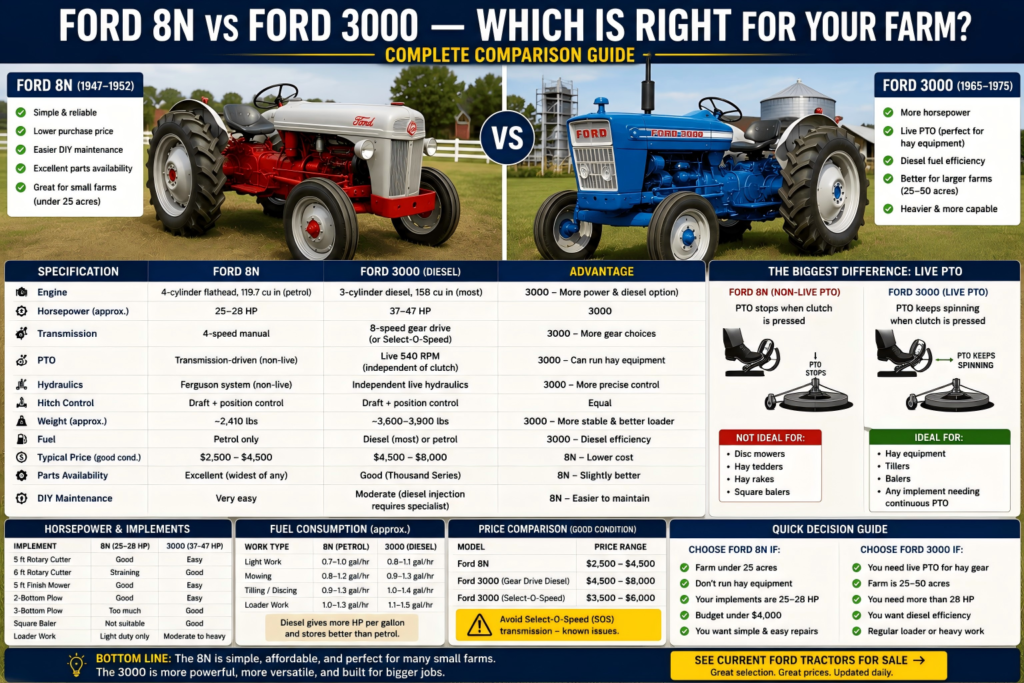
Ford 8N vs Ford 3000 — Quick Decision
Buy the Ford 8N if: your farm is under 25 acres, you don’t run hay equipment, your implements are sized for 25–28 HP, and budget matters — the 8N costs $2,000–$3,000 less than a comparable 3000.
Buy the Ford 3000 if: you need live PTO for hay equipment, your farm is 25–50 acres with regular demanding work, you want diesel fuel efficiency, or you need more than 28 HP for larger implements.
Ford 8N vs Ford 3000 — Full Specification Comparison
| Specification | Ford 8N | Ford 3000 | Advantage |
|---|---|---|---|
| Production years | 1947–1952 | 1965–1975 | — |
| Engine | 4-cylinder flathead, 119.7 cu in petrol | 3-cylinder diesel (most) or petrol, 158 cu in | 3000 — diesel option and more displacement |
| HP | ~25–28 HP | ~37–47 HP | 3000 — significant advantage |
| Transmission | 4-speed manual | 8-speed gear drive (or Select-O-Speed) | 3000 — more gear ratios |
| PTO | Transmission-driven 540 RPM (non-live) | Live 540 RPM — independent of clutch | 3000 — critical for hay equipment |
| Hydraulics | Ferguson system (non-live) | Independent live hydraulics | 3000 — more precise control |
| Hitch | Category 1 — draft + position control | Category 1 — draft + position control | Equal |
| Fuel | Petrol only | Diesel (most) or petrol | 3000 — diesel efficiency advantage |
| Weight | ~2,410 lbs | ~3,600–3,900 lbs | 3000 — more stable under load |
| Parts availability | Excellent — broadest of any classic tractor | Good — well-supported Thousand Series | 8N — slightly broader supply base |
| DIY maintenance | Very easy — no specialist tools or knowledge | Moderate — diesel injection is specialist | 8N — simpler for DIY owners |
| Purchase price (good condition) | $2,500–$4,500 | $4,500–$8,000 | 8N — significantly lower entry cost |
| Annual maintenance | $100–$300 | $200–$450 | 8N — lower running cost |
| Loader suitability | Limited — light front axle | Better — heavier frame | 3000 — more appropriate for loader use |
The Biggest Difference — Live PTO
The single most important difference between the Ford 8N and Ford 3000 for most buyers is not horsepower — it is the PTO type. This single factor determines which machine is correct for any farm that runs hay equipment:
| PTO Type | Ford 8N | Ford 3000 |
|---|---|---|
| PTO type | Transmission-driven (non-live) | Live — independent of clutch |
| What happens when clutch is depressed | PTO stops spinning | PTO keeps spinning |
| Effect on hay mower | Blade stops on every gear change — not suitable | Blade keeps cutting through turns and changes — works correctly |
| Effect on rotary cutter (brush hog) | Manageable — flywheel mass carries blade through brief stops | No interruption — cleaner operation |
| Effect on finish mower | Manageable for most use | No interruption |
| Effect on tedder / rake | Not suitable — continuous PTO required | Works correctly |
| Effect on tiller | Manageable with careful gear changing | No interruption |
The bottom line on PTO: if you cut, ted, or rake hay — buy the Ford 3000. The 8N’s non-live PTO is not a workaround limitation for hay equipment; it is a hard incompatibility. Every experienced Ford owner who has tried to run a sickle bar mower or disc mower on an 8N confirms this.
Horsepower — When Does the Difference Matter?
The Ford 3000’s 37–47 HP versus the 8N’s 25–28 HP is a 50–70% increase in available power. That difference matters in specific conditions:
| Task | Ford 8N (25–28 HP) | Ford 3000 (37–47 HP) |
|---|---|---|
| 5 ft rotary cutter, standard grass | ✅ Comfortable | ✅ Easy — HP in reserve |
| 6 ft rotary cutter, heavy brush | ⚠️ Straining — possible | ✅ Comfortable |
| 5 ft finish mower | ✅ Comfortable | ✅ Easy |
| 5 ft box blade | ✅ Good | ✅ Easy |
| 2-bottom plough | ✅ Most conditions | ✅ Easy |
| 3-bottom plough | ❌ Too much load | ✅ Comfortable |
| 6–7 ft disc harrow | ⚠️ Pushing limits | ✅ Good |
| Small square baler | ❌ Non-live PTO issue + HP limits | ✅ Works well |
| Loader work (moderate) | ⚠️ Possible, limited | ✅ Better suited |
The HP difference matters most in heavy brush clearing, larger disc work, ploughing beyond 2-bottom, and sustained loader use. For standard hobby farm tasks — mowing, box blade work, post holes, light tilling — the 8N handles it all without the 3000’s additional HP being necessary.
Diesel vs Petrol — The Fuel Efficiency Difference
The Ford 3000 diesel delivers real fuel economy advantages over the Ford 8N petrol for buyers who use the tractor regularly:
| Factor | Ford 8N (Petrol) | Ford 3000 (Diesel) |
|---|---|---|
| Typical fuel consumption | ~0.7–1.2 gal/hr | ~0.8–1.4 gal/hr |
| HP per gallon | Lower — petrol less efficient | Higher — diesel more efficient per unit of fuel |
| Fuel storage stability | Petrol degrades in 3–6 months — carburettor gumming on seasonal storage | Diesel more stable in storage — fewer carb issues |
| Annual fuel cost (80 hrs/year) | ~$200–$380 | ~$250–$450 (but more HP per dollar spent) |
| Cold weather starting | Easier — petrol starts in cold more readily | More care needed below freezing — glow plugs help |
For a machine used 40–60 hours per year on a small hobby farm, the fuel cost difference is modest and unlikely to justify the upgrade alone. For a machine used 100–150+ hours per season on a working farm, the diesel efficiency advantage adds up meaningfully across a farming season.
Maintenance — Which Is Easier to Own?
| Factor | Ford 8N | Ford 3000 |
|---|---|---|
| Engine complexity | Simple flathead — no specialist knowledge needed | Diesel — injection system requires professional service |
| Injection system service | N/A — carburettor only | Every 3–5 years — $200–$500 professional cost |
| Carburettor rebuild | $25–$50 kit — DIY in 2–3 hours | N/A on diesel variant |
| Ignition system | Points and condenser — simple, DIY service | Diesel — no ignition system to service |
| Parts sourcing | Broadest of any classic tractor — fast delivery | Good — slightly narrower but well-stocked |
| Annual maintenance cost | $100–$300 | $200–$450 |
| Transmission warning | N/A — no Select-O-Speed issue | Avoid Select-O-Speed variant — serious risk |
The Ford 8N is genuinely more DIY-friendly than the 3000. Parts for both models are available from suppliers like Steiner Tractor Parts, though the 8N’s supply base is notably broader for model-specific items. A mechanically confident owner can handle virtually all 8N maintenance with basic tools and a service manual. The Ford 3000 diesel’s injection system is the maintenance item that requires professional intervention — owners who are not comfortable delegating this should factor the cost into their budget.
Was the Ford 3000 a Good Tractor?
Yes — particularly the gear drive diesel variant. The Ford 3000 earned a strong reputation during its production run (1965–1975) and that reputation has only grown as the machines have proved their durability over six decades of farm use. Common complaints focus almost entirely on the Select-O-Speed transmission (avoid) and the diesel injection system service cost (budget for it). In gear drive diesel form, owners consistently report high satisfaction with the 3000’s capability and reliability for the workloads it was designed for.
What Is the Difference Between a Ford 2000 and Ford 3000?
The Ford 2000 and Ford 3000 were both part of the Thousand Series range introduced in 1965. The key differences:
| Feature | Ford 2000 | Ford 3000 |
|---|---|---|
| HP | ~32–36 HP | ~37–47 HP |
| Engine | 3-cylinder — smaller displacement | 3-cylinder — larger displacement |
| Target use | Light farm and property use | Small to medium farm — more demanding work |
| Price comparison | Typically less expensive than 3000 | Premium over 2000 for the additional HP |
For most buyers comparing a Ford 2000 to a Ford 3000 — the 3000’s additional HP and wider parts base make it the stronger choice at comparable prices. The 2000 sits between the 8N and 3000 in capability.
Which to Buy — Decision Guide by Scenario
| Your Situation | Best Choice | Why |
|---|---|---|
| Under 25 acres, standard hobby farm tasks | Ford 8N | Covers all standard tasks, lower cost, simpler maintenance |
| Budget under $4,000 | Ford 8N | A good 3000 costs $4,500+ — 8N is the right buy at this budget |
| Need to cut, ted, or rake hay | Ford 3000 | Live PTO is non-negotiable for hay equipment |
| 25–50 acres with regular demanding work | Ford 3000 | More HP makes a real difference at this scale and workload |
| First-time tractor owner, want DIY-friendly | Ford 8N | Simpler systems, better documented, easier maintenance |
| Regular loader use needed | Ford 3000 | Heavier frame and more HP — better suited for regular loader cycles |
| Want diesel fuel efficiency for regular use | Ford 3000 | Diesel efficiency pays back over a full farming season |
| Occasional light use — mowing and grading only | Ford 8N | No need to pay for 3000 capability if the 8N covers the task list |
| Collector interest alongside utility | Ford 8N or 9N | N-Series has stronger collector following than Thousand Series |
Price Comparison — What You Get for the Money
| Condition | Ford 8N Price | Ford 3000 Price (Gear Drive Diesel) |
|---|---|---|
| Running, needs work | $1,000–$2,000 | $2,000–$3,500 |
| Good working condition | $2,500–$4,500 | $4,500–$8,000 |
| Fully restored / particularly clean | $5,000–$8,000+ | $9,000–$12,000+ |
The Ford 3000 costs approximately $2,000–$3,500 more than a comparable Ford 8N. That premium is justified if you genuinely need live PTO, more HP, or diesel efficiency. It is not justified if your work stays within what the 8N can handle — save the money and buy a good 8N with the budget difference going to implements or maintenance reserve.
Verdict — Ford 8N vs Ford 3000
The Ford 8N vs Ford 3000 decision has a clear framework: the 8N wins on price, simplicity, and parts availability. The 3000 wins on live PTO, horsepower, diesel efficiency, and loader suitability. Neither machine is better than the other in absolute terms — the right choice depends entirely on what your farm requires.
If you are still unsure after working through the scenarios above, ask yourself one question: do you need to run hay equipment? If yes — buy the 3000, without further debate. If no — the 8N covers most of what you need at a meaningfully lower price, and the money you save is better spent on implements, maintenance parts, or a quality inspection before purchase.
For detailed individual reviews: Ford 8N review · Ford 3000 review · Best Ford Tractor for a Small Farm →
Before any purchase: Used Ford Tractor Inspection Checklist · Ford Tractor Serial Numbers guide →
Also available: Ford 9N · Ford 4000 · Ford 5000
👉 See Ford 8N listings · See Ford 3000 listings →
Frequently Asked Questions
Is the Ford 8N or Ford 3000 better for a small farm?
For most small farms under 25 acres without hay equipment — the Ford 8N. Lower purchase price, simpler maintenance, and broadest parts availability of any classic tractor. For small farms of 25–50 acres, farms running hay equipment, or where more than 28 HP is needed — the Ford 3000. The decision hinges primarily on whether live PTO is required and whether the budget supports the 3000’s higher purchase price.
How much horsepower does a Ford 3000 have vs a Ford 8N?
The Ford 3000 produces approximately 37–47 HP versus the Ford 8N’s 25–28 HP — a 50–70% increase in available power. The HP difference matters most for heavy brush clearing, 3-bottom ploughing, large disc work, and sustained loader use. For standard hobby farm tasks — mowing, box blade grading, post holes, light tilling — the 8N handles these within its HP range.
What is the main difference between the Ford 8N and Ford 3000?
The most important practical difference is the PTO type. The Ford 8N has a transmission-driven (non-live) PTO that stops when the clutch is depressed. The Ford 3000 has live PTO that keeps spinning independently — essential for hay mowers, tedders, and rakes. Secondary differences are horsepower (37–47 vs 25–28), diesel option on the 3000, and heavier frame for better loader suitability.
Was the Ford 3000 a good tractor?
Yes — particularly the gear drive diesel. It earned a strong reputation during its 1965–1975 production run and has proved durable over six decades of farm use. The Select-O-Speed transmission is the main reliability risk — avoid it without a documented professional rebuild. In gear drive diesel form, the 3000 is one of the most capable and cost-effective classic tractors for small to medium farm use.
What engine does a Ford 3000 have?
Most Ford 3000 tractors use a 3-cylinder diesel engine of approximately 158 cubic inches (2.6 litres) displacement. A petrol (gasoline) variant was also produced. The 3-cylinder diesel became the standard configuration in most markets — it is more fuel-efficient than the petrol variant and has a stronger reputation for long-term reliability.