A Ford 8N loader is possible — but with real limitations that every buyer needs to understand before committing to one. The Ford 8N was not designed as a loader tractor. Its manual steering, lighter front axle, and frame geometry make it significantly less capable for loader work than a Ford 4000 or modern compact tractor at the same price. That said, thousands of Ford 8N tractors have been fitted with front loaders over the decades, and for occasional light lifting on a hobby farm — moving mulch, soil, or gravel — a properly fitted loader on an 8N is a practical tool. The honest question is whether it fits your actual use case.
👉 Check current Ford 8N listings — see available stock and pricing →
Written by: Farmers Equipment editorial team — specialising in classic Ford tractors from the N-Series through the Thousand Series.
Ford 8N Loader — Quick Facts
| Question | Answer |
|---|---|
| Can you add a loader to a Ford 8N? | Yes — aftermarket loaders are available and widely used |
| Is the 8N designed for loader work? | No — it is a utility tractor, not a loader tractor |
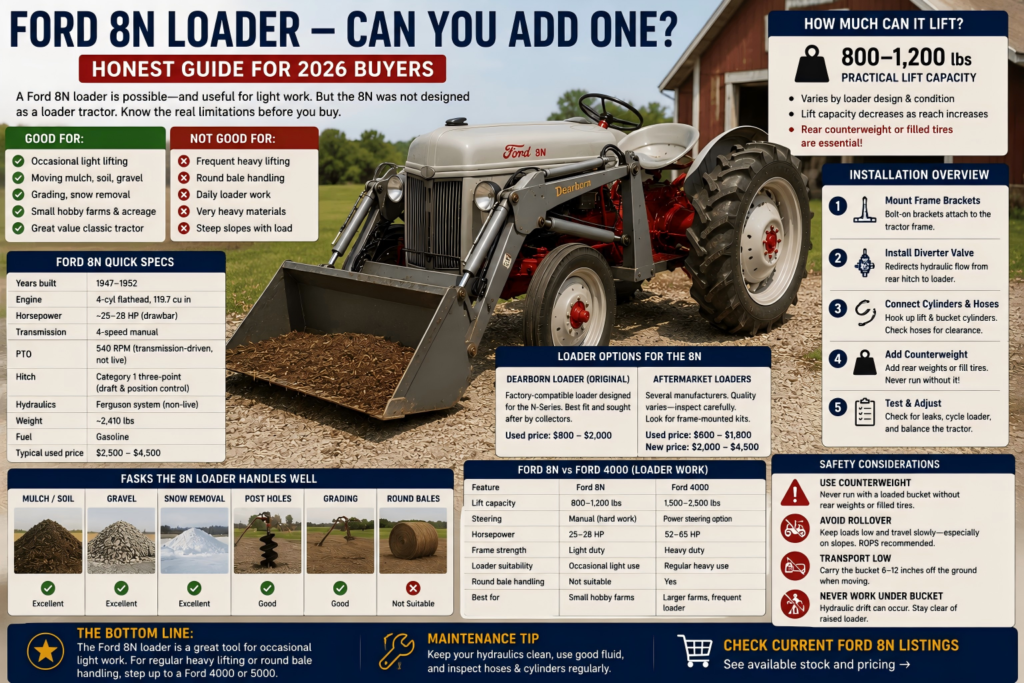
| Typical lift capacity | 800–1,200 lbs depending on loader and hydraulic condition |
| Manual steering with loader? | Yes — steering is physically demanding with a loaded bucket |
| Cost to add a loader | $800–$2,500 used; $2,000–$4,500 new |
| Best use case | Occasional light lifting — mulch, soil, gravel, snow |
| Not suitable for | Frequent heavy lifting, round bale handling, daily loader work |
| Better loader tractor | Ford 4000 or Ford 5000 — heavier frame, more HP, better geometry |
How Much Can a Ford 8N Loader Lift?
The Ford 8N’s three-point hitch rear lift capacity is rated at approximately 800–900 lbs in most references — but a front loader works differently from the rear hitch. Front loader lift capacity on an 8N depends on:
- Hydraulic system condition — the 8N’s non-live Ferguson hydraulic system powers the loader through a diverter valve. A worn hydraulic system with slow lift speed or low pressure will reduce loader performance meaningfully
- Loader design and mounting — loaders designed specifically for the 8N typically achieve 800–1,200 lbs at full lift height. Capacity drops as reach increases — a full bucket held at arm’s length is substantially less than the rated capacity
- Front axle counterbalance — the 8N’s front axle is relatively light. A heavy loaded bucket raises the rear wheels, reducing steering and braking capability. Rear counterweights or filled rear tyres help but do not eliminate this
Practical rule: treat 800 lbs as the comfortable working limit for frequent loader cycles on an 8N. Occasional lifts to 1,000–1,200 lbs are possible on a well-maintained machine, but sustained work at that weight accelerates wear on the front axle, steering components, and hydraulic system.
Ford 8N Loader Brands and Options
Dearborn Loader (Original)
The Dearborn loader is the original factory-compatible loader designed for the Ford 8N era. Dearborn Equipment Company was Ford’s implement partner during the N-Series years and produced a front loader specifically engineered for the 8N’s mounting points and hydraulic system. Original Dearborn loaders are sought by purists and collectors — parts and complete units appear on auction sites and in estate sales.
If you find a complete Dearborn loader in good condition matched to an 8N, it is the best-fitting option available — designed for the machine rather than adapted to it.
Sherman Bros / Modern Aftermarket Loaders
Several aftermarket manufacturers have produced or continue to produce loaders compatible with the Ford 8N. These adapt to the 8N’s frame using bolt-on mounting brackets and connect to the hydraulic system through a diverter valve. Quality varies significantly between manufacturers — a well-made loader with proper frame reinforcement brackets is a different machine from a light-duty unit with minimal mounting.
What to look for in an aftermarket 8N loader:
- Frame-mounted (not hitch-mounted) — loaders that mount to the tractor frame rather than the three-point hitch are more stable and put less stress on the hitch components
- Proper front axle reinforcement brackets — good loader kits include bracing that distributes loader forces across the front axle rather than concentrating them on a single point
- Hydraulic diverter valve — redirects hydraulic flow from the 8N’s rear hitch system to the loader cylinders. Confirm it is included and in good working condition on used units
Used Loaders — What to Inspect
Used loaders for the Ford 8N appear regularly on farm auction sites and Craigslist. Before purchasing:
- Confirm the loader is specifically designed for the Ford 8N — not an adapted unit from a different tractor model
- Check cylinder seals for leaks — a weeping hydraulic cylinder on a loader loses pressure and drops the bucket unexpectedly
- Inspect the mounting brackets and frame attachment points for cracks or previous welding repairs
- Confirm the diverter valve is present and functional
- Check bucket cutting edge wear — a badly worn edge is repairable but is a negotiating point
How Much Does a Loader for a Ford 8N Cost?
| Option | Cost Range | Notes |
|---|---|---|
| Original Dearborn loader (used, complete) | $800–$2,000 | Best fit — but finding a complete set in good condition takes time |
| Aftermarket loader kit (used) | $600–$1,800 | Condition varies widely — inspect cylinders and mounting carefully |
| Aftermarket loader kit (new) | $2,000–$4,500 | New manufacture is limited — most buyers use used equipment |
| Installation labour (if not DIY) | $200–$500 | Straightforward for a mechanic familiar with classic Fords |
| Hydraulic diverter valve (if not included) | $100–$250 | Required to run loader from 8N’s hydraulic system |
| Total estimated cost | $1,000–$2,500 | Used equipment, self-installed |
Installing a Loader on a Ford 8N — What’s Involved
Fitting a loader to a Ford 8N is a manageable project for a mechanically confident owner. The general process:
- Mount the frame brackets — the loader’s mounting brackets bolt to the tractor frame at specific attachment points. The exact mounting varies by loader design — follow the specific instructions for your loader unit
- Install the hydraulic diverter valve — this splits the 8N’s hydraulic output between the rear hitch and the loader cylinders. It is typically installed in the hydraulic line between the pump and the rear control valve
- Connect the loader cylinders — hydraulic hoses run from the diverter valve to the loader’s lift and tilt cylinders. Use proper hydraulic fittings and inspect hoses for abrasion against moving parts during operation
- Balance and test — with the loader fitted, the 8N’s weight distribution shifts forward significantly. Add rear counterweights or fill rear tyres with liquid ballast to restore front-to-rear balance before operating
Critical note on counterweighting: operating an 8N with a loaded front bucket and no rear counterweight raises the rear wheels, eliminating steering and braking traction. Rear tyre ballast (calcium chloride solution or commercial ballast) or bolt-on rear weights are essential for safe loader operation.
The Manual Steering Reality
This is the most significant practical limitation of a Ford 8N loader that most articles understate. The Ford 8N has no power steering. With a loaded bucket on the front — particularly on rough ground or when turning in tight spaces — steering requires significant physical effort. On a compact modern tractor with power steering, loader work is effortless. On an 8N, it is a workout.
For occasional loader use a few times a season, this is manageable. For regular daily loader cycles — moving round bales, filling trailers, grading with a loaded bucket — the manual steering fatigue becomes a real operational concern. Buyers who plan frequent loader use should seriously consider the Ford 4000 or Ford 5000 instead — both have heavier frames, more HP, and power steering options.
Ford 8N Loader vs Ford 4000 Loader — When to Upgrade
| Factor | Ford 8N with Loader | Ford 4000 with Loader |
|---|---|---|
| Lift capacity | ~800–1,200 lbs | ~1,500–2,500 lbs |
| Steering | Manual — physically demanding | Power steering option available |
| HP | 25–28 HP | 52–65 HP |
| Frame suitability | Light — adapted for loader use | Heavier frame — better suited |
| Round bale handling | Not suitable | Yes — with bale spear |
| Daily loader use | Not recommended | Yes — designed for it |
| Purchase price (tractor) | $2,500–$4,500 | $6,000–$10,000 |
| Best for | Occasional light lifting | Regular loader work on a small farm |
See our Ford 4000 listings and Ford 9N listings for comparison.
What an 8N Loader Is Good For
- ✅ Moving mulch, compost, and soil — light bucket loads a few times a session
- ✅ Spreading gravel on driveways and laneways
- ✅ Snow removal — pushing snow with the bucket rather than lifting
- ✅ Moving material around a small property where a wheelbarrow is too slow
- ✅ Backfilling post holes and small trenches
- ✅ Loading a small trailer with loose material (gravel, soil, mulch)
What an 8N Loader Is Not Good For
- ❌ Round bale handling — requires a heavier loader and significantly more HP
- ❌ Frequent daily loader cycles — manual steering fatigue and front axle stress
- ❌ Lifting heavy equipment or large stones — 800 lb practical limit
- ❌ Commercial or contractor use — the 8N is a light farm machine
- ❌ Working on steep terrain with a loaded bucket — serious rollover risk
Safety Considerations — Ford 8N with a Front Loader
- No ROPS — the Ford 8N has no Roll-Over Protective Structure from the factory. Adding a front loader raises the centre of gravity significantly. Rollover risk on slopes increases with a loaded bucket. Aftermarket ROPS frames are strongly recommended
- Never carry a raised loaded bucket while travelling — transport loads with the bucket as low as possible — 6–12 inches off the ground. A raised loaded bucket dramatically raises the centre of gravity and increases rollover risk on any terrain variation
- Counterweight is mandatory — never operate with a loaded front bucket without rear counterweights or tyre ballast. An unballasted 8N with a heavy bucket lifts the rear wheels, eliminating steering and braking traction entirely
- Hydraulic drift — the 8N’s non-live hydraulic system can allow the loader to drift downward slowly when held at height. Never work under a raised loader bucket
Verdict — Ford 8N Loader
A Ford 8N loader is a practical addition for occasional light lifting on a hobby farm — moving soil, gravel, mulch, and similar materials a few times a season. It is not a substitute for a purpose-built loader tractor. The manual steering, lighter front axle, and 800 lb practical lift limit are real constraints that make frequent or heavy loader use genuinely tiring and hard on the machine.
If loader work is occasional and light — fit a loader and use the 8N you already have or are planning to buy. If loader work is regular, involves round bales, or needs more than 1,200 lbs of capacity — buy the Ford 4000 and fit it properly. The price difference is significant, but so is the capability difference.
Current used loader prices and availability can be verified on TractorHouse.
For full guidance on the Ford 8N as a working tractor: Ford 8N review · Ford 8N for Hobby Farm · Best Implements for a Ford 8N · Used Ford Tractor Inspection Checklist →
👉 See current Ford 8N listings →
Ford 8N Attachments Full Range
What Attachments Are Available for the Ford 8N Tractor?
The Ford 8N’s Category 1 three-point hitch and 540 RPM PTO connect to the full range of standard Category 1 implements. Beyond the front loader covered in this guide, common attachments include:
| Attachment | Use | 8N Suitability |
|---|---|---|
| Rotary cutter (4 5 ft) | Pasture and brush mowing | Excellent 5 ft is the ideal size |
| Box blade (5 ft) | Grading driveways and levelling | Excellent one of the best 8N tasks |
| Rear blade (6 ft) | Snow removal and light grading | Excellent |
| Post hole digger (6 9 inch) | Fencing and planting | Good in soft to medium ground |
| Finish mower (5 ft) | Lawn and paddock mowing | Excellent |
| Tiller (4 ft) | Garden and food plot tillage | Good in prepared soil |
| 2-bottom moldboard plow | Primary tillage | Good rated 2-plow tractor |
| Disc harrow (5 ft) | Secondary tillage | Good in prepared soil |
| Front loader | Material lifting and moving | Possible light use only, see this guide |
| Hay mower / tedder | Hay production | Non-live PTO not suitable |
| Round baler | Hay baling | Too heavy and requires live PTO |
For a complete implement guide see our Best Implements for a Ford 8N ->
What Is a Ford 8N Good For?
The Ford 8N handles the core small farm task list reliably: pasture mowing with a 4 5 ft rotary cutter, driveway and lane grading with a box blade, light tillage in prepared soil, post hole digging, finish mowing, snow removal with a rear blade, and occasional light loader work. The three tasks it handles best brush hogging, box blade grading, and post hole digging are also the most common recurring tasks on hobby farms under 25 acres. Its main limitations are no live PTO (rules out hay equipment), 25 28 HP ceiling, and the light front axle that makes frequent loader use tiring. Browse our Ford 8N for sale ->
Will a Ford 8N Pull a 2-Bottom Plow?
Yes the Ford 8N is rated as a 2-plow tractor. Standard 14-inch 2-bottom moldboard plowing in worked or light soil is within design capability. The Ferguson draft control system automatically adjusts plow depth based on soil resistance making the 8N particularly capable at consistent tillage work relative to its HP. Reduce to single-bottom in heavy clay or unbroken sod. Avoid 16-inch or larger bottoms in tough conditions. For 3-bottom plowing you need the Ford 3000 at 37 47 HP or larger.
How Much Does It Cost to Add a Front-End Loader to a Tractor?
General loader addition costs by tractor class for context beyond the Ford 8N specifically:
| Tractor Class | OEM Loader Cost (new) | Aftermarket Loader (used) | Total Installed Est. |
|---|---|---|---|
| Sub-compact (Kubota BX, JD 1025R) | $3,500 $5,000 | $1,500 $3,000 | $2,000 $5,500 |
| Compact utility (Kubota L, JD 3 Series) | $5,000 $9,000 | $2,500 $5,000 | $3,000 $9,500 |
| Ford 8N (aftermarket) | $2,000 $4,500 (new kit) | $600 $2,000 (used) | $1,000 $2,500 total |
| Ford 4000 / 5000 (aftermarket) | $3,000 $6,000 | $1,500 $3,500 | $2,000 $4,500 total |
| Utility tractor (JD 5 Series, MF 5700) | $7,000 $16,000 OEM | $3,500 $7,000 | $4,000 $17,000 |
The Ford 8N loader addition is one of the cheapest loader options available but the capability difference versus a modern compact tractor with a factory-integrated loader is significant. For the cost of a good used Ford 8N with a loader ($3,500 $6,500 total), a buyer could also consider a used Kubota BX or John Deere 1025R which offers live hydraulics, power steering, factory loader integration, and modern serviceability. Browse our Kubota tractors for sale.
How to Tell the Year of a Ford 8N Tractor
Ford 8N Serial Number Year Guide
For full year-by-year records, TractorData.com maintains complete Nebraska Test data. The serial number on a Ford 8N is stamped on a plate on the engine block (left side) and on the instrument panel. The prefix “8N” identifies the model; the sequential number identifies the production year:
| Year | Serial Number Range (approx) | Notes |
|---|---|---|
| 1947 | 8N1 8N37,907 | First year of production |
| 1948 | 8N37,908 8N141,369 | |
| 1949 | 8N141,370 8N245,636 | |
| 1950 | 8N245,637 8N343,592 | Distributor change mid-year at ~8N263,844 |
| 1951 | 8N343,593 8N442,034 | |
| 1952 | 8N442,035 8N524,076 | Last year of production |
The distributor change in 1950 is the most important mid-year identification point: early 1950 machines (below approximately 8N263,844) have a front-mount distributor; later 1950 and all 1951 1952 machines have a side-mount distributor. The side-mount is generally preferred on the used market.
Can You Still Get Parts for a Ford 8N Tractor?
Yes the Ford 8N has one of the most comprehensive aftermarket parts supplies of any vintage tractor. 524,076 units produced and 75+ years of continued use have created a permanent, extensive aftermarket. Engine wear parts, ignition components, carburetor rebuild kits, hydraulic seals, sheet metal, and tyres are all universally available. There is essentially no part on a Ford 8N that cannot be sourced today a genuine ownership advantage over many other vintage machines. For N-Series parts, Steiner Tractor Parts specialises in Ford N-Series and Thousand Series components.
Ford 8N and Ford 9N Quick Comparison
How Much Horsepower Does a Ford 9N Have?
The Ford 9N produces approximately 23 26 HP at the belt slightly less than the Ford 8N’s 25 28 HP. The difference is meaningful but not dramatic. The 9N has a 3-speed transmission (vs the 8N’s 4-speed), draft control only (vs the 8N’s draft and position control), and a single brake pedal (vs the 8N’s two separate pedals). For loader work specifically, neither the 8N nor the 9N is a purpose-built loader tractor, but the 8N’s additional HP and transmission flexibility make it the stronger choice.
How Much Is a Ford 9N Worth?
Running, good working condition: $2,000 $3,500. Non-running or rough: $400 $1,500. Restored driver quality: $3,500 $6,000. 1939 1940 aluminium-component examples in unmodified original condition: $6,000 $15,000+. The 9N typically trades slightly below equivalent 8N examples due to lower production volume (less parts supply) and inferior specification for working use.
How Fast Does a Ford 9N Go?
Maximum approximately 12 14 mph in 3rd gear slightly lower top speed than the 8N’s 4-speed range. Working speeds: 1st ~2.0 mph, 2nd ~3.5 4.5 mph, 3rd ~12 14 mph (road transport only). The 9N’s 3-speed gives fewer working speed options than the 8N’s 4-speed.
Which Is Better Ford 8N or 9N?
For working use including loader work: the 8N in every dimension 4-speed vs 3-speed, position plus draft control, two brake pedals, more HP. For collection and historical significance: the 9N as the original first-year machine. Buy the 8N for work; the 9N for collecting.
What Is the Best Ford Tractor Ever Made?
For hobby farm use: the Ford 8N most produced, widest parts base, best N-Series specification. For larger farms where more HP and live PTO matter: the Ford 4000 3-cylinder diesel, live PTO, 52 HP. For the most capable classic Ford: the Ford 5000 at 65 HP. For historical significance: the Ford 9N it introduced the three-point hitch that became the global standard. Browse our Ford tractors for sale ->
Frequently Asked Questions
Can you put a loader on a Ford 8N?
Yes — aftermarket loaders are available and have been fitted to Ford 8N tractors for decades. The most compatible option is an original Dearborn loader designed specifically for the 8N era. Modern aftermarket loaders also fit with bolt-on mounting brackets. The key limitations are the 8N’s manual steering, ~800–1,200 lb practical lift capacity, and lighter front axle compared to purpose-built loader tractors.
How much can a Ford 8N loader lift?
A Ford 8N with a properly fitted loader typically lifts 800–1,200 lbs depending on loader design and hydraulic system condition. Treat 800 lbs as the comfortable working limit for frequent cycles. Rear counterweights or tyre ballast are essential for safe operation with any loaded bucket — without them, a heavy bucket raises the rear wheels and eliminates steering traction.
How much does it cost to add a loader to a Ford 8N?
Expect $1,000–$2,500 total for a used loader kit including a hydraulic diverter valve, self-installed. An original Dearborn loader in good condition runs $800–$2,000. New aftermarket loader kits are limited in availability and typically cost $2,000–$4,500. Installation labour from a mechanic adds $200–$500 if not self-installed.
What is the best loader for a Ford 8N?
An original Dearborn loader is the best fit — designed specifically for the 8N’s mounting points and hydraulic system. For modern aftermarket options, look for a frame-mounted loader (not hitch-mounted) with proper front axle reinforcement brackets and a hydraulic diverter valve. Avoid light-duty units with minimal mounting hardware — they concentrate loader forces on components not designed for sustained lifting.
Is the Ford 8N good for loader work?
For occasional light loader work — yes. For regular heavy loader use — no. The 8N’s manual steering makes frequent cycles with a loaded bucket physically demanding, and the lighter front axle and frame are not designed for sustained heavy lifting. For regular loader work, the Ford 4000 with power steering and a heavier frame is a significantly more capable machine at a higher price.