This tractor horsepower guide answers one of the first questions you’ll want settled when buying a tractor for a small farm: how much horsepower do I really need? Selecting the appropriate horsepower (HP) matters because it determines what work your tractor can handle, what attachments you can run, and how smoothly your day-to-day work flows.
Buy a tractor that’s too small, and you’ll be underpowered for critical tasks. Buy one that’s too big, and you’ll pay more up front, burn more fuel, and spend more on maintenance for power you don’t actually need.
Use this guide to find the right HP range for your land size, workload, and planned attachments.
Looking for a productive compact tractor? Check out our John Deere 1023E for Sale.
Why Your Tractor’s Horsepower Matters
Horsepower isn’t just a number — it’s a real indicator of your tractor’s capability. The greater the HP, the more your tractor can do:
- Pull heavier implements like tillers or plows
- Lift heavier loads with a loader
- Run heavier PTO-powered attachments like balers, mowers, or augers
- Cover ground faster
On the other hand, lower-HP tractors are easier to maneuver, cheaper to run, and well-suited to light farm work.
The key is matching your horsepower to your actual farm needs — not buying more than you’ll use.
Types of Horsepower on Tractors
When shopping for a tractor, you’ll run into different HP ratings. Here’s what they mean:
Engine Horsepower (Gross HP)
The total horsepower the engine produces. This is typically the number highlighted in advertising (e.g., “John Deere 1023E – 21.5 HP”). See John Deere’s official 1023E specifications for reference.
PTO Horsepower
The power actually delivered to PTO-driven implements (mowers, tillers, sprayers). Always lower than engine HP. Example: the John Deere 1023E has 21.5 engine HP but only approximately 15 PTO HP — the exact figure varies somewhat by model year and source.
Drawbar Horsepower
The tractor’s pulling capacity for towing or ground-working applications, relevant for plows and trailers.
For most small farm operators, PTO HP is the most important rating, since it determines what you can actually hook up and run.
Horsepower is only one part of tractor performance. Tractor weight, hydraulic flow, transmission type, tire choice, and ballast all influence lifting ability, traction, and pulling power. Two tractors with similar horsepower can perform very differently depending on their design.
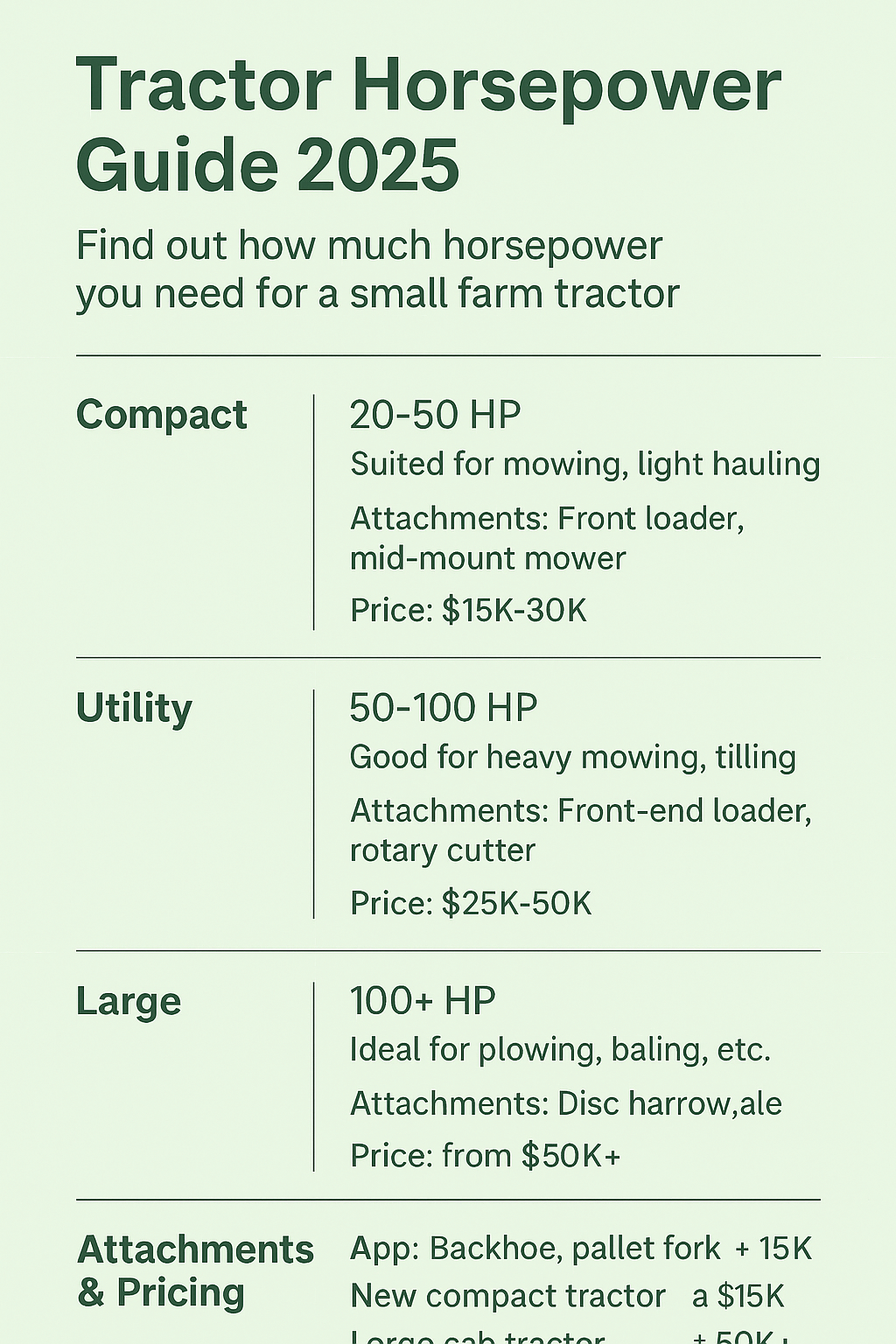
Tractor Horsepower by Property Size
Here’s an approximate rule of thumb for matching tractor HP to acreage:
| Property Size | Recommended HP Range | Best For | Example Models |
|---|---|---|---|
| 1–5 acres | 20–25 HP | Mowing, light hauling, snow plowing | John Deere 1023E, Kubota BX23S |
| 5–10 acres | 25–35 HP | Mowing, loader use, tilling | John Deere 1025R, Massey Ferguson GC1723 |
| 10–20 acres | 35–50 HP | Heavy loader work, plowing, baling small hay fields | Kubota L3301, Mahindra 1626 |
| 20–50 acres | 50–75 HP | Medium tillage, hay production, loader + backhoe | John Deere 4066R, New Holland Workmaster 55 |
| 50+ acres | 75+ HP | Full-scale farming, heavy tillage, baling | John Deere 5 Series, Case IH Farmall |
Tip: Consider future expansion. If you plan to grow your operation, it’s often worth buying slightly more horsepower than you need today.
Compact Tractors for Small Farms (20–30 HP)
For most small farmers, tractors in the 20–30 HP range are a great fit — affordable, easy to operate, and versatile for everyday chores.
John Deere 1023E (21.5 HP)
- Well-suited to 1–5 acres
- Handles mowing, snow blowing, and light loader work
- An accessible starter tractor
More details: John Deere 1023E Attachments Guide.
John Deere 1025R (23.9 HP)
- Similar to the 1023E, with a bit more horsepower and lifting capacity
- Added comfort features for extended use
See our full John Deere 1023E vs 1025R comparison.
Kubota BX23S (23 HP)
Known for integrated backhoe and loader capability — a strong option for digging and landscaping work.
Bad Boy 3026 (25.7 HP)
A newer entrant to the market, with a notably large 1,200 lb loader lift capacity.
Mid-Sized Tractors (30–50 HP)
If you have 10–20 acres, you’ll typically want more horsepower to run bigger implements and handle tougher jobs.
- Kubota L3301 (33 HP) — Powerful and versatile for medium farms
- Massey Ferguson 2850M (48 HP) — Strong loader capacity
- Mahindra 1626 (26 HP) — Economical and durable for mid-sized farms
Large Tractors (50+ HP)
For acreage over 20 acres or specialty production (hay, row crops, heavy tillage), 50+ HP tractors are typically necessary.
- John Deere 4066R (65 HP) — Strong for medium-to-large acreage
- New Holland Workmaster 75 (74 HP) — An affordable option at higher HP
- Case IH Farmall 75C (75 HP) — Built for heavy-duty work
Matching Horsepower to Attachments
Horsepower isn’t just about acreage — it also depends on the attachments you plan to run.
| Attachment | Minimum PTO HP Required | Recommended Tractor Size |
|---|---|---|
| Mid-Mount Mower (54″) | 15 HP | 20–25 HP compact |
| Rotary Tiller (5 ft) | 20 HP | 25–35 HP compact |
| Snow Blower (60″) | 20–25 HP | 25–35 HP compact |
| Box Blade (6 ft) | 25 HP | 30–40 HP compact |
| Round Baler | 35–40 HP | 40–50 HP utility |
| Plow (2-bottom) | 30 HP | 35–50 HP compact/utility |
For example, the John Deere 1023E is generally well suited to running a mid-mount mower and appropriately sized tillers, but larger PTO-driven implements such as round balers require substantially more horsepower.
Gas vs. Diesel Horsepower
Most new tractors today, including compact models, are diesel-powered. Here’s why:
- Diesel delivers more torque at lower RPMs, well-suited to heavy-duty work
- Generally more fuel-efficient over long working hours
- Typically longer engine life
Gas-powered tractors have become uncommon in the compact and sub-compact farm tractor market, with most major manufacturers now offering diesel-only lineups in these classes — though gas engines remain standard on riding/lawn tractors and turn up occasionally on specific compact models depending on the brand and region.
Another consideration is emissions equipment. Many tractors above 25 engine horsepower require additional emissions systems under current U.S. regulations, while many sub-25 HP compact tractors avoid this added complexity — one more reason smaller tractors in this class tend to be simpler and cheaper to maintain.
Cost of Horsepower – Price Ranges
Horsepower influences tractor pricing significantly. Typical new compact tractor pricing often falls within these ranges, although actual prices vary significantly by brand, attachments, dealer location, and whether the tractor is new or used:
- 20–25 HP Compact Tractors: roughly $10,000–$14,000
- 25–35 HP Tractors: roughly $14,000–$18,000
- 35–50 HP Tractors: roughly $18,000–$25,000
- 50–75 HP Utility Tractors: roughly $25,000–$40,000
- 75+ HP Tractors: $40,000+
These are general market ranges and will vary by brand, configuration, and new vs. used condition — contact us for current pricing on specific models.
Tip: Attachments add to the total cost, but package deals can offer real savings over buying separately.
Check current listings on TractorHouse.
Frequently Asked Questions Tractor Horsepower Guide
Q: How much horsepower for a 5-acre farm?
A 20–25 HP compact tractor like a John Deere 1023E or Kubota BX23S is typically ideal.
Q: Can a 25 HP tractor plow a field?
For light-duty plowing, yes. Larger fields will generally need 30–40 HP.
Q: How much horsepower do I need for a 10-acre farm?
At least 25–35 HP, depending on the attachments you plan to use.
Q: What’s the ideal tractor horsepower for hay baling?
Small balers typically need around 35–40 PTO HP, which usually means a 40–50 HP tractor at minimum.
Q: Should I buy more horsepower than I’ll actually use?
A little extra headroom is smart, especially if you plan to expand — but don’t pay for significantly more power than you’ll realistically use.
Conclusion – Finding the Right Tractor Horsepower
The optimal tractor horsepower for your small farm depends on your acreage, chores, and planned attachments.
- 1–5 acres: 20–25 HP (John Deere 1023E, Kubota BX23S)
- 5–10 acres: 25–35 HP (John Deere 1025R, Massey Ferguson GC1723E)
- 10–20 acres: 35–50 HP (Kubota L3301, Mahindra 1626)
- 20+ acres: 50+ HP (John Deere 4066R, New Holland Workmaster)
Taking your actual requirements into account lets you buy a tractor that serves you well today and grows with your future plans.
Ready to invest? Start with our John Deere 1023E for Sale or see our full John Deere 1023E Price Guide for a detailed pricing breakdown.