That new tractor isn’t just a piece of equipment it’s a strategic investment in your farm’s future. But what if you could turn a significant portion of that investment into an immediate tax savings this year?
You can. Understanding section 179 for tractor purchases specifically can save you thousands. The IRS Section 179 deduction and Bonus Depreciation are two of the most powerful tax incentives available to farm business owners. Yet, they’re often misunderstood or overlooked.
This guide will cut through the complexity. We’ll explain exactly how the section 179 tractor deduction works for farm equipment in 2025, how it differs from bonus depreciation, and walk you through a real-world example so you can confidently approach your tax professional and claim what you’re owed.
Return to our equipment homepage
What Exactly is Section 179? (The “Accelerated” Tax Break)
In simple terms, the section 179 tractor deduction allows businesses to deduct the full purchase price of qualifying equipment and software in the year it is purchased and placed into service, rather than depreciating it over many years.
- Normal Depreciation: You’d deduct the cost of a $100,000 tractor over 7 years (~$14,285 per year).
- With Section 179: You deduct the entire $100,000 from your taxable income in the first year.
This isn’t a “loophole.” It’s an intentional government incentive designed to encourage businesses to invest in themselves by making large equipment purchases more affordable upfront. For a deeper understanding of how equipment value changes over time, see our guide on Tractor Depreciation and Lifecycle.
Why Section 179 for Tractors Makes Financial Sense
Using section 179 for tractor purchases is particularly strategic because tractors represent one of the largest equipment investments most farms make. The ability to write off this major expense in year one rather than over several years provides significant cash flow advantages. This section 179 tractor strategy can free up capital for other crucial farm investments.
2025 Section 179 Limits & Key Rules
Before you start planning your section 179 tractor purchase, it’s crucial to understand the limits and requirements for the 2025 tax year.
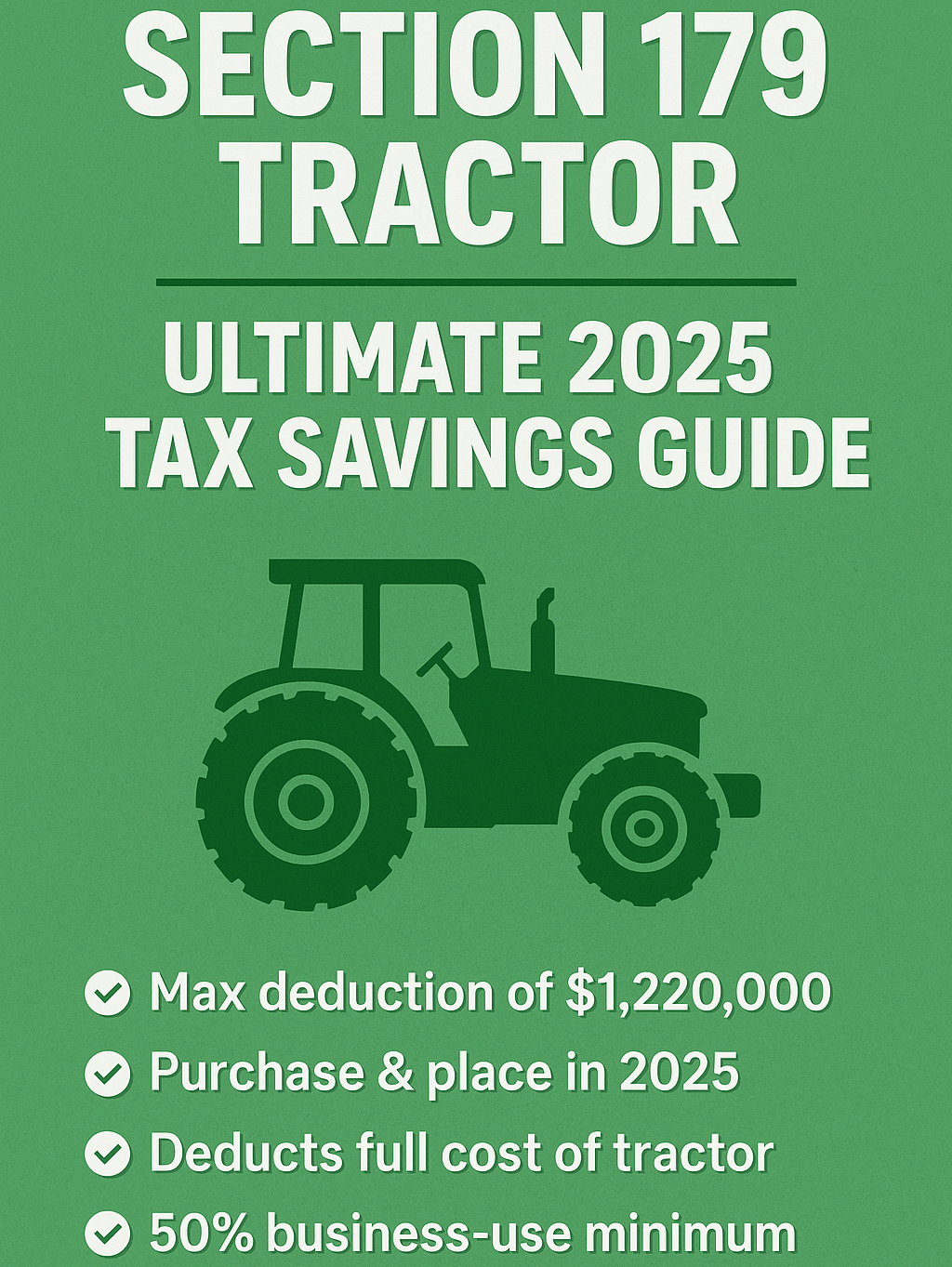
- Maximum Deduction: $1,220,000 (This is the total amount of equipment you can write off).
- Spending Cap: $3,050,000 (The deduction begins to phase out dollar-for-dollar once you exceed this total equipment purchase threshold for the year).
- Business Use Requirement: The equipment must be used for business purposes more than 50% of the time to qualify. If you use a tractor 80% for farming and 20% for personal use, you can only deduct 80% of the cost.
Most importantly, the equipment must be purchased and placed in service between January 1 and December 31, 2025. “Placed in service” means it’s ready and available for its specific use. You can find the official IRS guidelines on IRS.gov – Publication 946, How to Depreciate Property.
Section 179 vs. Bonus Depreciation: What’s the Difference?
While both offer accelerated deductions, they have key differences. Understanding both is critical for your farm equipment financing strategy, especially when considering section 179 for tractor purchases versus other equipment.
| Feature | Section 179 | Bonus Depreciation (2025) |
|---|---|---|
| Deduction Limit | Up to $1,220,000 | No Limit |
| Income Limit | Cannot exceed your taxable business income | No Income Limit |
| Can Create a Tax Loss? | No | Yes |
| New vs. Used Equipment | Both New & Used | New Equipment Only |
| Business Use % | >50% | >50% |
The Strategic Takeaway: Most farmers will use Section 179 first because it applies to both new and used equipment. Bonus Depreciation is a powerful secondary tool, especially for large purchases that exceed the Section 179 limit or if you have a low-income year.
A Real-Life Example: How a Farmer Uses Section 179
Let’s see how section 179 for a tractor works in practice. Let’s say your farm has a taxable income of $150,000. You decide to purchase a used skid steer for $40,000 and a new compact tractor for $65,000, for a total of $105,000.
- Without Section 179: You’d depreciate the $105,000 over 7 years, taking a ~$15,000 deduction this year.
- With Section 179: You can deduct the full $105,000 this year.
The Result? Your taxable income drops from $150,000 to $45,000. Assuming a 25% tax bracket, you’ve just saved over $26,000 on your current year’s tax bill.
This immediate savings can be reinvested back into your operation, making the true cost of owning a tractor significantly lower. For a full breakdown of other costs, see our guide on the True Cost of Owning a Tractor for 10 Years.
How to Claim the Section 179 Deduction: A Step-by-Step Checklist
Claiming your section 179 tractor deduction is straightforward, but precision is key.
- Determine Business-Use Percentage: Keep a logbook for any mixed-use equipment to substantiate your business percentage.
- File IRS Form 4562: This is the form used to report depreciation and amortization, including the Section 179 deduction. You will fill out Part I. The latest forms and instructions are always available on the IRS Form 4562 Download Page.
- Work With Your CPA: This is not optional. The rules are complex and change. A qualified agricultural CPA will ensure you maximize your section 179 tractor deduction without triggering an audit. This is a critical part of smart farm management.
Frequently Asked Questions
Q: Can I use Section 179 if I finance or lease the equipment?
A: Yes! You do not need to pay cash. If you finance the purchase with a loan or even a lease classified as a capital lease, you can still take the full deduction in the first year. This makes the decision to Lease vs. Buy a Tractor even more strategic from a tax perspective. The National Agricultural Law Center provides excellent, unbiased resources on how these financial agreements are treated. Visit their website for more on finance and credit.
Q: Is there a specific section 179 tractor limit?
A: While there’s no separate section 179 tractor limit, your deduction counts toward the overall $1,220,000 limit. This makes understanding section 179 tractor rules essential for large equipment purchases.
Q: What other farm equipment qualifies?
A: Almost any tangible property used in your business qualifies. This includes tractors, combines, balers, trucks over 6,000 lbs, livestock trailers, grain bins, and even certain software. The U.S. Department of Agriculture also offers resources on business planning and financing that can provide context for these investments. Explore USDA resources for farmers.
Q: What happens if I stop using the equipment for business?
A: If your business use drops below 50% in a subsequent year, you may have to “recapture” a portion of the deduction, meaning you’d have to add it back to your taxable income for that year.
Ready to invest in equipment that qualifies for these powerful tax savings? Explore Our Tractor Inventory to find the right machine for your operation and start maximizing your section 179 tractor deductions.