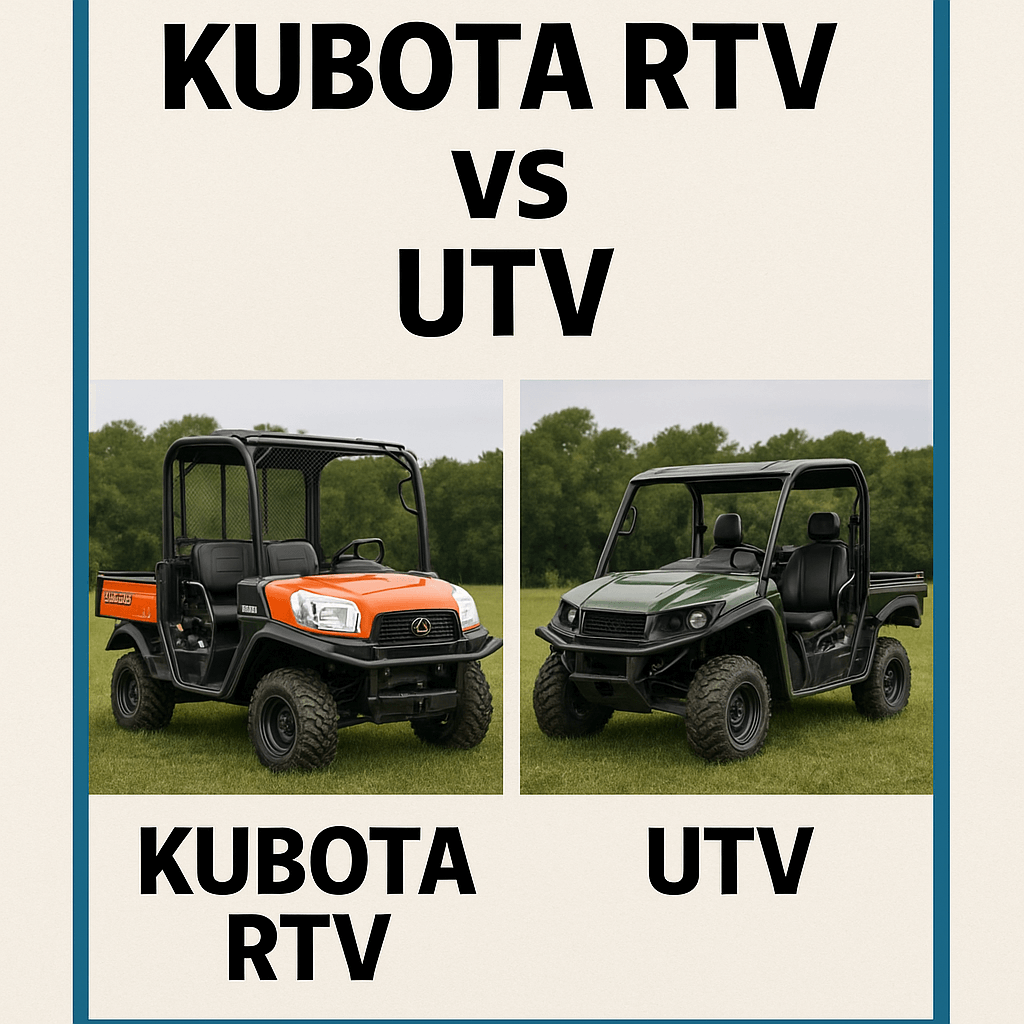
The Kubota RTV vs UTV comparison comes up every time a farmer or landowner starts shopping for a property vehicle — and the answer is more nuanced than most comparison guides suggest. The Kubota RTV is a work-first diesel machine designed for daily farm use. A UTV (utility task vehicle, also called a side-by-side) is a broader category ranging from recreation-focused sport machines to genuine work platforms. This guide covers the full comparison: what RTV stands for, the key specification differences, which brands are most reliable, which to avoid, how many hours a Kubota RTV lasts, street legal rules, oil change intervals, and every PAA question buyers search before making this decision.
👉 See Kubota RTVs for sale at Farmers Equipment →
Written by: Farmers Equipment editorial team. Updated August 2026.
What Does Kubota RTV Stand For?
RTV stands for Rugged Terrain Vehicle. Kubota introduced the RTV designation to distinguish their work-purpose utility vehicles from recreational UTVs — the “Rugged Terrain” name signals the machine’s priority: durability, traction, and work capability over speed or recreation. Kubota’s current RTV lineup includes the RTV-X900, RTV-X1100C, and RTV-XG850 Sidekick, each targeting different use cases from compact farm work to higher-speed property management.
What Is the Difference Between an RTV and a UTV?
| Feature | Kubota RTV | Standard UTV (Side-by-Side) |
|---|---|---|
| Full name | Rugged Terrain Vehicle | Utility Task Vehicle / Side-by-Side |
| Primary purpose | Work — farm, ranch, construction support | Recreation or light work |
| Transmission | Hydrostatic (HST) — smooth, precise speed control | CVT belt-drive — prioritises acceleration |
| Engine type | Diesel or gas — diesel offers more torque | Predominantly gas — some electric emerging |
| Top speed | 25–30 mph (Sidekick ~40 mph) | 40–70 mph depending on model |
| Towing capacity | ~1,300–2,000 lbs depending on model | Varies widely — 1,000–3,000+ lbs |
| Payload capacity | ~1,100–1,500 lbs cargo bed | ~500–2,000 lbs depending on model |
| Frame construction | Heavy-duty — designed for daily work | Lighter — designed for recreational use on most models |
| Expected lifespan (farm use) | 3,000–5,000+ hours / 15–20 years | Shorter under heavy daily work — CVT belt wear is primary failure point |
| Price range | $12,000–$20,000+ new | $8,000–$30,000+ depending on brand and spec |
Are UTV and ATV the Same Thing?
No — these are different vehicle types that are frequently confused:
- ATV (All-Terrain Vehicle) — single rider, straddle-seat, handlebars, no cab. Examples: Honda FourTrax, Yamaha Grizzly. Primarily recreational, some farm use for light tasks
- UTV (Utility Task Vehicle / Side-by-Side) — two or more seats side-by-side, steering wheel, roll cage. Examples: Polaris Ranger, John Deere Gator, Kubota RTV. More work capability than ATVs
- RTV — Kubota’s brand designation for their work-focused UTVs. Technically a subcategory of UTV
Kubota RTV vs UTV — Full Comparison
Kubota RTV Models and Prices (2026)
| Model | Engine | HP | Top Speed | Tow Capacity | New Price (approx) |
|---|---|---|---|---|---|
| RTV-X900 | Kubota diesel | 21.6 HP | ~25 mph | ~1,300 lbs | ~$12,000–$15,000 |
| RTV-X1100C | Kubota diesel | 24.8 HP | ~25 mph | ~1,600 lbs | ~$16,000–$20,000 |
| RTV-XG850 Sidekick | Gas | 48.4 HP | ~40 mph | ~2,000 lbs | ~$12,000–$15,000 |
Prices are approximate. For current Kubota RTV specs see Kubota.com. Contact your Kubota dealer or contact us for current pricing on available units.
Kubota RTV vs Key Competitors
| Model | HP | Transmission | Tow Capacity | Best For |
|---|---|---|---|---|
| Kubota RTV-X1100C | 24.8 HP diesel | HST | ~1,600 lbs | Daily farm work — diesel reliability |
| John Deere Gator XUV835M | 23.9 HP gas | CVT | ~2,000 lbs | Mixed work and property management |
| Polaris Ranger 1000 | 61 HP gas | CVT | ~2,500 lbs | Higher speed — recreation plus work |
| Can-Am Defender HD10 | 82 HP gas | CVT | ~2,500 lbs | Heavy hauling — highest tow in class |
| Honda Pioneer 1000 | 72.8 HP gas | DCT | ~2,000 lbs | Reliability — Honda engine reputation |
Which Is Better — Gator or Kubota RTV?
The John Deere Gator vs Kubota RTV is the most direct farm-use comparison in the work UTV class:
| Factor | Kubota RTV-X1100C | John Deere Gator XUV835M |
|---|---|---|
| Engine | Kubota diesel — 24.8 HP | Kawasaki gas — 23.9 HP |
| Transmission | HST — hydrostatic, precise control | CVT — belt-drive |
| Fuel type | Diesel — more torque, better fuel economy at load | Gas — lower upfront cost |
| Top speed | ~25 mph | ~45 mph |
| Tow capacity | ~1,600 lbs | ~2,000 lbs |
| Cab option | Yes — factory enclosed cab on X1100C | Yes — factory cab available |
| Dealer network | Strong — Kubota has largest compact equipment network | Very strong — John Deere has largest overall network |
| Resale value | Strong — Kubota holds value well | Very strong — John Deere premium resale |
| Purchase price | ~$16,000–$20,000 | ~$18,000–$24,000 |
| Verdict | Better for daily diesel farm work — more torque per dollar | Better for mixed property work and speed — premium resale |
The honest answer: both are strong machines. Kubota wins on diesel torque and hydrostatic transmission control — both significant advantages in sustained farm work. John Deere wins on speed, tow capacity, and resale value. Buyers who prioritise diesel reliability and precise low-speed control choose Kubota; buyers who want faster property travel and the strongest resale choose Gator.
What Is Comparable to a John Deere Gator?
The closest direct competitors to the Gator for farm work: Kubota RTV-X1100C (diesel — strongest work comparison), Polaris Ranger (higher speed, more recreational tilt), Can-Am Defender (highest tow capacity), and Honda Pioneer (most reliable gas engine). The Gator’s unique position is its John Deere ecosystem integration — for farms already running John Deere tractors and using Operations Center, the Gator fits that ecosystem.
Which UTV Brand Is Most Reliable — and Which to Avoid?
Most Reliable UTV Brands (2026)
| Brand | Reliability Reputation | Best Model | Notes |
|---|---|---|---|
| Kubota | ✅ Benchmark for farm work UTVs | RTV-X1100C | Diesel HST — fewest reported mechanical failures in sustained farm use |
| Honda | ✅ Most reliable gas engine in class | Pioneer 1000 | Honda engine reliability is the class benchmark for gas UTVs |
| John Deere | ✅ Strong — excellent dealer support | Gator XUV835M | Best dealer support; Kawasaki engine well-proven |
| Polaris Ranger | ✅ Good — most popular side-by-side | Ranger 1000 | CVT belt wear is the most common complaint — otherwise strong |
| Can-Am Defender | ✅ Good — strong for towing | Defender HD10 | Rotax engine reliable; electronic issues on some models |
| Yamaha | ✅ Good — strong engine reputation | Wolverine RMAX | Less work-focused; recreational tilt |
What UTV Brands to Stay Away From?
Honest assessment of brands with elevated problem rates based on owner surveys and independent reliability reports:
- Arctic Cat / Textron — inconsistent quality control since Textron acquisition; CVT and electrical issues reported more frequently than class average
- Chinese import brands (Massimo, Coleman, Hisun, Kymco) — significant quality variation, limited parts support in most US markets, CVT belt issues common. Fine for very light occasional use; not recommended for regular farm work
- Older Polaris RZR (sport models used for farm work) — sport-focused machines used in daily work conditions wear out significantly faster than work-rated UTVs. Not a brand problem — a spec mismatch problem
- Any UTV with deferred CVT belt maintenance — CVT belts are the most common failure point across all gas UTV brands. A well-maintained Polaris or Can-Am with regular belt changes outperforms a neglected Honda. Maintenance matters more than brand in this class
Which UTV Has the Least Problems?
For farm work specifically: the Kubota RTV diesel has the fewest mechanical problems per operating hour in sustained farm use — the hydrostatic transmission has no CVT belt to wear, the diesel engine requires less maintenance than gas, and the heavy-duty frame handles daily use without the fatigue cracking seen on lighter recreational machines. For gas UTVs: Honda Pioneer and John Deere Gator are most consistently cited for fewest problems.
How Many Hours Will a Kubota RTV Last?
A well-maintained Kubota RTV diesel (RTV-X900, RTV-X1100C) should provide 3,000–5,000+ operating hours of productive farm service — equivalent to 15–20 years at typical farm use rates of 200–300 hours per year.
Key factors that determine longevity:
| Factor | Impact on Lifespan |
|---|---|
| Fluid maintenance on schedule | Most important — oil and hydraulic fluid changes are the primary longevity factor |
| Operating environment | Dusty conditions accelerate air filter wear — check and replace more frequently in dry/dusty use |
| Load within rated capacity | Consistent overloading accelerates frame, suspension, and drivetrain wear |
| Diesel vs gas | Diesel engines typically outlast gas engines at equivalent hours under sustained load |
| Storage and weather protection | Covered storage significantly extends frame and electrical system life |
High-hour Kubota RTV-X900 and RTV-X1140 units from the mid-2000s are still in active daily farm use — the most meaningful longevity evidence available. The diesel engine and HST transmission combination has fewer wear points than CVT-belt gas UTVs, giving it a structural longevity advantage in sustained work conditions.
How Often Should I Change the Oil on a Kubota RTV?
Kubota’s recommended maintenance schedule for RTV diesel models:
| Interval | Service Items |
|---|---|
| Every 50 hours | Grease all fittings — front axle, rear axle, steering joints. Check all fluid levels |
| Every 100 hours (or annually) | Engine oil and filter change — Kubota recommends 10W-30 or 15W-40 diesel engine oil. Check air filter condition |
| Every 200 hours | Air filter replacement. Fuel filter check. Hydraulic system fluid level check |
| Every 400 hours | Hydraulic fluid and filter change. Transmission fluid check. Brake inspection |
| Every 800 hours | Coolant change. Full drivetrain inspection. Belt and hose inspection |
| Annual | Full visual inspection of all fluid lines, electrical connections, and frame regardless of hours |
For servicing guidance see OSHA agricultural equipment safety resources. Always verify against your specific model’s operator manual — intervals can vary between RTV-X900, RTV-X1100C, and Sidekick models. Using Kubota-approved oil specifications protects the engine warranty on newer machines.
Can You Drive a Kubota RTV on the Road?
This is one of the most searched RTV questions — and the answer is: it depends on your state.
What States Allow UTVs to Be Street Legal?
As of August 2026, the following states have provisions that allow UTVs to operate on public roads under certain conditions (local ordinances, county roads, or with registration and equipment requirements):
| Category | States (examples — verify current local law) |
|---|---|
| Generally permissive — UTVs allowed on most public roads with registration | Utah, South Dakota, Montana, North Dakota, Wyoming, Idaho, Kansas |
| Allowed on designated roads / county roads only | Texas, Oklahoma, Minnesota, Wisconsin, Michigan, Iowa, Missouri |
| Limited — local ordinance dependent | Tennessee, Georgia, North Carolina, Virginia, Pennsylvania |
| Generally restrictive — limited public road access | California, New York, Illinois, New Jersey, Florida |
Standard requirements where street-legal operation is permitted typically include:
- Registration and license plate
- Headlights, tail lights, and turn signals
- Mirrors
- Horn
- Windshield or windshield wiper
- Valid driver’s licence for the operator
- Insurance (in some states)
Important: UTV street-legal laws change frequently and vary significantly by county, city, and road type even within permissive states. Always verify current state and local regulations before operating a Kubota RTV or any UTV on public roads. The state DMV or department of transportation website is the authoritative reference.
Can You Legally Drive a Side-by-Side on the Road in Tennessee?
Tennessee law permits UTVs on public roads under specific conditions — they must be registered as a motor vehicle, equipped with required safety equipment (lights, horn, mirrors), and operators must have a valid driver’s licence. Tennessee law also limits operation to roads with posted speed limits of 45 mph or less in most cases. Local county ordinances may impose additional restrictions. Verify current Tennessee DMV requirements before operating on public roads.
Who Should Buy a Kubota RTV vs a UTV
Buy a Kubota RTV if:
- ✅ Daily farm work is the primary use — feeding, manure management, hay transport, maintenance
- ✅ You want diesel reliability and torque for sustained hauling and towing
- ✅ Precise low-speed control matters — HST gives fine speed control that CVT belt-drive can’t match
- ✅ Long-term ownership (10–20 years) is the plan — diesel HST outlasts CVT gas UTVs in sustained farm use
- ✅ An enclosed factory cab is a priority — the RTV-X1100C factory cab is purpose-built, not an aftermarket add-on
Buy a Standard UTV (Polaris, Can-Am, Honda) if:
- ✅ Higher top speed is needed for large property coverage (40–70 mph range)
- ✅ Recreation is part of the use — hunting, trails, family use
- ✅ Maximum tow capacity is the priority — Can-Am Defender and Polaris Ranger exceed Kubota RTV tow ratings
- ✅ Budget is tight — entry-level gas UTVs start lower than Kubota RTV models
Buy a John Deere Gator if:
- ✅ You’re already in the John Deere ecosystem and want consistent branding and shared dealer support
- ✅ Mixed work and property management is the use — Gator splits the difference between RTV and recreational UTV better than most
- ✅ Maximum resale value is a priority
See our farm utility vehicles for sale and Kubota equipment for sale →
Kubota RTV vs UTV — Independent Specifications
For independent RTV and UTV specifications and comparisons, TractorData.com lists verified manufacturer data across all brands. For used RTV and UTV market pricing, TractorHouse.com lists current sales.
Verdict — Kubota RTV vs UTV
For sustained daily farm work — the Kubota RTV is the stronger machine. The diesel engine, hydrostatic transmission, and heavy-duty frame are the right combination for the work that actually happens on farms every day. The CVT belt-drive gas UTV is built for a different brief — speed and recreation — and it shows in longevity when those machines are used in daily work conditions.
For property management where speed matters, mixed recreational use, or maximum tow capacity — the Polaris Ranger, Can-Am Defender, or Honda Pioneer all have genuine merits that the Kubota RTV’s slower speed doesn’t address. And the John Deere Gator remains the strongest direct farm-work competitor to the Kubota RTV if brand ecosystem matters to your operation.
👉 See Kubota RTVs for sale at Farmers Equipment →
Also browse: Kubota tractors for sale · Sub-compact tractors · Farm utility vehicles · John Deere tractors and equipment →
👉 Contact us with questions about Kubota RTV models, availability, or financing →
Frequently Asked Questions
What does Kubota RTV stand for?
RTV stands for Rugged Terrain Vehicle — Kubota’s designation for their work-purpose utility vehicles, distinguishing them from recreational UTVs. The name signals the machine’s priority: durability, traction, and work capability over speed.
What is the difference between an RTV and a UTV?
An RTV (Rugged Terrain Vehicle) is Kubota’s work-first utility vehicle — diesel or gas engine, hydrostatic transmission, heavy-duty frame, 25–40 mph top speed. A UTV (Utility Task Vehicle or side-by-side) is a broader category — most are gas-powered with CVT belt-drive transmissions and emphasise speed (40–70 mph) over sustained work capability. All RTVs are technically UTVs — not all UTVs are RTVs.
Are UTV and ATV the same thing?
No. An ATV (All-Terrain Vehicle) is a single-rider straddle machine with handlebars — primarily recreational. A UTV (Utility Task Vehicle / side-by-side) seats two or more side-by-side with a steering wheel and roll cage. More work capability than ATVs. The Kubota RTV is a UTV, not an ATV.
Which is better — Gator or Kubota RTV?
For daily diesel farm work: Kubota RTV — diesel torque and hydrostatic transmission control are genuine advantages. For speed, tow capacity, and resale value: John Deere Gator. Both are strong farm machines. The choice depends on whether diesel reliability and precise low-speed control or faster property travel and maximum resale matter more.
How many hours will a Kubota RTV last?
3,000–5,000+ hours with proper maintenance — equivalent to 15–20 years at 200–300 farm hours per year. The diesel engine and HST transmission combination has fewer wear points than CVT-belt gas UTVs, giving it a structural longevity advantage in sustained work conditions.
How often should I change the oil on a Kubota RTV?
Every 100 hours or annually (whichever comes first) for engine oil and filter — Kubota recommends 10W-30 or 15W-40 diesel engine oil. Hydraulic fluid and filter every 400 hours. Grease all fittings every 50 hours. Always verify against your specific model’s operator manual.
Can you drive a Kubota RTV on the road?
Depends on your state and local ordinances. States like Utah, Montana, South Dakota, and Wyoming are generally permissive with registration and equipment requirements. States like California and New York are generally restrictive. Most states that allow street operation require registration, lights, mirrors, and a valid driver’s licence. Always verify current state and local law before operating on public roads.
Which UTV brand is most reliable?
For farm work: Kubota (diesel HST — fewest mechanical failures in sustained use). For gas UTVs: Honda Pioneer (most reliable gas engine in class) and John Deere Gator (Kawasaki engine, best dealer support). Polaris Ranger and Can-Am Defender are also strong — CVT belt maintenance is the primary reliability factor for both.
What UTV brands to stay away from?
Arctic Cat/Textron (inconsistent quality since acquisition), Chinese import brands (Massimo, Coleman, Hisun — parts availability and quality issues), and any sport-focused RZR or recreation machine used daily for heavy farm work (spec mismatch, not a brand problem). Sport machines used in farm conditions wear out significantly faster than work-rated UTVs.