The search for a “John Deere 3020 for sale” is a journey thousands of people undertake every year. It’s not just a search for metal and rubber — it’s a search for a piece of agricultural history, a symbol of reliability, and proof of a design so well-crafted it remains desirable decades later. If you’re reading this, you’re likely considering joining the club of owners who run this legendary machine.
This guide is meant to be your starting point. We’ll dive into the history of the 3020, cover what makes it special, and give you an honest read on who it’s the right fit for. For the technical deep-dive, inspection checklist, and pricing breakdown, we’ll point you to our dedicated guides throughout.
Ready to see current inventory? Visit our John Deere 3020 for sale page.
A Revolution in Green: The “New Generation” and the 3020’s Legacy
To fully appreciate the 3020, it helps to understand the revolution it represented. Until 1960, John Deere’s reputation rested on the rugged, distinctive two-cylinder engines that had powered American farms for generations. Farmers knew the sound, the feel, and the quirks of those “Johnny Poppers” intimately. But by the second half of the 1950s, the market had turned competitive, and farmers were demanding more power, smoother operation, and modern features that two-cylinder engineering simply couldn’t deliver.
John Deere responded by betting everything on its “New Generation” tractor line, launched in 1963. This wasn’t a modest facelift — it was a complete, ground-up overhaul, developed in near-total secrecy at a dedicated engineering facility. Four-cylinder and six-cylinder engines replaced the two-cylinder design entirely. Operator stations became more comfortable. Hydraulics got a genuine technical upgrade with the closed-center system. The 3020, positioned as the mid-power row-crop and utility tractor, was one of the standouts of that new lineup, slotting neatly between the smaller 2020 and the larger, more famous 4020.
It was a genuine risk. Replacing beloved models like the 620 and 630 could have alienated a loyal customer base that had spent a decade or more learning to trust John Deere’s two-cylinder machines. Instead, the 3020 won farmers over with real performance gains — more horsepower, smoother power delivery, and a hydraulic system that made loader and implement work noticeably easier. It became the tractor that bridged the classic two-cylinder era and the modern era of farming, with features still relevant today: independent PTO, closed-center hydraulics, and an operator-focused control layout that later tractors would continue to refine.
A lesser-known piece of the 3020’s history: from 1964 to 1969, John Deere also built an industrial variant called the John Deere 500, painted yellow instead of the familiar green, aimed at construction and industrial buyers rather than farmers. It shared the same core mechanicals as the agricultural 3020, and today it’s a genuine curiosity for collectors who want something a little different from the standard green-and-yellow farm tractor.
Owning a 3020 means owning a genuine turning point in John Deere’s history — not just another old tractor, but the machine that proved the New Generation approach could work.
What Makes the 3020 Special: A Quick Specs Overview
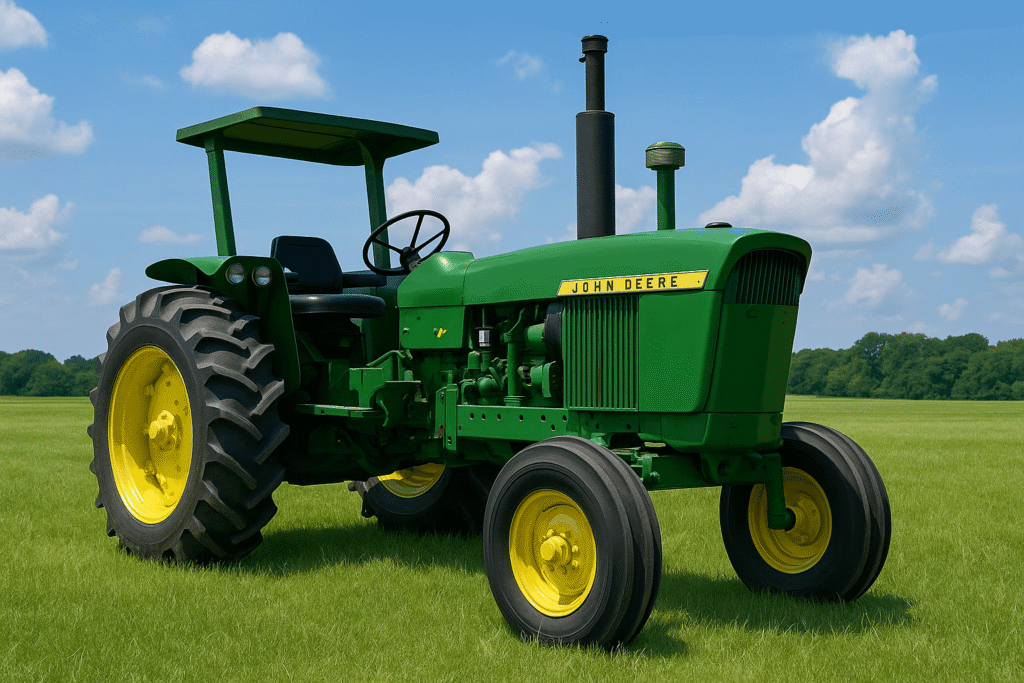
The 3020 was offered in three fuel types — gasoline, diesel, and LP-gas — with the diesel generally considered the most desirable for its fuel economy and torque. It offered two main transmission choices: the standard 8-Speed Synchro Range, and the higher-end Power Shift, which allowed shifting under load but comes with a steeper repair cost if it fails. Its closed-center hydraulic system was a genuine advancement over the open-center designs it replaced, delivering steadier pressure and smoother implement operation.
For the full technical breakdown — exact displacement, horsepower, hydraulic specs, and transmission details — see our complete John Deere 3020 Specs guide.
What to Check Before You Buy
Like any 50-plus-year-old machine, the 3020 has a handful of well-documented weak points worth checking before you buy — most notably around the Power Shift transmission, the hydraulic pump, steering components, and the electrical system. A thorough cold-start inspection, checking every gear under load, and reviewing service history can save you from an expensive surprise.
For the complete inspection checklist and repair cost breakdown, see our John Deere 3020 Problems guide.
What’s It Worth? A Quick Look at Price
3020 prices generally fall into three tiers: project tractors needing real work, solid “worker” condition tractors ready for daily use, and excellent or fully restored examples commanding a premium. Engine type, transmission, originality, and included implements all move the number up or down.
For the full price breakdown by condition and the key value drivers, see our John Deere 3020 Price Guide.
The 3020 Today: A Living Piece of History
What sets the 3020 apart from most 50-plus-year-old machinery is that it’s still genuinely working. Walk through any tractor show or county fair and you’ll likely spot one — but you’re just as likely to find one hauling hay, running a bush hog, or plowing a garden on a working farm. That dual life, part working tool and part rolling piece of history, is a big part of its appeal.
This ongoing use has kept the support ecosystem alive in a way that many vintage machines don’t enjoy. Active owner communities trade troubleshooting advice, dedicated parts suppliers keep wear items in stock, and enough units remain in circulation that finding a good example — rather than settling for whatever happens to be listed nearby — is genuinely realistic for most buyers.
Final Verdict: Is the John Deere 3020 the Right Tractor for You?
The John Deere 3020 is a strong fit for:
- Small to mid-sized farms needing an effective chore tractor
- Hay producers running balers, rakes, and mowers
- Homesteaders and hobby farmers who value mechanical simplicity and fix-it-yourself repairability
- Collectors who appreciate its historical significance and authenticity
You might want to consider a newer model instead if:
- You need more than roughly 65 PTO HP for aggressive tillage work
- Operator comfort and protection are a top priority (for example, you specifically want a ROPS-equipped cab)
- You need modern features like electronic controls or high-flow hydraulics
It’s also worth being honest about the tradeoffs. A 3020 won’t give you climate-controlled comfort, GPS guidance, or the plug-and-play reliability of a machine still under factory warranty. What it offers instead is mechanical transparency — nearly everything on the tractor can be diagnosed and repaired by an owner with basic tools and some patience, without needing a laptop or a dealer visit. For some buyers that’s a dealbreaker; for others, it’s precisely the point.
For many buyers, the 3020 hits a sweet spot: modern enough to be genuinely useful day-to-day, yet simple enough to remain fully maintainable by its owner — with plenty of character along the way.
Frequently Asked Questions
Q: Is the John Deere 3020 a good first tractor?
Yes, for many buyers. It’s mechanically straightforward, well-supported by parts suppliers and owner communities, and versatile enough to handle common chore-tractor tasks. First-time buyers should still budget time and money for inspection and any needed repairs before relying on it for daily work.
Q: What’s the difference between the 3020 and the 4020?
The 4020 is the larger, more powerful sibling in the same New Generation lineup, with more horsepower and a higher price point both new and on the used market today. The 3020 is the better fit for buyers who don’t need the 4020’s extra power and would rather pay less upfront and in ongoing operating costs.
Q: How do I know if a 3020 has been well maintained?
Look for documented service records, consistent fluid conditions, a hydraulic system that operates smoothly, and an owner who can speak knowledgeably about the tractor’s history. A well-documented tractor with moderate hours is often a better buy than a low-hour tractor with no history at all.
Q: Where should I start if I’m serious about buying one?
Start with our Specs guide to understand the configuration options, review our Problems guide before any in-person inspection, and use our Price guide to make sure any offer you’re considering is fair for the tractor’s actual condition.
Your Next John Deere 3020 Is Waiting
Your search for a “John Deere 3020 for sale” brought you here — now you’re better equipped to find a great tractor without costly surprises. The 3020 isn’t just an investment; for many owners, it becomes a genuine working partner on the property.
Ready to move forward? Browse our inspected, well-maintained inventory of used John Deere tractors to find a 3020 ready for its next chapter.
View Our Inventory of John Deere Tractors
Not the perfect fit after all? Browse our entire inventory of tractors for sale to find the right power and size for your operation.