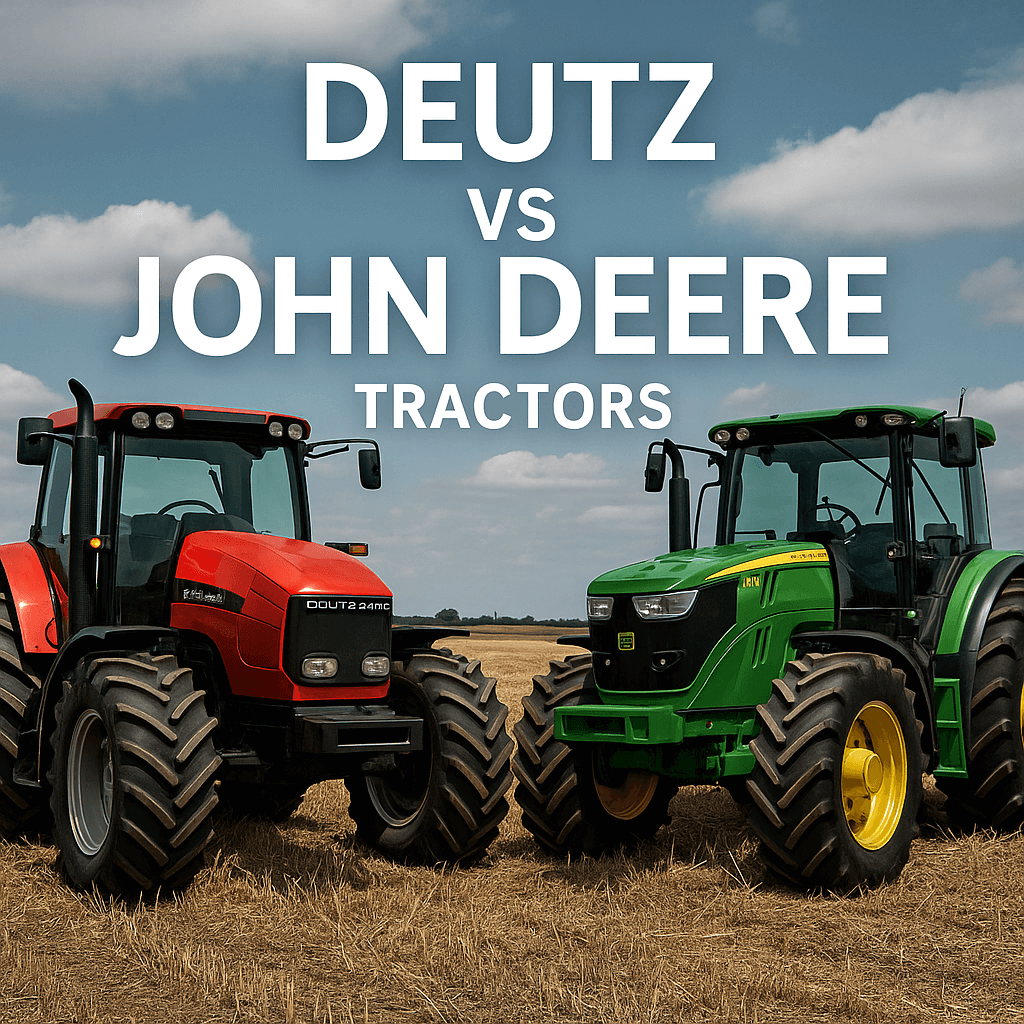
Looking to purchase a reliable tractor for your farm? Two brands come up more than any other: Deutz tractors and John Deere tractors. Farm owners worldwide weigh the advantages and disadvantages of Deutz vs John Deere tractors against one another on specs, longevity, price, and performance.
This comparison will help you decide whether a Deutz or John Deere tractor is the better fit. We’ll cover:
- Brand history & reputation
- Key features and performance
- Fuel efficiency and technology
- Comfort and usability
- Cost and resale
- Which brand suits different types of farms
Ready to purchase now? Visit our Deutz Tractor for Sale page for current listings.
Brand Overview: Deutz vs. John Deere
Deutz Tractors
Deutz, or Deutz-Fahr, is a German company with a long track record of efficient engines and innovative engineering. Farmers find Deutz appealing for value and performance, especially in Europe, Africa, and Asia.
John Deere Tractors
John Deere, the American giant, is likely the most recognized farm machinery brand in the world. Known for reliability, resale value, and an extensive dealership network, John Deere tractors have a strong presence across North America and beyond.
If you’re shopping secondhand, see our used tractors for sale for current inventory across brands.
Specs and Performance
Deutz and John Deere tractors both offer strong power, but they differ in how that power is delivered.
Deutz Tractor Specs
- Horsepower Range: Roughly 50–340+ HP depending on series and market
- Engine: Deutz AG diesel engines
- Hydraulics: High flow, well-suited to loader attachments
- Transmission: Powershift and mechanical options depending on series
- Strengths: Strong fuel efficiency and long service life
John Deere Tractor Specs
- Horsepower Range: Roughly 25–600+ HP depending on series
- Engine: PowerTech diesel engines with strong torque
- Hydraulics: High capacity, well-suited to heavy-duty implements
- Transmission: AutoPowr/IVT and traditional powershift options depending on series
- Strengths: Widely produced, well-proven durability, extensive parts and service support
For loader-specific guidance, see our tractor loader attachments guide.
Field Performance Comparison
Tillage & Seeding
Deutz: Fuel-efficient, reliable power, well-suited to medium-sized farms.
John Deere: High-horsepower options available, well-suited to very large operations.
Loader Work
Deutz: Durable hydraulics, smooth operation.
John Deere: Equally durable, with a wide range of dealer-installed loader options.
Transport & Hauling
Deutz: Balanced and stable for road towing.
John Deere: Strong torque options make it well-suited for longer-distance hauling.
Specialty Farming
Deutz: Strong vineyard and compact/narrow tractor options.
John Deere: Broader row-crop and large-acreage lineup.
Price Comparison
Tractor pricing varies significantly based on horsepower, series, configuration, and new vs. used condition — for both brands. Rather than quote fixed price bands that may not reflect current market conditions, we’d encourage checking current listings and contacting us directly for a quote on the specific model you’re considering.
For a sense of real-world market pricing, browse live listings at TractorHouse – Deutz-Fahr tractors and TractorHouse – John Deere tractors.
Fuel Efficiency
Fuel economy is frequently cited as one of Deutz’s strengths, with many owners reporting favorable fuel consumption compared to similarly-sized John Deere models — though the exact difference depends heavily on load, terrain, maintenance, and operating conditions rather than a fixed percentage.
John Deere often offsets this with strong torque that supports faster work across large fields.
If lower operating cost is your priority, Deutz is generally the stronger choice. If you’re covering large acreage and need raw pulling power, John Deere may be the better fit.
Maintenance & Reliability
Deutz
- Straightforward maintenance with easy engine access
- Solid aftermarket parts support in many regions
- Strong reputation for longevity when properly serviced
John Deere
- Extensive global service network
- OEM parts widely available, sometimes at a higher cost
- Well-known reputation for long-term durability
Warranty & Ownership Costs
Warranty terms and long-term ownership costs are worth weighing alongside sticker price, since they shape your total cost of ownership over the life of the tractor.
Deutz: New Deutz-Fahr tractors typically come with a standard manufacturer warranty, with extended coverage often available through dealers. Because the mechanical design tends to be more straightforward, day-to-day repair costs are frequently lower, though this varies by region and dealer network density.
John Deere: John Deere backs new tractors with manufacturer warranty coverage as well, and PowerGard extended warranty programs are widely available through its dealer network. Parts are easy to source almost everywhere, but OEM pricing on some components can run higher than aftermarket alternatives — a tradeoff many owners accept in exchange for guaranteed fit and dealer support.
Neither brand has a clear universal advantage here — the right call depends on how much you value dealer-backed support versus lower baseline repair costs.
Comfort and Technology
Deutz: Modern cabs with ergonomic controls, strong visibility, and precision farming packages available on newer models.
John Deere: Widely regarded cab comfort, advanced GPS/autosteer systems, and extensive dealer-installed technology upgrades.
Resale Value
Deutz: Holds value well in Europe, Africa, and Asia. Resale demand in North America is more moderate.
John Deere: Strong resale value worldwide, driven by brand recognition and dealer support.
Attachment & Implement Ecosystem
Your tractor is only as useful as the implements it can run, so compatibility and availability matter.
Deutz: Supports a solid range of standard implements — loaders, mowers, tillage tools, and more — through both OEM and third-party manufacturers. Compact and narrow models are particularly well-supported for orchard and vineyard-specific attachments.
John Deere: Offers one of the largest implement ecosystems in the industry, with OEM attachments engineered specifically for each tractor series, plus a massive secondary market of compatible aftermarket options. If you anticipate needing specialized or hard-to-find attachments down the line, John Deere’s ecosystem gives you more options to search from.
For loader-specific needs on either platform, see our tractor attachments and implements guide.
Emissions & Environmental Considerations
Modern diesel tractors from both brands are built to meet current emissions standards, but there are some differences worth knowing if this factors into your decision.
Deutz: Deutz AG has a long engineering history specifically in diesel engine design (the company predates its tractor business), and newer Deutz-Fahr models are engineered around efficient combustion and reduced emissions as a core design priority.
John Deere: PowerTech engines meet current Tier emissions requirements across the John Deere lineup, with technology like selective catalytic reduction (SCR) and diesel exhaust fluid (DEF) systems standard on many newer models.
Both brands comply with current regulatory requirements, so the practical difference for most buyers comes down to day-to-day fuel consumption and DEF/maintenance requirements rather than emissions compliance itself.
Buying Used: What to Check on Either Brand
Whether you land on a Deutz or a John Deere, a used tractor purchase deserves the same level of scrutiny. Before buying either brand secondhand, check:
- Engine oil condition and any signs of leaks around gaskets and seals
- Hydraulic system operation under load — test with an attached implement if possible
- PTO engagement at both 540 and 1000 RPM, listening for grinding or vibration
- Transmission shifting smoothness through all gears
- Front axle and steering component wear
- Cab electronics, switches, and — if equipped — GPS/autosteer system function
- Tire tread depth and sidewall condition
- Documented service history and hour meter consistency
A thorough inspection matters more than brand loyalty when it comes to avoiding costly surprises after purchase.
Operator Learning Curve
How quickly a new operator gets comfortable behind the wheel can matter as much as raw specs, especially on family farms where multiple people may run the same tractor.
Deutz: Controls are generally straightforward, and mechanical shuttle transmissions on entry-level models give new operators a tactile, easy-to-understand shifting experience. Higher-end TTV (continuously variable) models add a learning curve similar to any modern CVT-equipped tractor.
John Deere: AutoPowr/IVT transmissions are widely praised for smooth, intuitive operation once operators are familiar with the system, though the touchscreen displays and precision-ag features on newer models can take longer to master fully. Simpler, older John Deere models remain easy for first-time operators to pick up quickly.
Neither brand poses a major barrier to entry — most farmers find both approachable within a few hours of seat time, with the technology-heavy top-tier models on both sides requiring more of a ramp-up period.
Regional Suitability
Where you farm can meaningfully influence which brand makes more practical sense.
- North America: John Deere’s dealer density and parts availability give it a strong practical edge, particularly in rural areas where fast service turnaround matters.
- Europe: Deutz-Fahr has deep roots and strong dealer support, often putting it on equal or better footing than John Deere for service and parts.
- Africa & Asia: Deutz has built strong brand recognition and demand in these markets, frequently making it a go-to choice for value-focused buyers.
- Vineyard & Orchard Regions: Deutz’s narrow and compact specialty models are purpose-built for these applications and often outperform general-purpose alternatives from either brand.
If you’re farming in a region with strong support for one brand over the other, that local infrastructure often matters more than a spec-sheet comparison.
Which Tractor Is Right for You?
Both Deutz and John Deere offer strong options across horsepower classes, but the right choice depends on your specific farm requirements.
Choose Deutz tractors if you want:
- Strong fuel economy
- A lower typical upfront cost in many configurations
- Proven German engineering
- Strong compact and vineyard-specific options
Choose John Deere tractors if you want:
- An extensive dealer and service network
- Strong resale value
- More power options for large-scale farms
- Top-tier cab comfort and GPS technology packages
Frequently Asked Questions Deutz vs John Deere Tractors
Q: Is Deutz better than John Deere?
It depends on your farm’s needs. Deutz tends to offer lower upfront cost and strong fuel efficiency, while John Deere typically offers stronger resale value and a larger dealer/service network.
Q: Is Deutz cheaper than John Deere?
Generally, Deutz tractors run less expensive to purchase in many configurations, while John Deere models often command a higher resale price. Exact pricing varies significantly by model and market — contact us for current figures.
Q: Where can I buy a Deutz tractor?
See our Deutz Tractor for Sale page for active listings.
Q: Is it worth the cost?
Generally yes, particularly if your operation matches the brand’s strengths — fuel efficiency and value for Deutz, or dealer support and resale for John Deere.
Q: Which brand is more fuel efficient?
Deutz has a strong general reputation for fuel efficiency, though actual results vary by model, load, and operating conditions rather than being true in every single comparison.
Q: Is there a simple way to compare John Deere with other brands?
Most buyers weigh price, resale value, and service availability when comparing John Deere against alternatives like Deutz — the sections above cover each of those factors in detail.
Q: Which brand has better technology?
John Deere generally leads on precision-ag technology, GPS/autosteer systems, and connected farm management tools, thanks to years of investment in that space. Deutz offers solid technology packages on newer models but doesn’t match John Deere’s breadth in this specific area.
Q: Are Deutz parts hard to find in the US?
Parts availability for Deutz varies more by region in North America compared to Europe, Africa, or Asia. Working with a dealer who stocks Deutz parts regularly, or planning ahead for parts orders, helps offset this compared to John Deere’s denser North American network.
Q: Can I get financing for either brand through Farmers Equipment?
Yes — we offer financing options for both Deutz and John Deere tractors. Contact us to discuss terms based on the specific model and configuration you’re considering.
Last Thoughts
The Deutz vs. John Deere decision largely comes down to farm size, budget, and long-term priorities.
- Choose Deutz for fuel efficiency, lower typical cost, and versatile compact options.
- Choose John Deere for cab comfort, resale value, and an extensive service network.
At Farmers Equipment, we specialize in helping farmers find the right tractor for their specific needs.
Visit our Deutz Tractor for Sale page to see current listings, or read our full Deutz Tractor Review for a deeper look at the brand.
Contact us for personalized support finding the right tractor.