The best commercial zero turn mower for landscaping in 2026 comes down to two machines that have dominated the professional landscaping equipment market for decades: the Scag Turf Tiger II and the Exmark Lazer Z. Both are proven daily-use commercial lawn mowers. Both handle the workload that wears residential zero-turns out in a season. Both are what you’ll find on the trailers of established lawn care companies running full commercial mowing routes. The difference between them is narrower than most buyers expect — and the right choice depends on what your crew runs into most.
Short answer: the Exmark Lazer Z is the machine most often cited for cut quality and finish. The Scag Turf Tiger II is the machine most often cited for durability under hard daily use. Both are the correct choice — depending on what your business prioritises.
👉 Check current Scag Turf Tiger II stock and pricing →
Written by: Farmers Equipment editorial team — based on 2024–2026 dealer service trends, manufacturer specifications, and commercial used market data.
Quick Pick — Best Commercial Zero-Turn for Landscaping by Priority
| Priority | Best Pick | Why |
|---|---|---|
| Cut quality + finish | Exmark Lazer Z | UltraCut deck — the finish clients notice and remember |
| Durability under hard daily use | Scag Turf Tiger II | Heavier frame, stronger overall construction for demanding routes |
| Widest deck coverage | Scag Turf Tiger II 72″ | Largest available deck in the commercial segment |
| Best used market value | Exmark Lazer Z | Strong demand from professional buyers on the used market |
Why Residential Machines Aren’t Enough for Commercial Work
This question comes up often from solo operators starting out — and the answer is consistent: residential machines are not designed for daily professional use. The differences that matter in a commercial context:
- Transmission rating: commercial machines use transmissions rated for 2,000–3,000+ hours. Residential EZT and ZT-2800 units are typically rated for residential use cycles — significantly less than daily professional operation demands
- Frame construction: commercial frames are heavier-gauge steel built to absorb the vibration and stress of running 6–10 hours per day across varied terrain. Residential frames show fatigue faster under that workload
- Engine options: commercial machines offer 25–37 HP Kawasaki FX and Kohler EFI options designed for sustained high-output use. The fuel injection options provide meaningful fuel savings at high hours
- Deck design: commercial decks — UltraCut (Exmark) and Velocity Plus (Scag) — are engineered for consistent cut quality at speed on varied grass types. The difference in cut finish at commercial speeds is visible compared to residential decks
If you’re running 5+ properties per day, the economics of commercial equipment make sense within the first season. If you’re maintaining one large private property occasionally — a used residential machine may be sufficient. See our large yard zero-turn guide for that use case.
Top Picks — Best Commercial Zero-Turn Mowers for Landscaping
🥇 1. Exmark Lazer Z — Best for Cut Quality and Finish
The Exmark Lazer Z is the most widely used commercial zero-turn in the US professional landscaping market — a position it has held for many years. The primary reason: the UltraCut™ deck produces a cut finish that clients consistently notice. On ornamental turf, residential lawns where appearance matters, and any property where the visual result of the cut is part of the service — the Exmark Lazer Z is the machine most professional operators recommend first.
Available in 48″–72″ deck configurations with 25–35 HP Kawasaki FX or Kohler EFI engines, the Lazer Z handles everything from medium residential routes to large commercial properties. The Kohler EFI option provides meaningful fuel savings at high hours — worth the price premium for operators running multiple machines across a full season.
Based on commercial used market data from TractorHouse across 2024–2026, clean Lazer Z units with documented service history command consistent premiums over comparable commercial machines — reflecting genuine professional demand.
Main limitation: some operators regard the Lazer Z as slightly less durable under the hardest daily use compared to the Scag Turf Tiger II. The difference is marginal at normal commercial use levels — but operators who push machines extremely hard tend to favour the Scag for longevity.
- Deck: 48″–72″ UltraCut™
- Engine: 25–35 HP Kawasaki FX or Kohler EFI
- Transmission: Hydro-Gear ZT-5400 (commercial grade)
- Best for: Cut quality priority, residential and commercial routes, operators who compete on finish
- New price: generally $11,000–$16,000 depending on configuration
- Used from: ~$4,000 in working condition
👉 Check current Exmark Lazer Z stock and pricing →
🥈 2. Scag Turf Tiger II — Best for Durability Under Hard Daily Use
The Scag Turf Tiger II is the machine operators reach for when the priority is durability above everything else. The heavier frame, Velocity Plus™ deck, and 25–37 HP Kawasaki FX engine options are designed for crews who run their machines hard across demanding terrain, multiple properties per day, and full commercial seasons without the machine becoming a reliability problem.
The Velocity Plus deck handles heavy, wet, or varied grass conditions with strong consistency — designed to maintain cut quality even when conditions aren’t ideal. The 52″–72″ deck range covers both medium and large commercial properties efficiently.
Most consistent feedback from operators who run both machines: the Scag holds up slightly better at very high hours and under the hardest commercial use. On normal commercial routes, the difference in longevity between a well-maintained Lazer Z and a well-maintained Turf Tiger II is not dramatic — maintenance consistency is the bigger variable.
Main limitation: cut finish on the Velocity Plus deck is regarded as slightly below the Exmark UltraCut on premium ornamental turf. On standard commercial grass, the difference is minimal. On high-end residential accounts where cut appearance is critical — some operators prefer the Exmark.
- Deck: 52″–72″ Velocity Plus™
- Engine: 25–37 HP Kawasaki FX
- Transmission: Hydro-Gear commercial grade
- Best for: Durability priority, demanding terrain, high-hour commercial routes
- New price: generally $12,000–$16,000 depending on configuration
- Used from: ~$4,000 in working condition
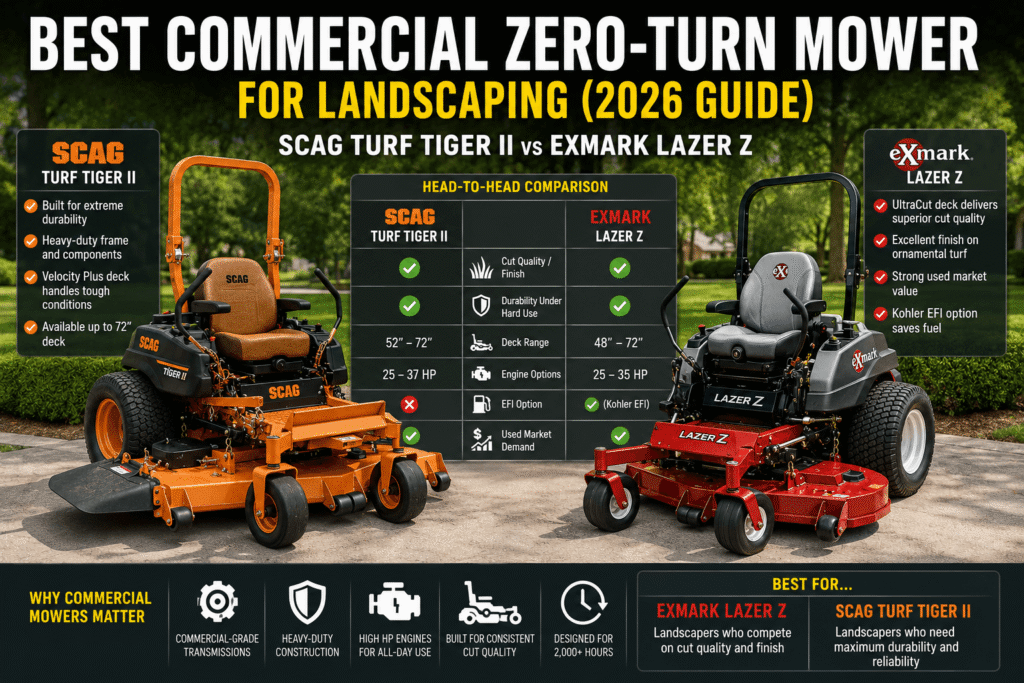
Scag Turf Tiger II vs Exmark Lazer Z — Head-to-Head
| Factor | Exmark Lazer Z | Scag Turf Tiger II |
|---|---|---|
| Cut quality / finish | ✅ UltraCut deck — generally regarded as the stronger finish | Velocity Plus — excellent, slightly below Exmark on premium turf |
| Durability under hard use | Very good | ✅ Generally regarded as slightly more durable at extreme hours |
| Deck range | 48″–72″ | 52″–72″ |
| Engine options | 25–35 HP Kawasaki FX / Kohler EFI | 25–37 HP Kawasaki FX |
| Fuel injection option | ✅ Kohler EFI available | Not available on most configs |
| Used market demand | ✅ Strong — consistent professional demand | Strong — both hold value well |
| Best suited to | Cut quality priority, residential and mixed routes | Durability priority, demanding terrain, high hours |
Other Commercial Machines Worth Knowing
Ferris ISX 2200 — best for rough terrain
The Ferris ISX 2200 remains an excellent commercial mower, particularly for operators working rough or uneven ground. Its full suspension system reduces operator fatigue significantly on bumpy terrain — an advantage no Scag or Exmark at this price matches. For most landscaping businesses focused on standard residential and commercial routes, the Exmark and Scag offer a stronger balance of durability, dealer support, and resale value. But for crews regularly working rough ground or operators with back issues, the Ferris suspension is a genuine differentiator worth considering.
Wright and stand-on mowers — right for some routes
Crews focused on smaller residential lots often prefer stand-on mowers — Wright Standers and similar machines are faster to load and unload, more maneuverable in tight spaces, and practical on routes with many small properties. If your route is 15–20 small residential lots per day rather than larger commercial properties, a stand-on mower may be more productive than a full-size zero-turn. For larger properties and mixed commercial routes, the Lazer Z and Turf Tiger II are more efficient.
Dealer Support — Often More Important Than the Machine Itself
Commercial buyers consistently underestimate how much dealer proximity and support matters once a machine is in daily use. Downtime during peak season costs more than a slightly higher purchase price — a machine sitting in a dealer’s service queue for two weeks in June is more expensive than paying a $500 premium for the brand with the closest dealer.
Before choosing between Scag and Exmark, check which brand has the stronger dealer presence in your area. Both have broad national networks, but regional coverage varies. Parts availability, warranty turnaround time, and the ability to get a loaner machine during service are all worth asking about before signing a purchase order. A dealer you can call and get a same-day answer from is worth more than a marginally better spec sheet on a machine serviced three counties away.
New commercial zero-turns from Scag and Exmark run $11,000–$16,000 depending on deck size and engine configuration. That’s a significant capital commitment for a solo operator or small crew starting out. The used commercial market is the more practical entry point for most buyers:
- Used commercial at $4,000–$7,000 — working machines from landscape companies typically at 800–1,500 hours. Still significant remaining life with proper maintenance. Worth having a dealer inspect before purchase
- Used commercial at $7,000–$10,000 — lower hours, better condition, closer to new-machine reliability. The sweet spot for buyers who want commercial capability without new-machine pricing
Key checks on any used commercial machine: transmission smoothness at both slow and full speed, deck spindle bearing condition (listen for grinding), belt wear, engine oil condition and colour, and service history. A machine with dealer service stamps and documented maintenance is worth significantly more than one without — and worth paying for.
Commercial Mower Maintenance Intervals
Commercial machines run at significantly higher hours than residential equipment — maintenance intervals matter more and skipping them has faster consequences. Most service failures on commercial zero-turns trace back to missed maintenance rather than machine defects.
| Item | Interval | Notes |
|---|---|---|
| Engine oil change | Every 100 hours | More frequently in dusty conditions |
| Air filter inspection | Daily | Clean or replace when clogged — engine damage accelerates fast on a dirty filter |
| Blade sharpening | Weekly on busy routes | Dull blades tear grass rather than cut — visible in the finish and in increased fuel consumption |
| Spindle grease | Every 8–25 hours depending on manufacturer spec | Check your specific model — under-greasing is one of the most common spindle failure causes |
| Hydraulic oil change | Every 500 hours | Check fluid level weekly — hydraulic fluid loss is an early warning sign of seal wear |
| Drive belt inspection | Every 200 hours | Replace before failure — a broken belt mid-route costs more in lost time than a scheduled replacement |
| Fuel filter | Every 200–250 hours | More frequently on machines used with ethanol-blend fuel |
Budget $800–$1,500 per machine per year for routine commercial maintenance at high hours. This is a real operating cost that belongs in your pricing model — not an afterthought.
- Starting with new when used makes more sense — a $5,000–$6,000 used Lazer Z or Turf Tiger II in good condition does the same job as a $13,000 new machine for a solo operator proving the business model. Buy used first, buy new when the revenue justifies it
- Buying on deck size alone — a 72″ deck is efficient on large open properties and a liability on smaller residential lots. Match deck size to the properties you’re actually servicing, not the largest you might ever encounter
- Underestimating maintenance costs — commercial machines at high hours need regular blade changes (weekly on busy routes), belt inspections, spindle greasing, and filter changes. Budget for this before buying
- Ignoring the engine option — the Kohler EFI option on the Exmark Lazer Z provides approximately 10–15% fuel savings at commercial use levels. Across a full season on multiple machines, that adds up to real money
Verdict — Best Commercial Zero-Turn for Landscaping
For landscapers who compete on cut quality — buy the Exmark Lazer Z. The UltraCut deck finish is the reason it leads the professional market, and clients on high-end residential and commercial accounts notice it. For operators who run machines hard on demanding terrain and prioritise durability — buy the Scag Turf Tiger II. The heavier construction handles sustained hard use slightly better at extreme hours.
Both are the correct answer depending on what your routes demand. Neither is a wrong choice for professional daily use — the machines are closer than the brand rivalry suggests.
For deeper coverage: Scag Turf Tiger II vs Exmark Lazer Z · Is the Scag Turf Tiger II Worth It? · Is the Exmark Lazer Z Worth It? · Best Commercial Mower for a Lawn Business
👉 View Scag Turf Tiger II listings — commercial stock available →
👉 View Exmark Lazer Z listings — commercial stock available →
Frequently Asked Questions
What is the best commercial zero-turn mower for landscaping?
The Exmark Lazer Z for cut quality and finish — the UltraCut deck is consistently regarded as one of the best in the professional segment. The Scag Turf Tiger II for durability under hard daily use — heavier construction, slightly better longevity at extreme hours. Both are proven commercial machines that professional crews run successfully on full daily routes.
How long do commercial zero-turn mowers last?
Commercial machines from Scag and Exmark are engineered for 2,000–3,000+ hours with proper maintenance. At commercial use rates (6–8 hours per day), that represents several years of daily operation. Maintenance consistency — particularly blade changes, belt inspections, spindle greasing, and filter schedules — is the biggest variable in actual lifespan.
Is the Scag Turf Tiger II better than the Exmark Lazer Z?
Neither is universally better — they lead in different areas. Exmark leads on cut quality and finish. Scag leads on durability under the hardest daily use. Most professional operators who’ve run both regard them as comparable machines overall, with the choice coming down to route type and business priorities. For a full comparison see our Scag Turf Tiger II vs Exmark Lazer Z guide →
Should I buy new or used commercial equipment?
For most solo operators and small crews, a used commercial machine at $4,000–$7,000 in good condition is the more practical starting point than $13,000+ new. Commercial machines are built for high hours — a well-maintained used Lazer Z or Turf Tiger II at 800–1,200 hours still has significant commercial life remaining. Have a dealer inspect before purchase and prioritise machines with documented service history.
What size deck do I need for commercial landscaping?
Deck size should match the properties you’re servicing. 52″–60″ handles most residential and mid-size commercial properties efficiently — maneuverable enough for obstacles, wide enough to be productive. 72″ is efficient on large open commercial properties but difficult to maneuver on smaller residential lots. Most professional crews run 60″ as their primary deck size for general-purpose routes.