Choosing the best compact tractors for small farms in 2026 comes down to three things: matching horsepower to your actual workload, finding a brand with reliable dealer support in your region, and buying a machine you won’t outgrow in two seasons. One insight worth stating upfront: most small farm buyers overspend on horsepower they never use. A 40 HP machine doing 90% of its work mowing and moving hay is an oversized, underutilized investment — and you pay for that in fuel, purchase price, and depreciation. Get the HP right first, then choose the brand.
At Farmers Equipment Co., we supply compact and sub-compact tractors to small farm buyers across Europe and internationally. This guide is based on manufacturer specifications for 2025–2026 models and current market pricing data.
Ready to browse? See our full compact tractor inventory, including Kubota tractors and used compact tractors. Already decided on a John Deere sub-compact? See our John Deere 1023E Price Guide and 1023E Attachments Guide for a deeper look at that model specifically.
Why Compact Tractors Are the Right Choice for Small Farms
A compact tractor sits between a ride-on mower and a full-size farm tractor — typically 20–60 HP, designed for versatility rather than raw power. For small farm owners managing 2–50 acres, they offer a strong balance of capability, maneuverability, and cost:
- Versatility — With the right attachments (front loader, rear mower, box blade, backhoe, snow blower), a single compact tractor handles most tasks on a small farm year-round
- Maneuverability — Compact machines work in tighter spaces than full-size tractors — around buildings, in orchards, on smaller paddocks
- Running costs — Lower fuel consumption, simpler maintenance, and lower parts costs than large-farm machines
- Resale value — Quality compact tractors from established brands (John Deere, Kubota) tend to hold value well — worth considering if you plan to upgrade later
How to Choose the Right Compact Tractor for a Small Farm
Before comparing models, answer these four questions — they’ll narrow your choice significantly:
1. How many acres are you managing?
- Under 5 acres — 20–25 HP is sufficient for most tasks. A sub-compact handles mowing, light loader work, and basic cultivation
- 5–20 acres — 25–40 HP covers mowing, loader work, light cultivation, and hay handling comfortably
- 20–50 acres — 40–60 HP gives headroom for larger implements, heavier loader work, and more demanding cultivation
2. What tasks will the tractor perform?
Mowing and loader work are the most common — almost any compact tractor handles these. Add a backhoe for digging, a rotary tiller for cultivation, or a post-hole digger for fencing, and confirm your chosen model supports the required implement attachment standard (Category 1 three-point hitch is standard on most compacts).
3. What transmission type suits you?
- Hydrostatic (HST) — Most popular for small farms. Simple to operate, smooth for loader work and mowing, no manual gear changes. Slight fuel efficiency trade-off vs. manual at sustained speeds
- Gear / shuttle shift — More efficient at sustained field work speeds. Less convenient for stop-start loader and yard tasks
4. How important is dealer proximity?
Compact tractors require authorized dealer service for warranty work and complex repairs. John Deere and Kubota have extensive global dealer networks, making parts and service easier to access in many regions — a meaningful advantage if you’re in a more remote location.
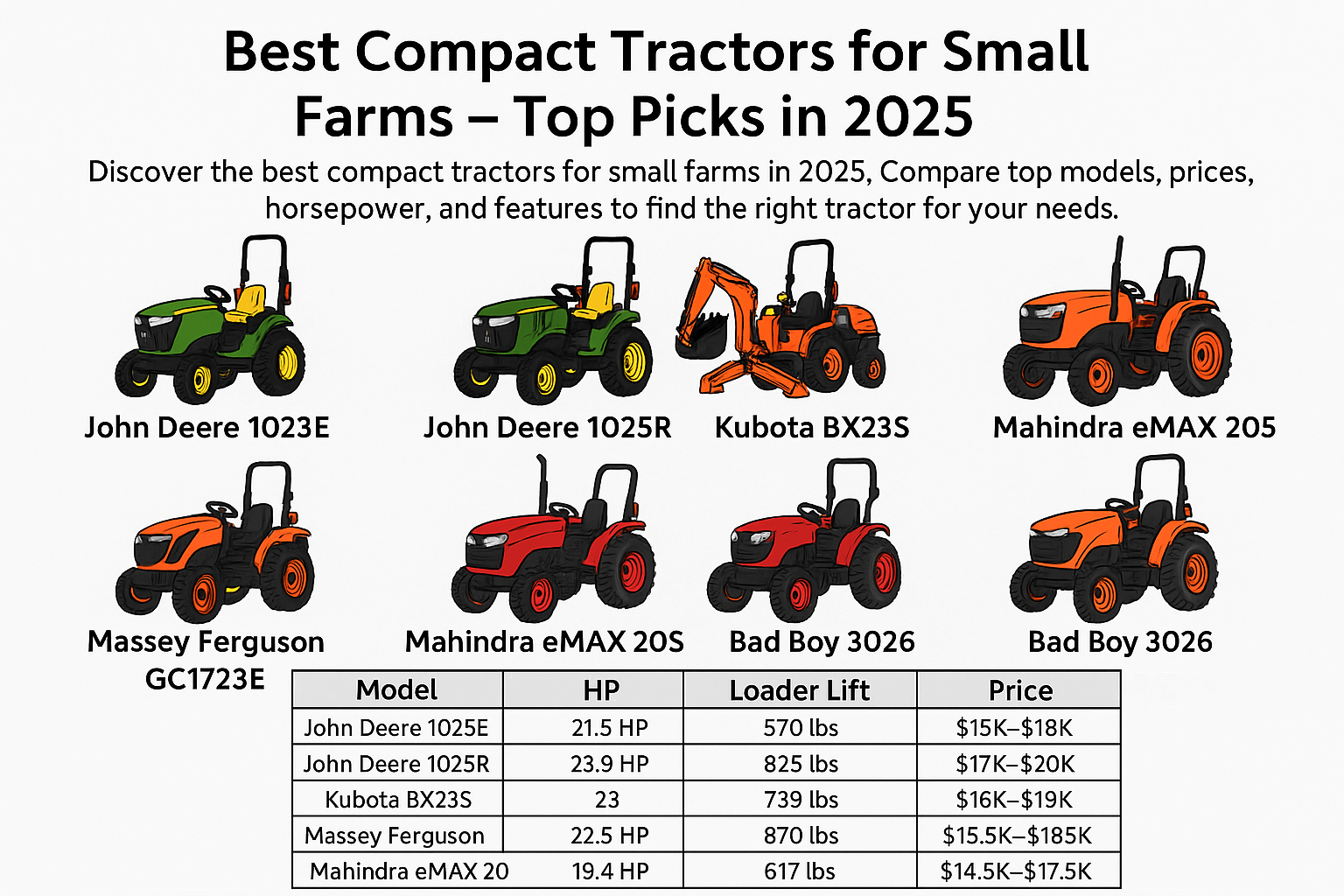
Best Compact Tractors for Small Farms (2026)
Note: loader lift capacities below are manufacturer-rated figures — the measurement method (pivot pin, full height, or a specified forward distance) varies by brand and model, so figures aren’t always directly comparable across manufacturers.
1. John Deere 1025R — Best Overall Sub-Compact
The John Deere 1025R is one of the benchmark sub-compact tractors for small farm buyers. At 23.9 HP with a hydrostatic transmission, it handles mowing, light loader work, and basic cultivation comfortably on farms up to 10 acres. Build quality, dealer support, and resale value have helped make it one of the most popular sub-compact tractors in its class.
- HP: 23.9 HP
- Transmission: Hydrostatic, 2-range
- Loader lift capacity: ~825 lbs (374 kg)
- Price range (new): $17,000–$21,000 — loader typically sold separately, add $3,000–$5,000 for a factory-matched 120R loader
- Best for: Small farms up to 10 acres — mowing, loader work, light cultivation
See John Deere’s official 1 Series specifications for full details.
Ownership insight: Most commonly found on 3–10 acre hobby and lifestyle farms. Fuel consumption estimates run roughly 1.5–2 liters/hr on mowing and 2.5–3.5 liters/hr on loader work, though actual consumption varies by load and conditions. A front axle seal leak is a commonly reported issue among 1025R owners on high-hour machines — worth checking during inspection on any used unit.
Downside: Limited HP for larger implements; premium pricing vs. competitors.
2. Kubota BX23S — Best for Digging and Versatility
The Kubota BX23S stands out for its factory-integrated loader and backhoe — making it one of the most capable machines in the sub-compact class for small farms that need digging, trenching, or landscaping work alongside mowing and general tasks. Kubota’s build quality and dealer network are comparable to John Deere.
- HP: 23 HP
- Transmission: Hydrostatic
- Loader lift capacity: ~739 lbs (335 kg)
- Backhoe: Standard on most configurations
- Price range (new): $16,500–$20,000 — loader and backhoe typically included in package pricing, making this a strong value versus a comparable JD with add-ons
- Best for: Small farms needing digging, trenching, and landscaping alongside standard tasks. Popular with landscaping businesses and 5–15 acre properties with ongoing groundwork
See Kubota’s official product specifications for full details.
Ownership insight: The hydrostatic transmission has a strong general reliability reputation among Kubota HST units. The backhoe adds weight, which can compact soft ground — worth planning around on wetter properties.
Downside: Slightly lower loader capacity than some competitors; backhoe adds weight.
3. John Deere 3025E — Best Step-Up Compact (25 HP)
The John Deere 3025E bridges the gap between the sub-compact 1025R and the larger 4-series compacts. At approximately 24–25 HP with a more substantial frame, it handles heavier loader work, larger mower decks, and light cultivation on farms up to 20 acres, while retaining the simplicity and maneuverability of a compact machine.
- HP: 24.4 HP
- Transmission: Hydrostatic or gear
- Loader lift capacity: ~1,433 lbs (650 kg) — nearly double the 1025R, the key reason to step up
- Price range (new): $18,000–$23,000 — loader included in most package deals
- Best for: Small farms 10–20 acres — a step up in loader capacity and frame strength from the 1025R
Ownership insight: Commonly used on 10–20 acre farms with hay handling, heavier grading, and regular loader work. Buyers doing sustained cultivation may find the gear transmission option worth considering, since it can offer better fuel efficiency at field speeds than HST.
Downside: Larger footprint than sub-compact — less maneuverable in tight spaces.
4. Kubota L3902 — Best Mid-Range Compact (~38 HP)
The Kubota L3902 is a workhorse compact in the upper-30s HP class — capable of handling demanding loader work, hay tasks, and heavier cultivation on farms up to 30 acres. The L-series has a strong reputation for reliability and is one of the most widely sold compact tractor lines globally.
- HP: 37.5 HP
- Transmission: Gear or hydrostatic
- Loader lift capacity: ~2,315 lbs (1,050 kg)
- Price range (new): $22,000–$28,000 — loader typically included in dealer packages; confirm before comparing
- Best for: Small-to-medium farms 15–35 acres — more demanding compact farm work
Ownership insight: The L-series has a strong reputation for durability among compact tractor lines. Fuel consumption estimates at this HP range roughly 3–5 liters/hr depending on task and load. Parts are widely stocked, and service intervals are generally straightforward.
Downside: Larger and heavier — not as nimble as sub-compact models in tight areas.
5. Massey Ferguson 1835M — Best Value Compact
The Massey Ferguson 1835M offers strong specifications at a price point typically below John Deere and Kubota equivalents. At roughly 35 HP with a hydrostatic transmission option, it covers the full range of small farm tasks with good loader capacity and a practical build. MF’s global parts network helps keep maintenance accessible.
- HP: 34.9 HP
- Transmission: Hydrostatic or gear
- Loader lift capacity: ~2,028 lbs (920 kg)
- Price range (new): $19,000–$25,000 — typically priced somewhat below equivalent Kubota L-series models with comparable specs
- Best for: Value-focused small farm buyers who want 30–35 HP capability without the John Deere or Kubota premium
Ownership insight: MF compact tractors are supported through a wide global parts network, and servicing costs are generally competitive versus mainstream compact brands. Resale value tends to run somewhat lower than JD/Kubota, which reduces trade-in value but also lowers used entry prices for buyers shopping secondhand.
Downside: Weaker resale vs. JD/Kubota — less attractive for buyers who trade up regularly.
6. Fendt 211 Vario — Premium Small Farm Tractor (Not a Traditional Compact Tractor)
Included here as a crossover option for professional small farms considering a step beyond traditional compact tractors — not a true sub-compact, but a capable small-farm machine from Fendt’s lineup. Although the Fendt 211 Vario exceeds the horsepower normally associated with compact tractors, it’s included here for professional growers who want a premium machine for vineyards, orchards, and intensive small-farm operations.
The Fendt 200 series brings the Vario CVT transmission, premium cab quality, and Fendt’s professional build standards to the small-farm market. Purpose-built for horticulture, vineyards, orchards, and intensive small-farm operations, it’s a significant step up in price, but delivers professional-grade longevity, operator comfort, and residual value that a true compact typically can’t match.
- HP: 115 HP
- Transmission: Vario CVT
- Price range (new): $85,000–$110,000+
- Best for: Professional horticulture, vineyard, orchard, and high-intensity small farm operations — buyers who want premium compact engineering and maximum residual value
Ownership insight: The Vario CVT can offer genuine fuel savings over conventional transmissions at high annual hours. Service costs tend to run higher than mainstream compact brands — budget for authorized Fendt dealer servicing. Residual value is generally strong relative to other machines on this list.
Downside: Premium price only really justifiable for professional or very high-use applications — for occasional small farm use, the economics don’t stack up.
Compact Tractor Comparison Table (2026)
| Model | HP | Transmission | Loader Lift | Price (New) | Best For |
|---|---|---|---|---|---|
| John Deere 1025R | 23.9 HP | Hydrostatic | 825 lbs | $17,000–$21,000 | Best all-round sub-compact — up to 10 acres |
| Kubota BX23S | 23 HP | Hydrostatic | 739 lbs | $16,500–$20,000 | Best for digging — backhoe standard |
| John Deere 3025E | 24.4 HP | HST or gear | 1,433 lbs | $18,000–$23,000 | Step-up compact — more loader capacity |
| Kubota L3902 | 37.5 HP | HST or gear | 2,315 lbs | $22,000–$28,000 | Mid-range compact — 15–35 acres |
| Massey Ferguson 1835M | 34.9 HP | HST or gear | 2,028 lbs | $19,000–$25,000 | Best value compact — 30–35 HP class |
| Fendt 211 Vario | 115 HP | Vario CVT | Professional spec | $85,000–$110,000+ | Premium professional compact |
Matching Attachments to Common Tasks
| Task | Recommended Attachment |
|---|---|
| Mowing | Mid-mount mower |
| Moving gravel | Front loader |
| Digging | Backhoe |
| Fence installation | Post hole digger |
| Driveway grading | Box blade |
| Snow removal | Front blade / snow blower |
For a deeper dive into pairing implements with a specific model, see our John Deere 1023E Attachments Guide as a reference example.
Which Compact Tractor Is Right for Your Farm?
| Your Situation | Best Choice |
|---|---|
| Under 5 acres — mowing and light loader work | John Deere 1025R — best sub-compact, strong resale |
| Need a backhoe for digging and trenching | Kubota BX23S — backhoe standard, excellent build |
| 5–20 acres — want more loader capacity | John Deere 3025E — one of the strongest loader capacities among tractors in this comparison |
| 20–35 acres — need real working horsepower | Kubota L3902 — most capable mid-range compact on this list |
| Value buyer — want 30–35 HP below JD/Kubota price | Massey Ferguson 1835M — best value in the segment |
| Professional / high-use / want maximum residual | Fendt 211 Vario — premium CVT compact, best long-term value at high hours |
Quick Summary
- Best overall → John Deere 1025R — a strong sub-compact choice for most small farm buyers
- Best for versatility → Kubota BX23S — backhoe standard, strong build, great for varied tasks
- Best value → Massey Ferguson 1835M — capable specs at pricing below JD/Kubota
- Best for growing farms → Kubota L3902 — real working horsepower with a compact footprint
- Best premium → Fendt 211 Vario — professional engineering in a compact package
Browse available compact tractors — stock updates regularly. Contact us to compare current prices and in-stock models before buying.
Typical Running Costs for a Compact Tractor (2026)
Purchase price is only part of the story. For a mid-range compact (25–40 HP) running 200–400 hours annually on a small farm, expect annual running costs broadly in the following ranges. These are approximate ownership cost estimates based on typical 200–400 hour annual usage. Actual fuel consumption, servicing costs, tire life, and depreciation vary by region, dealer labor rates, operating conditions, and machine age.
| Cost Category | Estimated Annual Cost (USD) | Notes |
|---|---|---|
| Fuel | $800 – $2,500 | Based on $3.50–$4.50/gal diesel, 2–5 gal/hr depending on task |
| Servicing (oil, filters, minor service) | $300 – $800 | Tends to run higher at JD/Fendt dealers; often lower at independent Kubota/MF shops |
| Tires (amortized) | $200 – $600 | Compact tires typically last 1,500–3,000 hrs depending on surface |
| Depreciation (used, 3–6 yr old machine) | $1,500 – $4,000 | Generally lower on well-maintained JD/Kubota; can run higher on faster-depreciating brands |
| Unexpected repairs | $0 – $1,500 | Budgeting $500–$1,000 annually as a reserve is a reasonable practice on any used machine |
Total annual running cost for a well-maintained used compact tractor on a small farm typically falls somewhere between $3,000–$9,000 per year — a wide range driven mainly by annual hours, brand, and whether the machine is new or used.
Common Mistakes When Buying a Compact Tractor for a Small Farm
1. Overbuying horsepower — the most common and costly mistake
A 40 HP machine doing 90% mowing and light loader work is over-specified and over-priced. Match HP to your most demanding regular task, not your most demanding imaginable one.
2. Ignoring dealer proximity
A compact tractor from a brand with no nearby dealer is a real risk. Warranty repairs and complex diagnostics need authorized technicians. John Deere and Kubota have the widest networks globally — if you’re remote, proximity matters more than brand preference.
3. Underestimating attachment costs
The tractor is often just the start. A front loader can add $3,000–$6,000. A rear mower deck can add $2,000–$5,000. A backhoe can add $4,000–$8,000. Budget for the implements you actually need before committing to a machine price.
4. Buying the cheapest used machine available
A well-documented 3–5 year old John Deere or Kubota is generally a sound purchase. A cheap machine with no service records carries much more risk — the savings on purchase price are often lost in the first season of repairs.
5. Not checking the loader spec in package deals
Some package deals include lower-spec loaders that can’t handle the tasks you need. Always check loader lift capacity and hydraulic flow — not just whether a loader is included.
Who Should NOT Buy a Compact Tractor?
Compact tractors are the right tool for most small-farm work, but they’re not the answer for every operation. Consider a full-size utility tractor instead if you’re dealing with:
- Farms over 50 acres with regular field work
- Heavy tillage across large areas
- Large round bale handling
- Commercial-scale hay production
- Continuous field cultivation on a working farm schedule
If your operation fits any of these, a compact tractor will likely feel underpowered and require far more hours to get the same work done — a full-size utility tractor is usually the more efficient investment at that scale.
Compact Tractor Buying Checklist
- ✓ Match horsepower to your acreage and workload
- ✓ Compare loader lift capacity, not just engine power
- ✓ Confirm three-point hitch and PTO compatibility
- ✓ Check dealer support and parts availability
- ✓ Budget for attachments before purchasing
- ✓ Inspect service records on used tractors
Frequently Asked Questions
What is the best compact tractor for a small farm?
For most buyers: the John Deere 1025R (under 10 acres) or Kubota L3902 (15–35 acres) are strong starting points. For backhoe work, consider the Kubota BX23S. For value at 30–35 HP, the Massey Ferguson 1835M.
How many HP do I need for a small farm?
Under 5 acres: 20–25 HP. 5–20 acres: 25–40 HP. 20–50 acres: 40–60 HP. Match HP to your most demanding regular task — not to the biggest thing you might ever do.
Is hydrostatic or gear transmission better for a small farm?
Hydrostatic works well for most small farm buyers — simpler to operate, smooth for loader and mowing work. Gear tends to be slightly more fuel-efficient at sustained cultivation speeds, but convenience often wins out for typical small farm tasks.
What is the most reliable compact tractor brand?
John Deere and Kubota generally rank well for reliability and have extensive global dealer networks. Choosing based on which brand has the closest authorized dealer to your farm is often more practical than brand preference alone at this HP class.
Is it worth buying a used compact tractor for a small farm?
Often yes — a well-documented 3–6 year old John Deere or Kubota can offer strong value. Cold start test the engine, check hydraulics and the loader, and verify service records. Be cautious of machines with documentation gaps. For used compact tractor listings, TractorHouse is one of the largest agricultural equipment marketplaces — useful for price benchmarking before you buy.
What attachments do I need for a small farm compact tractor?
A front loader (essential for most buyers), rear mower deck, box blade for grading, and a rotary tiller or post-hole digger depending on your work. Most compacts use a Category 1 three-point hitch. Budget roughly $5,000–$15,000 for a full basic attachment set, and factor this into your total budget before choosing a machine.