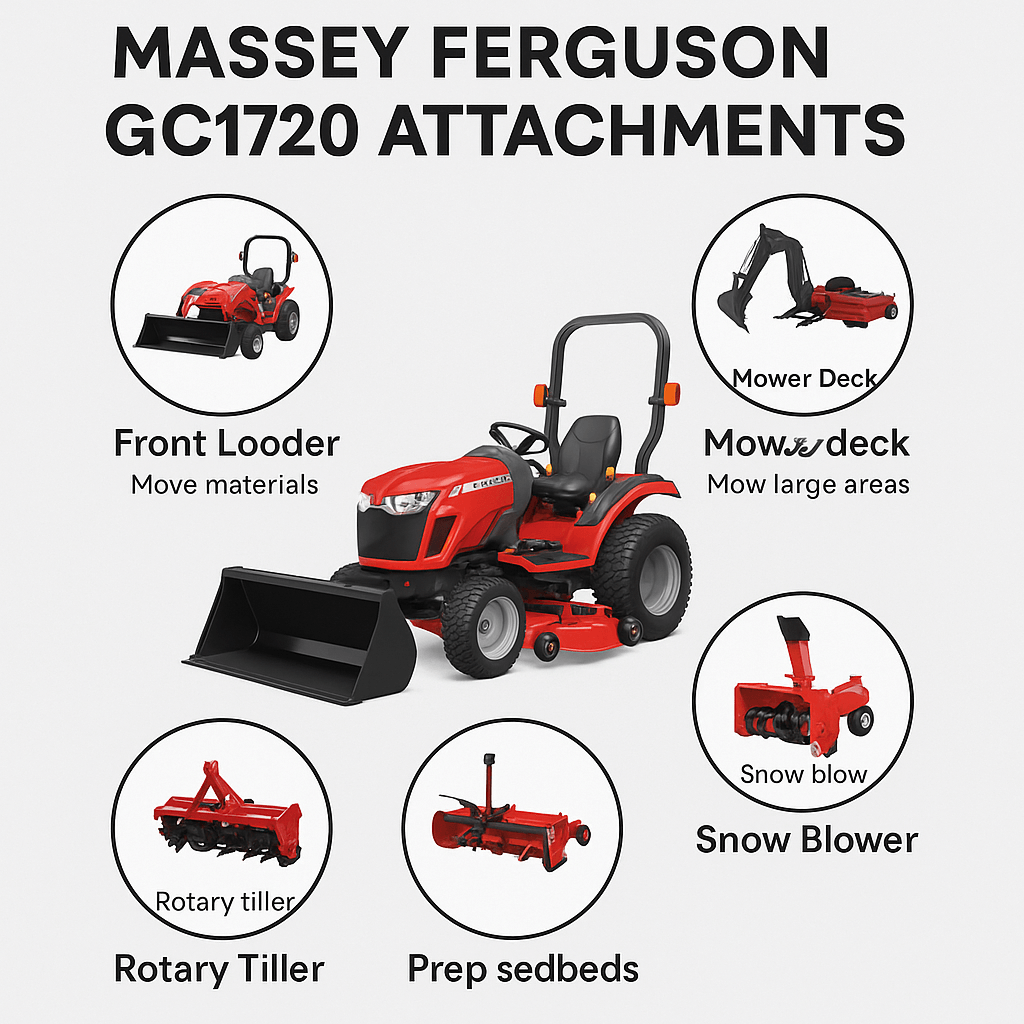
Massey Ferguson GC1720 attachments are what turn this sub-compact workhorse into far more than something that pulls a cart or mows the lawn. What actually unlocks its full potential is the range of attachments and implements that let you dig, lift, grade, mow, till, blow snow, and drive posts — all with one quick, nimble machine. For small acreage or heavy landscaping schedules, the right attachments replace several single-task machines and pay for themselves in time saved.
Whether you’re a first-time buyer or replacing a worn-out tractor, this guide walks you through the top 5 GC1720 attachments, real-world uses, costs, how to choose the right one, and maintenance advice — so you buy once and buy right.
Ready to build your setup? Shop the Massey Ferguson GC1720 for sale and ask about attachment bundle pricing.
Fit & Power Basics (Quick Review Before You Buy)
The GC1720 is a compact tractor designed to run standard attachments through a Category 1 three-point hitch and mid/rear PTO. Exact lift capacity and hydraulic flow can vary by model year, so always confirm fit and weight/balance before buying:
- Check hitch category (Cat-1) and use weight + width
- Verify ballast requirements — rear ballast for loader work, front ballast for heavy 3-point equipment
- Confirm PTO speed and driveline length with your dealer or implement manual
For official platform specs and current options, see Massey Ferguson’s sub-compact tractor lineup. For older model data, TractorData is a helpful resource.
1) Front Loader — The Workhorse Essential
If you buy only one attachment, make it the front loader. It’s the implement that turns “nice to have” into “can’t live without.”
What it does best:
- Moves soil, gravel, mulch, firewood, feed, and compost quickly
- Spot-levels areas, back-drags driveways, cleans stalls, loads trailers
- Pairs with add-ons like pallet forks, tooth bars, and light grapples for more applications
Pro tips:
- Ballast is key: Carry a ballast box or heavy 3-point implement on the back for stability
- Bucket upgrades: A tooth bar helps bite into packed dirt; pallet forks are ideal for wood, fence posts, or IBC tanks
- Technique: Scoop low and move low. Back-drag in float mode to grade gravel
Real-world example: A 5-acre hobby farm cut weekly chore time in half using the loader to move bedding, mulch garden beds, and top gravel lanes — work that previously meant hours with a wheelbarrow.
2) Backhoe — Compact Digging Power
Don’t underestimate a backhoe on a sub-compact. The GC1720’s compact size fits into places larger machines can’t, while still digging deep enough for utility lines and drains.
What it does best:
- Water and electrical line trenching, French drains, irrigation
- Planting hole digging, ditch cleaning, light stump removal
- Works with a range of bucket sizes — narrow trench, general purpose, cleanup
Pro tips:
- Call before you dig: Locate utilities and plan where spoil goes
- Level on stable ground and use outriggers when possible
- Use a tooth bucket for hardpan and roots; a cleanup bucket for finishing work
Real-world example: Landscaping crews trench for drip irrigation and plant trees without renting a mini-excavator — saving travel time and rental costs while keeping the job moving.
3) Mid-Mount Mower Deck — Lawn & Orchard Perfection
A mid-mount mower deck (MMM) upgrades the GC1720 into a heavy-duty mower — a shortcut to mowing large lawns, orchards, and open spaces.
What it’s best at:
- Clean, broad-swath mowing on estate lawns, acreage, and orchard rows
- More durable than box-store riding mowers, with better cut quality at scale
- Height adjustment and anti-scalp wheels protect uneven ground
Pro tips:
- Match deck width to your gates and trees (most owners prefer 54–60″ on sub-compacts)
- Keep blades sharp and the underside of the deck clear for the best cut
- Coordinate “mow days” to swap between the deck and loader/backhoe efficiently
Real-world example: An orchard operator uses a 60″ deck between rows for clean lanes and fewer pests, swapping to the loader weekly for material handling — one tractor covering two primary jobs.
For a deeper look at the tractor itself, see our Massey Ferguson GC1720 buyer’s guide.
4) Snow Blower & Blades — Winter, Solved
With the right setup, the GC1720 becomes a genuine winter workhorse. Choose from a front snow blower, rear 3-point blower, or front/rear blades.
What they do best:
- Front blower: Most comfortable for long driveways; throws snow well clear of the lane
- Rear blower: Cost-effective if you don’t need a front PTO kit; strong in heavy drift areas
- Blades (front or rear): Fast for light-to-moderate snow; ideal for frequent, quick clears
Pro tips:
- Install tire chains and sufficient ballast for stability and traction
- Tip blades to windrow snow off the drive; avoid building up high frozen berms
Looking to round out your setup for winter? Browse our full Massey Ferguson lineup for compatible units and attachments.
Safety: Wear visible clothing and slow down. For winter operation safety and general farm equipment best practices, refer to OSHA’s tractor safety guidelines.
5) Rotary Tiller — Garden & Food-Plot Champ
A rotary tiller turns the GC1720 into a genuine garden and field machine.
What it does best:
- Breaks up hard-packed soil, incorporates compost, preps seedbeds
- Creates new garden beds, micro-pastures, and wildlife food plots
Pro tips:
- Match tiller width to your tractor’s stance so you fill in your tire tracks
- Use a slip-clutch driveline for rocky ground, or carry spare shear bolts
- Till in multiple passes rather than trying to hit full depth on the first lap
Real-world example: A market gardener preps half-acre beds each spring with a 50–60″ tiller, then uses the loader for compost and the mower to keep field edges clean.
Other Implements You’ll Love
The top five handle most tasks, but these frequently earn a spot in the shed too:
- Post Hole Digger: Fast, straight fence lines and deck footings
- Box Blade / Land Plane: Re-crown gravel lanes and smooth ruts
- Landscape Rake: Collect sticks and rocks, groom seedbeds
- Pallet Forks: Lift lumber, totes, pallets, small logs
- Sprayers & Spreaders: Pasture management and orchard care
How to Choose: Build the Right Kit for Your Work
Think in packages so you’re ready year-round:
- Farm Starter Bundle: Loader + Tiller + Box Blade — spring tillage, summer material moves, fall lane repair
- Property Care Bundle: Loader + Mower Deck + Rear Blade — weekly mowing, gravel maintenance, leaf/snow management
- Landscaper Pro Bundle: Loader + Backhoe + Pallet Forks — trenching, grading, hardscape material handling
Questions to ask before you buy:
- What’s your primary chore — mowing, moving, digging, or upkeep?
- What size and type of ground are you working?
- Are there gateways or tight spots to squeeze through?
- Will you need winter equipment (blower/blade + chains)?
- Will you haul the tractor frequently, and does that affect weight/trailer capacity?
Still unsure? Contact Farmers Equipment and we’ll help tailor a package for your property and workload.
Massey Ferguson GC1720 Attachments Pricing: Ranges & Ways to Save
Average new-attachment price ranges (may vary by brand and options):
- Front Loader: $1,500–$3,000
- Backhoe: $3,000–$4,000
- Mid-Mount Mower Deck: $1,000–$2,500
- Snow Blower (front or rear): $1,500–$2,500
- Rotary Tiller: $1,500–$2,000
- Post Hole Digger: $700–$1,500
- Box Blade / Land Plane: $500–$1,000
- Pallet Forks: $300–$1,000
Pricing varies by brand, condition, and dealer — contact us for current pricing on available inventory.
Cost-cutting tips:
- Bundle & finance: Tractor + attachments purchased together often qualifies for a discount and a single payment
- Buy core tools now: Add specialty implements later as needs grow
- OEM vs. aftermarket: OEM fits and finishes match perfectly; quality aftermarket parts can stretch your budget further
Ask us about current bulk and seasonal specials.
Seasonal Workflow: What to Run, When
- Spring: Tiller (beds/plots), Loader (compost/soil), Box Blade (lane repair)
- Summer: Mower Deck (weekly), Loader (mulch/rock), Sprayer/Spreader (pasture)
- Fall: Loader (firewood), Landscape Rake (cleanup), Box Blade (rut fixes)
- Winter: Snow Blower/Blade + Chains, Loader (salt/sand totes)
Care & Maintenance for Attachments
Treat implements like machines — service them and they’ll last:
- Grease pivot points (loader/backhoe) and PTO shafts on schedule
- Sharpen blades (tiller/mower)
- Inspect hydraulic lines, pins, shear bolts, and quick-attach latches
- Rinse off salt and mud, dry, and store in the shade
- Label and hang PTO shafts to protect yokes and guards
Still comparing brands? Check out our GC1720 vs Kubota BX comparison.
Frequently Asked Questions
Q1: Will the GC1720 handle a loader and backhoe year-round?
Yes — just keep ballast in good shape and stay on your maintenance schedule. Many owners keep the loader on most of the year and attach the backhoe as needed.
Q2: Which attachment should I buy first?
For most owners, the loader delivers the fastest return on investment. If you do extensive digging or landscaping, the backhoe is a strong second choice. If lawn maintenance is your primary focus, start with the mower deck.
Q3: Front snow blade or blower — what do I need?
Heavy or long winters with bad drifts favor a blower, since it ejects snow well clear of the lane. Frequent light snows are better served by a blade — simple and fast.
Q4: Will a 60″ mower deck scalp on rough ground?
With anti-scalp wheels properly installed, mowing in the right direction on slopes, and slowing down on rough areas, the GC1720 handles a 54–60″ deck well when set correctly.
Q5: What tiller width should I use?
Match or slightly exceed your rear tire track width so you’re not tilling through your own tire tracks.
Q6: Can I use aftermarket implements?
Yes — there are several reputable Cat-1 implement brands. OEM parts typically fit and finish best; quality aftermarket options can stretch your budget. Check PTO driveline length and hitch geometry before buying.
Q7: Do attachments reduce resale value?
Generally the opposite — loader, backhoe, and mower deck packages tend to add resale value.
Q8: Can I finance attachments with the tractor?
Yes. Most buyers purchase the tractor and implements as a package for better terms and a single down payment. We can help structure that for you.
Q9: How often should I grease the loader and backhoe?
Follow manufacturer guidelines — many owners grease every 8–10 hours of hard use, or after dirty jobs. Keep grease and rags on the tractor for convenience.
Q10: Where do I look up specs and compatibility?
Start with your owner’s manual and the Massey Ferguson website. For legacy model data, TractorData is useful, and your dealer can confirm exact fit.
Conclusion & Next Steps
Massey Ferguson GC1720 attachments are the reason this little tractor punches above its weight. Pair a loader with a mower deck for weekly work, add a backhoe and tiller for projects and planting, and keep a snow solution ready for winter. With a thoughtful package, you’ll handle four seasons of chores with one compact, comfortable machine.
At Farmers Equipment, we’ll help you put together the right package, finance it, and deliver it ready to work.
Shop the Massey Ferguson GC1720 today and ask about attachment packages and seasonal promotions.