Kioti vs Kubota is the most common brand comparison in the compact and sub-compact tractor market — and it is closer than most buyers expect. Kubota is the benchmark brand: largest dealer network, strongest resale, best parts availability, and a 60-year reputation in North American compact tractors. Kioti is the value challenger: competitive machine quality, class-leading torque in multiple segments, lower purchase price, and the only factory climate-controlled cab in the sub-compact class. This guide compares both brands honestly across every factor that matters for a buying decision.
👉 See our Kioti CS2530 — factory cab, 24.5 HP, $30,000 →
Written by: Farmers Equipment editorial team.
Kioti vs Kubota — Quick Verdict
Buy Kioti if: you want more machine per dollar, need a factory cab in the sub-compact class, plan long-term ownership, and have verified a competent local Kioti dealer.
Buy Kubota if: dealer network density and parts availability are priorities, you plan to sell within 5 years and want maximum resale value, or you want the most established compact tractor brand in North America.
👉 See current Kioti CS2530 listing — $30,000 with factory cab →
Kioti vs Kubota — Full Brand Comparison
| Factor | Kioti | Kubota | Advantage |
|---|---|---|---|
| Founded | 1947 (Daedong Corporation) | 1890 | Kubota — longer history |
| North American presence | Since 1993 | Since 1969 | Kubota — more established |
| Market position (compact tractors) | 3rd largest in North America | Largest in North America | Kubota |
| Engine manufacturer | Daedong — in-house | Kubota — in-house | Equal — both build own engines |
| Engine reputation | Strong — Daedong diesel well-regarded | Benchmark — most trusted in class | Kubota — stronger long-term reputation |
| Torque output (sub-compact) | Class-leading — CS2530: 51.63 lb-ft | Competitive — BX23S: ~40 lb-ft | Kioti — significant advantage |
| Factory cab (sub-compact) | Yes — CS2530 standard | No — option only | Kioti — unique advantage |
| Dealer network | Growing — smaller, quality varies | Largest in compact class — consistent quality | Kubota — major advantage |
| Parts availability | Good — improving since 2020 | Excellent — next-day most US markets | Kubota — significant advantage |
| Resale value | Moderate — 45–60% after 5 years | Best in class — 60–75% after 5 years | Kubota — significant advantage |
| Purchase price | Typically 10–20% lower for equivalent spec | Premium pricing | Kioti — meaningful advantage |
| Warranty | Competitive — verify current terms | Strong — well-established coverage | Roughly equal |
| Loader capacity (sub-compact) | Higher — CS2530: ~1,100 lbs | BX23S: ~748 lbs | Kioti — higher rated |
| Hydraulic flow (sub-compact) | CS2530: ~7.7 GPM | BX23S: ~6.0 GPM | Kioti — faster response |
| Technology / telematics | KIOTI Connect — recent models | Kubota Advanced — well-developed | Kubota — more mature ecosystem |
| Customer complaint pattern | Dealer service inconsistency | Rare — dealer network quality consistent | Kubota — better service experience |
| Manufacturing location | South Korea | Japan and USA (some models) | Equal — both quality manufacturing |
Engine and Build Quality — Closer Than the Brand Gap Suggests
Does Kioti use Kubota engines? No — this is a common misconception. Kioti engines are designed and built by Daedong Corporation, Kioti’s South Korean parent company. They are entirely separate from Kubota’s engine designs and manufacturing. Both brands build their own diesel engines in-house, which is the most important quality signal and distinguishes both from competitors that source engines externally.
Both Kioti and Kubota design and manufacture their own diesel engines — this is the most important quality signal and distinguishes both brands from competitors that source engines externally. The Daedong diesel in a Kioti and the Kubota diesel in a Kubota are both proven, in-house designs with strong long-term reputations.
In independent owner surveys and forum discussions among experienced compact tractor operators, the most consistent finding is that Kioti and Kubota machines of equivalent specification perform comparably in field conditions. The quality gap between the brands is narrower than the brand gap — Kubota’s stronger reputation reflects its longer North American history and dealer infrastructure more than a fundamental engineering superiority.
Where the build quality difference is most often cited: fit and finish details — panel gaps, control feel, and minor trim quality — where Kubota’s longer production refinement shows. These are real differences but they do not affect performance or durability in farm use.
Dealer Network — Kubota’s Most Important Advantage
This is not a minor difference — it is Kubota’s single most meaningful practical advantage over Kioti for working farm buyers:
| Dealer Factor | Kioti | Kubota |
|---|---|---|
| Dealer density (US) | ~900+ dealers | ~1,600+ dealers |
| Dealer quality consistency | Variable — research your local dealer before buying | Generally consistent — established dealer standards |
| Parts in-stock availability | Common parts — good. Specialty parts — 1–2 week lead time possible | Excellent — most parts next-day nationally |
| Service technician experience | Growing — some dealers very experienced, others less so | Deep — decades of Kubota-specific training |
| Loaner machine availability | Rare at most Kioti dealers | Available at many Kubota dealers |
| Impact on buying decision | Research local dealer first — critical | Less critical — network quality is reliable |
For a commercial farmer who needs a tractor back in service within 24–48 hours of a breakdown — Kubota’s dealer network is a genuine operational advantage that Kioti cannot currently match. For a rural property owner or hobby farmer who can plan service appointments 1–2 weeks out — the dealer gap is manageable and not a reason to pay the Kubota premium.
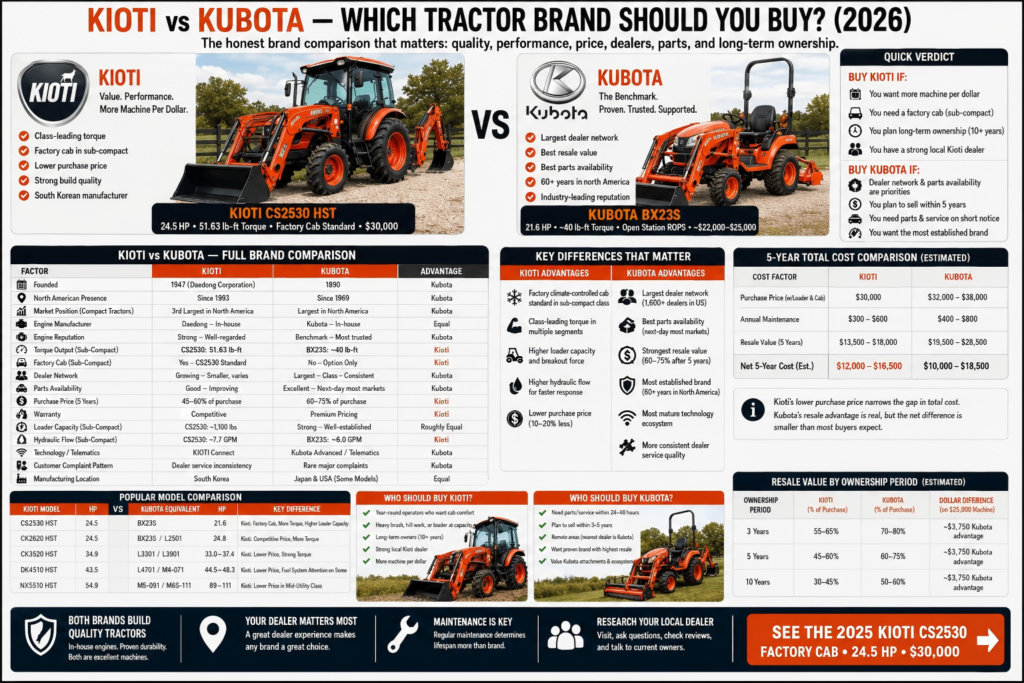
Resale Value — What the Numbers Mean for Your Wallet
| Ownership Period | Kioti Resale (% of purchase) | Kubota Resale (% of purchase) | Dollar Difference (on $25,000 machine) |
|---|---|---|---|
| 3 years | 55–65% | 70–80% | ~$3,750 Kubota advantage |
| 5 years | 45–60% | 60–75% | ~$3,750 Kubota advantage |
| 10 years | 30–45% | 50–60% | ~$3,750 Kubota advantage |
The resale advantage is real — but the dollar value is often smaller than buyers assume. On a $25,000 machine, Kubota’s resale advantage translates to approximately $3,000–$4,000 more at resale. If Kioti’s lower purchase price saves $3,000–$5,000 upfront, the net financial difference over a 5-year ownership period is modest — often less than $2,000 either way. The Kubota resale advantage becomes more significant on higher-priced configurations and shorter ownership periods.
Price Comparison — Model by Model
| Segment | Kioti Model | Kubota Equivalent | Approximate Price Difference |
|---|---|---|---|
| Sub-compact (cab) | CS2530 — $30,000 with factory cab | BX23S — $32,000–$38,000 with cab | Kioti $2,000–$8,000 cheaper at equivalent spec |
| Sub-compact (open station) | CS Series — from ~$20,000 | BX Series — from ~$17,000–$22,000 | Roughly equal — varies by config |
| Compact (25–35 HP) | CK Series — from ~$20,000–$28,000 | L Series — from ~$24,000–$35,000 | Kioti typically 10–15% lower |
| Compact (35–55 HP) | DK Series — from ~$28,000–$45,000 | M Series — from ~$35,000–$55,000 | Kioti typically 10–20% lower |
Which Kioti Models Compete with Which Kubota Models?
| Kioti Model | HP Range | Kubota Equivalent | Key Difference |
|---|---|---|---|
| CS2530 HST | 24.5 HP | BX23S | Kioti: factory cab, more torque, higher loader capacity |
| CK2620 HST | 24.5 HP | BX23S / L2501 | Kioti: competitive price, more torque |
| CK3520 HST | 34.9 HP | L3301 / L3901 | Kioti: lower price, strong torque |
| DK4510 HST | 43.5 HP | L4701 / M4-071 | Kioti: lower price — injection system needs attention on some units |
| NX5510 HST | 54.9 HP | M5-091 / M6S-111 | Kioti: lower price for mid-utility class |
Common Problems — Kioti vs Kubota
| Issue | Kioti | Kubota |
|---|---|---|
| Most common complaint | Dealer service inconsistency | Rare major complaints — DPF issues on some Tier 4 models |
| Engine problems | Fuel system issues on some DK Series | Generally reliable — occasional cooling system issues on high-hour machines |
| Transmission | HST generally reliable | HST generally reliable — well-proven design |
| Hydraulics | Competitive — minor seal leaks on older machines | Strong — minor seal leaks on older machines |
| Parts wait time | 1–2 weeks for non-standard parts | Next-day in most markets |
| Warranty disputes | Some documented — dealer-dependent | Rare — consistent warranty handling |
What Kubota Tractor to Stay Away From?
No Kubota model is fundamentally flawed, but experienced owners flag a few areas of caution:
| Model / Configuration | Caution | Details |
|---|---|---|
| Tier 4 final models with DPF (2014+) | ⚠️ Diesel Particulate Filter issues | DPF regeneration problems reported on M and L Series Tier 4 Final — common in low-hour or light-use applications where regen cycle doesn’t complete. Check DPF service history on any used Tier 4 Kubota |
| High-hour used machines with unknown service history | ⚠️ Standard used equipment risk | Kubota’s reputation for reliability assumes maintained machines. A neglected Kubota is not more reliable than a maintained Kioti |
| GST (Glide Shift Transmission) on some L Series | ⚠️ Clutch wear on high-hour examples | GST clutch packs can wear on high-hour machines — service history and clutch condition check important on used L Series with GST |
| Dealer-fitted accessories of unknown quality | ⚠️ Variable quality on used machines | Dealer-added loaders, cabs, and attachments vary in quality and fit — inspect carefully on used Kubota purchases |
The Kubota models with the strongest reliability reputations: BX Series (sub-compact), L Series gear drive, and MX Series — all well-proven designs with straightforward maintenance requirements.
Who Should Buy Kioti
- ✅ Buyers who want a factory climate-controlled cab in the sub-compact class — no Kubota equivalent at standard equipment
- ✅ Buyers who want the highest torque per dollar in the compact segment
- ✅ Long-term owners (10+ years) for whom the lower purchase price outweighs the resale gap
- ✅ Buyers who have researched and found a highly-rated local Kioti dealer
- ✅ Buyers who want to spend 10–20% less for equivalent capability
👉 See the 2025 Kioti CS2530 — factory cab, class-leading torque, $30,000 →
Who Should Buy Kubota
- ✅ Commercial operators who need parts and service within 24–48 hours
- ✅ Buyers who plan to sell within 3–5 years and want maximum resale value
- ✅ Buyers in remote areas where a nearby Kubota dealer is the nearest quality service option
- ✅ Buyers who want the most proven, established compact tractor brand with the longest North American track record
- ✅ Buyers for whom the mid-mount mower AutoConnect system or Kubota-specific attachment ecosystem matters
Compare: Kubota tractors for sale →
Verdict — Kioti vs Kubota
The Kioti vs Kubota decision is not a quality question — it is a priorities question. Kubota wins on dealer network, parts availability, resale value, and brand reputation. Kioti wins on torque per dollar, factory cab availability in the sub-compact class, purchase price, and loader capacity.
For the buyer whose nearest quality dealer is a Kubota dealer, who plans to sell within 5 years, or who needs parts on short notice — buy the Kubota. For the buyer who has a strong local Kioti dealer, plans long-term ownership, and wants more machine per dollar — Kioti is a genuine alternative that the specifications support.
Both brands build quality machines. The decision is about infrastructure and ownership plan, not engineering. For independent specifications see TractorData.com and Kioti.com.
For model-specific comparisons: Kioti CS2530 vs Kubota BX23S · Full Kioti Tractor Review · Is Kioti a Good Tractor Brand? →
Also available: John Deere tractors · Massey Ferguson tractors · Full tractor range →
👉 See the 2025 Kioti CS2530 — factory cab, 24.5 HP, class-leading torque, $30,000 →
Frequently Asked Questions
Is Kioti as good as Kubota?
On machine quality: yes — Kioti is competitive with Kubota in the compact and sub-compact segments. Both brands build their own diesel engines in-house, and independent owner experience confirms comparable reliability in equivalent configurations. Kubota’s advantages are dealer network density, parts availability, and resale value — not fundamental engineering superiority. The right choice depends on which of these advantages matters more for your situation.
Why is Kioti cheaper than Kubota?
Kioti is typically 10–20% less expensive than equivalent Kubota configurations for three reasons: shorter North American brand history (30 years vs 55 years) means lower brand premium; smaller dealer network means less dealer margin built into pricing; and Kioti is positioning as a value alternative to capture buyers priced out of Kubota. The lower price does not reflect lower machine quality — it reflects brand positioning and infrastructure cost differences.
Which lasts longer — Kioti or Kubota?
Both are comparable in expected service life — 4,000–6,000+ hours with proper maintenance. Kubota has more long-term data available given its longer North American presence. Early Kioti machines from the late 1990s and early 2000s that have been maintained are still in regular farm use, which is the best available evidence for Kioti’s durability. Neither brand has a documented lifespan advantage over the other at equivalent maintenance levels.
Is Kioti or Kubota better for resale?
Kubota resale is significantly stronger — typically 60–75% of purchase price after 5 years versus 45–60% for Kioti. On a $25,000 machine this translates to approximately $3,000–$4,000 more at resale. If Kioti’s lower purchase price saves a similar amount upfront, the net financial difference over 5 years is often modest. For buyers planning to sell within 3 years, the Kubota resale advantage is more meaningful.
Does Kioti use Kubota engines?
No — Kioti engines are designed and manufactured by Daedong Corporation, Kioti’s South Korean parent company. They are entirely Daedong’s own designs, not Kubota engines or Kubota-licensed technology. Both Kioti and Kubota build their own diesel engines in-house — this is one of the key quality signals for both brands and distinguishes them from competitors that source engines from third parties.
Does Kioti have as many dealers as Kubota?
No — Kioti has approximately 900+ dealers in the US versus Kubota’s 1,600+. More importantly, Kubota dealer quality is more consistent nationally, while Kioti dealer quality varies more. Before buying a Kioti, research your specific local dealer — check reviews, ask about parts stock, and confirm service wait times. A strong local Kioti dealer makes the brand decision straightforward; a weak one is the primary ownership risk.