Is Ford 8N worth it in 2026? For a hobby farm, small property, or light utility work on up to 50 acres — yes, and it has been a strong choice for decades. The Ford 8N is the most produced classic Ford tractor ever built, parts are among the most available of any vintage machine on the market, and a well-maintained example delivers reliable utility work that justifies the purchase price for the right buyer. It is not a high-horsepower machine, it will not handle heavy commercial work, and a neglected example can cost more to restore than it is worth. But for the buyer it was designed for — the Ford 8N consistently earns its recommendation in 2026 just as it did in 1948.
👉 Check current Ford 8N listings — see available stock and pricing →
Based on used market data from 2024–2026 and common service findings on classic Ford N-Series tractors.
Written by: Farmers Equipment editorial team — specialising in classic Ford tractors from the N-Series through the Thousand Series.
Buy the Ford 8N if you:
✅ Need a reliable utility tractor for a hobby farm or small property
✅ Want the most parts-available classic tractor on the market
✅ Are comfortable with basic mechanical maintenance
✅ Have a budget of $2,500–$4,500 for a good working example
❌ Don’t buy it if you need more than 25–28 HP
❌ Don’t buy it if you want something that requires no mechanical attention
Ford 8N Pros and Cons
| ✅ Pros | ⚠️ Cons |
|---|---|
| Most parts-available classic tractor on the market | Only 25–28 HP — not suited to heavy work |
| Simple, DIY-friendly mechanics | No power steering — physically demanding on long sessions |
| 4-speed transmission — more capable than the 9N | Hydraulic system requires periodic attention |
| Three-point hitch — wide implement compatibility | No live PTO — transmission-driven PTO stops when clutch is depressed |
| Strong used market — predictable pricing | 70+ year old machine — expect maintenance |
| Good resale value for a maintained example | Distributor type varies by serial number — affects parts ordering |
Quick Comparison — Ford 8N vs Alternatives
| Model | HP | Best For | Price Range (Good Condition) |
|---|---|---|---|
| Ford 8N | 25–28 HP | Hobby farm, light utility, small property | $2,500–$4,500 |
| Ford 9N | 23–26 HP | Collectors, light use, smaller property | $2,000–$3,500 |
| Ford 3000 | 37–47 HP | More demanding farm work, larger acreage | $4,500–$8,000 |
| Ford 4000 | 52–65 HP | Serious farm use, loader work | $6,000–$10,000 |
Ford 8N Quick Specs
| Spec | Detail |
|---|---|
| Production years | 1947–1952 |
| Total produced | ~524,000 units |
| Engine | 4-cylinder flathead, 119.7 cu in |
| HP (rated) | ~25–28 HP at the drawbar |
| Transmission | 4-speed manual |
| Hydraulic system | Ferguson three-point hydraulic system (non-live — stops when clutch is fully depressed) |
| PTO | Transmission-driven 540 RPM (not live PTO — stops when clutch is depressed) |
| Weight | ~2,410 lbs |
| Fuel | Gasoline |
| Distributor (early) | Front-mount — serial 1 to ~263,843 |
| Distributor (late) | Side-mount — serial 263,844 to 524,076 |
| Typical used price | $2,500–$4,500 in good working condition |
Ford 8N vs Classic Tractor Alternatives
| Model | HP | Production Years | Key Difference vs 8N |
|---|---|---|---|
| Ford 8N | ~27 HP | 1947–1952 | Best parts availability, 4-speed, widest implement support |
| Ferguson TO-20 | ~23 HP | 1948–1951 | Similar Ferguson system, slightly less HP, good parts availability |
| Ferguson TO-30 | ~28 HP | 1951–1954 | Comparable HP, live hydraulics, strong following among collectors |
| John Deere M | ~18 HP | 1947–1952 | Less HP, 2-cylinder engine, strong collector market |
| Farmall Cub | ~10 HP | 1947–1979 | Much lighter — garden and cultivating use only |
| Massey Ferguson 35 | ~37 HP | 1956–1964 | More HP, live PTO, more capable — also more expensive used |
| Ford 3000 | ~37–47 HP | 1965–1975 | Significantly more power — next step up from the 8N |
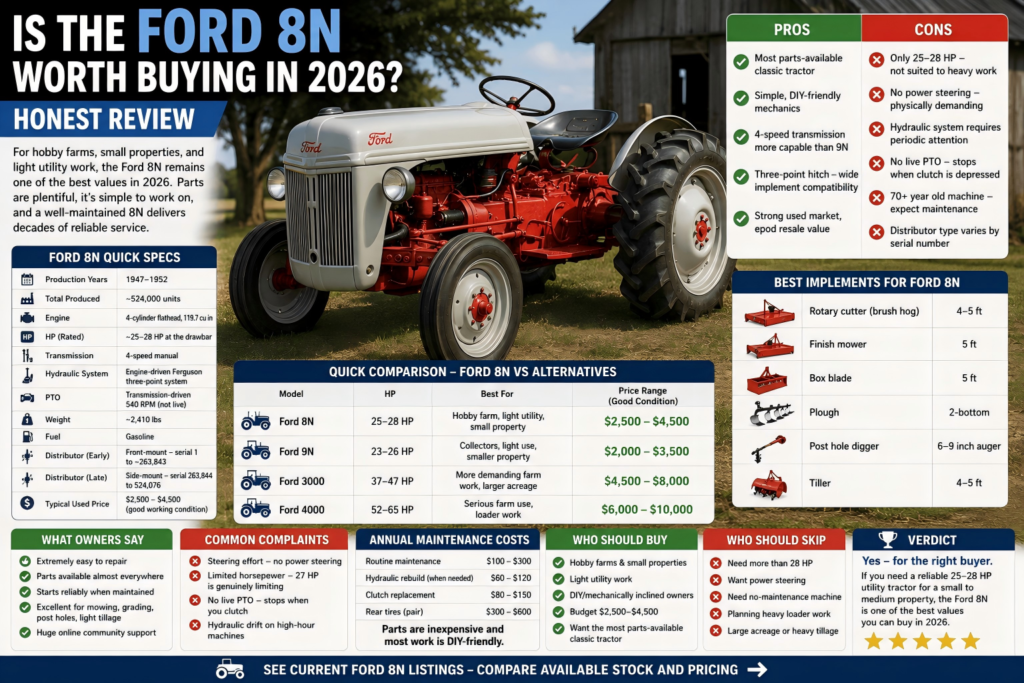
Is Ford 8N Worth It — What It Does Well
Parts availability — the biggest practical advantage in 2026
Over 524,000 Ford 8N tractors were built between 1947 and 1952 — more than any other classic Ford model. That production volume created a parts ecosystem that has never dried up. In 2026, virtually every mechanical component on a Ford 8N is still available new: carburettors, pistons, rings, gasket sets, hydraulic lift cover kits, clutch discs, brake linings, steering components, and body panels. Multiple aftermarket suppliers stock comprehensive 8N parts catalogues — Steiner Tractor Parts is one of the most well-known sources for N-Series components.
Most common buyer positive: owners who have maintained their own 8N for years consistently cite parts availability as the reason they would buy one again. A breakdown mid-season rarely means weeks of waiting — most parts arrive within days.
DIY-friendly simplicity
The Ford 8N flathead engine and mechanical systems are among the most owner-serviceable of any tractor ever built. No electronics, no complex hydraulic control systems, no specialist tools required for most maintenance. A mechanically inclined owner with basic tools can perform the majority of service tasks — oil changes, carburetor rebuilds, ignition timing, hydraulic lift cover rebuilds — from available service manuals without dealer involvement.
Most common buyer feedback: first-time tractor owners who chose an 8N specifically because it was workable for someone learning mechanical maintenance. The simplicity is a feature, not a limitation.
Three-point hitch — wide implement compatibility
The Ford 8N was the machine that popularised the Ferguson three-point hitch system in the US market. That system is now the global standard — which means an enormous range of implements designed and built over the past 70+ years are compatible with an 8N. Box blades, rotary tillers, post hole diggers, ploughs, disc harrows, and mowers all connect directly to a standard Category 1 three-point hitch.
What implements work well on a Ford 8N?
The 8N’s Category 1 three-point hitch and 540 RPM PTO are compatible with a wide range of implements sized appropriately for 25–28 HP:
- 4–5 ft rotary cutter (brush hog) — well within the 8N’s capability on standard vegetation
- 4–5 ft finish mower — one of the most common and effective 8N pairings
- 5 ft box blade — ideal for grading driveways and levelling ground
- 2-bottom plough — the practical limit for the 8N in most soil conditions
- 6–9 inch post hole digger — works well in soft to medium ground; larger augers in hard ground will strain the engine
- 4–5 ft tiller — adequate in prepared soil; heavy primary tillage on unbroken ground is at the edge of the 8N’s power
Avoid implements sized for 40+ HP tractors — oversized implements push the 8N beyond its power rating and accelerate wear on the engine and hydraulic system.
Resale value — holds well for a maintained example
A well-maintained Ford 8N sells relatively quickly on the used market. Based on observed listings across 2024–2026, clean examples in good working condition consistently list at $2,500–$4,500 and move. A fully restored example commands $5,000–$8,000+. The broad buyer pool — hobby farmers, collectors, property owners — means the machine is never hard to sell when properly maintained.
👉 View current Ford 8N listings — see available stock and pricing →
Is the Ford 8N Worth It — What It Doesn’t Do Well
Horsepower — 25–28 HP has real limits
The Ford 8N produces approximately 25–28 HP at the drawbar. For mowing, light tilling, post hole digging on soft ground, and general property maintenance — it is sufficient. For heavy tillage, loader work on firm ground, large-diameter post hole digging, or working with larger implements — the 8N struggles. Pushing the machine beyond its power rating consistently is the fastest way to accelerate wear on the engine and hydraulics.
If your work regularly exceeds what 25–28 HP can handle, the Ford 3000 (37–47 HP) or Ford 4000 (52–65 HP) is the more appropriate machine. More power at a higher price, but the right tool for heavier demands.
No power steering
The Ford 8N has no power steering. On hard or rough ground, particularly when using front implements or a loader (if fitted), steering requires real physical effort. For occasional light use this is manageable. For long daily sessions on demanding terrain, operator fatigue becomes a real consideration — particularly for buyers who are not used to manual steering on a tractor.
Hydraulic system — requires periodic attention
The N-Series hydraulic system is reliable when maintained but does require periodic attention. The most common issue: worn lift cover pistons and control valves that cause slow lift and hitch drift. Rebuild kits are inexpensive and widely available, and the repair is DIY-friendly — but buyers who want a machine that requires nothing should factor this in. A hitch that drifts slowly downward under load is the most common hydraulic complaint on high-hour 8N machines.
Age — 70+ year old machine
The newest Ford 8N was built in 1952. Every example you encounter has had 70+ years of use, storage, previous owners, and varying maintenance. That is not a reason to avoid the 8N — parts availability and mechanical simplicity make it very maintainable — but it does mean every purchase requires a proper inspection. See our complete Used Ford Tractor Inspection Checklist before buying any classic Ford.
What Ford 8N Owners Actually Say
What owners consistently praise:
- Extremely easy to repair — most jobs can be done with basic hand tools and a service manual
- Parts available almost everywhere — online, local dealers, farm stores — rarely waiting more than a few days for anything
- Starts reliably when properly maintained — a tuned 8N with fresh points, plugs, and a good battery is a dependable machine
- Excellent for mowing, box blade work, and small-acreage utility tasks — does exactly what most small property owners need
- Community support — the Ford 8N has one of the largest online enthusiast communities of any classic tractor, meaning free advice and guidance is widely available
Common complaints:
- Steering effort — no power steering makes long sessions on rough ground physically tiring
- Limited horsepower — 27 HP is genuinely limiting for heavy tillage or serious loader work
- No live PTO — the transmission-driven PTO stopping when you clutch is noticed most by operators switching from more modern machines
- Hydraulic drift — worn lift cover components on high-hour machines cause the hitch to drift slowly downward, affecting implement depth control
Real Ownership Costs
| Item | Cost | When |
|---|---|---|
| Engine oil change | $15–$25 | Every 100 hours or annually |
| Carburetor rebuild kit | $25–$50 | Every few years or when needed |
| Ignition tune-up (points, plugs, condenser) | $30–$60 | Every 2–3 years |
| Hydraulic lift cover rebuild kit | $60–$120 | When hitch drifts or lifts slowly |
| Rear axle seal replacement | $20–$40 parts | As needed — common on older examples |
| Clutch disc replacement | $80–$150 parts | Every 500–1,000+ hours depending on use |
| Rear tyre replacement (pair) | $300–$600 fitted | As needed — check sidewalls for cracking |
| Annual maintenance estimate | $100–$300 | Routine — varies with use intensity |
The Ford 8N is one of the more affordable classic tractors to maintain. Parts are cheap relative to most alternatives, and most work is DIY-friendly for a mechanically confident owner. Budget $100–$300 per year for routine maintenance on a regularly used machine.
Ford 8N Fuel Consumption — What to Expect
| Work Type | Estimated Fuel Use | Notes |
|---|---|---|
| Light mowing (finish mower) | ~0.5–0.8 gal/hr | Light load on the engine — most efficient use |
| Rotary cutting (brush hog) | ~0.8–1.2 gal/hr | Varies with grass density and ground speed |
| Light tillage (disc, tiller) | ~1.0–1.5 gal/hr | Engine under consistent load |
| Ploughing (2-bottom plough) | ~1.2–1.8 gal/hr | Near maximum engine load — heaviest fuel draw |
| General property work | ~0.7–1.2 gal/hr | Average across varied light tasks |
The Ford 8N runs on regular pump gasoline. At modern fuel prices, expect to spend $4–$8 per hour of operation depending on work intensity — modest running cost for the utility delivered on a small property.
New vs Used — What’s the Right Call on a Ford 8N?
The Ford 8N has not been in production since 1952 — every available machine is used by definition. What varies is condition:
- Running, needs work ($1,000–$2,000) — starts and runs but has known issues. Good for a mechanically confident buyer who wants a project and will do their own repairs. Factor the repair cost into the total before purchasing
- Good working condition ($2,500–$4,500) — the sweet spot for most buyers. Starts reliably, lifts its hitch, shifts cleanly, no immediate major repairs needed. The machine most buyers should be targeting
- Fully restored ($5,000–$8,000+) — cosmetically and mechanically restored to a high standard. Worth the premium if you want a showpiece or a machine you don’t want to work on. The premium over a solid working machine is significant — evaluate whether it is justified for your use
Key checks before any purchase: oil condition, cold start, exhaust smoke colour, hydraulic hitch lift and hold, clutch engagement, and brake pedal travel. Full guidance in our Used Ford Tractor Inspection Checklist →
7 Common Ford 8N Buying Mistakes
- Buying for cosmetics, ignoring mechanicals — a freshly painted 8N with a slipping clutch and drifting hydraulics costs more to own than an honest-looking machine with service records. Paint is cheap; hydraulic rebuilds are not
- Not testing the hydraulics cold — hydraulic hitch drift is one of the most common 8N issues and is most visible on a cold machine. Always raise the hitch to full height and hold it there for 5 minutes — a hitch that drifts down significantly indicates worn lift cover components
- Buying without a cold start — always insist on starting the tractor cold. A seller who pre-warms the engine before your arrival is hiding something — hard cold starts, smoke, or oil pressure issues are what a warm engine conceals
- Ignoring oil pressure — watch the oil pressure gauge on startup. Slow build or low reading at idle after warmup is a serious sign of engine wear
- Overlooking rear tyre condition — rear tyres on a 70-year-old machine often have cracked sidewalls from age and UV exposure even when tread looks adequate. A pair of rear tyres costs $300–$600 fitted — factor it into any offer where sidewall cracking is visible
- Ignoring steering play — excessive steering play (more than 2–3 inches at the wheel rim) makes the machine unpleasant and less safe to operate. Steering component wear is common and parts are available, but it is a negotiating point, not something to overlook
- Not checking the serial number — the serial number confirms the production year and distributor type (front-mount vs side-mount), which affects parts ordering. A seller who can’t or won’t show you the serial number is a red flag. Full serial number guide: Ford Tractor Serial Numbers →
Who Should Buy the Ford 8N
- ✅ Hobby farm or small property up to 50 acres
- ✅ Light utility work — mowing, tilling, post holes, box blade work
- ✅ First-time tractor owner who wants a DIY-friendly machine
- ✅ Buyer with a $2,500–$4,500 budget for a good working example
- ✅ Anyone who wants the most parts-available classic tractor on the market
- ✅ Collector — strong used market, recognisable model, good resale
Who Should Skip the Ford 8N
- ❌ Need more than 28 HP — the Ford 3000 or Ford 4000 is more appropriate
- ❌ Want power steering — the 8N has none
- ❌ Need a machine that requires no mechanical attention — classic tractors need maintenance
- ❌ Plan to use a heavy front loader — the 8N frame is not designed for heavy loader use
- ❌ Large acreage or heavy tillage — the Ford 5000 is more appropriate
Ford 8N Parts Availability — Where to Source in 2026
The Ford 8N’s long production run and large owner base has created a robust aftermarket parts supply that remains active in 2026. Key sources:
- Steiner Tractor Parts — one of the most comprehensive N-Series catalogues available, covering engine, hydraulic, electrical, and sheet metal components
- Yesterday’s Tractors — strong online community and parts marketplace specifically focused on classic Ford and Ferguson tractors
- Sparex — UK-based supplier with broad Ford Thousand Series and N-Series coverage, useful for international buyers
- Tisco / All States Ag Parts — competitive aftermarket pricing on common wear items — gasket sets, seals, filters, belts
- New Holland dealers — some original Ford tractor parts are still available through the New Holland network (Ford’s tractor line was absorbed into New Holland)
For most common maintenance items — carburettor kits, hydraulic lift cover rebuild kits, ignition components, clutch discs, and brake linings — multiple sources stock the part and shipping is typically 2–5 days. The Ford 8N is not a machine where you wait weeks for parts.
Best Ford 8N Attachments — Recommended Sizes
| Attachment | Recommended Size | Notes |
|---|---|---|
| Rotary cutter (brush hog) | 4–5 ft | 5 ft is the practical limit at 27 HP in heavy brush |
| Finish mower | 5 ft | One of the most natural 8N pairings — well within power range |
| Box blade | 5 ft | Ideal for driveway grading and levelling |
| Rear blade | 6 ft | Good for snow and light grading — stays within HP range |
| Disc harrow | 5–6 ft | In prepared soil; heavy primary tillage in unbroken ground is at the HP limit |
| Plough | 2-bottom | Practical limit in most soil conditions |
| Post hole digger | 6–9 inch auger | Works well in soft to medium ground; larger augers in hard ground strain the engine |
| Tiller | 4–5 ft | Adequate in prepared soil |
| Carry-all / cargo frame | Category 1 | Useful for moving materials around a small property |
Safety Considerations — What Every Ford 8N Owner Should Know
The Ford 8N was designed and built decades before modern tractor safety standards. Every owner and operator should be aware of the following:
- No ROPS (Roll-Over Protective Structure) — the Ford 8N was never equipped with a safety cab or roll bar from the factory. Aftermarket ROPS frames are available and strongly recommended for any operation on sloped ground
- No seat belt — in the absence of ROPS, a seat belt provides no protection and increases rollover risk by trapping the operator. Do not add a seat belt without also fitting ROPS
- High rollover risk on slopes — the 8N’s narrow front axle and relatively high centre of gravity make side rollover a real risk on terrain above 15–20°. Never operate sideways across a steep slope
- PTO safety — the 8N’s exposed PTO shaft is a serious entanglement hazard. Keep the PTO shield in place whenever the PTO is not connected to an implement. Loose clothing, strings, and straps near an unshielded spinning PTO shaft are a documented cause of serious injury
- No live PTO — because the 8N uses a transmission-driven PTO, the PTO shaft stops spinning when the clutch is depressed. Operators used to live PTO machines should note this difference — implements will stop mid-operation when clutching for a gear change
Verdict — Is the Ford 8N Worth It?
Is the Ford 8N worth it in 2026? Yes — for the right buyer, without much qualification. It is the most parts-available classic tractor on the market, mechanically simple enough for a confident DIY owner to maintain, and priced accessibly enough that a good working example represents genuine value for hobby farm and small property use. The 70+ year age is not the concern it would be on a less well-supported machine — the parts ecosystem around the 8N is robust enough to keep well-maintained examples running indefinitely.
If you need more power — buy the Ford 3000 or 4000. If you want power steering — look at something more modern. But if you need a reliable 25–28 HP utility tractor for a small to medium property and want the most supportable classic machine available — the Ford 8N earns its recommendation in 2026 as it has every year since 1947.
👉 See current Ford 8N listings — compare available stock and pricing →
Frequently Asked Questions
Is a Ford 8N a good tractor to buy?
Yes — for hobby farms, small properties, and light utility work. The Ford 8N is the most parts-available classic tractor on the market, mechanically simple enough for DIY maintenance, and priced accessibly for a good working example. The main limitations are horsepower (25–28 HP) and no power steering. For buyers whose work stays within those limits, the 8N is a reliable and practical purchase.
How much is a Ford 8N tractor worth in 2026?
A Ford 8N in good working condition typically lists between $2,500 and $4,500. Running examples that need work list from $1,000–$2,000. Fully restored examples with high-quality mechanical and cosmetic work command $5,000–$8,000+. Prices vary by region, condition, and what implements are included. Verify current listings on TractorHouse before negotiating.
What are common Ford 8N problems?
The most common issues on used Ford 8N tractors are: hydraulic lift cover wear (slow hitch lift, hitch drift under load), rear axle oil seal leaks, ignition timing issues — front-mount distributor models (serial 1–263,843) require the distributor to be removed from the engine for timing, which is more involved than the side-mount procedure on later models, and piston ring wear from sitting with old oil causing blue exhaust smoke. All are repairable with widely available, inexpensive parts.
How many hours will a Ford 8N last?
A well-maintained Ford 8N can run for thousands of hours — many examples still working today have accumulated well over 5,000 hours across multiple decades. The flathead engine and simple drivetrain respond well to regular oil changes and basic maintenance. Condition and maintenance history matter far more than any hour reading on these machines.
Ford 8N vs Ford 9N — which should I buy?
The 8N in almost every practical situation. It has a 4-speed transmission versus the 9N’s 3-speed, improved hydraulics, and better parts availability due to higher production numbers. The 9N has collector appeal as the first Ford tractor, but for a working machine the 8N is the stronger choice. For a full comparison see our Ford 9N vs Ford 8N guide →