The Ford 4000 vs Ford 5000 comparison is the top-of-range decision in the classic Ford Thousand Series lineup. Both machines share live PTO, live hydraulics, and gear drive transmissions — but the 5000 delivers 65–75 HP versus the 4000’s 52–65 HP, a significantly heavier frame, power steering fitted on many configurations, and better loader capability for sustained heavy use. The premium is real, and so is the capability difference. This guide cuts through the specs to tell you which machine your actual farm work justifies.
👉 Browse our current Ford tractor inventory →
Written by: Farmers Equipment editorial team — specialising in classic Ford tractors from the N-Series through the Thousand Series.
Ford 4000 vs Ford 5000 — Quick Decision
Buy the Ford 4000 if: your farm is 40–75 acres with varied work, your implements are sized comfortably within 52–65 HP, you don’t need daily heavy loader use, and the 4000’s $1,500–$3,000 price advantage matters to your budget.
Buy the Ford 5000 if: you use a front loader daily, you run large hay equipment all day, you need 65–75 HP for heavy tillage or large implements, or all-day power steering comfort is a priority.
Ford 4000 vs Ford 5000 — At a Glance
| If you… | Buy |
|---|---|
| Farm 40–60 acres with varied work | Ford 4000 |
| Farm 60–100 acres with heavy regular work | Ford 5000 |
| Move round bales daily | Ford 5000 |
| Mostly mow, grade, and light tillage | Ford 4000 |
| Want lower purchase and operating costs | Ford 4000 |
| Need maximum PTO power for large hay equipment | Ford 5000 |
| Need better manoeuvrability in tight spaces | Ford 4000 |
| Daily heavy loader work | Ford 5000 |
| Want power steering most likely already fitted | Ford 5000 |
Ford 4000 vs Ford 5000 — Full Specification Comparison
| Specification | Ford 4000 | Ford 5000 | Advantage |
|---|---|---|---|
| Production years | 1962–1975 | 1964–1975 | — |
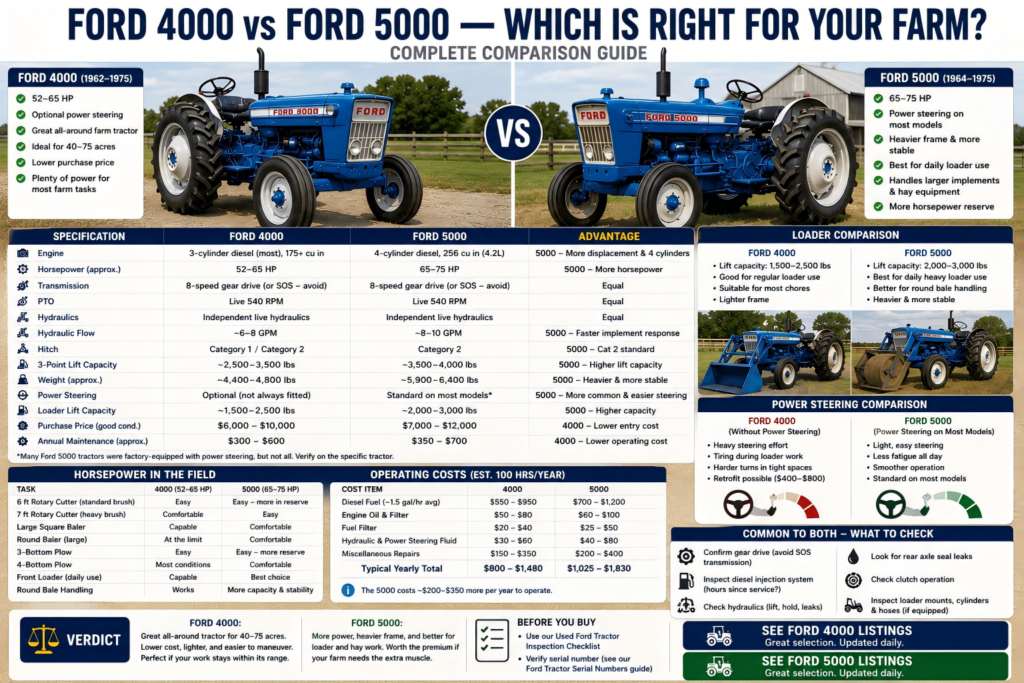
| Engine | 3-cylinder diesel (most), 175+ cu in | 4-cylinder diesel, 256 cu in (4.2L) | 5000 — larger displacement, more cylinders |
| HP | ~52–65 HP | ~65–75 HP | 5000 — meaningful advantage |
| Transmission | 8-speed gear drive (or SOS — avoid) | 8-speed gear drive (or SOS — avoid) | Equal |
| PTO | Live 540 RPM | Live 540 RPM | Equal |
| Hydraulics | Independent live | Independent live | Equal |
| Hydraulic flow | ~6–8 GPM | ~8–10 GPM | 5000 — faster implement response |
| Hitch | Category 1 / Category 2 | Category 2 | 5000 — Category 2 standard |
| 3-point rear lift capacity | ~2,500–3,500 lbs | ~3,500–4,000 lbs | 5000 — higher capacity |
| Weight | ~4,400–4,800 lbs | ~5,900–6,400 lbs | 5000 — substantially heavier frame |
| Power steering | Optional — not always fitted | Standard on most configurations | 5000 — significant advantage for daily use |
| Loader lift capacity | ~1,500–2,500 lbs | ~2,000–3,000 lbs | 5000 — more capable |
| Purchase price (good condition) | $6,000–$10,000 | $7,000–$12,000 | 4000 — lower entry cost |
| Annual maintenance | $300–$600 | $350–$700 | 4000 — modestly lower |
The Power Steering Difference — More Important Than It Sounds
Many Ford 5000 tractors were factory-equipped with power steering, and it is much more common on the 5000 than on the 4000. However, not every Ford 5000 left the factory with power steering — buyers should verify the equipment on the specific machine they are considering. Power steering was optional on the 4000, and many 4000 machines on the market do not have it. For buyers considering these machines for daily work, this difference deserves more attention than the HP gap:
| Factor | Ford 4000 (no power steering) | Ford 5000 (power steering — verify fitted) |
|---|---|---|
| Loader work (full day) | Physically demanding — significant steering effort per cycle | Comfortable — minimal steering effort throughout |
| Tight headland turns | Requires full arm effort in heavy soil or at slow speed | Light effort regardless of conditions |
| Road transport | Manageable at speed, heavy at low speed | Comfortable at all speeds |
| Older operator or physical limitation | Can become fatiguing | Not a physical demand |
| Adding power steering retrofit | Possible — $400–$800 parts plus labour | Already fitted |
Owners who upgrade from a 4000 without power steering to a 5000 consistently describe the power steering as the biggest quality-of-life improvement — larger than the HP increase. If the 4000 you are considering has power steering fitted, this gap narrows considerably. If it does not, factor either the retrofit cost or the physical reality of manual steering into your decision.
Horsepower — What the Difference Means in the Field
| Task | Ford 4000 (52–65 HP) | Ford 5000 (65–75 HP) |
|---|---|---|
| 6 ft rotary cutter, standard brush | ✅ Easy | ✅ Easy — more in reserve |
| 7 ft rotary cutter, heavy brush | ✅ Comfortable | ✅ Easy |
| 7 ft rotary cutter, dense material all day | ⚠️ Pushing upper limit | ✅ Comfortable |
| Small square baler | ✅ Works well | ✅ Easy |
| Large square baler | ✅ Capable | ✅ Comfortable |
| Round baler (medium) | ✅ Good | ✅ Easy |
| Round baler (large) | ⚠️ At the limit | ✅ Comfortable |
| 3-bottom plough | ✅ Easy | ✅ Easy — more reserve |
| 4-bottom plough | ✅ Most conditions | ✅ Comfortable most conditions |
| 7–8 ft disc harrow | ✅ Good in worked soil | ✅ Good in most conditions |
| Front loader (regular heavy use) | ✅ Capable | ✅ Best classic Ford for loader |
| Round bale handling with bale spear | ✅ Works | ✅ More capacity and stability |
The HP gap between the 4000 and 5000 is smaller than the gap between the 3000 and 4000 — both machines are capable tractors, and the 4000 handles most demanding farm work without strain. The 5000’s HP advantage shows most clearly in sustained heavy brush clearing, large round baler use, and situations where the 4000 is working at high throttle for extended periods.
Owners who upgraded from a 4000 to a 5000 for large hay operations specifically note that the 5000 maintains PTO speed more consistently under heavy baler load — the HP reserve translates directly into more consistent bale formation quality on demanding crop conditions.
Loader Comparison
| Loader Factor | Ford 4000 | Ford 5000 |
|---|---|---|
| Lift capacity at height | ~1,500–2,500 lbs | ~2,000–3,000 lbs |
| Frame suitability for daily cycles | Good — handles regular loader use | Best — heaviest classic Ford frame |
| Round bale handling | ✅ Yes — within rated capacity | ✅ Yes — more capacity and stability |
| Heavy material (wet soil, gravel, silage) | ✅ Good within capacity | ✅ Higher capacity |
| Steering effort during loader cycles | Physical if no power steering | Minimal — power steering on most examples |
| Rear counterbalance | Good with ballast weight | Better — heavier machine naturally |
For buyers whose primary use case is a front loader — particularly if daily loader cycles are involved — the 5000 is the stronger choice. The combination of higher frame weight, more HP, higher lift capacity, and power steering on most examples makes it noticeably more capable and less fatiguing for sustained loader work than the 4000.
Operating Costs Comparison
| Annual Cost Item | Ford 4000 | Ford 5000 |
|---|---|---|
| Diesel fuel (est. 100 hrs/year at ~1.5 gal/hr avg) | $550–$950 | $700–$1,200 |
| Engine oil and filter | $50–$80 | $60–$100 |
| Fuel filter | $20–$40 | $25–$50 |
| Hydraulic and power steering fluid | $30–$60 | $40–$80 |
| Miscellaneous repairs | $150–$350 | $200–$400 |
| Typical yearly total | $800–$1,480 | $1,025–$1,830 |
Check current asking prices on TractorHouse before negotiating — regional variation on Thousand Series machines is significant. The annual cost difference is modest — roughly $200–$350 more per year on the 5000. Over a 10-year ownership period that is $2,000–$3,500 additional running cost — comparable to the purchase price premium. For a machine used 150+ hours per season on a working farm, the 5000’s fuel consumption at higher HP means the gap widens with heavier use.
Which to Buy — Decision Guide by Scenario
| Your Situation | Best Choice | Why |
|---|---|---|
| 40–75 acres, varied work, no daily loader | Ford 4000 | Covers the task list — no need for 5000 premium |
| 4000 has power steering fitted | Ford 4000 | Main 5000 advantage already addressed — strong buy |
| Daily front loader use | Ford 5000 | Power steering + heavier frame + more HP = far better loader tractor |
| Large hay operation — round balers, tedders | Ford 5000 | HP reserve and consistent PTO speed under heavy baler load |
| Heavy tillage — regular 4-bottom ploughing | Ford 5000 | More HP reserve for sustained heavy draw |
| 50+ acres with demanding regular work | Ford 5000 | At this scale and intensity, the 5000 is the appropriate machine |
| Budget under $8,000 | Ford 4000 | A good 5000 starts at $7,000+ — 4000 is the right buy at this budget |
| Older operator, physical fatigue a concern | Ford 5000 | Power steering makes all-day work significantly less demanding |
| Need maximum manoeuvrability | Ford 4000 | Lighter machine is easier to work in tight spaces |
What to Check When Comparing Specific Machines
- Transmission type first — confirm gear drive on whichever model you inspect. Select-O-Speed on a 4000 or 5000 is the most expensive mistake in classic Ford buying. Both models had the SOS option and both have the same serious failure mode
- Power steering on the 4000 — confirm whether the specific 4000 you are inspecting has power steering. A 4000 with power steering narrows the gap with the 5000 considerably
- Injection system condition on both — ask when last serviced professionally. The 5000’s 4-cylinder diesel injection system is not dramatically more expensive to service than the 4000’s, but both require periodic professional attention
- Loader mounting condition — on loader-equipped machines, inspect all mounting brackets, pins, cylinders, and hoses regardless of model. A good loader adds real value; an unknown adaptation needs thorough evaluation
See our full Used Ford Tractor Inspection Checklist before purchasing either model.
Verdict — Ford 4000 vs Ford 5000
The Ford 4000 vs Ford 5000 decision has a cleaner answer than most classic tractor comparisons. The 4000 is the right machine for farms of 40–75 acres doing varied work within its HP range — particularly if power steering is already fitted. The 5000 earns its premium when loader use is daily and heavy, hay operations run large round balers or tedders all season, or when the 4000 is consistently working at high throttle for extended periods.
One practical shortcut: if the 4000 you are considering has power steering, it is a strong buy for most working farms and the 5000’s advantage narrows to HP and frame weight alone. If it does not have power steering, either budget for the retrofit or take the 5000 seriously — because a full day of loader work on a manual steering 4000 is a genuinely different physical experience from the 5000.
Individual model reviews: Ford 4000 review · Ford 5000 review · Best Ford Tractor for a Small Farm →
Stepping down the range: Ford 3000 vs Ford 4000 · Ford 8N vs Ford 3000 →
Before any purchase: Used Ford Tractor Inspection Checklist · Ford Tractor Serial Numbers →
👉 See Ford 4000 listings · See Ford 5000 listings →
Frequently Asked Questions
What is the difference between a Ford 4000 and Ford 5000 tractor?
The Ford 5000 produces 65–75 HP versus the 4000’s 52–65 HP, has a substantially heavier frame (~5,900–6,400 lbs vs ~4,400–4,800 lbs), higher loader capacity (~2,000–3,000 lbs vs ~1,500–2,500 lbs), higher hydraulic flow (~8–10 GPM vs ~6–8 GPM), and power steering fitted on many configurations versus optional on the 4000. Both share live PTO, live hydraulics, and 8-speed gear drive. The 5000 costs $1,500–$3,000 more than a comparable 4000.
Which is better for loader work — Ford 4000 or Ford 5000?
The Ford 5000 is the better loader tractor — heavier frame, higher lift capacity, more HP, and power steering on most configurations. The combination makes it noticeably more capable and less fatiguing for sustained daily loader work. The 4000 handles a front loader well for regular farm use; the 5000 is the correct choice when loader use is daily and heavy or when round bale handling is a regular requirement.
Does the Ford 5000 have power steering?
Power steering is standard on most Ford 5000 configurations. It was optional on the Ford 4000 — and many 4000 machines on the market do not have it. This is one of the most practically significant differences between the two models for buyers who plan daily loader work or long working days on the tractor.
How much does a Ford 5000 cost compared to a Ford 4000?
A Ford 4000 in good working condition (gear drive diesel) typically sells for $6,000–$10,000. A comparable Ford 5000 typically sells for $7,000–$12,000 — a premium of approximately $1,500–$3,000. Check current listings on TractorHouse for regional pricing before negotiating, as variation is significant.
Is the Ford 4000 or Ford 5000 better for hay work?
Both machines handle standard hay work well — tedding, raking, and square baling are within the 4000’s range. The 5000 becomes the clear choice for large round balers where consistent HP delivery under heavy baler load matters, and for operations running large equipment all day where HP reserve prevents the tractor from being worked at maximum throttle continuously. For most small to medium hay operations, the 4000 is sufficient.