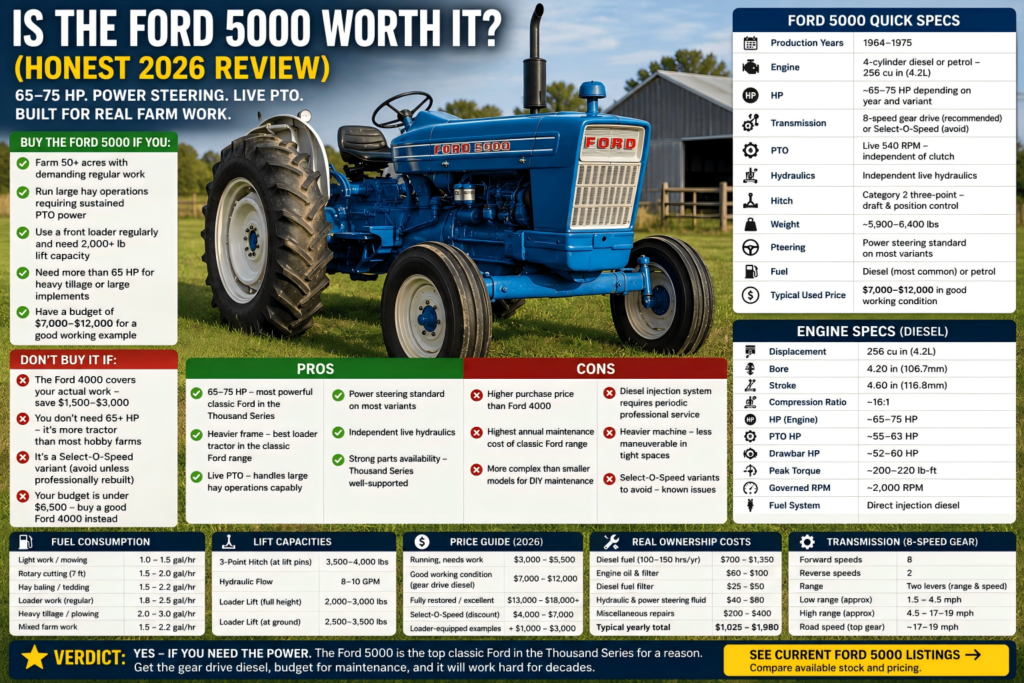
Is Ford 5000 worth it in 2026? For farms that genuinely need 65–75 HP — running large hay operations, frequent front loader work, heavy tillage, or demanding daily farm tasks — yes. The Ford 5000 is the most powerful classic Ford in the Thousand Series range, built on a heavier frame than the 4000, and capable of handling implements and workloads that push the smaller models to their limits. It costs more to buy and more to maintain than the 4000, and parts availability — while still good — is slightly narrower than the most common Thousand Series models. But for the farm it was designed for, the Ford 5000 earns its price in 2026 as it has for six decades.
👉 Check current Ford 5000 listings — see available stock and pricing →
Written by: Farmers Equipment editorial team — specialising in classic Ford tractors from the N-Series through the Thousand Series.
Buy the Ford 5000 if you:
✅ Farm 50+ acres with demanding regular work
✅ Run large hay operations requiring sustained PTO power
✅ Use a front loader regularly and need 2,000+ lb lift capacity
✅ Need more than 65 HP for heavy tillage or large implements
✅ Have a budget of $7,000–$12,000 for a good working example
❌ Don’t buy it if the Ford 4000 covers your actual work — save $1,500–$3,000
❌ Don’t buy it for a small property — it is more tractor than most hobby farms need
Is Ford 5000 Worth It — Pros and Cons
| ✅ Pros | ⚠️ Cons |
|---|---|
| 65–75 HP — most powerful classic Ford in the Thousand Series | Higher purchase price than Ford 4000 |
| Heavier frame — best loader tractor in the classic Ford range | Highest annual maintenance cost of classic Ford range |
| Live PTO — handles large hay operations capably | More complex than smaller models for DIY maintenance |
| Power steering standard on most variants | Diesel injection system requires periodic professional service |
| Independent live hydraulics | Heavier machine — less manoeuvrable in tight spaces |
| Strong parts availability — Thousand Series well-supported | Select-O-Speed variants to avoid — same warning as 3000 and 4000 |
Ford 5000 Quick Specs
| Specification | Detail |
|---|---|
| Production years | 1964–1975 |
| Engine | 4-cylinder diesel or petrol — 256 cu in (4.2L) |
| HP | ~65–75 HP depending on year and variant |
| Transmission | 8-speed gear drive (recommended) or Select-O-Speed (avoid) |
| PTO | Live 540 RPM — independent of clutch |
| Hydraulic system | Independent live hydraulics |
| Hitch | Category 2 three-point — draft and position control |
| Weight | ~5,900–6,400 lbs depending on configuration |
| Steering | Power steering standard on most variants |
| Fuel | Diesel (most common) or petrol |
| Typical used price | $7,000–$12,000 in good working condition |
Ford 5000 Engine Specifications — Full Details
| Specification | Detail |
|---|---|
| Engine type | 4-cylinder inline diesel (or petrol on some variants) |
| Displacement | 256 cu in (4.2 litres) |
| Bore | 4.20 inch (106.7mm) |
| Stroke | 4.60 inch (116.8mm) |
| Compression ratio | Approximately 16:1 (diesel) |
| Engine HP (rated) | ~65–75 HP depending on year |
| PTO HP | ~55–63 HP (approximately 83–84% of engine HP) |
| Drawbar HP | ~52–60 HP (varies with tyre and surface conditions) |
| Peak torque | Approximately 200–220 lb-ft at mid-range RPM |
| Governed RPM | ~2,000 RPM |
| Cooling | Water-cooled |
| Fuel system | Direct injection diesel (most common) |
Specifications vary by production year and market variant. Verify against original Ford documentation for your specific serial number where precision is required.
How Many Horsepower Is a Ford 5000?
The Ford 5000 produces approximately 65–75 HP depending on the year and specific engine configuration. Early 5000 models (1964–1968) produced approximately 65 HP. Later Thousand Series models (1968–1975) were rated at closer to 75 HP with engine refinements. Always verify the specific year and configuration when making implement sizing decisions — the difference between 65 and 75 HP is meaningful for large implement selection.
Is the Ford 5000 a Good Tractor?
Yes — and owners consistently confirm it. The Ford 5000 occupies the top of the classic Ford Thousand Series range and was built for full-day demanding farm work. Its 4-cylinder diesel engine is known for durability and fuel efficiency relative to its output. The heavier frame compared to the 4000 makes it a genuinely better loader tractor — the additional weight improves rear counterbalance under load and the frame handles loader forces more comfortably over sustained use.
Owners who run the Ford 5000 for hay operations specifically note that the combination of live PTO, adequate HP reserve, and power steering makes it one of the most capable classic Ford configurations for that purpose. Running a square baler, tedder, or round baler on a field all day is exactly the workload the 5000 was designed for.
Ford 5000 Reliability Ratings
| Category | Rating | Notes |
|---|---|---|
| Engine reliability (diesel) | ⭐⭐⭐⭐⭐ | 4-cylinder diesel — proven durable across decades of farm use |
| Transmission (gear drive) | ⭐⭐⭐⭐⭐ | 8-speed gear drive is robust and long-lived at this HP |
| Transmission (Select-O-Speed) | ⭐⭐☆☆☆ | Known issues — avoid without documented professional rebuild |
| Hydraulic system | ⭐⭐⭐⭐☆ | Independent live system — reliable when serviced |
| Loader suitability | ⭐⭐⭐⭐⭐ | Best classic Ford for regular loader use — heavier frame advantage |
| Power steering | ⭐⭐⭐⭐☆ | Standard on most — check for leaks and response at inspection |
| Parts availability | ⭐⭐⭐⭐☆ | Good — slightly narrower than Ford 4000 but well-supported |
| Ease of DIY repair | ⭐⭐⭐☆☆ | More complex than smaller models — diesel injection is specialist territory |
| Overall value (gear drive diesel) | ⭐⭐⭐⭐⭐ | Best classic Ford for 50+ acre farms with heavy regular work |
Ford 5000 Transmission — 8-Speed Gear Drive Details
The 8-speed gear drive transmission is the configuration to seek on the Ford 5000. Here is what it provides:
| Feature | Detail |
|---|---|
| Forward speeds | 8 |
| Reverse speeds | 2 |
| Synchronised gears | No — non-synchronised, requires clutch for all changes |
| Gear selection | Two levers — range and speed selectors |
| Low range speeds (approx) | 1.5 – 4.5 mph |
| High range speeds (approx) | 4.5 – 17–19 mph |
| Typical field working speed | 2nd–5th gear depending on implement and conditions |
| Road travel | 7th or 8th gear — 14–19 mph depending on tyre size |
The 8-speed provides well-spaced ratios that cover both slow implement work and field transport efficiently. The absence of synchronisation means all gear changes require a full clutch depression — experienced operators work around this naturally, but buyers coming from synchronised transmissions should be aware of the difference.
The Select-O-Speed (SOS) alternative allowed on-the-go gear changes under load — theoretically useful, practically troubled. Avoid without a documented professional rebuild.
Ford 5000 vs Ford 4000 — Which Should You Buy?
| Feature | Ford 5000 | Ford 4000 | Verdict |
|---|---|---|---|
| HP | 65–75 HP | 52–65 HP | 5000 — meaningful advantage for heavy implements |
| Frame weight | ~5,900–6,400 lbs | ~4,400–4,800 lbs | 5000 — better loader stability |
| Loader capacity | ~2,000–3,000 lbs | ~1,500–2,500 lbs | 5000 — higher rated capacity |
| Power steering | Standard (most) | Optional | 5000 — significant comfort advantage |
| Live PTO | Yes | Yes | Equal |
| Hydraulics | Independent live | Independent live | Equal |
| Purchase price | $7,000–$12,000 | $6,000–$10,000 | 4000 — lower entry cost |
| Annual maintenance | $350–$700 | $300–$600 | 4000 — modestly lower |
| Manoeuvrability | Heavier — less nimble in tight spaces | More manoeuvrable | 4000 — easier to work in confined areas |
| Best acreage | 50+ acres | 40–75 acres | Match to your property |
Buy the 5000 if: power steering is important to you, your loader work is frequent and heavy, your hay operation runs large equipment, or you consistently need more than 65 HP. Buy the 4000 if: your work is within the 4000’s HP range, you need more manoeuvrability, or the price difference matters. See our full Ford 4000 review for direct comparison.
Ford 5000 Lifting Capacity
| Capacity Type | Specification | Notes |
|---|---|---|
| Three-point hitch rear lift | ~3,500–4,000 lbs (at hitch) | Category 2 hitch — higher capacity than Category 1 models |
| Hydraulic flow | ~8–10 GPM | Independent live hydraulic pump |
| Front loader lift capacity (typical) | ~2,000–3,000 lbs at full height | Depends on specific loader model and mounting |
| Front loader lift capacity (at ground) | ~2,500–3,500 lbs | Higher capacity at breakout than at full height |
The Ford 5000’s Category 2 three-point hitch and higher rear lift capacity is a meaningful practical advantage over the Category 1 models. Implements sized for Category 2 attach directly without adapter bushings and the higher lift ratings accommodate heavier rear-mounted equipment more comfortably.
Best Implements for the Ford 5000
| Implement | Ideal Size | Notes |
|---|---|---|
| Rotary cutter (brush hog) | 6–7 ft | Handles 7 ft cutters in most material — the step up from the 4000 |
| Finish mower | 7 ft | Covers more ground per pass than smaller models |
| Square baler | Standard to large | HP reserve makes all-day square baling reliable |
| Round baler | Medium to large | Live PTO and 65–75 HP handles round balers comfortably |
| Hay tedder | Large | One of the strongest classic Ford configurations for hay work |
| Disc harrow | 7–8 ft | Handles heavier disc work than the 4000 in tough conditions |
| Front loader | Large — category-matched | Best classic Ford for regular loader use — heavier frame advantage |
| 3–4 bottom plough | 3–4 bottom | Handles 3-bottom comfortably, 4-bottom in most conditions |
| Post hole digger | Up to 18 inch | Handles larger augers than any smaller classic Ford |
Ford 5000 Common Problems
| Problem | Symptoms | Typical Cost to Fix |
|---|---|---|
| Select-O-Speed transmission failure | Slipping, no gear selection, jerky shifts | $1,000–$3,000+ rebuild — avoid without documented history |
| Diesel injection pump wear | Hard warm starting, black smoke, power loss | $500–$1,200 rebuild or replace |
| Power steering leaks | Fluid loss, heavy steering, leaks at cylinder ends | $150–$400 seal kit; $400–$800 cylinder replace |
| Hydraulic system leaks | Slow lift, hitch drift, external oil leaks | $200–$600 depending on source |
| Rear axle seal leaks | Oil on rear wheels, drips under axle | $100–$250 parts |
| Clutch wear | Slipping under load, high engagement point | $500–$1,000 parts + labour |
| Cooling system issues | Overheating, especially under sustained load | $400–$1,200 depending on cause |
| Front axle wear | Steering play, front axle movement | $200–$500 |
The Select-O-Speed warning is the same as the 3000 and 4000 — avoid any Ford 5000 with this transmission unless it has a documented professional rebuild. On the 5000, which handles heavier loads, a failing SOS transmission is even more expensive to address than on smaller models.
Ford 5000 Fuel Consumption
| Work Type | Estimated Fuel Use |
|---|---|
| Light work / mowing | ~1.0–1.5 gal/hr |
| Rotary cutting (7 ft) | ~1.5–2.0 gal/hr |
| Hay baling / tedding | ~1.5–2.2 gal/hr |
| Loader work (regular cycles) | ~1.8–2.5 gal/hr |
| Heavy tillage / ploughing | ~2.0–3.0 gal/hr |
| General mixed farm work | ~1.5–2.2 gal/hr |
The Ford 5000 diesel is efficient for its output — consuming less fuel per HP than comparable petrol tractors of the era. For a machine used 100–150 hours per season, expect $600–$1,500 in fuel annually depending on work intensity and diesel prices.
How Much Is a Ford 5000 Worth in 2026?
| Condition | Price Range |
|---|---|
| Running, needs work | $3,000–$5,500 |
| Good working condition (gear drive diesel) | $7,000–$12,000 |
| Fully restored or particularly clean | $13,000–$18,000+ |
| Select-O-Speed variant (discount) | $4,000–$7,000 depending on transmission condition |
| Loader-equipped examples (add for quality loader) | $1,000–$3,000 premium |
Real Ownership Costs — Ford 5000
| Item | Annual Estimate |
|---|---|
| Diesel fuel (est. 100–150 hrs/year at 1.8 gal/hr) | $700–$1,350 |
| Engine oil and filter | $60–$100 |
| Diesel fuel filter | $25–$50 |
| Hydraulic and power steering fluid | $40–$80 |
| Miscellaneous repairs | $200–$400 |
| Typical yearly total | $1,025–$1,980 |
Every few years, add the injection system service ($300–$700) and any wear item replacements. A Ford 5000 running 100–150 hours per year on a working farm is a cost-effective machine compared to a modern 65–75 HP diesel tractor at $35,000–$55,000 new.
What Owners Say About the Ford 5000
Owners who run Ford 5000 tractors for hay operations and regular loader work are consistently the most satisfied users in the classic Ford range. The power steering — standard on most 5000 configurations — makes all-day loader work a different experience from the manual steering on the 4000 or 3000. Owners who upgrade from a 4000 to a 5000 for loader-intensive operations describe the power steering difference as significant rather than marginal.
A specific capability difference that owners consistently mention: the Ford 5000 will comfortably run a 7 ft rotary cutter all day while maintaining PTO speed in heavier vegetation — something the Ford 4000 begins to struggle with in dense material. That HP reserve in the field, not just on paper, is what justifies the premium for farms where heavy brush clearing or sustained hay work is a regular task.
The most common complaint from Ford 5000 owners is the injection system service cost — not because it fails frequently, but because when it requires attention it needs a specialist. Owners who budget for this upfront report very few unexpected costs beyond routine maintenance. The Select-O-Speed transmission is the universal buying regret — without exception, experienced Ford owners who have dealt with a failing SOS on a 5000 recommend avoiding it.
How to Tell What Year a Ford 5000 Is
The Ford 5000 serial number is stamped on the right side of the engine block, above the starter motor. The serial number format encodes the factory, model series, and production sequence. For definitive year identification, cross-reference your serial number with TractorData.com — the most comprehensive free reference for Ford Thousand Series production data.
General guidance: Ford 5000 production ran from 1964 to 1975. The tractor was replaced by the Ford 5600 in 1975 as part of the broader Thousand Series update to the 600/700 series designations. See our Ford Tractor Serial Numbers guide for full decoding guidance.
What to Check When Buying a Ford 5000
All the checks from our Used Ford Tractor Inspection Checklist apply — plus these 5000-specific items:
- Transmission type — confirm gear drive before anything else. The Select-O-Speed is the single most important buying variable on any Thousand Series Ford
- Power steering function — confirm no leaks and that steering is properly power-assisted. A Ford 5000 with non-functional power steering requires significant physical effort
- Diesel injection system — cold and warm start, smoke colour, power under load. The 5000’s 4-cylinder diesel requires professional injection service — ask when last done
- Loader mounting and condition — if loader-equipped, inspect all mounting points, cylinders, and hoses carefully. A quality matched loader adds real value; an unknown adaptation needs evaluation
- Serial number and year — confirm using our Ford Tractor Serial Numbers guide →
Who Should Buy the Ford 5000
- ✅ Farms of 50+ acres with demanding regular work
- ✅ Hay operations — large tedders, balers, rakes benefit from sustained HP and live PTO
- ✅ Regular front loader use — heavier frame and power steering make this the best classic Ford for the job
- ✅ Heavy tillage — handles 3–4 bottom ploughs comfortably in most conditions
- ✅ Buyers who want power steering — standard on most 5000 configurations
Who Should Skip the Ford 5000
- ❌ Work stays within what a Ford 4000 handles — save the premium
- ❌ Small property under 30 acres — too much tractor and too much cost
- ❌ Looking at a Select-O-Speed variant with unknown history
- ❌ Budget under $6,500 — buy a good Ford 4000 instead
- ❌ Need maximum manoeuvrability in tight spaces — the 5000’s weight and size is a consideration
Verdict — Is the Ford 5000 Worth It?
Is the Ford 5000 worth it in 2026? Yes — for the farm that genuinely needs what it offers. The most powerful classic Ford in the Thousand Series range, with power steering, live PTO, a heavier frame suited to sustained loader work, and 65–75 HP that handles large hay operations and heavy implements without strain.
To be direct about the decision: if you are mowing 15 acres every few weekends, the Ford 5000 is more tractor than you need — the Ford 4000 saves $1,500–$3,000 without sacrificing productivity for that workload. But if you are running large hay equipment, loading round bales daily, pulling 3–4 bottom ploughs through tough ground, or need the day-long comfort of power steering — the Ford 5000’s extra HP, heavier chassis, and power steering justify both the higher purchase price and the increased maintenance costs.
Avoid the Select-O-Speed. Buy the gear drive diesel. Budget for injection system service every few years. Do those three things and the Ford 5000 will work reliably for decades more.
Compare all models: Ford 8N · Ford 9N · Ford 3000 · Ford 4000 · Best Ford Tractor for a Small Farm guide →
👉 See current Ford 5000 listings — compare available stock and pricing →
Frequently Asked Questions
Is the Ford 5000 a good tractor?
Yes — particularly the gear drive diesel variant. At 65–75 HP with live PTO, power steering on most configurations, independent hydraulics, and a heavier frame suited to regular loader use, the Ford 5000 is one of the most capable classic tractors for demanding farm work. The Select-O-Speed transmission is the main risk — avoid without a documented rebuild. In gear drive form, the 5000 has an excellent reliability record across six decades of farm use.
How much is a Ford 5000 tractor worth in 2026?
Good working condition (gear drive diesel): $7,000–$12,000. Running but needs work: $3,000–$5,500. Fully restored: $13,000–$18,000+. Loader-equipped examples typically command a $1,000–$3,000 premium for a quality matched loader. Confirm current pricing on TractorHouse before negotiating.
How many horsepower is a Ford 5000 tractor?
Approximately 65–75 HP depending on the year. Early Ford 5000 models (1964–1968) produced approximately 65 HP. Later 1968–1975 Thousand Series models produced closer to 75 HP with engine refinements. Always confirm the specific year when making implement sizing decisions — the 10 HP difference is meaningful for large implement selection.
What is the difference between the Ford 4000 and Ford 5000?
The Ford 5000 offers 65–75 HP versus the 4000’s 52–65 HP, a heavier frame with greater loader capacity (~2,000–3,000 lbs vs ~1,500–2,500 lbs), and power steering standard on most configurations. The 4000 is more affordable and more manoeuvrable. The 5000 is justified when regularly working at the upper HP limit, running large hay equipment, or needing sustained heavy loader capability.
How fast does a Ford 5000 go?
The Ford 5000 with the standard 8-speed gear drive transmission has a top road speed of approximately 17–19 mph in high gear depending on tyre size and engine condition. Operating speeds for fieldwork typically range from 2–6 mph depending on the implement and conditions.