A proper Ford 8N maintenance schedule is the single most effective thing you can do to keep a classic Ford running reliably for decades. The 8N’s flathead engine and simple drivetrain are forgiving of hard work — they are not forgiving of neglected oil, ignored grease fittings, and skipped service intervals. This guide covers every maintenance task on the Ford 8N: what fluids to use, how much, how often, and what to watch for between services. A printable checklist is included at the bottom.
👉 Check current Ford 8N listings — see available stock and pricing →
Written by: Farmers Equipment editorial team — specialising in classic Ford tractors from the N-Series through the Thousand Series.
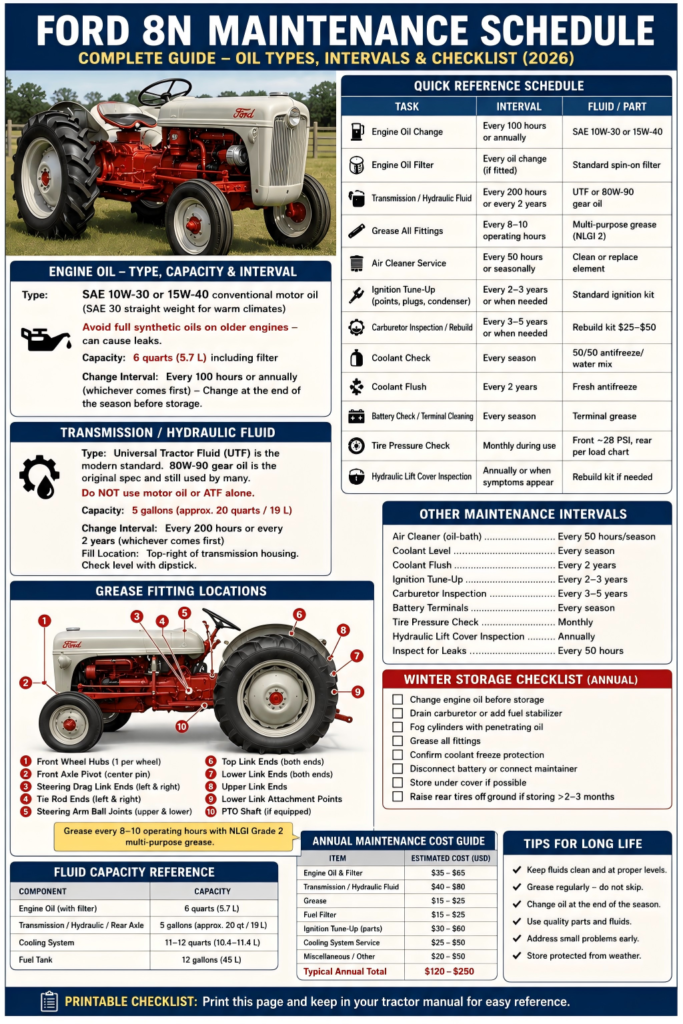
Ford 8N Maintenance Schedule — Quick Reference
| Task | Interval | Fluid / Part |
|---|---|---|
| Engine oil change | Every 100 hours or annually | SAE 10W-30 or 15W-40 (see below) |
| Engine oil filter | Every oil change (if filter fitted) | Standard spin-on filter |
| Transmission / hydraulic fluid | Every 200 hours or every 2 years | UTF or 80W-90 gear oil (see below) |
| Air cleaner service | Every 50 hours or seasonally | Clean or replace element |
| Grease all fittings | Every 8–10 operating hours | Multi-purpose grease (NLGI 2) |
| Ignition tune-up (points, plugs, condenser) | Every 2–3 years or when needed | Standard ignition kit |
| Carburetor inspection / rebuild | Every 3–5 years or when needed | Rebuild kit $25–$50 |
| Coolant check | Every season | 50/50 antifreeze/water mix |
| Coolant flush | Every 2 years | Fresh antifreeze |
| Battery check / terminal cleaning | Every season | Terminal grease |
| Tyre pressure check | Monthly during use | Front ~28 PSI, rear per load chart |
| Hydraulic lift cover inspection | Annually or when symptoms appear | Rebuild kit if needed |
Ford 8N Engine Oil — Type, Capacity, and Change Interval
What type of oil does a Ford 8N take?
The Ford 8N flathead engine is compatible with modern multi-viscosity motor oils. The most commonly recommended options in 2026:
- SAE 10W-30 or 15W-40 conventional motor oil — the standard recommendation for most climates and operating conditions. Conventional (non-synthetic) oil is preferred by many classic Ford owners as it is less prone to leaking through old gaskets and seals
- SAE 30 straight weight — a traditional choice for warm-weather operation. Works well in climates that don’t see sustained cold temperatures below freezing
- 10W-40 — a reasonable alternative in warmer climates where slightly heavier viscosity is preferred
Avoid full synthetic oils on high-mileage or older-gasket engines — the lower surface tension of full synthetics can cause seepage through gaskets and seals that conventional oil would not penetrate. Semi-synthetic or conventional is the safer choice on a classic Ford.
How many quarts of oil does a Ford 8N take?
The Ford 8N engine holds approximately 6 quarts (5.7 litres) of oil including the filter. Check with the dipstick after filling — add gradually and check the level rather than assuming the full 6 quarts are needed after a drain.
How often to change the oil on a Ford 8N?
Every 100 operating hours or once per year — whichever comes first. On a hobby farm tractor used 40–80 hours per year, this means one annual oil change. On a more heavily used machine, track hours and change at 100.
Change the oil at the end of the season, not at the beginning. Old oil left in the sump over winter becomes acidic and attacks bearing surfaces during the long idle period. Fresh oil going into winter storage is better insurance than fresh oil at spring startup.
Ford 8N Transmission and Hydraulic Fluid
What kind of oil for the rear end on a Ford 8N?
The Ford 8N uses a shared transmission and hydraulic sump — the same fluid lubricates the transmission, rear axle, and powers the three-point hitch hydraulic system. This is one of the most frequently asked questions among new 8N owners, and the fluid choice matters.
Recommended fluids:
- Universal Tractor Fluid (UTF) — the modern standard recommendation for the Ford 8N shared sump. UTF is formulated to lubricate gears, wet clutches, and hydraulic systems simultaneously — exactly what the 8N’s combined system requires. Available from Tractor Supply, farm stores, and online. Use a UTF that meets Ford/New Holland specification or equivalent
- 80W-90 gear oil — the original specification fluid. Still used by many classic Ford owners, particularly those who prefer to stay close to original specification. Works well but does not have the hydraulic additives that UTF provides
Do not use: straight motor oil, automatic transmission fluid (ATF) alone, or any fluid not rated for use in a combined transmission/hydraulic system. Using the wrong fluid causes hydraulic system problems and can damage the transmission.
How much hydraulic fluid does a Ford 8N hold?
The Ford 8N’s combined transmission/hydraulic sump holds approximately 6 quarts (5.7 litres). The fill point is on the right side of the transmission housing. Check the level with the dipstick — the sump should be filled to the full mark on the dipstick, not beyond it.
Where to fill hydraulic fluid on a Ford 8N?
The transmission/hydraulic fill point is located on the top-right of the transmission housing, accessed by removing a plug or fill cap. The dipstick for checking level is in the same area. Clean the area around the fill point before opening — contaminated fluid entering the combined sump damages the hydraulic control valve.
How often to change transmission fluid on a Ford 8N?
Every 200 operating hours or every 2 years — whichever comes first. On a lightly used hobby farm tractor, a 2-year fluid change schedule is appropriate. On a machine used heavily, track hours and change at 200.
Ford 8N Grease Fittings — Location and Frequency
How often to grease a Ford 8N?
Every 8–10 operating hours. This is more frequent than many owners realise — on a classic machine without sealed bearings, greasing is the primary defence against accelerated wear at pivot points and steering components.
Ford 8N grease fitting locations
| Location | Fittings | Notes |
|---|---|---|
| Front wheel hubs | 1 per wheel | Critical — front wheel bearing failure is expensive |
| Front axle pivot (centre pin) | 1 | N-Series known weak point — do not skip |
| Steering drag link ends | 2 | Left and right ends of the drag link |
| Tie rod ends | 2 | Left and right steering tie rod ends |
| Steering arm ball joints | 2 | Upper and lower steering arm connections |
| Three-point hitch lower link ends | 2 | Where lower links attach to the implement |
| Three-point hitch upper link ends | 2 | Both ends of the top link |
| PTO shaft (if equipped) | Per fitting | PTO shaft and implement input shaft fittings |
Use a standard NLGI Grade 2 multi-purpose grease. Pump slowly until fresh grease appears at the seal — do not over-grease as this can damage seals. On fittings that won’t accept grease, the fitting itself may be blocked or failed — replace before the next use.
Ford 8N Ignition Maintenance
The Ford 8N uses a points-and-condenser ignition system — either a front-mount distributor (early 8N, serial 1 through approximately 263,843) or a side-mount distributor (late 8N, serial 263,844 onward). Confirm which distributor your machine has before ordering ignition parts — see our Ford Tractor Serial Numbers guide to verify your year. Both require periodic service for reliable starting.
Ignition tune-up interval
Every 2–3 years on a lightly used machine, or when symptoms appear (hard starting, rough running, misfiring).
Ignition tune-up components
| Component | Replace Every | Cost |
|---|---|---|
| Points | 2–3 years | $8–$15 |
| Condenser | 2–3 years (with points) | $5–$12 |
| Spark plugs (4) | 2–3 years | $12–$25 |
| Rotor | 3–5 years | $8–$15 |
| Distributor cap | 3–5 years or when cracked | $12–$20 |
| Plug wires | When cracked or arcing | $20–$40 |
Electronic ignition upgrade: many 8N owners replace the points-and-condenser system with an electronic ignition module ($40–$80). This eliminates points adjustment as a recurring maintenance task and improves cold-start reliability. The upgrade is reversible and recommended for any machine used regularly.
Ford 8N Air Cleaner Maintenance
The Ford 8N uses an oil-bath air cleaner — a pre-electronic filtration system that uses an oil reservoir to trap airborne dust and debris before it reaches the engine. It requires more frequent attention than a modern paper element filter.
- Check the oil level in the air cleaner cup every 50 hours or at the start of each season
- Clean the oil bath cup and refill when the oil is dirty or when operating in dusty conditions. Dirty, debris-laden oil in the air cleaner provides no filtration
- Use the same engine oil you use in the engine — SAE 30 or 10W-30
- Inspect the sealing gasket where the air cleaner body meets the intake — a leaking gasket allows unfiltered air directly into the engine
Ford 8N Cooling System Maintenance
| Task | Interval | Notes |
|---|---|---|
| Check coolant level | Every season before use | Should be at the full mark — low coolant causes overheating |
| Check coolant condition | Every season | Should be green or orange — brown sludge indicates neglect |
| Flush and refill | Every 2 years | 50/50 antifreeze and distilled water |
| Inspect radiator hoses | Annually | Check for cracks, softness, and swelling at clamp ends |
| Clean radiator exterior | Annually or when blocked | Compressed air or soft brush — blocked fins cause overheating |
| Check thermostat | When overheating symptoms appear | Thermostat failure is a common overheating cause on classic Fords |
Ford 8N Battery and Electrical Maintenance
Whether your Ford 8N runs the original 6-volt system or has been converted to 12-volt, the battery and electrical system need annual attention:
- Clean battery terminals every season — corrosion on terminals causes starting problems and charging issues. Use a wire brush and terminal spray or petroleum jelly to protect after cleaning
- Check electrolyte level on non-sealed batteries — top up with distilled water if below the plates
- Test battery voltage and charging — a battery that won’t hold charge after a full season of use needs replacement. On a 12-volt converted system, confirm the alternator is charging at 13.5–14.5 volts at running speed
- Inspect wiring for cracks or brittleness — original wiring on a 70-year-old machine can be dangerously brittle. Cracked insulation near fuel lines is a fire risk. Replace suspect wiring sections rather than taping them
Ford 8N Winter Storage Preparation
Preparing a Ford 8N for winter storage properly prevents the majority of problems that show up at spring startup:
- Change the engine oil before storage — do not store with used oil in the sump. Old oil is acidic and attacks bearing surfaces during long idle periods. Fresh oil going into storage is the most impactful single step
- Run the fuel system dry or add fuel stabiliser — old petrol in the carburettor and fuel lines gums up over winter. Either drain the carburettor float bowl completely or add a quality fuel stabiliser to the tank and run it through the system for 10 minutes
- Fog the cylinders — remove the spark plugs and spray a small amount of penetrating oil or fogging oil into each cylinder. Reinstall the plugs. This prevents cylinder wall rust during storage
- Grease all fittings — a final greasing before storage keeps moisture out of bearing surfaces over winter
- Check and top up coolant antifreeze — confirm the coolant mix provides adequate freeze protection for your coldest expected temperature
- Disconnect the battery — or use a battery maintainer. A battery left connected but not charged over winter will sulfate and fail by spring
- Store under cover if possible — outdoor storage accelerates tyre sidewall cracking, sheet metal rust, and rubber seal deterioration. A shed or barn is significantly better than a tarpaulin
- Raise rear tyres off the ground if storing for more than 2–3 months — sustained weight on one point of an agricultural tyre causes flat spots that can be difficult to resolve
Where to Buy Ford 8N Maintenance Parts
- Steiner Tractor Parts — comprehensive N-Series catalogue including ignition kits, gasket sets, filters, and hydraulic components
- Tractor Supply Company — stocks UTF, multi-purpose grease, batteries, and basic filters in-store
- Yesterday’s Tractors online community — parts listings, sourcing advice, and technical guidance specifically for classic Ford owners
- eBay and online dealers — wide selection of NOS (new old stock) and reproduction parts including ignition components, carburetor kits, and sheet metal
Ford 8N Maintenance Checklist — Printable
Ford 8N Seasonal Maintenance Checklist
Every 8–10 Hours:
☐ Grease all fittings (front hubs, axle pivot, steering, hitch links, PTO shaft)
☐ Check engine oil level
☐ Check coolant level
Every 50 Hours / Monthly During Use:
☐ Service oil-bath air cleaner (check and clean oil cup)
☐ Check tyre pressures (front ~28 PSI, rear per load chart)
☐ Inspect for oil or fluid leaks
Every 100 Hours / Annually:
☐ Change engine oil and filter (6 quarts SAE 10W-30 or 15W-40)
☐ Check battery terminals — clean and protect
☐ Check and test charging system
☐ Inspect all wiring for cracks or brittleness
☐ Check hydraulic hitch operation (lift and hold test)
☐ Inspect brake pedal travel and equalisation
Every 200 Hours / Every 2 Years:
☐ Change transmission/hydraulic fluid (6 quarts UTF or 80W-90)
☐ Flush and refill cooling system (50/50 antifreeze/distilled water)
☐ Inspect and replace radiator hoses if cracked or soft
Every 2–3 Years:
☐ Ignition tune-up (points, condenser, plugs)
☐ Inspect distributor cap and rotor
☐ Carburetor inspection — rebuild if needed
Winter Storage (Annual):
☐ Change engine oil before storage
☐ Drain carburettor or add fuel stabiliser
☐ Fog cylinders with penetrating oil
☐ Grease all fittings
☐ Confirm coolant freeze protection
☐ Disconnect battery or connect maintainer
☐ Store under cover if possible
Verdict — Ford 8N Maintenance Schedule
The Ford 8N maintenance schedule is straightforward by any standard — no electronics to diagnose, no complex systems requiring specialist tools, and parts available for every service item. The most important habits: change the engine oil at the end of every season rather than letting it sit over winter, grease the fittings every 8–10 hours without skipping, and service the ignition system every 2–3 years. A Ford 8N that gets this basic attention runs reliably for decades. One that doesn’t eventually reveals exactly what was skipped.
For full buying guidance before purchasing a Ford 8N to maintain: Ford 8N review · Ford 8N for Hobby Farm · Best Implements for a Ford 8N · Used Ford Tractor Inspection Checklist →
Also available: Ford 9N · Ford 3000 · Ford 4000 · Ford 5000
👉 See current Ford 8N listings →
Ford 8N Points Setting Gap, Adjustment, and TDC
What Should the Points Be Set At on a Ford 8N?
The recommended points gap on a Ford 8N is 0.015 inches (0.38mm) for both the front-mount and side-mount distributor configurations. This is the factory specification and the setting most owners and rebuilders use in practice. A feeler gauge is the correct tool set to 0.015 inches and slip it between the open points at the widest gap position (points fully open, with the cam lobe at peak).
| Specification | Value | Notes |
|---|---|---|
| Points gap | 0.015 inches (0.38mm) | Factory specification both front-mount and side-mount |
| Spark plug gap | 0.023 0.028 inches | Standard for Champions H10 or equivalent |
| Ignition timing | TDC (top dead centre) at idle | Set with timing light or static timing method |
| Dwell angle | Approximately 42 45 degrees | Result of correct 0.015 inch gap check with dwell meter |
How to Set the Points on a Ford 8N Tractor
- Remove the distributor cap side-mount or front-mount depending on your machine. Set aside with wires still attached
- Rotate the engine to points-open position turn the engine by hand (using the fan or turning a rear wheel in gear) until the distributor cam lobe pushes the points to their widest open position. The rubbing block on the points arm should be sitting on the peak of the cam lobe
- Check the existing gap slide a 0.015 inch feeler gauge between the open points. It should slide with light resistance. Too tight or too loose adjust
- Loosen the points mounting screw slightly just enough to allow the fixed point plate to move
- Adjust to 0.015 inches use a screwdriver in the adjustment slot to move the fixed plate until the feeler gauge slides with light drag and no binding
- Tighten the mounting screw confirm the gap hasn’t changed after tightening. Re-check with the feeler gauge
- Replace the distributor cap and test start
How to Find Top Dead Centre (TDC) on a Ford 8N
TDC on cylinder #1 is needed for static timing. The simplest method:
- Remove the #1 spark plug (front cylinder) and hold a finger or tissue lightly over the hole
- Rotate the engine slowly use the fan, crank, or turn a rear wheel with the tractor in gear
- Feel for air pressure at the spark plug hole when you feel air pushing out, the piston is coming up on the compression stroke
- Continue rotating slowly until the timing mark on the crankshaft pulley aligns with the timing pointer on the engine block. At this point cylinder #1 is at TDC compression
- Confirm the distributor rotor should be pointing toward the #1 terminal on the distributor cap
Alternative method: remove the valve cover and watch the intake and exhaust valves on #1 cylinder. TDC compression occurs just after both valves close (exhaust just closed, intake not yet opened).
Oil Questions Ford 8N and Classic Tractors
What Type of Engine Oil Is Best for Old Tractors?
For N-Series parts including ZDDP-formulated classic engine oils, Steiner Tractor Parts stocks a comprehensive Ford 8N range. For flathead gasoline engines (Ford 8N, 9N, 2N) and most pre-1980 petrol tractor engines: conventional SAE 10W-30 or 15W-40 motor oil is the standard recommendation. Key considerations for old engines:
- Use conventional, not full synthetic full synthetic oils have lower surface tension and can seep through aged gaskets and seals that conventional oil would not penetrate. This is a practical concern on 70-year-old engines with original or aged gaskets
- Zinc (ZDDP) additive pre-emission-control engines with flat-tappet camshafts benefit from zinc dialkyldithiophosphate (ZDDP) anti-wear additives. Modern API SN oils have reduced ZDDP levels versus older oils. For a heavily worn engine, a ZDDP additive supplement ($8 $15 per bottle) or a purpose-formulated classic engine oil with higher ZDDP content is worth considering
- SAE 30 straight weight the original specification for the Ford 8N and still used by many classic Ford owners in warm climates. Perfectly acceptable slightly less cold-start protection below freezing than a multi-viscosity oil
- Change frequently old engines with wear and blow-by contaminate oil faster than tight modern engines. The 100-hour or annual change interval is the minimum; 50 75 hours is better on a heavily worn engine
Can I Use 10W-30 Engine Oil as Hydraulic Oil in a Ford 8N?
Not recommended as a long-term solution. The Ford 8N uses a combined transmission/hydraulic sump the fluid must lubricate gears, wet clutches, and power the Ferguson hydraulic system simultaneously. Motor oil (10W-30 or any grade) can function as a stopgap but is not optimised for this combined role:
- Motor oil lacks the extreme pressure (EP) additives needed for gear lubrication under load
- Motor oil lacks the specific friction modifiers needed for wet clutch surfaces in the transmission
- Using motor oil long-term in the hydraulic sump can cause clutch chatter, gear wear, and hydraulic control valve deposits
Use Universal Tractor Fluid (UTF) instead it is purpose-formulated for combined transmission/hydraulic systems and costs no more than motor oil at farm stores. If motor oil is all that is available in an emergency top-up, use it temporarily and change to UTF at the next service.
Ford 8N Common Problems
What Are Common Ford 8N Problems?
Most Ford 8N problems are predictable and preventable. The most commonly reported issues by category:
| Problem | Most Common Cause | Fix |
|---|---|---|
| Hard starting / no start | Points gap out of spec, worn condenser, stale fuel, gummed carburettor | Set points to 0.015″, replace condenser, drain and clean carburettor, fresh fuel |
| Rough running / misfiring | Points worn, plug wires arcing, incorrect timing, worn spark plugs | Full ignition tune-up points, condenser, plugs, cap, rotor |
| Hydraulic hitch won’t lift | Low fluid in sump, worn pump, failed lift cover seals, control valve sticking | Check fluid level first. If full: inspect lift cover, rebuild if needed ($80 $150 kit) |
| Hydraulic hitch won’t hold position | Lift cover control valve seals worn | Lift cover rebuild kit straightforward DIY job on the 8N |
| Excessive steering play | Worn steering drag link ends, worn tie rod ends, worn steering box | Grease and inspect first. Replace worn drag link or tie rod ends. Steering box rebuild if play persists |
| Overheating | Low coolant, blocked radiator, failed thermostat, blown head gasket | Check coolant level and condition. Clean radiator fins. Test thermostat. Compression test if overheating persists |
| Oil leaks | Front crankshaft seal, rear main seal, valve cover gasket, oil pan gasket | Most seals and gaskets are inexpensive and widely available. Front crankshaft seal replacement is the most involved job |
| PTO not engaging | PTO shift lever linkage, worn PTO clutch gear | Check and adjust PTO shift linkage. PTO clutch gear replacement if linkage is intact |
| 6-volt electrical issues | Aging wiring, weak generator, hard-to-find 6V batteries | 12-volt conversion ($80 $150 kit) eliminates most 6V electrical frustrations permanently |
| Carburettor flooding / fuel starvation | Worn needle and seat, debris in fuel bowl, deteriorated fuel lines | Carburettor rebuild kit ($20 $40), replace fuel lines, install inline fuel filter |
The honest summary: most Ford 8N problems are maintenance problems the result of skipped oil changes, ignored grease fittings, and deferred ignition service. A properly maintained 8N has very few mechanical failures. The machine’s simplicity means that when problems do occur, they are almost always diagnosable and fixable by any mechanically confident owner.
Ford 8N Quick Reference for Common Questions
Was the Ford 8N a Good Tractor?
Yes unambiguously. The Ford 8N was rated the most produced two-plow tractor in US history for a reason: it delivered the right combination of capability, reliability, and price for the farms that needed it most. Its Ferguson three-point hitch and draft control were genuinely innovative advantages that no affordable competing tractor offered. 75+ years later, hundreds of thousands of examples are still in active use which is the most honest possible answer to whether it was a good machine. Browse our Ford 8N for sale ->
How Much Horsepower Is a Ford 8N?
Approximately 25 28 HP at the belt (engine output). PTO HP is approximately 20 24 HP the figure relevant for sizing implements. The Nebraska Tractor Test recorded belt HP at approximately 23.2 25.5 HP depending on engine condition. For practical purposes: the 8N is a 2-plow tractor comfortable with 4 5 ft implements.
How Much Can a Ford 8N Lift?
Approximately 800 1,000 lbs at the hitch link pins. Sufficient for all standard Category 1 implements in the size range the 8N was designed for. The hydraulic system is non-live it stops responding when the clutch is depressed.
How Fast Will a Ford 8N Go?
Maximum approximately 12 17 mph in 4th gear. Working speeds: 1st ~2.0 mph (heavy tillage), 2nd ~3.3 mph (standard field work), 3rd ~4.5 mph (most implement work), 4th for road transport only.
How Many Ford 8N Tractors Were Made?
524,076 units between 1947 and 1952 the most produced two-plow tractor in US history and the reason parts remain universally available today.
How Much Is a Ford 8N Worth Today?
Running good working condition: $2,500 $4,000. Non-running or rough: $500 $2,200. Restored driver quality: $4,000 $6,500. Show quality: $7,000 $12,000+. For current comparables, TractorHouse.com lists active Ford 8N sales.
Which Is Better Ford 8N or 9N?
For a working tractor: the 8N in every dimension 4-speed vs 3-speed, position plus draft control vs draft only, two brake pedals vs one, more HP, and far more parts available from 524,000 units produced. The 9N has collector appeal as the original first-year machine. For any working or maintenance use: buy the 8N.
What Is Considered the Greatest Tractor Ever Made?
By historical impact: the Ford 9N (1939) introduced the Ferguson three-point hitch and draft control that became the global standard for implement attachment. The system introduced on the 9N is still the global standard 87 years later. By longevity in active use: the Massey Ferguson 135. By American row-crop legacy: the John Deere 4020. By modern engineering: the Fendt Vario CVT. The Ford 8N, while not as historically significant as the 9N, is the most practical expression of what the N-Series became and is the most widely owned and used classic tractor in North America today. Browse our Ford tractors for sale ->
Frequently Asked Questions
What type of oil does a Ford 8N take?
SAE 10W-30 or 15W-40 conventional motor oil is the standard recommendation for the Ford 8N in most climates. SAE 30 straight weight is also used in warm climates. Avoid full synthetic oils on older engines — the lower surface tension can cause seepage through aged gaskets and seals. Change every 100 hours or annually, whichever comes first.
How many quarts of oil does a Ford 8N take?
Approximately 6 quarts (5.7 litres) including the filter. Add oil gradually and check the dipstick — always fill to the indicated level rather than assuming the full 6 quarts are needed after a drain and refill.
What kind of hydraulic fluid for a Ford 8N?
Universal Tractor Fluid (UTF) is the modern standard recommendation for the Ford 8N’s combined transmission/hydraulic sump. 80W-90 gear oil is the original specification and still used by many classic Ford owners. Do not use straight motor oil or ATF alone — the shared sump requires fluid rated for both gear lubrication and hydraulic system function.
How much hydraulic fluid does a Ford 8N take?
Approximately 6 quarts (5.7 litres) in the shared transmission/hydraulic sump. The fill point is on the top-right of the transmission housing. Check the level with the dipstick and fill to the indicated mark — do not overfill.
How often should I grease a Ford 8N tractor?
Every 8–10 operating hours. Key locations: front wheel hubs, front axle centre pivot, steering drag link ends, tie rod ends, steering arm ball joints, three-point hitch link ends, and PTO shaft fittings. Use NLGI Grade 2 multi-purpose grease. Pump until fresh grease appears — do not over-grease.