Wondering how many Ford tractor hours is too many before you should walk away from a purchase? It comes up in almost every used tractor sale — and the honest answer is that hours matter far less than most buyers think. A Ford 8N or 9N with 3,000 hours and a documented maintenance history is a better purchase than a 500-hour machine that sat outside for a decade with bad oil. This guide explains what the hour meter actually tells you, what it doesn’t, and what to look for instead when evaluating a classic Ford.
👉 Browse our current Ford tractor inventory →
Written by: Farmers Equipment editorial team — specialising in classic Ford tractors from the N-Series through the Thousand Series.
Ford Tractor Hours Too Many — The Short Answer
On modern tractors with electronic monitoring, hour meters provide reliable guidance on service intervals and remaining component life. On classic Ford tractors — the 9N, 8N, 3000, 4000, and 5000 — the situation is more complicated:
- Most N-Series tractors (9N and 8N) were never fitted with hour meters from the factory — any hour reading on an N-Series is from an aftermarket gauge added at some point in the tractor’s life. That gauge may have been installed at 500 hours, reset, or replaced. The reading tells you hours since the gauge was fitted, not hours on the machine
- Classic Ford engines are rebuild-friendly — a flathead Ford 8N engine that has been properly rebuilt is effectively a zero-hour engine in terms of remaining life, regardless of what the chassis has accumulated
- Maintenance history matters more than hours — a high-hour machine with regular oil changes, proper storage, and documented service is consistently a better purchase than a low-hour machine that was neglected
The practical conclusion: worrying about Ford tractor hours being too many is less useful than inspecting what those hours actually did to the machine. Use the hour reading as one data point, not the deciding factor. What you find when you inspect the machine tells you far more about its remaining life than any number on a gauge.
What Hours Actually Mean on Each Classic Ford Model
| Model | Factory Hour Meter? | Typical Reliable Life (with maintenance) | What “High Hours” Means |
|---|---|---|---|
| Ford 9N | No — aftermarket only | Many require rebuilding beyond 2,000–4,000 hrs depending on maintenance and workload — well-maintained engines can last considerably longer | Focus on condition, not hours |
| Ford 8N | No — aftermarket only | Many require rebuilding beyond 2,000–4,000 hrs depending on maintenance and workload — well-maintained engines can last considerably longer | Focus on condition, not hours |
| Ford 3000 | Yes — standard fitment | 2,000–5,000+ hrs with good maintenance | Above 3,000 hrs — inspect engine carefully |
| Ford 4000 | Yes — standard fitment | 2,000–5,000+ hrs with good maintenance | Above 3,000 hrs — inspect engine carefully |
| Ford 5000 | Yes — standard fitment | 2,500–6,000+ hrs with good maintenance | Above 4,000 hrs — full compression check recommended |
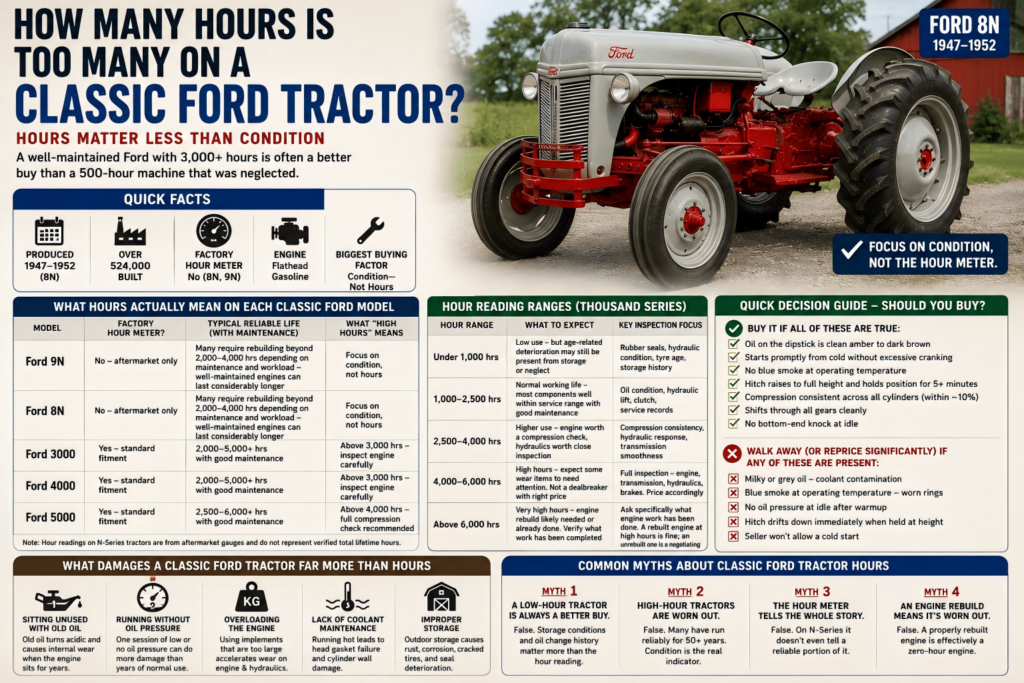
What Damages a Classic Ford Tractor Far More Than Hours
In practice, the following factors cause more mechanical deterioration than accumulated hours:
1. Sitting unused with old oil
A classic Ford tractor that sat for 5–10 years without being run — particularly with old oil left in the sump — suffers far more internal damage than one that ran 5,000 hours with regular oil changes. Old oil loses its protective additives and becomes acidic over time, attacking bearing surfaces and cylinder walls during the inevitable restart after long storage. The ring and bearing wear that causes blue exhaust smoke on many old tractors is almost always the result of sitting with degraded oil, not high-hour use.
2. Running without oil pressure
One session of running with low or no oil pressure can do more damage than years of normal operation. Always check the oil pressure gauge on startup. Slow build or low reading at idle after warmup is a red flag that significantly outweighs any hour reading on the machine.
3. Overloading the engine consistently
Running a Ford 8N (27 HP) with implements sized for a 40+ HP tractor — oversized brush hogs, heavy disc harrows, 3-bottom ploughs — accelerates wear on pistons, rings, and the hydraulic system more rapidly than normal-use hours accumulate. A machine used within its rated capacity at 3,000 hours is in better shape than one overloaded at 1,000.
4. Lack of coolant maintenance
Classic Ford tractors run hot when coolant is neglected — low coolant level, worn thermostat, or a blocked radiator cause head gasket failure and cylinder wall damage that no hour meter captures. Always check coolant condition and level as part of any inspection.
5. Improper storage
Outdoor storage without cover accelerates rust on sheet metal, corrosion in the electrical system, tyre sidewall cracking from UV exposure, and deterioration of rubber seals throughout the hydraulic and fuel systems. A 2,000-hour machine stored outdoors uncovered for 10 years may present more restoration work than a 4,000-hour machine kept in a barn.
Hour Reading Ranges — What They Suggest on a Thousand Series Ford
For Ford 3000, 4000, and 5000 tractors where the factory hour meter is present and has not been replaced, these ranges provide general guidance — not guarantees:
| Hour Range | What to Expect | Key Inspection Focus |
|---|---|---|
| Under 1,000 hrs | Low use — but age-related deterioration may still be present from storage or neglect | Rubber seals, hydraulic condition, tyre age, storage history |
| 1,000–2,500 hrs | Normal working life — most components well within service range with good maintenance | Oil condition, hydraulic lift, clutch, service records |
| 2,500–4,000 hrs | Higher use — engine worth a compression check, hydraulics worth close inspection | Compression consistency, hydraulic response, transmission smoothness |
| 4,000–6,000 hrs | High hours — expect some wear items to need attention. Not a dealbreaker with right price | Full inspection — engine, transmission, hydraulics, brakes. Price accordingly |
| Above 6,000 hrs | Very high hours — engine rebuild likely needed or already done. Verify what work has been completed | Ask specifically what engine work has been done. A rebuilt engine at high hours is fine; an unrebilt one is a negotiating point |
How to Evaluate a Classic Ford With No Hour Meter
For Ford 9N and 8N tractors without a reliable hour reading, these are the indicators that actually tell you about remaining engine life:
Compression test — the most reliable engine health indicator
A compression test gives you direct evidence of piston ring and valve condition — the two primary wear items in a classic Ford flathead engine. Readings should be consistent across all cylinders — ideally within about 10% of each other. One significantly low cylinder indicates a ring, valve, or head gasket problem regardless of what the hour gauge says. This test takes 15 minutes and requires a basic compression tester available at any auto parts store. For model-specific compression specifications, TractorData.com lists factory engine specs for all classic Ford models.
Oil condition on the dipstick
Pull the dipstick cold. Dark brown to black oil is normal on a working tractor and tells you the oil has been working. Milky or grey oil indicates coolant contamination — head gasket failure. Gritty oil indicates no filter changes. Either of the latter two findings outweighs any hour reading in terms of what they tell you about the engine’s recent care.
Exhaust smoke at operating temperature
Blue smoke at operating temperature (after the engine has warmed up fully) indicates oil burning — worn piston rings. This is the most visible indicator of engine wear on a classic Ford flathead. A machine that smokes blue at temperature has worn rings regardless of what the hour meter says — and a machine that runs clean at temperature is in good mechanical shape regardless of high hours.
Hydraulic lift hold test
Raise the three-point hitch to full height and hold it there for 5 minutes. A hitch that drifts down significantly indicates worn lift cover pistons or control valves. This is a wear indicator that reflects hours of hydraulic use more accurately than an hour meter — the hydraulic system is used every time the hitch is raised or lowered, and wear accumulates proportionally.
The Real Question — Condition or Hours?
Consider two Ford 8N tractors:
Note: the following are hypothetical examples to illustrate the principle. Hour readings on N-Series tractors are from aftermarket gauges and do not represent verified total lifetime hours.
- Machine A (hypothetical) — 800 hours on the aftermarket gauge, bought at auction 3 years ago, stored outside uncovered, oil hasn’t been changed since purchase, rear tyres cracked and flat, hitch drifts down immediately when held at height
- Machine B (hypothetical) — 3,500 hours on the aftermarket gauge, owned by one family for 30 years, oil changed annually, stored in a barn, starts immediately cold, hitch holds position, no blue smoke at temperature
Machine B is the better purchase at almost any price comparison. Hours tell you how long the engine has been running. Condition tells you how it was treated while it was running — and that is the more important variable on a 70-year-old machine.
When High Hours Are a Dealbreaker
High hours do become a meaningful concern in specific situations:
- Very high hours with no engine work documentation — a Ford 3000 or 5000 at 5,000+ hours where the seller cannot confirm whether the engine has been rebuilt should be priced to reflect the likelihood of imminent major work
- High hours combined with neglect indicators — high hours plus bad oil, blue smoke, and no service records is a combination that suggests the machine has been worked hard and maintained poorly. This is when hours and condition align to indicate a genuine risk
- Transmission wear at very high hours — on Ford Thousand Series tractors at very high hours, transmission and hydraulic pump wear can become expensive. These are harder to assess on a quick inspection than engine condition — ask specifically about transmission service history
Quick Decision Guide — Should You Buy This Tractor?
✅ Buy it if all of these are true:
☑ Oil on the dipstick is clean amber to dark brown — not milky or gritty
☑ Starts promptly from cold without excessive cranking
☑ No blue smoke at operating temperature
☑ Hitch raises to full height and holds position for 5+ minutes
☑ Compression consistent across all cylinders (within ~10%)
☑ Shifts through all gears cleanly
☑ No bottom-end knock at idle
❌ Walk away (or reprice significantly) if any of these are present:
✗ Milky or grey oil — coolant contamination
✗ Blue smoke at operating temperature — worn rings
✗ No oil pressure at idle after warmup
✗ Hitch drifts down immediately when held at height
✗ Seller won’t allow a cold start
Common Myths About Classic Ford Tractor Hours
Myth 1: A low-hour tractor is always a better buy.
False. A 500-hour tractor that sat outdoors for 10 years with old oil in the sump has more internal damage than a 4,000-hour tractor serviced regularly and stored in a barn. Storage conditions and oil change history matter more than the hour reading on machines of this age.
Myth 2: High-hour tractors are worn out.
False — particularly on N-Series machines where the hour reading comes from an aftermarket gauge of unknown history. Many Ford 8N tractors have been running reliably for 50+ years with accumulated hours that would concern a buyer focused on the number. The machine’s condition at inspection is the real indicator.
Myth 3: The hour meter tells the whole story.
False. On N-Series tractors it doesn’t even tell a reliable portion of it. On Thousand Series tractors with factory hour meters, it tells you one data point — useful in combination with oil condition, compression, and service records, not as a standalone verdict.
Myth 4: An engine rebuild means the tractor is worn out.
False. A properly rebuilt Ford 8N engine is effectively a zero-hour engine in terms of remaining service life. A tractor represented as having a recent professional engine rebuild — with receipts — is often a stronger purchase than an unrebilt machine at lower hours. Ask what was done, when, and by whom.
Summary — What to Focus On Instead of Hours
| Instead of… | Focus on… |
|---|---|
| Hour meter reading | Oil condition on the dipstick |
| Low hours = good machine | Service history and maintenance records |
| High hours = avoid | Compression test results |
| Hour gauge accuracy | Exhaust smoke at operating temperature |
| Engine hours only | Hydraulic lift hold and response |
| Seller’s stated history | Physical inspection — what you find yourself |
For a complete guide to what to check before purchasing, see our Used Ford Tractor Inspection Checklist →
Browse current stock by model: Ford 8N · Ford 9N · Ford 3000 · Ford 4000 · Ford 5000
Verdict
There is no universal answer to how many hours is too many on a classic Ford tractor — because hours alone do not tell the story. A well-maintained Ford 8N at 4,000 hours is a more reliable purchase than a neglected one at 500. What matters is oil condition, compression consistency, hydraulic function, storage history, and maintenance records. Use the hour meter as one data point among many — not as the deciding factor.
Browse current stock: Ford tractors for sale →
Tractor Hours — What Is Too Many? (All Brands)
The Ford-specific guidance above applies to classic machines. But the question of how many hours is too many comes up on every used tractor purchase regardless of brand. Here is the honest answer by hour range — and by brand.
How Many Hours Is Average for a Tractor?
| Tractor Type | Average Annual Hours | Expected Total Life (maintained) |
|---|---|---|
| Hobby / small farm (under 50 HP) | 100–200 hours/year | 3,000–6,000+ hours |
| Mid-size farm tractor (50–100 HP) | 300–600 hours/year | 5,000–10,000+ hours |
| Large commercial farm tractor (100+ HP) | 600–1,000+ hours/year | 8,000–15,000+ hours |
| Classic Ford (N-Series, Thousand Series) | Varies widely — often 50–200 hours/year | 2,000–6,000+ hours before rebuild needed |
Is 500 Hours on a Tractor a Lot?
No — 500 hours is low for most tractors. On a compact or utility tractor used at 100–200 hours per year, 500 hours represents 2–5 years of use. The machine should be well within its productive life with normal maintenance. On a classic Ford, 500 hours on an aftermarket gauge is not a meaningful number — the gauge may have been added mid-life. Focus on condition not the reading.
Is 700 Hours a Lot on a John Deere Tractor?
No — 700 hours is low on any John Deere tractor. John Deere utility and compact tractors (1 Series through 5 Series) are designed for 8,000–12,000+ hours with proper maintenance. At 700 hours, a John Deere is early in its productive life — equivalent to a few years of typical use. Focus on service history rather than the hour count at this level.
Is 900 Hours a Lot on a Kubota Tractor?
No — 900 hours is low to mid on a Kubota. Kubota compact and utility tractors (BX, B, L, M Series) are known for diesel engine longevity and routinely reach 8,000–12,000+ hours with consistent maintenance. At 900 hours a Kubota is early in its working life. Check oil change history, hydraulic fluid condition, and filter service — at 900 hours these are the variables that matter, not the hour count.
Is 1,000 Hours on a Tractor a Lot?
For a modern compact or utility tractor — no. 1,000 hours on a Kubota, John Deere, Massey Ferguson, or New Holland compact tractor represents approximately 5–10 years of hobby farm use. These machines are designed for 8,000–12,000+ hours. At 1,000 hours, a well-maintained modern tractor has the large majority of its productive life ahead of it. On a classic Ford Thousand Series, 1,000 hours is low — the engine is well within normal operating range.
Is 1,200 Hours a Lot on a Kubota Tractor?
No — 1,200 hours is low to mid on a Kubota tractor. Kubota diesel engines are built for longevity and 1,200 hours represents early to mid-life on any Kubota compact or utility model. Routine maintenance items at this stage: check hydraulic filter service history, verify transmission fluid has been changed, inspect loader pivot points if equipped. But 1,200 hours is not a concern on a Kubota with documented service.
Is 1,700 Hours on a Tractor a Lot?
For a modern tractor — low to mid. 1,700 hours on a Kubota, John Deere, or Massey Ferguson compact tractor is approximately 8–15 years of hobby farm use. Well within productive life for machines designed for 8,000–12,000 hours. For a classic Ford Thousand Series — mid-range. A Ford 3000 or 4000 at 1,700 hours with good maintenance history is a solid used buy. Run a compression test and check hydraulic function — the machine should pass both comfortably at this hour level with good care.
Is 1,800 Hours a Lot for a Tractor?
For a modern tractor — no. For a classic Ford Thousand Series — mid-range, worth a careful inspection but not a dealbreaker. The key question at 1,800 hours on any tractor is the maintenance history — specifically oil change intervals. A machine at 1,800 hours with annual oil changes and documented filter service is in fundamentally better shape than one at 800 hours where maintenance was neglected.
Is 2,000 Hours a Lot on a Tractor?
For a modern compact or utility tractor — low to mid. John Deere, Kubota, Massey Ferguson, and New Holland compact tractors are routinely bought and sold at 2,000–4,000 hours with significant productive life remaining. For a classic Ford Thousand Series — higher end of normal, worth a compression test. For N-Series Ford tractors where the reading is from an aftermarket gauge — the number is unreliable; inspect condition instead.
Is 3,000 Hours a Lot for a Tractor?
For a modern compact tractor — mid-range. Well-maintained Kubota and John Deere compact tractors at 3,000 hours are common in active farm use — expect wear items but not end-of-life. For a mid-size utility tractor (50–100 HP) — low to mid. For a classic Ford Thousand Series — higher end; budget for possible near-term engine work but not a dealbreaker at the right price with good maintenance history.
Is 5,000 Hours a Lot for a Tractor?
For a compact tractor — high but not unusual on well-maintained machines. A 5,000-hour Kubota L Series or John Deere 3 Series with documented service history is still a viable working tractor — expect to budget for some component wear. For a large farm tractor (100+ HP John Deere, Case IH, New Holland) — mid-range. These machines are engineered for 10,000–15,000+ hours. For a classic Ford — very high; ask specifically what engine and transmission work has been done.
Is 7,000 Hours a Lot on a Tractor?
For a large farm tractor (100+ HP) — mid-range. John Deere 6 Series, Case IH Puma, and Massey Ferguson 5700 Series tractors regularly reach 7,000 hours and beyond with consistent maintenance. At 7,000 hours expect some component wear — turbo, injection pump, hydraulic seals — but these are manageable maintenance costs on working farm tractors, not end-of-life indicators. For a compact tractor at 7,000 hours — high; inspect carefully and price accordingly.
Is 12,000 Hours a Lot for a Tractor?
For a large farm tractor — yes, 12,000 hours is high. Most components will have been serviced or replaced at least once. A 12,000-hour John Deere 8 Series or Case IH Magnum that has been through dealer service records is a very different proposition from one with no history. At this level: price reflects remaining life, and thorough inspection of engine, transmission, and hydraulics is essential before purchase.
How Many Hours Is Considered High on a Tractor?
| Tractor Type | Low Hours | Mid Hours | High Hours | Very High |
|---|---|---|---|---|
| Classic Ford (N-Series) | Under 1,000* | 1,000–2,500* | 2,500–4,000* | 4,000+* |
| Classic Ford (3000/4000/5000) | Under 1,500 | 1,500–3,000 | 3,000–5,000 | 5,000+ |
| Compact tractor (under 50 HP) | Under 1,000 | 1,000–3,000 | 3,000–5,000 | 5,000+ |
| Utility tractor (50–100 HP) | Under 2,000 | 2,000–5,000 | 5,000–8,000 | 8,000+ |
| Large farm tractor (100+ HP) | Under 3,000 | 3,000–7,000 | 7,000–12,000 | 12,000+ |
*N-Series readings are from aftermarket gauges — treat as approximate, not verified total hours.
What Is the Longest Lasting Tractor Brand?
No single brand definitively wins — but certain brands consistently appear in discussions of tractor longevity based on fleet data and owner surveys:
| Brand | Known For | Common High-Hour Examples |
|---|---|---|
| John Deere | Largest dealer network — service access drives longevity as much as engineering | 6 and 7 Series commonly reach 10,000–15,000+ hours in commercial farm use |
| Kubota | Diesel engine reliability — compact and utility range particularly strong | L and M Series reaching 8,000–12,000+ hours common |
| Massey Ferguson | Long commercial track record — MF 135 and 165 still working after 50+ years | Classic MF and modern 5700/6700 Series both known for longevity |
| Case IH | Large farm tractors built for very high hours | Magnum Series commonly 10,000–15,000+ hours in commercial use |
| Ford / New Holland | Classic Ford engines — N-Series and Thousand Series legendary for repairability and longevity | Many 8N and 9N tractors working after 70+ years |
| Fendt | Premium European — highest engineering specification | Known for 10,000–15,000+ hours in European commercial farming |
The honest answer: longevity is more a function of maintenance quality than brand. A neglected John Deere fails earlier than a well-maintained Kubota — and vice versa. The brands above have reputations for longevity partly because their dealer networks make proper maintenance more accessible. See our stock of Massey Ferguson tractors, Kubota tractors, and John Deere tractors currently in stock.
What Is the Most Reliable Compact Tractor?
In owner surveys and dealer feedback, Kubota and John Deere consistently rank at the top for compact tractor reliability. Kubota’s BX and L Series diesel engines have a particularly strong reputation for low-maintenance longevity. John Deere’s 1 and 2 Series benefit from the largest dealer network in North America — which makes reliable ongoing service accessible wherever you are. Kioti and Branson are strong value alternatives with improving reliability track records. See our Kioti tractors for sale and Branson tractors for sale.
Frequently Asked Questions
How many hours is too many on a Ford 8N tractor?
There is no fixed limit — condition matters more than hours on a Ford 8N. The 8N was not fitted with a factory hour meter, so any reading is from an aftermarket gauge of unknown history. A well-maintained 8N at 3,000+ hours is typically a better purchase than a neglected low-hour example. Focus on oil condition, compression, hydraulic function, and service history rather than the hour reading.
Do Ford 8N tractors have hour meters?
Not from the factory. The Ford 8N and 9N were not fitted with hour meters as standard equipment. Any hour reading on an N-Series tractor comes from an aftermarket gauge that was added at some point during the tractor’s life. That gauge may have been installed mid-life, reset, or replaced — making the reading unreliable as a measure of total engine hours.
How long do classic Ford tractors last?
Classic Ford tractors — particularly the N-Series and Thousand Series — are known for longevity when properly maintained. Many Ford 8N and 9N engines require rebuilding somewhere beyond 2,000–4,000 hours depending on maintenance, workload, and operating conditions — well-maintained engines can last considerably longer. Ford 3000, 4000, and 5000 engines commonly reach 3,000–6,000+ hours with consistent maintenance, though this varies significantly with care. Many examples are still working after 50+ years of use — the limiting factor is maintenance quality, not the machines themselves.
Is a high-hour Ford tractor worth buying?
Often yes — if the price reflects the hours and the machine has been properly maintained. A Ford 3000 or 4000 at 4,000 hours with documented service history, good oil condition, and strong compression can still deliver years of reliable service. The key question is not how many hours are on it, but what those hours were like — hard use with poor maintenance is more damaging than normal use with good care.
What should I check instead of hours on a classic Ford tractor?
The most useful indicators of remaining engine life on a classic Ford are: oil condition on the dipstick (milky = head gasket, gritty = neglect), exhaust smoke colour at operating temperature (blue = worn rings), compression test consistency across cylinders, hydraulic hitch lift and hold, and the seller’s service records. These tell you far more about the machine’s condition than any hour reading.