Tractor Attachments & Implements are what transform a tractor from a vehicle into a working farm machine. The tractor provides power and mobility — the attachments and implements determine what work it can actually do. This guide covers every major category, which attachments are most useful by farm type, how three-point hitch compatibility works, and what to prioritise when building your implement collection.
👉 Browse tractors in current stock → · Backhoe attachments for sale →
What Is the Difference Between a Tractor Attachment and an Implement?
The terms are often used interchangeably, but there is a practical distinction:
| Term | Definition | Examples |
|---|---|---|
| Implement | A tool that connects to the tractor and performs a specific task — typically three-point hitch or PTO-driven | Rotary cutter, tiller, plough, spreader, post hole digger |
| Attachment | A tool that mounts to the loader or tractor frame — typically hydraulically controlled from the front | Loader bucket, pallet forks, grapple, snow blade, bale spear |
In practice: implements go on the back (three-point hitch or PTO), attachments go on the front (loader). Both are covered in this guide.
What Are the Most Useful Tractor Attachments and Implements?
The most useful depends on what the tractor is used for. By use case:
| Use Case | Most Useful Attachments / Implements |
|---|---|
| Small property / rural homestead | Front loader + bucket, box blade, rotary cutter, post hole digger, pallet forks |
| Livestock farm | Loader with bale spear, manure spreader, squeeze, hay rake, round baler |
| Arable / crop farm | Plough, disc harrow, cultivator, seed drill, sprayer, front loader |
| Forestry / land clearing | Grapple, wood chipper, stump grinder, log splitter, land clearing rake |
| Construction / groundworks | Backhoe attachment, box blade, grading blade, pallet forks, auger |
| Winter operations | Snow blade, front snow blower, rear blade, salt/grit spreader |
What Are the Must-Have Accessories for a Tractor?
If you can only prioritise a few — these are the attachments that earn their cost fastest on most farms and rural properties:
- Front-end loader with bucket — the single most versatile tractor attachment. Moves material, clears snow, lifts, loads, and grades. Without a loader, a large percentage of common tractor tasks cannot be done
- Box blade / rear blade — for grading driveways, levelling ground, pushing material. Inexpensive and immediately useful on virtually any property
- Rotary cutter (bush hog) — for mowing pastures, roadsides, and clearing brush. More capable than any lawn mower on rough terrain
- Pallet forks — converts the loader from a bucket to a forklift in minutes. Essential for moving palletised materials, hay bales, and equipment
- Post hole digger / auger — for fencing, signage, tree planting. Replaces days of manual digging with hours of machine work
Three-Point Hitch Attachments — The Full Category Guide
For implement specifications and compatibility by tractor model, TractorHouse.com lists current used implement inventory. The three-point hitch (3PH or 3PT) is the standard rear mounting system on virtually all tractors. It was introduced on the Ford 9N in 1939 and is now the global standard for rear implement attachment.
Are Three-Point Tractor Attachments Universal?
Mostly — but not entirely. Three-point hitch implements use a Category system based on hitch pin diameter and spacing. Matching categories are compatible; mismatched categories are not without adapters:
| Category | Hitch Pin Diameter | Typical Tractor HP | Common Tractors |
|---|---|---|---|
| Category 0 | 5/8″ (15.9mm) | Under 20 HP | Sub-compact tractors, garden tractors |
| Category 1 | 7/8″ (22.4mm) | 20–45 HP | Kubota BX/B/L, John Deere 1/2 Series, compact tractors |
| Category 2 | 1-1/8″ (28.6mm) | 40–100 HP | Kubota L/M, John Deere 5/6 Series, utility tractors |
| Category 3 | 1-7/16″ (36.5mm) | 80–225 HP | Large farm tractors — JD 6R/7R, Case IH Puma |
| Category 4 | 2″ (50.8mm) | 180+ HP | Very large commercial tractors |
A Category 1 implement will not directly connect to a Category 2 hitch — the pin holes are different sizes. However, reducer bushings and Category adapters are widely available and allow cross-category connections in many cases. Always confirm the implement category matches (or is adapter-compatible with) your tractor before purchase.
What Are the Best Three-Point Hitch Attachments for a Tractor?
| Attachment | Use | Category | Best For |
|---|---|---|---|
| Rotary cutter / bush hog | Pasture mowing, brush clearing | 1, 2, 3 | Any property with grass or brush to manage |
| Box blade | Grading, levelling, driveway maintenance | 1, 2, 3 | Properties with gravel driveways or uneven ground |
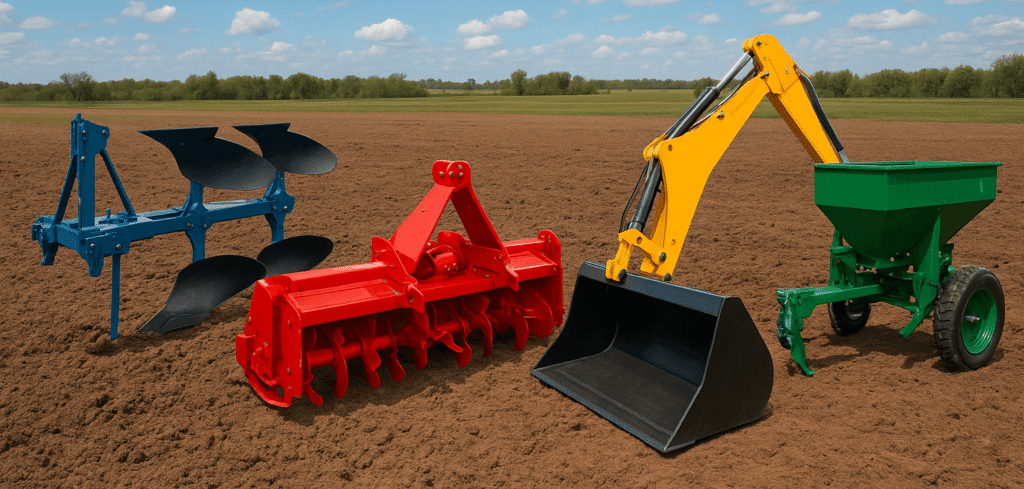
| Rotary tiller | Soil preparation, garden beds, food plots | 1, 2 | Market gardens, food plots, seedbed preparation |
| Post hole digger / auger | Fencing, planting, signage | 1, 2 | Any property needing fence posts or tree planting |
| Rear blade / angle blade | Snow, grading, road maintenance | 1, 2, 3 | Snow removal, gravel road grading |
| Disc harrow | Primary tillage, seedbed prep | 2, 3 | Arable and crop farms |
| Subsoiler / ripper | Breaking compacted soils, drainage improvement | 2, 3 | Farms with compaction or drainage problems |
| Finish mower | Precision lawn mowing — smoother cut than rotary | 1, 2 | Lawns, paddocks, sports fields |
| Sprayer | Herbicide, pesticide, fertiliser application | 1, 2 | Crop production, pasture management |
| Spreader (fertiliser / lime) | Fertiliser and amendment distribution | 1, 2 | Pasture improvement, crop farms |
What Are Some Quick-Attach Attachments for Tractors?
Quick-attach (also called quick coupler) systems allow the loader bucket to be swapped for other tools without removing pins manually. Common quick-attach loader attachments:
- Standard bucket — general material handling, scooping, grading
- Pallet forks — lifts palletised materials and hay bales
- Bale spear / bale grapple — handles round and square bales
- Rock bucket / skeleton bucket — scoops material while letting fines fall through
- Grapple bucket — combines scoop and grab for brush, debris, logs
- Snow bucket / push blade — wider blade for snow management
- Material handling arm — extends reach for placing posts, rocks, and materials
The two most common quick-attach standards are Euro/Global coupler (most compact and European tractors) and Skid Steer Universal (larger utility and American tractors). Confirm your loader’s standard before purchasing attachments.
What Are 10 Examples of Common Farm Implements?
- Mouldboard plough — turns and inverts soil for primary tillage. Buries crop residue and controls weeds before seeding
- Disc harrow — breaks up clods and incorporates residue after ploughing. Used for secondary tillage and seedbed refinement
- Cultivator — shallow tillage between crop rows. Controls weeds and aerates topsoil without deep disturbance
- Seed drill / planter — places seed at controlled depth and spacing. Critical for consistent germination and crop establishment
- Rotary cutter / bush hog — heavy-duty rotary mower for pastures, roadways, and brush control
- Round baler — gathers cut hay or straw into cylindrical bales for storage and handling
- Hay rake — gathers cut grass into windrows for drying and baling
- Sprayer — applies herbicides, pesticides, fungicides, and liquid fertilisers to crops
- Manure spreader — distributes manure across fields for soil improvement and nutrient recycling
- Subsoiler / deep ripper — breaks compaction layers below normal tillage depth, improving drainage and root penetration
What Are 20 Common Agricultural Tools and Implements?
Expanding to 20: mouldboard plough, disc harrow, cultivator, seed drill, rotary cutter, round baler, square baler, hay rake, mower-conditioner, sprayer, manure spreader, subsoiler, box blade, post hole digger, rotary tiller, front loader, pallet forks, grapple, grain auger, and fertiliser spreader. Each serves a specific function in crop production, livestock management, or land maintenance — most connect via three-point hitch or PTO, a handful via loader quick-attach.
Loader Attachments — Front-of-Tractor Tools
Pallet Forks
The most universally useful loader attachment after the standard bucket. Converts the loader into a forklift for palletised materials, hay bales, lumber, and equipment. Available in fixed and adjustable widths. Rated by maximum load capacity — match to your loader’s rated lift capacity.
Grapple
For handling brush, logs, rocks, and irregularly-shaped material that a standard bucket cannot grip. Root grapples, brush grapples, and rock grapples are the main variants. Hydraulically operated — requires auxiliary hydraulic outlets on the loader.
Bale Spear / Bale Grapple
Designed specifically for moving round bales. A single or multi-tine spear penetrates the bale core; a grapple wraps around to hold the bale from the outside. Essential for livestock operations moving bales without manual handling.
Snow Blade / Snow Blower
Front-mounted snow blades push and angle snow for clearing driveways and access roads. Snow blowers (PTO or hydraulic) throw snow to the side — better than blades when snow must be moved away from the cleared path rather than just pushed to the edge.
Backhoe Attachment
Rear-mounted hydraulic digging arm that converts a utility tractor into a compact excavator. For trenching, foundation digging, post hole excavation, and drainage work. Most useful on properties requiring occasional but significant digging work where hiring an excavator would otherwise be necessary. See our backhoe attachments for sale.
PTO-Driven Implements
The Power Take-Off (PTO) shaft drives implements that need rotational power from the tractor engine — distinct from implements that simply use the tractor’s hydraulic system or three-point lift. PTO speed is standardised at 540 RPM (most common on smaller tractors) or 1,000 RPM (larger tractors). Always match the implement’s required PTO speed to your tractor’s output.
| Implement | PTO Speed | Use |
|---|---|---|
| Rotary cutter | 540 RPM | Pasture mowing, brush clearing |
| Rotary tiller | 540 RPM | Soil cultivation, seedbed preparation |
| Round baler | 540 or 1,000 RPM | Baling hay and straw |
| Hay mower conditioner | 540 or 1,000 RPM | Cutting and conditioning hay |
| Wood chipper | 540 RPM | Processing brush and limbs into chips |
| Post hole digger | 540 RPM | Drilling holes for fence posts |
| Spreader | 540 RPM | Fertiliser, lime, seed distribution |
| Stump grinder | 540 RPM | Grinding stumps below grade |
| Generator | 540 or 1,000 RPM | On-site power generation |
Kubota Tractor Attachments and Implements
Kubota produces a complete OEM implements range matched to their tractor series. Key compatibility points:
| Kubota Series | 3-Point Category | PTO Speed | Common OEM Implements |
|---|---|---|---|
| BX Series (sub-compact) | Category 1 | 540 RPM mid/rear | LA525 loader, RCK mower deck, BX2816 tiller, BX2750D snow blower |
| B Series (compact) | Category 1 | 540 RPM | LA805 loader, RC series rotary cutters, BT600 backhoe |
| L Series (utility compact) | Category 1/2 | 540 RPM | LA1055 loader, RCR series cutters, BT1400 backhoe, 3-point tillers |
| M Series (utility) | Category 2 | 540/1,000 RPM | LA2556 loader, full tillage range, hay equipment |
For Kubota OEM implement specifications and part numbers, KubotaUSA.com maintains the full model lookup. Third-party implements from Titan Attachments, Land Pride, Woods, and King Kutter also fit Kubota three-point hitches — confirm category compatibility. Browse our Kubota tractors for sale.
Kioti Tractor Attachments and Implements
Kioti tractors use standard Category 1 and Category 2 three-point hitches (depending on model) — compatible with the same third-party implement range as Kubota and John Deere at the same HP class. Kioti also offers OEM implements through their dealer network including loaders, tillers, rotary cutters, and backhoe attachments. The CS, CK, and DK Series accept Category 1; the NX and PX Series accept Category 2. Browse our Kioti tractors for sale.
What Are the Essential Tractor Parts?
Understanding the key tractor components helps when evaluating implement compatibility:
| Component | Function | Relevance to Implements |
|---|---|---|
| Three-point hitch (3PH) | Rear implement mounting system | Category determines which implements connect |
| Power Take-Off (PTO) | Shaft delivering rotational power to implements | Speed (540/1,000 RPM) must match implement requirement |
| Hydraulic system | Powers loader, three-point lift, and auxiliary functions | Flow rate and pressure determine loader and attachment performance |
| Selective Control Valves (SCVs) | Hydraulic outlets for additional implements | Grapples and other powered attachments require SCVs |
| Front loader frame | Mounting structure for front attachments | Loader must be rated for the tractor model |
| Rear drawbar | Towing point for trailers and trailed equipment | Height and category rating for towing implements |
What Are the Most Common Tractor Repairs?
Knowing the most common failures helps prioritise inspection when buying used tractors with implements:
- Hydraulic hose and seal leaks — the most common issue on older tractors and implements. Hydraulic hoses age and crack; seals wear under pressure cycles
- PTO shaft wear and seal leaks — PTO shaft seal leaks are common on high-hour machines. PTO clutch wear develops with heavy implement use
- Three-point hitch lift cylinder leaks — lift cylinder seals wear over time, causing draft and position control drift
- Electrical and sensor faults — on modern Tier 4 tractors, electronic sensors and control modules are a common failure source
- Loader pivot wear — loader pivot pins and bushings wear under heavy loader use. Check for play in loader arms on any used machine
- Implement gearbox wear — rotary cutter and tiller gearboxes develop wear at high hours without proper lubrication maintenance
How to Choose the Right Tractor Attachments and Implements
Three questions to answer before purchasing any implement:
- Does my tractor have the right category hitch? — Category 1, 2, or 3. Check your operator’s manual
- Does my tractor have sufficient PTO HP and hydraulic flow? — match implement requirements to tractor output. Overloading causes premature wear
- How often will I use it? — high-frequency use justifies quality OEM implements; occasional use makes aftermarket or used implements more cost-effective
Browse our John Deere tractors for sale, Massey Ferguson tractors for sale, and Branson tractors for sale.
👉 Contact us for help matching implements to your tractor model →
Frequently Asked Questions: Tractor Attachments & Implements
What are the most useful tractor attachments?
Front-end loader with bucket (most versatile single attachment), box blade (grading and levelling), rotary cutter/bush hog (pasture and brush mowing), pallet forks (material handling), and post hole digger (fencing). These five cover the majority of recurring tasks on most farms and rural properties.
What are the best three-point hitch attachments for a tractor?
By usefulness: rotary cutter, box blade, rotary tiller, post hole digger, rear blade, disc harrow, subsoiler, finish mower, sprayer, and fertiliser spreader. Priority depends on your specific farm type and tasks.
Are three-point tractor attachments universal?
Mostly, within the same category. Category 1, 2, 3, and 4 hitches have different pin diameters and are not directly interchangeable without adapters. A Category 1 implement does not fit a Category 2 hitch without a reducer bushing. Always confirm category compatibility before purchasing implements.
What are 10 examples of common farm implements?
Mouldboard plough, disc harrow, cultivator, seed drill, rotary cutter, round baler, hay rake, sprayer, manure spreader, and subsoiler. Each connects via three-point hitch or is PTO-driven and performs a specific field or livestock management task.
What are some quick-attach attachments for tractors?
Standard bucket, pallet forks, bale spear, rock/skeleton bucket, grapple bucket, snow blade, and material handling arm. Quick-attach systems use Euro/Global or Skid Steer Universal coupler standards — confirm which fits your loader before purchasing.
What are Kubota tractor implements and attachments?
Kubota offers full OEM implement ranges by series: LA-Series loaders, RCK mower decks, BT-Series backhoes, rotary cutters, tillers, and snow blowers — matched to BX, B, L, and M Series tractors. Category 1 for BX/B/L, Category 2 for M Series. Third-party implements from Land Pride, Titan, and King Kutter also fit Kubota hitches.
What are the most common tractor repairs?
Hydraulic hose and seal leaks (most common), PTO shaft seal and clutch wear, three-point hitch cylinder leaks, electrical and sensor faults on Tier 4 machines, loader pivot pin wear, and implement gearbox wear from deferred lubrication maintenance.