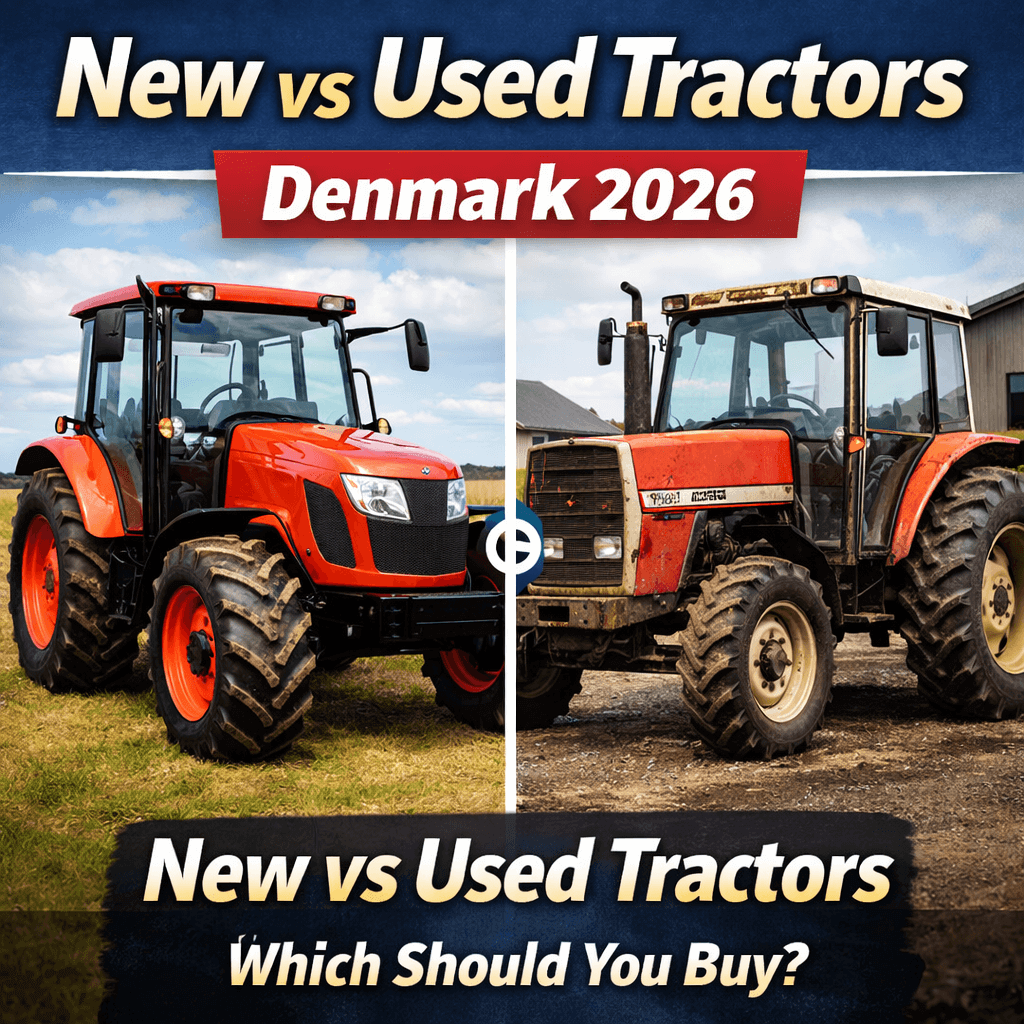
Choosing between new vs used tractors in Denmark is one of the most important financial decisions a Danish farmer makes — and in August 2026 the answer is clearer than it has been in several years. Used tractor supply across Scandinavia has improved significantly since the supply-constrained years of 2021–2023. Prices have softened from their post-COVID peaks. Quality documented machines are available in the 3–6 year bracket at prices that represent genuine value. For most Danish farms, the case for buying used has rarely been stronger. This guide gives you the honest breakdown — prices in DKK, depreciation data, brand comparisons, the best buying window, and answers to every question Danish buyers search before making this decision.
All prices in Danish kroner (DKK) — approximately 1 DKK = 0.14 USD / 0.13 EUR at time of publication. Exchange rates vary; confirm current conversion before budgeting.
👉 Browse our tractor inventory — new and used, worldwide shipping →
New vs Used Tractors in Denmark — Quick Comparison
| Factor | New Tractor | Used Tractor |
|---|---|---|
| Purchase price | Full market value — highest upfront cost | Typically 35–60% lower than new equivalent |
| Warranty | Full 2-year manufacturer warranty standard | Limited or negotiated — varies by seller |
| Depreciation | Loses 15–25% in year one | Steepest depreciation already absorbed |
| Technology | Latest GPS, ISOBUS, Stage V engine, auto-steer | Depends on age — pre-2018 may lack current systems |
| Availability | Factory delivery wait possible — weeks to months | Immediate — ready to work on delivery |
| Running costs | More fuel-efficient modern engine | Older machines use more fuel per hour |
| Service history | Known from day one | Must be verified — key risk factor |
| Financing | Manufacturer-backed deals — 0% finance often available end of year | Dealer or bank financing — terms vary |
| August 2026 market | Prices stable — no significant falls expected | Supply up, prices softer than 2022–2023 — good buying window |
| Best for | Large commercial farms, 1,000+ annual hours, precision farming | Most Danish farms — best overall value in August 2026 |
New vs Used Tractor Prices in Denmark — DKK (August 2026)
| Tractor Class | New Price (DKK) | Used Price (DKK) | Typical Saving |
|---|---|---|---|
| Compact utility (50–80 HP) | 400,000–700,000 | 160,000–380,000 | 40–55% |
| Mid-range farm (100–150 HP) | 900,000–1,500,000 | 400,000–850,000 | 40–50% |
| Large farm (180–250 HP) | 1,500,000–2,500,000 | 700,000–1,300,000 | 40–50% |
| High-horsepower (300 HP+) | 2,500,000–4,000,000+ | 1,200,000–2,200,000 | 35–45% |
For independent market price comparison, TractorHouse.com lists current European tractor sales prices across all major brands. A practical example at current August 2026 market prices: a new John Deere 6155R in Denmark costs approximately 1,200,000–1,400,000 DKK. The same model, 4 years old with 3,500 hours and full service history, currently lists at approximately 650,000–800,000 DKK. That is a saving of 400,000–700,000 DKK on effectively the same machine — with the majority of its productive working life still ahead of it.
👉 Browse current tractor listings — all brands, worldwide shipping →
Is It Better to Buy a New or Used Tractor in Denmark?
For most Danish farms in August 2026 — used. The depreciation mathematics are compelling, Denmark’s used market is exceptionally well-documented by European standards, and supply has improved significantly since 2023. The case for new narrows to specific situations: high annual hours, contractor operations where downtime carries real cost, and buyers who need the latest precision farming technology integrated from day one.
The decision framework:
| Your Annual Hours | Recommendation | Reason |
|---|---|---|
| Under 200 hours/year | ✅ Used — strongly | Fuel efficiency gains from new machine never justify premium at low hours |
| 200–500 hours/year | ✅ Used (3–6 years) | Best value point in Danish market — significant depreciation absorbed |
| 500–800 hours/year | ✅ Used preferred | Run the numbers — used still wins for most operations |
| 800–1,000 hours/year | ⚖️ Either — evaluate | Fuel savings begin to close the gap — compare total cost of ownership |
| Over 1,000 hours/year | ✅ New — justified | Warranty, technology, and fuel efficiency justify premium at high hours |
Depreciation — The Strongest Argument for Buying Used in Denmark
A new tractor in Denmark typically loses 15–25% of its value in year one. By year three, it has lost 35–45% of the purchase price. When you buy a 3–5 year old machine, you enter the ownership cycle after the steepest depreciation curve has already passed — the first owner absorbs the largest loss, and you buy at the bottom of it.
| Age | Typical Residual Value (% of new price) | Brand Variation |
|---|---|---|
| 1 year | 75–85% | John Deere / Fendt hold highest — MF / NH lower |
| 3 years | 55–70% | JD and Fendt 65–70%; MF and NH 55–60% |
| 5 years | 45–60% | JD and Fendt 55–60%; MF and NH 45–52% |
| 7 years | 35–50% | Condition and hours dominate brand premium |
| 10 years | 25–40% | Service history is the primary value driver |
The 3–6 year bracket is the optimal used buying window in Denmark — enough depreciation absorbed to generate real savings, modern enough to have Stage V engines and current technology, and significant working life remaining. In August 2026 this bracket is well-supplied with quality post-harvest Danish trade-ins.
What Is the Main Crop in Denmark — and What Tractor Does It Need?
Denmark’s agricultural sector is dominated by cereal crops and a significant livestock sector — and this shapes the tractor market in specific ways:
| Farm Type | Share of Danish Agriculture | Typical Tractor Requirement |
|---|---|---|
| Cereal / arable (wheat, barley, rapeseed) | ~60% of farmland | Large HP (150–300+ HP) — row crop tractor with precision GPS guidance |
| Pig farming — ~28 million pigs/year | Major export sector | Mid-range utility (80–130 HP) — loader work, feed transport, daily yard use |
| Dairy / mixed livestock | Significant in Jutland | Mid-range (80–150 HP) — daily loader work, silage, CVT transmission preferred |
| Horticulture / specialty crops | Smaller segment | Compact (40–80 HP) — manoeuvrability priority |
Denmark’s large flat arable fields in Jutland and Funen suit high-HP row crop tractors with integrated GPS guidance — the primary reason John Deere and Fendt dominate this market. Livestock operations in the same regions favour mid-range machines with CVT or powershift transmissions for daily feed and yard work.
Most Popular and Most Reliable Tractor Brands in Denmark (2026)
| Brand | Denmark Market Position | New vs Used Verdict | Reliability |
|---|---|---|---|
| John Deere | Dominant — large arable, commercial scale | Used (3–6 years) for most; new for large commercial | ✅ Benchmark in class |
| Fendt | Premium — Vario CVT preferred in high-hour operations | Used for high-hour; new for contractors | ✅ Premium — excellent when serviced |
| Massey Ferguson | Strong mid-market — dairy and mixed farms | Used strongly — depreciates faster, better used value | ✅ Good — strong in MF 5700/6700 Series |
| Valtra | Strong Scandinavian loyalty — mixed and forestry | Either — well-supported in Denmark both ways | ✅ Excellent Nordic track record |
| New Holland | Solid mid-market — competitive pricing | Used — depreciates faster than JD/Fendt | ✅ Good — some DPF issues on Tier 4 units |
| Kubota | Compact and sub-compact segment — hobby farms, horticulture | New for compact segment; used for budget buyers | ✅ Benchmark in compact class |
| Claas | Less dominant than in Germany — present in cereals | Used preferred — competitive pricing | ✅ Strong in harvesting/larger HP |
What Are the Top 3 Tractor Brands in Denmark?
By unit sales in Denmark: John Deere, Fendt, and Massey Ferguson consistently hold the top three positions across most HP segments. Valtra competes closely for third place in mixed and dairy farming. In the compact/sub-compact class, Kubota challenges for top-3 position. By resale value retention: John Deere and Fendt are clearly first and second — the brands that hold their value best in the Danish used market.
What Is the Most Reliable Tractor to Buy in Denmark?
For reliability across ownership, Danish operators and independent surveys consistently point to John Deere (strongest dealer support and parts availability), Fendt (best CVT reliability in the premium class), and Kubota (benchmark in the compact class). The most reliable tractor is ultimately a well-maintained machine from any major brand — maintenance history predicts reliability more accurately than brand alone in the Danish market.
Will Tractor Prices Go Down in 2026?
New tractor prices: unlikely to fall significantly. Stage V emissions compliance costs, input cost pressure from steel and electronics, and stable dealer demand in Denmark’s commercially active arable sector mean prices are holding. The best route to new tractor price concessions in Denmark remains end-of-year dealer deals in November–December.
Used tractor prices: have softened from their 2022–2023 peaks as European supply has recovered. In August 2026 the used market in Denmark is well-supplied — particularly in the 130–180 HP bracket where post-harvest trade-ins are coming to market. This is currently one of the better buying windows for used machines in Denmark in recent years. The softening has been modest, not dramatic — expect 5–15% off 2023 peak prices depending on model and segment, not the 30–40% corrections that some buyers anticipated.
Why Are Farmers Buying 40-Year-Old Tractors?
A growing trend across Denmark and wider Europe — and the reasons are practical, not nostalgic:
- Right to repair — pre-1990 tractors have no software locks, no proprietary diagnostic systems, and no emissions control systems. Any mechanic can work on them with basic tools and standard parts
- Parts availability — classic tractors from major brands have mature aftermarket parts ecosystems. A 1980s Massey Ferguson or John Deere 40 Series has parts available from dozens of suppliers at low cost
- Depreciation floor — a 40-year-old tractor has hit its residual value floor. It won’t depreciate further and well-maintained examples can hold or appreciate
- Low annual hours — a hobby farmer or smallholder running 100–200 hours per year doesn’t need a modern machine. A well-maintained classic at DKK 30,000–80,000 does the same work as a DKK 400,000+ modern compact for light use
- Simplicity — DPF systems, SCR systems, telematics, and electronic controls add cost, complexity, and potential failure points that experienced practical farmers prefer to avoid on machines used lightly
When Is the Best Time to Buy a Tractor in Denmark?
| Time of Year | New Tractors | Used Tractors |
|---|---|---|
| January–March | Weak deals — dealer year-end already closed | Limited trade-in supply — quieter market |
| April–June | Moderate — pre-season purchasing | Moderate supply — spring machinery shows |
| July–August | Moderate — mid-year deals possible | ✅ Good — pre-harvest trade-in activity, improving supply |
| September–October | Good — post-summer promotions | ✅ Best — post-harvest trade-ins flood market, best selection |
| November–December | ✅ Best — year-end dealer targets, 0% finance, added extras | Good — end of season clearance pricing |
August 2026 is a reasonable buying window for used tractors — post-harvest trade-ins are beginning to come to market and supply is better than earlier in the year. For new tractors, November–December remains the strongest window.
What to Look for When Buying a Used Tractor in Denmark
- Service records — Denmark has strong documentation culture. A complete dealer-stamped service history is realistic to find and is the single most important indicator of machine condition
- Hours vs condition — 4,000 hours with documented maintenance is preferable to 2,000 hours with no paperwork. Hours without history tells you nothing useful
- DPF / emissions system — on Tier 4 Final / Stage V machines (post-2014), check the DPF regeneration history. A machine used predominantly at low load or in short cycles can have problematic DPF build-up
- Hydraulic seals — check all hydraulic cylinder rods for weeping seals. Common on higher-hour machines and can escalate if ignored
- Transmission test — test all gears, both PTO speeds, and any powershift or CVT functions under load before purchase
- Import origin — many Danish used tractors are imported from Germany, Netherlands, or France. Verify that service records match the claimed history and that parts are available through Danish dealers
Financing Tractors in Denmark — New vs Used
New tractor financing in Denmark is generally more accessible and more competitive than used. Manufacturer-backed finance from John Deere Financial, AGCO Finance, and CNH Industrial Capital is available through authorised Danish dealers — promotional rates including 0% APR for 12–24 months are common at year-end. EU and Danish agricultural investment support schemes via Landbrug & Fødevarer (Danish Agriculture and Food Council) periodically include equipment investment grants — verify current program availability before signing any purchase contract.
Used tractor financing is available through dealerships and Danish agricultural banks. Dealer-sold used tractors can often be financed through the same manufacturer programs as new. Private used sales require independent bank financing which carries higher rates.
New vs Used Tractors in Denmark — Final Verdict (August 2026)
Buy new in Denmark if:
- You run 1,000+ hours annually and fuel efficiency savings matter over the machine’s life
- You’re a contractor or large commercial operation where unplanned downtime costs are significant
- You need fully integrated precision farming technology from day one
- You plan to buy at year-end (November–December) when finance deals meaningfully improve the economics
Buy used in Denmark if:
- You run fewer than 800 hours annually — fuel efficiency gains from a new machine don’t justify the premium
- You can find a 3–6 year old machine with complete Danish service history — August 2026 supply is good
- You want immediate availability — no factory delivery wait
- Budget is a priority and you want to preserve capital for other farm investment
- You’re adding a second or specialist machine for lighter seasonal work
The honest summary for August 2026: for most Danish farmers, a quality used tractor aged 3–6 years from a well-documented source is the clearest recommendation. The depreciation mathematics, improved supply, and softened prices from 2022–2023 peaks make this one of the better used buying windows Denmark has seen in several years.
Browse our John Deere tractors for sale · Fendt tractors for sale · Massey Ferguson tractors for sale · Kubota tractors for sale · Fendt tractors · Contact us →
👉 Contact our team to discuss which tractor suits your Danish farming operation →
Frequently Asked Questions: New vs Used Tractors in Denmark
Is it better to buy a new or used tractor in Denmark?
For most Danish farms in 2026, a quality used tractor aged 3–6 years with complete service history is the better financial decision. New tractors make more sense for large commercial operations running 1,000+ annual hours where warranty and precision technology justify the premium. Denmark’s well-documented used market makes finding a quality used machine more reliable here than in most European countries.
What is the most popular tractor in Europe?
John Deere is the most popular tractor brand in Europe by unit volume across most HP classes. In Denmark specifically, John Deere dominates large arable operations in Jutland; Fendt leads the premium segment; Massey Ferguson and Valtra are strongest in mixed and dairy farming.
Will tractor prices go down in 2026?
New tractor prices are unlikely to fall significantly — Stage V compliance costs and input cost pressure are holding prices stable. Used tractor prices have softened 5–15% from 2022–2023 peaks as European supply recovered. August 2026 represents a reasonable used buying window — better supply and softer prices than the recent peak years.
What is the main crop in Denmark?
Winter wheat, barley, and rapeseed dominate Danish arable farming — approximately 60% of farmland. Denmark is also a major pig producer (~28 million pigs/year) and has a significant dairy sector, particularly in Jutland. This mix drives demand for large HP arable tractors in cereal areas and mid-range utility machines for livestock operations.
Why are farmers buying 40-year-old tractors?
Right to repair (no software locks), mature aftermarket parts availability, depreciation floor (won’t lose further value), and low cost for buyers who run under 200 hours per year. A well-maintained classic at DKK 30,000–80,000 does the same work as a DKK 400,000+ modern compact for light-use operations — and any mechanic can service it without dealer diagnostic tools.
What is the best time of year to buy a tractor in Denmark?
For new tractors: November–December when dealer year-end targets create genuine flexibility on price, finance rates, and added extras. For used tractors: September–October when post-harvest trade-ins flood the Danish market with the widest selection. August is a reasonable window for used — post-harvest trade-ins are starting to arrive and supply is better than earlier in the year.
What is the most reliable tractor to buy in Denmark?
John Deere (strongest dealer support and parts infrastructure), Fendt (best CVT reliability in the premium class), and Kubota (benchmark in compact class) are most consistently cited. The most reliable tractor is ultimately a well-maintained machine from any major brand — maintenance history is a stronger predictor of reliability than brand in the Danish market.
What are the top 3 tractor brands in Denmark?
By unit sales: John Deere, Fendt, and Massey Ferguson (with Valtra competing closely for third in mixed and dairy farming). By resale value: John Deere and Fendt are clearly first and second in the Danish used market — both hold their value significantly better than the market average.