If you’re searching for a John Deere tractor with loader for sale, you’re considering one of the smartest investments for any farm. John Deere is a global leader in agricultural machinery, known for its quality, innovation, and long-lasting equipment. Adding a front-end loader to a John Deere tractor enhances its versatility, allowing farmers to handle tasks that would otherwise require multiple machines.
From hay bale stacking to soil hauling, a John Deere tractor equipped with a loader can save hours of backbreaking work and increase productivity. At Farmers Equipment, we help farmers and landowners like you locate new and pre-owned John Deere tractors with loaders at affordable prices.
Why Purchase a John Deere Tractor with Loader for Sale?
A John Deere tractor with loader is not just equipment — it’s a productivity investment.
Top reasons to purchase John Deere with a loader:
- Proven Reliability: Decades of trust by farm communities worldwide.
- Versatility: Use the loader for dirt, sand, gravel, hay, compost, or pallets.
- Durability: Heavy-duty steel frames and reliable hydraulic systems.
- User-Friendly: Hydrostatic transmissions and ergonomic cab designs.
- Resale Value: John Deere equipment consistently retains strong resale value.
Browse our John Deere Tractors to see available models →
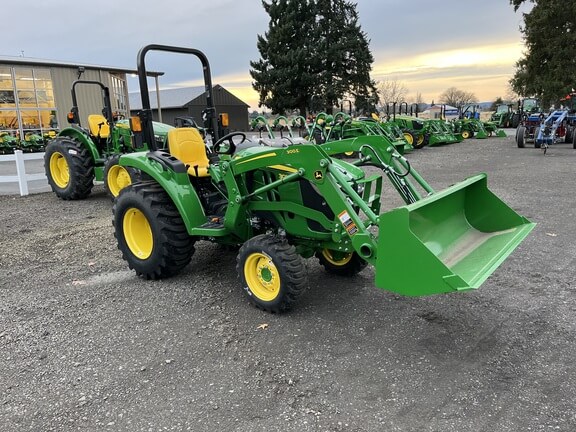
Compact vs. Utility Loader Tractors — Which Class Do You Need?
| Feature | Compact Loader Tractor | Utility Loader Tractor |
|---|---|---|
| HP | 25–40 | 60–110 |
| Lift Capacity | Lower | Higher |
| Turning Radius | Smaller — better in tight spaces | Larger — needs more room to maneuver |
| Best For | Small farms, landscaping, property work | Commercial farms, heavier daily loader cycles |
| Fuel Use | Lower | Higher |
A compact tractor like the 1025R covers most property and small farm loader work. Once you’re moving heavier material daily or running larger implements alongside the loader, a utility-class tractor like the 5065E or 6110M is the better fit.
Buying a John Deere Tractor Online – What to Verify Before Ordering
Online marketplaces like Farmers Equipment make it possible to buy a John Deere tractor without visiting a dealership in person — but that means doing your own verification before committing. Before ordering, confirm:
- Loader model and compatibility: Confirm the specific loader model fitted and that it’s rated for your intended tasks, not just that “a loader” is included.
- Tractor hours (for used units): Ask for the exact hour meter reading and how it compares to the tractor’s age — high hours aren’t automatically a problem if service history backs it up.
- Service records: Request documented maintenance history where available, particularly for hydraulic and engine service.
- Tire condition: Tread depth and sidewall condition affect both safety and near-term replacement cost.
- Hydraulic leaks: Ask specifically whether the loader and any rear remotes have been checked for leaks at the cylinders and hose fittings.
- Included attachments: Get a written list of exactly what’s included — bucket, forks, grapple — since “loader-ready” and “loader-equipped with bucket” are not the same thing.
- Shipping method: Confirm how the tractor will be delivered and who’s responsible for it in transit.
Buying online works well when you do this verification upfront rather than after the tractor arrives.
Affordable John Deere Tractor with Loader – Finding Value
Farmers don’t all have the same budget, and that’s why affordable John Deere tractors with loaders are in such high demand.
- New models: Provide warranties, the newest technology, and a longer service life.
- Used models: Less costly to buy upfront, often well-maintained and dependable.
- Mid-range HP tractors: A sweet spot for affordability and performance — strong enough for loader use, but fuel-efficient for daily use.
Our John Deere 2305 is one of the most affordable entry points in our current range at $4,500 — a solid starting point if budget is the main constraint.
Loader-Specific Buying Advice — What Actually Determines Performance
The tractor’s horsepower gets most of the attention, but these loader-specific factors are what actually determine how the machine performs day to day:
| Loader Feature | Why It Matters |
|---|---|
| Lift Capacity (at pivot pins) | Determines how much material you can safely lift — always check the rating at full height, not just at the ground. |
| Lift Height | Important for loading trailers and stacking bales — measure your typical loading height before assuming a loader is tall enough. |
| Breakout Force | Determines how effectively the bucket can dig into compacted material rather than riding over it. |
| Quick-Attach System | Makes changing buckets, forks, or grapples faster — a genuine time saver on machines that switch tasks often. |
| Third-Function Hydraulics | Required to power grapples and other hydraulically actuated attachments beyond basic curl and lift. |
A few additional details matter as much as the spec sheet:
- Rear ballast: A loaded bucket at full height shifts weight forward significantly. Rear ballast weights or filled rear tires help prevent the front axle from lifting under load — particularly important on compact tractors carrying near their rated capacity. See OSHA’s agricultural equipment safety guidance for broader loader and tractor stability practices.
- Avoiding front axle overload: Exceeding a loader’s rated lift capacity doesn’t just risk tipping — it accelerates wear on the front axle and steering components even when the tractor stays upright.
- Matching bucket size to tractor weight: An oversized bucket on a light tractor can look impressive on paper but overload the machine in practice. Match bucket capacity to what the tractor is actually rated to lift and carry.
- Hydraulic flow vs. horsepower: Loader cycle speed depends on hydraulic flow (GPM), not engine horsepower alone. Two tractors with similar HP can have noticeably different loader responsiveness depending on pump output.
Key Features to Look for in a Loader Tractor
When investing in a John Deere tractor with loader, consider these essential features:
- Horsepower: Compact tractors start at 25 HP, while 65–110 HP models suit mid-size to larger farms.
- Loader Lift Capacity: Match capacity to the weight of soil, bales, or materials you’ll move.
- Transmission Options: Hydrostatic is better for novice operators, while gear drive suits seasoned operators.
- Attachment Compatibility: Make sure your tractor supports rotavators, backhoes, and snow blowers.
- Cab Design: Visibility, operator comfort, and climate control can make long workdays easier.
Contact us to confirm implement compatibility for your John Deere model.
Real Farm Uses for a Loader Tractor
A John Deere with a loader is a serious game-changer on farms, ranches, and even construction sites.
Practical farm uses include:
- Hauling and stacking bales of hay in barns.
- Hauling topsoil, sand, and gravel for land preparation.
- Snow removal during winter.
- Hauling pallets of fertilizers or produce.
- Grading and landscaping land.
- Assisting orchard and vineyard maintenance by hauling compost and mulch.
- Small construction jobs like site grading, backfilling, and digging.
- Municipalities clearing debris from public property or roads.
Best John Deere Models for Loaders
Some of the best John Deere models when paired with loaders are:
- John Deere 1025R (25 HP): Compact and nimble, ideal for small farms and landscaping. See current pricing →
- John Deere 5065E (65 HP): Mid-level utility tractor with solid loader functionality for medium farms. See current pricing →
- John Deere 6110M (110 HP): Large and durable model, excellent for larger farms needing more lifting capacity and hydraulic flow. See current pricing →
All of these models provide reliability, power, and solid loader integration.
Attachments That Take Loader Tractors to the Next Level
Although loaders are powerful, farmers tend to add more implements to enhance their tractor’s performance.
Some common attachments include:
- Rotavators: To till the soil and prepare seedbeds.
- Backhoes: For digging trenches and drainage.
- Snow Blowers: Suitable for winter climates.
- Pallet Forks: To handle crates and heavy farm material.
- Grapples: To carry logs, brush, or bulky material — typically requires third-function hydraulics.
View our backhoe attachments for greater versatility →
John Deere vs Competitors
It’s natural to compare John Deere with other brands like Kubota and Massey Ferguson when buying. John Deere is known for its extensive dealer network and strong resale value, while Kubota is especially popular in the compact tractor segment and Massey Ferguson offers competitive value across many utility models. Which brand is “best” depends on your priorities — dealer proximity, budget, and the specific class of tractor you need all factor in.
Compare our Kubota range or our Massey Ferguson range directly.
New vs Used John Deere Loader Tractors
The new or used decision is based on your needs and budget.
Buying New:
- Comes with warranty.
- New feature availability.
- Longer life span.
- Higher initial cost.
Buying Used:
- Economical.
- Good for part-time or secondary use.
- Reliable if properly maintained.
- May lack the newest technology or warranty.
Check our current tractor listings for available inventory →
Maintenance Tips for Long-Term Use
Regular maintenance makes your tractor deliver optimum performance:
- Replace oil and filters as scheduled.
- Inspect and fill hydraulic systems.
- Lubricate loader joints periodically.
- Clean radiators to avoid overheating.
- Store covered to protect from harsh weather.
Financing Solutions for Farmers
At Farmers Equipment, we offer affordable John Deere tractors through:
- Flexible monthly installment plans.
- Seasonal financing designed for crop cycles.
- Trade-in options for replacing old equipment.
This enables every farmer to own a John Deere loader tractor without straining their budget.
Frequently Asked Questions
Can a compact John Deere handle a loader?
Yes — compact models like the 1025R are designed with loader capability standard or as a compatible option.
How heavy a load can a loader lift?
Varies by model, typically 1,000–1,600 lbs on compact and mid-size tractors, with higher capacity available on larger models like the 6110M. Always check the rated capacity at full lift height, not just at ground level.
Should I buy new or used?
Buy new for long-term daily use; buy used for secondary or budget equipment.
Is it safe to buy John Deere tractors online?
Yes, with a trusted seller — but verify loader compatibility, service records, hours, and included attachments before ordering. See our verification checklist above.
What John Deere models work best with loaders?
The 1025R, 5065E, and 6110M are strong choices across compact, mid-size, and large categories. See our full John Deere range for additional options.
What’s the average price of a John Deere loader tractor?
Pricing varies significantly by size and condition. Compact used tractors in our current stock start around $4,500–$9,000, while larger 100+ HP models run $40,000 and up. Contact us for current pricing on specific models.
Can tractors and attachments be financed together?
Yes, Farmers Equipment finances tractors and implements together.
How fast can loaders be detached or attached?
Many John Deere quick-attach loader systems can be removed in minutes once the operator is familiar with the procedure — exact time depends on the specific loader model and operator experience.
Conclusion
A John Deere tractor with loader for sale is a wise investment for farmers who need versatility, durability, and efficiency. Whether you choose a compact model for smaller farms or a large 100+ HP model for bigger operations, John Deere delivers consistent quality and value.
Check our John Deere tractor listings today and find the perfect tractor with loader for your farm →