Ford tractor serial numbers are the most reliable way to confirm exactly what year a classic Ford was built — and in some cases, what factory it came from. Whether you are trying to verify a seller’s claims, date a tractor for restoration purposes, or confirm parts compatibility before ordering, the serial number is the definitive reference. This guide covers where to find it, how to read it, and what the numbers mean for every major classic Ford model.
Written by: Farmers Equipment editorial team — based on manufacturer production records and established serial number references for classic Ford tractors.
👉 Browse our current Ford tractor inventory →
Ford Tractor Serial Number — Quick Location Reference
| Model | Serial Number Location | Notes |
|---|---|---|
| Ford 9N | Left side of engine block | Below cylinder head |
| Ford 2N | Left side of engine block | Same location as 9N, continuous sequence |
| Ford 8N | Left side of engine block | Below cylinder head; restarted at serial 1 |
| Ford NAA (Jubilee) | Left side of engine block | NAA prefix identifies these immediately |
| Ford 3000 | Right side of engine block | Above the starter motor |
| Ford 4000 | Right side of engine block | Above the starter motor |
| Ford 5000 | Right side of engine block | Above the starter motor |
Where to Find the Serial Number on a Ford Tractor
The serial number location varies by model and era. Here is where to look on each:
| Model | Serial Number Location | Additional Notes |
|---|---|---|
| Ford 9N | Left side of engine block, just below the head | Also on the dealer’s original invoice if available |
| Ford 2N | Left side of engine block, same position as 9N | 2N production ran 1942–1947 during wartime |
| Ford 8N | Left side of engine block, below the cylinder head | Some units also have it on the transmission housing |
| Ford NAA (Jubilee) | Left side of engine block | First Ford with a year-letter prefix in the serial |
| Ford 3000 | Right side of the engine block, above the starter | Thousand Series moved the location from N-Series |
| Ford 4000 | Right side of the engine block, above the starter | Same location as 3000 |
| Ford 5000 | Right side of the engine block, above the starter | Same location as 3000 and 4000 |
Practical tip: bring a wire brush and a rag. Serial numbers on 60–80 year old tractors are often partially obscured by decades of paint, grease, and rust. Clean the area before trying to read it — a rubbing with paper and pencil can help reveal worn digits on the N-Series.
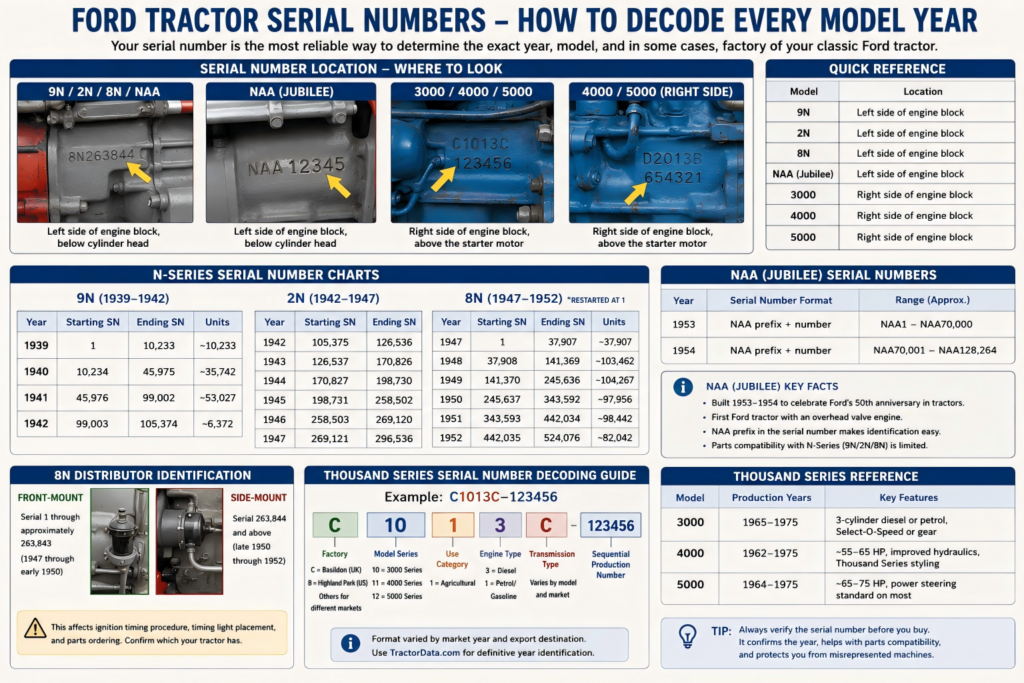
Ford N-Series Serial Numbers — 9N, 2N, and 8N
The Ford N-Series (9N, 2N, 8N) used a simple sequential numbering system with no year prefix. To determine the model year, find where your serial number falls in the production range below.
Ford 9N Serial Numbers (1939–1942)
| Year | Starting Serial Number | Ending Serial Number | Units Produced |
|---|---|---|---|
| 1939 | 1 | 10,233 | ~10,233 |
| 1940 | 10,234 | 45,975 | ~35,742 |
| 1941 | 45,976 | 99,002 | ~53,027 |
| 1942 | 99,003 | 105,374 | ~6,372 |
The 9N was the first production Ford tractor and introduced the revolutionary Ferguson system three-point hitch. Production was halted in 1942 as the US entered World War II and materials were redirected. See our Ford 9N listing for current stock.
Ford 2N Serial Numbers (1942–1947)
| Year | Starting Serial Number | Ending Serial Number |
|---|---|---|
| 1942 | 105,375 | 126,536 |
| 1943 | 126,537 | 170,826 |
| 1944 | 170,827 | 198,730 |
| 1945 | 198,731 | 258,502 |
| 1946 | 258,503 | 269,120 |
| 1947 | 269,121 | 296,536 |
The 2N was the wartime version of the 9N — mechanically identical but built with substitute materials where steel and rubber were rationed. Most 2N tractors that survive have been updated with 9N or 8N parts over the decades.
Ford 8N Serial Numbers (1947–1952)
| Year | Starting Serial Number | Ending Serial Number | Units Produced |
|---|---|---|---|
| 1947 | 1 | 37,907 | ~37,907 |
| 1948 | 37,908 | 141,369 | ~103,462 |
| 1949 | 141,370 | 245,636 | ~104,267 |
| 1950 | 245,637 | 343,592 | ~97,956 |
| 1951 | 343,593 | 442,034 | ~98,442 |
| 1952 | 442,035 | 524,076 | ~82,042 |
The Ford 8N restarted serial numbering at 1 — separate from the 9N/2N sequence. Over 524,000 units were produced, making it the most produced classic Ford tractor. The 8N introduced a 4-speed transmission and position control — significant improvements over the 9N. See our Ford 8N listing.
Important 8N distributor identification: Ford changed the distributor location mid-production — and the order is the opposite of what many sources state. Early 8N units (serial 1 through approximately 263,843, produced 1947 through early 1950) used a front-mount distributor. Later 8N units (serial 263,844 onward, late 1950 through 1952) used a side-mount distributor. This distinction matters for ignition timing procedure, timing light placement, and parts ordering — confirm which your machine has before purchasing ignition components.
Ford NAA (Jubilee) Serial Numbers (1953–1954)
| Year | Serial Number Format | Range |
|---|---|---|
| 1953 | NAA prefix + number | NAA1 – NAA70,000 (approx) |
| 1954 | NAA prefix + number | NAA70,001 – NAA128,264 (approx) |
The NAA Jubilee was produced to mark Ford’s 50th anniversary in the tractor business. It introduced a new overhead valve engine — a significant departure from the flathead used in the N-Series. The NAA prefix in the serial number makes these easy to identify. Parts compatibility with the N-Series is limited due to the engine change.
Ford Thousand Series Serial Numbers — 3000, 4000, 5000
The Thousand Series (introduced 1962–1965 depending on market) used a completely different serial number format from the N-Series. Ford moved to a system that encodes model, factory, and production sequence in a single string.
How to Read a Thousand Series Serial Number
Thousand Series serial numbers follow a more structured format than the simple sequential N-Series numbering. A typical code looks like C1013C — each character encodes specific information about the tractor. Here is how to read it:
| Position | Character | Meaning |
|---|---|---|
| 1st character | C | Factory — C = Basildon (UK), B = Highland Park (US), others for different markets |
| 2nd–3rd characters | 10 | Model series — 10 = 3000 Series, 11 = 4000 Series, 12 = 5000 Series |
| 4th character | 1 | Use category — 1 = Agricultural |
| 5th character | 3 | Engine type — 3 = Diesel, 1 = Petrol/Gasoline |
| 6th character | C | Transmission type |
| Following digits | XXXXXX | Sequential production number |
Example decoded: C1013C = Basildon factory, 3000 Series, Agricultural, Diesel, specific transmission type. This tells you the factory of origin and specification before you even look up the production sequence.
Note: the exact format varied by market year and export destination. For definitive year identification on Thousand Series tractors, cross-reference your serial number with TractorData.com — the most comprehensive free reference for Ford Thousand Series production data. Treat the decode above as a guide to the format, not a universal key.
Ford 3000 Production Years and Key Identifiers
| Production Period | Key Feature | Engine |
|---|---|---|
| 1965–1968 | Early Thousand Series — some overlap with 2000 Series branding | 3-cylinder petrol or diesel |
| 1968–1975 | Updated styling, Select-O-Speed or gear transmission | 3-cylinder diesel standard in most markets |
See our Ford 3000 listing for current stock and confirmed year on our units.
Ford 4000 Production Years and Key Identifiers
| Production Period | Key Feature | HP |
|---|---|---|
| 1962–1964 | Early 4000 — sometimes called 4000 Super Major in some markets | ~53 HP |
| 1965–1975 | Thousand Series redesign — new sheet metal and improved hydraulics | ~55–65 HP |
See our Ford 4000 listing.
Ford 5000 Production Years and Key Identifiers
| Production Period | Key Feature | HP |
|---|---|---|
| 1964–1968 | First generation 5000 — introduced as the most powerful Ford in the range | ~65 HP |
| 1968–1975 | Updated Thousand Series styling, power steering standard on most | ~65–75 HP |
See our Ford 5000 listing.
Why the Serial Number Matters When Buying
Beyond confirming the model year, the serial number tells you four important things before you buy:
- Confirms the seller’s stated year — a seller who claims a 1950 Ford 8N but can’t produce a serial number starting in the 245,637–343,592 range is either mistaken or misrepresenting the machine
- Parts compatibility — on the Ford 8N specifically, the serial number tells you which distributor the tractor was built with (side vs front mount), which affects ignition parts ordering
- Theft and title verification — in states or countries where classic tractors require title documentation, the serial number is the primary identifier
- Restoration accuracy — for collectors wanting to restore a tractor to its correct year specification, the serial number is the starting point for confirming original equipment
What to Do If the Serial Number Is Missing or Unreadable
On machines that have been repainted multiple times or stored outdoors for years, the serial number stamping can be partially or fully obscured. Options:
- Clean the area thoroughly — use a wire brush, solvent, and good lighting before concluding it is unreadable
- Pencil rubbing — place paper over the stamping and rub gently with a pencil. Often reveals digits that are invisible to the eye
- Acid reveal — a small amount of ferric chloride solution applied to a cleaned steel surface can reveal stamped numbers that have been ground or painted over. This is a last resort and should be done carefully
- Check the registration or title — some classic tractors in the US have title documentation with the serial number recorded from original sale
A machine with a missing or unreadable serial number is not automatically a dealbreaker — but it does mean you cannot verify the year, confirm parts compatibility, or check for theft history. Price accordingly. For full pre-purchase guidance see our Used Ford Tractor Inspection Checklist →
Common Serial Number Mistakes Buyers Make
- Trusting the paint colour as proof of year — Ford grey and red is not a reliable indicator of model year. Many tractors have been repainted, sometimes in correct colours that don’t match the actual production year
- Confusing model codes with serial numbers — the part numbers stamped on components (like C3NN- prefix parts) are Ford engineering codes, not serial numbers. The serial number is on the engine block only
- Assuming engine number = tractor serial number — on tractors that have had engine replacements during restoration, the engine block serial number may belong to a different tractor. Cross-check with the transmission casting date codes where visible
- Ignoring decal inconsistencies — aftermarket decal sets are widely available for classic Fords. A tractor with fresh period-correct decals is not necessarily an unrestored original. Serial number verification is more reliable than decal condition
- Misreading worn digits — a worn 3 can look like an 8, and a worn 6 can look like a 0 on old engine block stampings. If you are uncertain about a digit, use the pencil rubbing method or consult a specialist before ordering parts based on that year
- Assuming the distributor type from the year alone — on Ford 8N tractors, both front-mount and side-mount distributors appear across multiple production years. Always confirm which distributor is physically fitted before ordering ignition parts
Can Ford Tractor Serial Numbers Be Faked?
Yes — but it is uncommon on classic tractors, and detectable if you know what to look for. Serial number fraud is more of a concern on high-value collector machines than on working farm tractors, but it is worth understanding:
- Inspect the stamp depth — original factory stampings are deep and consistent. Re-stamped numbers often show uneven depth or slightly different font weight from character to character
- Look for grinding marks — a freshly ground area around the serial number location (smoother than the surrounding casting) suggests the original stamping was removed
- Check the surrounding casting — original stampings sit within the natural texture of the engine block casting. A stamped area that is suspiciously smooth or polished warrants further investigation
- Compare with casting date codes — Ford engine blocks have separate casting date codes that pre-date final assembly. If the casting date is inconsistent with the serial number year, investigate further
- Ask for supporting documentation — original bill of sale, title documents, or registration records that list the serial number from original purchase are strong supporting evidence of authenticity
For most buyers of working classic Ford tractors in the $2,000–$6,000 range, serial number fraud is not a significant risk. It becomes more relevant when purchasing a machine represented as a rare first-year example or a particularly low-serial-number collector piece.
Verdict
The Ford tractor serial number is the single most reliable piece of identification on any classic Ford — more reliable than the seller’s memory, the paint colour, or the decals. For N-Series tractors, the tables above give you the model year directly from the number. For Thousand Series machines, use TractorData.com to confirm. Always verify the serial number before finalising any purchase.
Browse current stock: Ford tractors for sale →
Frequently Asked Questions
Where is the serial number on a Ford 8N tractor?
On the left side of the engine block, below the cylinder head. Clean the area with a wire brush before trying to read it — decades of paint and grease commonly obscure the stamping on older machines. Some 8N units also have the number on the transmission housing.
How do I know what year my Ford 8N is?
Find the serial number on the left side of the engine block and match it to the production ranges: 1947 (1–37,907), 1948 (37,908–141,369), 1949 (141,370–245,636), 1950 (245,637–343,592), 1951 (343,593–442,034), 1952 (442,035–524,076). The Ford 8N restarted serial numbering at 1 — separate from the 9N sequence.
How do I know what year my Ford 9N is?
Match your serial number to these ranges: 1939 (1–10,233), 1940 (10,234–45,975), 1941 (45,976–99,002), 1942 (99,003–105,374). Numbers above 105,374 are Ford 2N tractors produced during wartime.
What is the difference between a Ford 9N and 2N serial number?
The 9N and 2N share a continuous serial number sequence — the 2N picked up where the 9N left off at serial number 105,375. There is no prefix change between the two models. The only way to confirm whether a machine in the 105,375–296,536 range is a 2N rather than a late 9N is by checking specific features — the 2N used cast iron wheels and a magneto ignition in early production due to wartime material restrictions.
How do I find the year of a Ford 3000, 4000, or 5000 tractor?
The Thousand Series used a more complex serial number format than the N-Series. Cross-reference your serial number at TractorData.com, which maintains the most comprehensive free database for Ford Thousand Series production records. The serial number is stamped on the right side of the engine block, above the starter motor.