Buying a used tractor in Sweden is one of the smartest ways to get quality farm machinery at a fraction of the new price — but only if you know what to look for. A tractor that looks clean and runs fine on a short test drive can be hiding tens of thousands of kronor in hidden faults. This checklist covers everything you need to inspect before committing to a purchase.
At Farmers Equipment Co., we supply inspected used tractors to buyers across Sweden and the Nordic region. Based on real inspections of farm machinery supplied across Sweden, this checklist reflects the most common issues found on used machines from brands like John Deere, Valtra, Fendt, and Massey Ferguson — all known for strong parts availability and resale value in Sweden. We’re sharing it here so you can apply the same standard to any used tractor purchase.
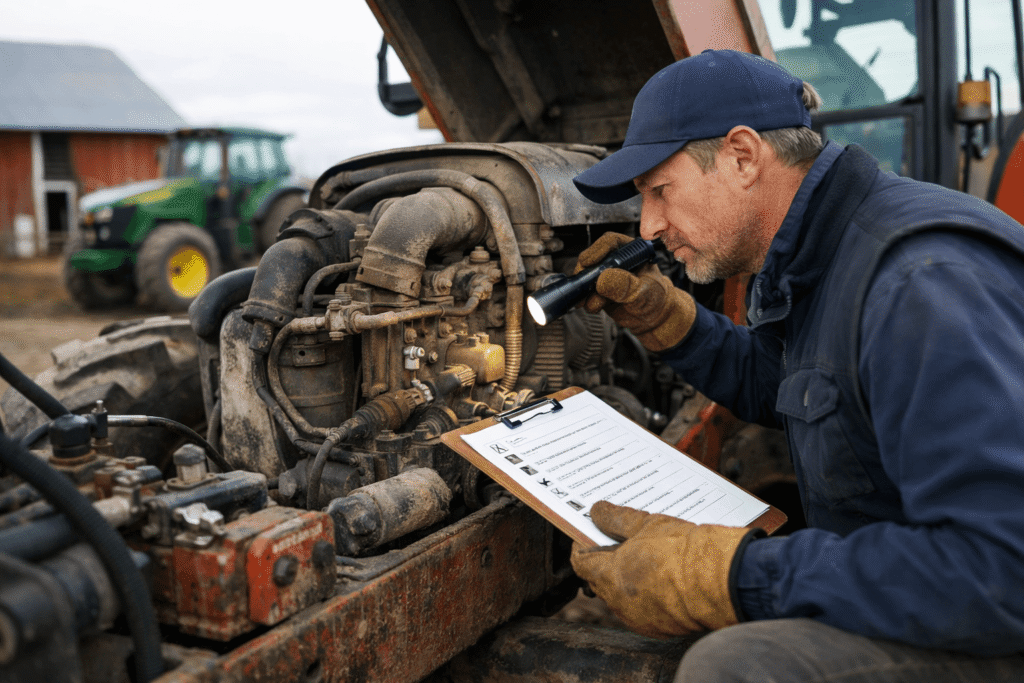
What to Check When Buying a Used Tractor in Sweden
- Cold start engine test — non-negotiable
- Exhaust smoke colour (blue, black, or persistent white = red flag)
- Transmission performance across all gear ranges
- Hydraulic system and three-point linkage
- PTO engagement and operation
- Tyre condition and sidewall integrity
- Full service history and documentation
- Test drive on varied ground before any offer
Before You Go — Preparation
The biggest mistakes buyers make happen before they even see the tractor. Good preparation saves you from wasted trips and costly purchases. Before browsing used tractors for sale in Sweden, take the time to work through these steps.
- Research the model thoroughly — know the common faults, typical service costs, and expensive parts for that specific machine. Brand manufacturer sites and owner forums are useful starting points.
- Ask key questions before visiting — hours, major repairs, winter storage history, service records. If the seller can’t answer these, that’s already informative.
- Check market prices — browse current listings for the same make, model, year, and hours to judge whether the asking price is fair.
- Bring a torch, gloves, and overalls — you’ll need to get underneath and into dark corners. A powerful torch reveals leaks, cracks, and rust that are otherwise invisible.
- Consider bringing a mechanic — an experienced tractor mechanic will spot problems in minutes that a buyer might miss. The cost (typically 1,500–3,000 SEK) is minimal compared to the risk of buying a problem machine.
Always view a used tractor in daylight on a dry day — wet conditions hide oil leaks, rust, and tyre damage. And never buy a tractor you haven’t seen start from cold. This is where most engine problems reveal themselves.
1. Engine and Exhaust — The Most Important Check
The engine is the most expensive component on any tractor. A major engine overhaul on a mid-range farm machine in Sweden can cost 40,000–150,000 SEK. Give it serious attention.
- Cold start test — non-negotiable. Insist the engine is cold when you arrive. A warm engine masks smoking, hard starting, and many issues that disappear at operating temperature.
- Exhaust smoke colour — blue smoke indicates burning oil; black smoke points to a fuelling issue; white smoke that persists after warmup suggests head gasket problems. All are red flags.
- Unusual engine noises — knocking or tapping sounds can indicate worn bearings or valve train issues. Investigate before making any offer.
- Oil condition — pull the dipstick. Oil should be dark amber to brown. Milky oil (coolant contamination) is a serious warning sign.
- Leaks underneath — get under the tractor with a torch. Look for fresh oil around the sump, gearbox, and rear axle. Minor seeps are common on older machines; significant pooling is not.
- Hour meter vs wear — cross-reference the hours against pedal rubber, seat, and cab control wear. Excessive wear for the stated hours is a red flag for meter tampering.
- DPF/SCR systems (post-2014 models) — ask for records of DPF regeneration and check for dashboard warning lights. These systems are expensive to service if neglected.
2. Transmission and Gearbox
A gearbox rebuild on a mid-range tractor in Sweden can reach 60,000–120,000 SEK. Test every gear methodically.
- Test every gear range including reverse — hesitation, grinding, or refusal to engage cleanly are warning signs
- Check for transmission slipping under load — drive uphill or engage a heavy implement if possible
- Listen for whining or grinding from the gearbox in gear and during changes
- Check transmission oil — discoloured, burnt-smelling, or contaminated oil signals neglected maintenance
- Test diff-lock and 4WD — both should engage and release cleanly at low speed
3. Hydraulics and Three-Point Linkage
The hydraulic system powers implements, the three-point hitch, and front loaders. Problems here are costly and directly affect how useful the machine is on your farm.
- Raise and lower the linkage fully — it should move smoothly and hold position without drifting. A hitch that drops slowly under load indicates worn seals or a failing pump.
- Hydraulic leaks — inspect all lines, rams, and connection points. Minor seeps can be managed; major leaks should reduce the offer price significantly.
- Hydraulic oil condition — clean oil should be amber to light red. Dark or cloudy oil means the system hasn’t been maintained on schedule.
- Front loader (if fitted) — raise, lower, curl and dump through full range. Check for cylinder drift at full height and inspect all pivot points for wear.
4. PTO (Power Take-Off)
- Engage and disengage the PTO under no load — it should release smoothly with no juddering or grinding
- Test both 540 and 1000 rpm settings if present
- Inspect the PTO shaft and safety guard — missing guards are a safety hazard and a sign of careless ownership
- Test under load if possible — connecting a mower or pump is the most reliable way to check PTO clutch condition
5. Tyres, Wheels and Axles
New rear tyres for a mid-to-large tractor in Sweden typically cost 8,000–25,000 SEK each — making tyre condition one of the most significant price factors when buying a used tractor in Sweden. When comparing different farm tractors for sale in Sweden, tyre wear alone can justify a 20,000–50,000 SEK difference in offer price.
- Rear tread depth — worn lugs reduce traction significantly, especially in Sweden’s wet spring and autumn conditions
- Sidewall cracking — tyres stored in Swedish winters are prone to UV and frost cracking. Cracked sidewalls mean replacement regardless of tread depth
- Wheel rims — check for cracks, bends, or heavy rust
- Front axle play — grip the front wheel at 3 and 9 o’clock and rock it. Any play indicates worn king pins or wheel bearings
6. Cab, Controls and Electrical Systems
Electrical gremlins on modern tractors with CANBUS systems can be particularly costly to diagnose and resolve — factor this into any offer if issues are found.
- Dashboard warning lights — observe carefully once the ignition cycle completes. Any lights that remain need investigation
- All cab controls and switches — lights, indicators, wipers, heating, air conditioning, joystick controls
- Water ingress — look for staining on the headliner, mould, or rust at the base of cab pillars. Common in tractors stored outdoors in Sweden, and expensive to fix
- GPS/precision farming systems — verify subscriptions are active and equipment is functioning. Some systems carry annual fees
7. Frame, Chassis and Bodywork
- Frame cracks or repairs — look for weld repairs or fresh paint on the chassis. A cracked main frame is typically uneconomical to fix
- Rust — Swedish winters with road salt accelerate rust. Check under the bonnet, around the battery tray, chassis rails, and cab base
- ROPS integrity — the roll-over protection structure must be intact and straight. A bent or repaired ROPS is a serious safety concern — avoid the machine
- Linkage attachment points — check for excessive wear on all three-point linkage pins and bushes
According to Jordbruksverket (Swedish Board of Agriculture), agricultural machinery must meet specific safety standards including intact ROPS certification for operator protection. A damaged ROPS doesn’t just affect resale — it may affect insurance and legal compliance.
| 🚨 Walk Away Immediately If: |
|---|
| The seller won’t allow a cold start |
| No service history is available |
| The seller avoids or dismisses your questions |
| A test drive is refused |
| You’re pressured to decide on the spot |
8. Service Records and Documentation
Documentation is as important as the physical inspection. A machine with a complete, verifiable service history is worth significantly more than an identical tractor with missing records — and for good reason.
- Full service history — ideally dealer-stamped or with original invoices. Large gaps in the service record are a red flag
- Repair invoices — ask to see receipts for any major work: engine rebuilds, new tyres, hydraulic repairs, gearbox work
- No outstanding finance — in Sweden, tractors can be sold with outstanding finance. If you buy a machine with undisclosed finance, the lender may have a legal claim on it. Ask the seller to confirm in writing
- Proof of ownership — when buying privately, confirm the seller’s identity matches the documentation
The LRF (Lantbrukarnas Riksförbund), Sweden’s farmers’ federation, provides useful guidance on private machinery transactions and buyer rights in Sweden.
9. The Test Drive — Essential
Never finalise any used tractor purchase in Sweden without driving it first. Even 15 minutes on varied ground reveals far more than a static inspection alone. If a seller refuses, walk away.
- Drive at multiple speeds in both directions — listen for vibrations, noises, and handling irregularities
- Test steering both directions to full lock — should be light and responsive with no play
- Test brakes firmly at moderate speed — must stop straight without pulling to one side
- Drive on uneven or sloped ground — reveals axle, suspension, and structural issues invisible on flat terrain
- Re-check after reaching operating temperature — look again for smoke, listen for new noises, check temperature gauges
Pro tip: after the test drive, park on clean ground and let it idle for 5 minutes. Move the tractor forward and check where it was parked — any fresh fluid drips on clean ground are immediately visible.
Popular Used Tractor Models in Sweden Worth Looking For
If you’re not sure which model to target, these are the used machines we most commonly supply to Swedish buyers — all with strong parts availability and a solid track record in Nordic conditions:
| Model | Type | Why It Works in Sweden |
|---|---|---|
| John Deere 6155M | Mid-range utility | Reliable, strong resale value, widely supported across Sweden |
| Valtra T174 | Mid-high HP utility | Nordic-engineered, excellent for mixed farming and challenging terrain |
| Fendt 724 Vario | Premium utility | Best-in-class fuel efficiency and CVT transmission for high-hour operations |
| Massey Ferguson 6716S | Mid-range farm | Strong value for money, excellent parts network across Scandinavia |
| Kubota L3901 | Compact utility | Best compact choice for small farms and property maintenance |
10. Typical Repair Costs in Sweden (2026)
Knowing what repairs cost helps you negotiate price or decide whether a machine is worth buying at all. These are approximate costs at Swedish tractor dealerships in 2026:
| Repair / Service | Estimated Cost (SEK) | Severity |
|---|---|---|
| New rear tyres (per pair) | 16,000 – 50,000 | High |
| Engine overhaul (mid-range) | 40,000 – 150,000 | Very High |
| Gearbox / transmission rebuild | 60,000 – 120,000 | Very High |
| Hydraulic pump replacement | 15,000 – 40,000 | High |
| DPF / SCR system service | 8,000 – 25,000 | High |
| Front axle king pin replacement | 5,000 – 15,000 | Medium |
| Hydraulic hose replacement (set) | 3,000 – 8,000 | Low–Medium |
| Cab water ingress repair | 5,000 – 20,000 | Medium |
| Full service (major interval) | 4,000 – 10,000 | Routine |
Use this table when negotiating. If an inspection reveals worn tyres, a needed DPF service, and hydraulic hose issues, that’s potentially 30,000–80,000 SEK of upcoming costs — which should be reflected in the purchase price. Always get dealer quotes before making an offer based on identified faults.
Before You Buy — Compare Against Verified Listings
Once you’ve completed your inspection, compare what you’ve found against professionally inspected machines. A verified listing gives you a benchmark for condition, pricing, and documentation — especially useful if you’re unsure whether the faults you’ve found are typical for the model or signs of something more serious.
All used tractors we list at Farmers Equipment Co. come with pre-delivery inspection reports, full specification details, and warranty coverage — giving you a clear standard to compare against any private or dealer purchase you’re evaluating.
If you’re still deciding between new and used, see our full comparison of new vs used tractors for sale in Sweden before committing.
👉 Compare inspected used tractors across Sweden — ready for delivery →
👉 View verified listings with full inspection reports →
👉 Get expert advice before you buy — avoid costly mistakes →
Common Mistakes When Buying a Used Tractor in Sweden
Most costly used tractor purchases come down to one of these mistakes — and most of them are avoidable.
| Mistake | Why It’s Costly |
|---|---|
| Buying without a cold start test | Hides smoking, hard starting, and engine issues worth 40,000–150,000 SEK to fix |
| Ignoring service history | No records = no visibility on what’s been neglected — a major financial risk |
| Trusting the hour meter blindly | Meters can be tampered with — cross-check against visible wear on seat, pedals, and controls |
| Skipping the test drive | Transmission slipping, steering faults, and brake issues only reveal themselves under load |
| Choosing price over condition | A cheap tractor with worn tyres, DPF issues, and hydraulic leaks can cost more than buying right first time |
| Not checking for outstanding finance | In Sweden, a lender can legally claim a tractor sold with undisclosed debt — even from a new owner |
Frequently Asked Questions: Buying a Used Tractor in Sweden
What should I check when buying a used tractor in Sweden?
The most important checks are: cold start engine test, exhaust smoke colour, transmission across all gears, hydraulic system and three-point linkage, PTO operation, tyre condition, cab and electrics, and a full review of service documentation. Always test drive before buying — never skip it.
How many hours is too many on a used tractor in Sweden?
Under 5,000 hours is considered low-to-medium use for a mid-range farm tractor. Machines with 6,000–10,000 hours can still offer good value if major components have been maintained. Above 10,000 hours, the price should reflect significantly reduced remaining component life — and service history becomes even more important.
Should I get an independent inspection before buying?
Yes — always. An independent inspection by a qualified mechanic or authorised dealer technician typically costs 1,500–3,000 SEK. It’s the single best investment you can make before any used tractor purchase. Most problems that cost tens of thousands to fix are invisible to the untrained eye on a first viewing.
What documents should I ask for when buying a used tractor?
Full service history, original repair invoices, proof of ownership, and written confirmation that there’s no outstanding finance on the machine. Missing or incomplete documentation should either reduce the price significantly or be reason enough to walk away.
Can I trust hour meter readings on used tractors in Sweden?
Not always. Compare the displayed hours against wear on the seat, pedal rubbers, and cab controls. Excessive wear relative to stated hours suggests tampering. If the reading seems implausibly low for the machine’s age or visible condition, factor it into your offer accordingly.
Ready to find a verified used tractor for your Swedish farm?
Browse inspected used tractors for sale in Sweden →
Talk to our team before you buy →