This Kioti tractor review gives you the honest picture — what Kioti tractors do well, where they fall short, how they compare to Kubota and John Deere, what the common problems are, and whether they are worth buying in 2026. Kioti is manufactured by Daedong Corporation, a South Korean company that has been building tractors since 1947 and entered the North American market in 1993. They are the third-largest compact tractor brand in North America — not a fringe brand, not a budget compromise, but a genuine alternative to the market leaders at a competitive price point.
👉 See the 2025 Kioti CS2530 — $30,000. Factory cab, 24.5 HP, 4WD, backhoe compatible →
Written by: Farmers Equipment editorial team.
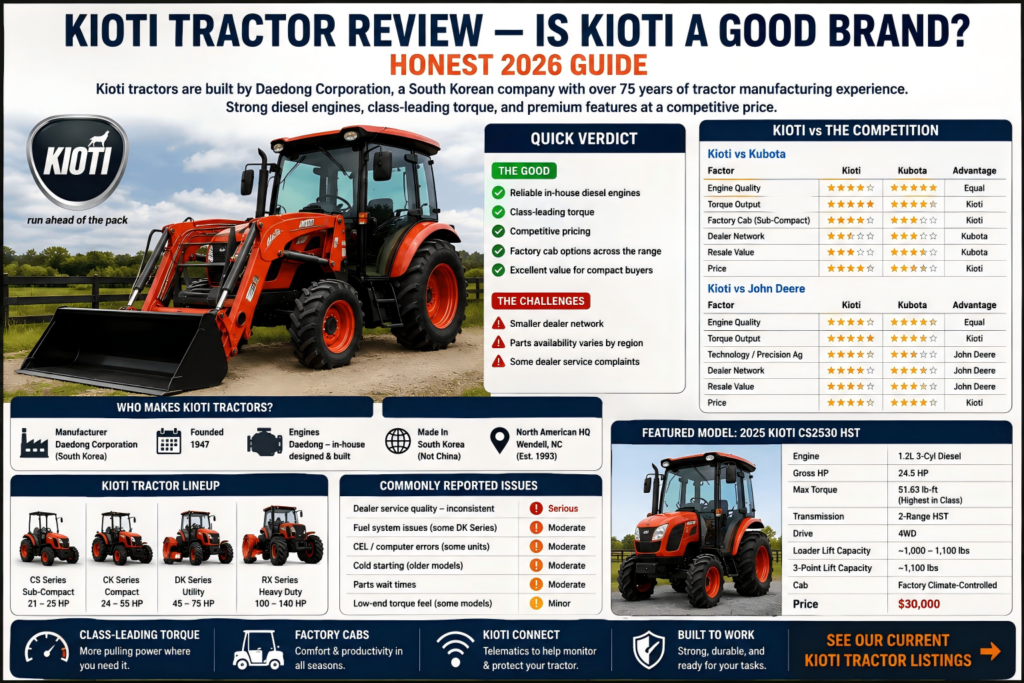
Kioti tractor — quick verdict:
✅ Reliable diesel engines built in-house by Daedong
✅ Class-leading torque figures across multiple model lines
✅ Competitive pricing against Kubota and John Deere equivalents
✅ Factory cab options across the range — genuine operator comfort
✅ Strong value for compact and sub-compact buyers
⚠️ Dealer network smaller than Kubota or John Deere — important to verify local service before buying
⚠️ Parts availability varies by region — less universal than the major brands
⚠️ Customer service complaints exist — primarily dealer-level, not factory-level issues
👉 See the 2025 Kioti CS2530 listing — $30,000 →
Are Kioti Tractors Good Quality?
Yes — Kioti tractors are good quality for their price class. For independent specification data, TractorData.com lists Kioti specs without commercial bias. The key context: Kioti builds its own engines through parent company Daedong Corporation, which has been manufacturing diesel engines since 1983. This vertical integration — designing and producing the engine, transmission, and tractor in-house — gives Kioti more control over quality than brands that source engines externally.
Build quality in the compact and sub-compact segments is genuinely competitive with Kubota and John Deere. Frame construction, hydraulic system quality, and powertrain durability are all well-regarded by experienced owners. Where Kioti has historically fallen short of the market leaders is in fit and finish details, electronics and telematics maturity, and dealer network density. The 2025 models — particularly the CS30 Series — address the electronics gap significantly with the KIOTI Connect telematics system.
| Quality Category | Kioti Rating | vs Kubota | vs John Deere |
|---|---|---|---|
| Engine reliability | ⭐⭐⭐⭐⭐ | Equal | Equal |
| Transmission durability | ⭐⭐⭐⭐ | Slightly below | Slightly below |
| Hydraulic system | ⭐⭐⭐⭐ | Equal | Equal |
| Cab comfort (factory cab models) | ⭐⭐⭐⭐⭐ | Above | Above in sub-compact class |
| Fit and finish | ⭐⭐⭐⭐ | Slightly below | Slightly below |
| Electronics and telematics | ⭐⭐⭐⭐ | Equal (recent models) | Below |
| Dealer network | ⭐⭐⭐ | Below | Below |
| Parts availability | ⭐⭐⭐ | Below | Below |
| Value for price | ⭐⭐⭐⭐⭐ | Above | Above |
Who Makes Kioti Tractors — And Their Engines?
Kioti tractors are manufactured by Daedong Corporation, a South Korean agricultural machinery company founded in 1947 and headquartered in Daegu, South Korea. Daedong has been building tractors since the 1950s and developed its own multi-cylinder diesel engine technology in 1983 — meaning Kioti engines are not sourced from Honda, Yanmar, or another third party. They are Daedong-designed and Daedong-built engines.
Kioti USA was established in 1993 to serve the North American market, operating out of Wendell, North Carolina. The tractors are assembled in South Korea and shipped to North America — they are not made in China, despite this being a common search question. Daedong is a publicly traded company on the Korea Stock Exchange (KRX: 000490).
| Item | Detail |
|---|---|
| Parent company | Daedong Corporation (South Korea) |
| Founded | 1947 |
| Engine manufacturer | Daedong — in-house designed and built |
| Manufacturing location | South Korea — not China |
| North American operations | Kioti USA — Wendell, North Carolina (est. 1993) |
| Market position | Third-largest compact tractor brand in North America |
| Engine certification | EPA, CARB, and EEC certified |
Is Kioti as Good as Kubota?
In most practical respects, yes — particularly in the compact and sub-compact segments where both brands compete most directly. The honest comparison:
| Factor | Kioti | Kubota | Verdict |
|---|---|---|---|
| Engine quality | Daedong in-house diesel — excellent reputation | Kubota diesel — benchmark reputation | Equal in practice |
| Torque output | Class-leading in multiple segments | Strong but not leading | Kioti advantage |
| Factory cab (sub-compact) | CS2530 — industry first factory cab in sub-compact class | BX series — open station or aftermarket cab | Kioti significant advantage |
| Dealer network | Growing — smaller than Kubota | Largest in compact tractor market | Kubota advantage |
| Parts availability | Good but not universal | Excellent — broadest parts network | Kubota advantage |
| Resale value | Lower — less brand recognition | Highest in class | Kubota advantage |
| Purchase price | Typically 10–20% less for equivalent spec | Premium pricing | Kioti advantage |
| Warranty | Competitive — verify current terms | Strong — well-established | Roughly equal |
Bottom line: if a Kubota dealer is nearby and resale value matters — buy the Kubota. If you want more torque, a factory cab at sub-compact size, or better value for money and there is a competent Kioti dealer within a reasonable distance — the Kioti is genuinely competitive. The machine quality is not the reason to choose Kubota over Kioti. The dealer network and resale value are.
Compare models directly: Kubota tractors for sale →
Is Kioti as Good as John Deere?
| Factor | Kioti | John Deere | Verdict |
|---|---|---|---|
| Engine quality | Daedong diesel — strong reputation | Yanmar-sourced (1 Series) or in-house — varies by model | Equal in compact class |
| Torque output | Class-leading in multiple segments | Competitive — not the torque leader | Kioti advantage |
| Factory cab (sub-compact) | CS2530 — factory climate-controlled cab | 1025R — open station; factory cab available but expensive | Kioti advantage at price point |
| Technology / precision ag | KIOTI Connect telematics (recent models) | JDLink and Operations Center — industry leading | John Deere significant advantage |
| Dealer network | Growing — smaller | Largest in the industry | John Deere significant advantage |
| Brand recognition and resale | Lower | Highest in industry | John Deere significant advantage |
| Purchase price | 15–25% less for comparable spec | Premium — most expensive in class | Kioti advantage |
| Parts availability | Good — not universal | Excellent — universal | John Deere advantage |
Bottom line: John Deere’s advantages over Kioti are dealer network, technology ecosystem, and resale value — not machine quality at the compact tractor level. If you are farming commercially and need parts on a Tuesday morning anywhere in the country, John Deere’s dealer density is a genuine operational advantage. If you are a rural property owner or small farmer who can plan service appointments, the Kioti gives you more machine for the money.
Kioti Tractor Common Problems
Honest reviews require honest problem disclosure. The most commonly reported Kioti tractor issues:
| Problem | Models Affected | Severity | Notes |
|---|---|---|---|
| Dealer service quality — inconsistent | All models | 🔴 Serious — most common complaint | Not a machine problem — a dealer network problem. Varies significantly by location |
| Fuel system issues (some DK Series) | DK4510, some DK models | 🟠 Serious on affected units | Fuel pump and injector failures reported on some early DK units — warranty coverage disputes have been reported |
| CEL / computer errors (some units) | Newer models with electronics | 🟡 Moderate | Emissions system related — more common on machines used in conditions outside design parameters |
| Cold starting (older models) | Older CK and DK Series | 🟡 Moderate | Some owners report needing more glow plug time in cold weather — normal diesel behaviour on older engines |
| Parts wait times | All models | 🟡 Moderate | Less stocked at local dealers than Kubota/JD — some owners report longer wait times for non-common parts |
| Low-end torque feel (some models) | Older units — lugged down on hills | 🟡 Minor | Some owners note the engine prefers to be kept in the power band rather than lugging — manageable with correct gear selection |
Important context on the complaints: the most visible negative reviews of Kioti tractors — including a 1.7-star rating on one consumer review site — centre primarily on dealer service experiences and warranty claim disputes, not on fundamental machine quality failures. A machine that fails to get warranty support is a serious problem regardless of the cause, but it reflects the dealer network rather than the engineering. Verifying your local Kioti dealer’s reputation before purchasing is more important with Kioti than with Kubota or John Deere, where dealer quality is more consistent nationally.
Are Kioti Parts Hard to Get?
More so than Kubota or John Deere — this is a genuine limitation to be aware of. The practical reality in 2026:
- Common maintenance parts (filters, belts, standard seals) — generally available through Kioti dealers and online suppliers within a few days
- Model-specific mechanical parts — may require ordering through the Kioti dealer network, with lead times of 1–2 weeks in some cases
- Electronic and emissions system parts — dealer-only on most recent models; lead times vary
- Rural and remote locations — parts availability is the most significant concern for owners far from a Kioti dealer
The mitigation: Kioti’s parts network has improved significantly since 2020 as the brand has grown. For owners near a competent Kioti dealer, parts availability is not the practical problem it was for earlier owners. For owners in remote areas, this remains a legitimate concern that Kubota and John Deere handle better.
What Is the Lifespan of a Kioti Tractor?
A well-maintained Kioti tractor should provide 4,000–6,000+ hours of service life — comparable to other quality compact tractor brands. The Daedong diesel engine has a strong reputation for longevity when maintained on schedule. The key variables are maintenance adherence (oil changes, filter changes, hydraulic fluid) and operating conditions. Kioti tractors used in dusty or demanding conditions without proper maintenance intervals will not achieve their potential lifespan — the same is true of any brand.
There is not yet a long-term resale data set for Kioti as extensive as Kubota’s, simply because Kioti has had a shorter North American presence. Early CS and CK Series machines from the late 1990s and 2000s that have been maintained are still working — which is the best available evidence for the brand’s durability.
Is Kubota Suing Kioti?
This is a commonly searched question. Kubota has historically pursued patent and trade dress litigation against compact tractor competitors in the North American market — this is well-documented. Whether any active litigation between Kubota and Kioti/Daedong exists at the time of publication should be verified through current legal databases, as litigation status changes. The existence of such disputes is not unusual in the compact tractor market and does not directly affect machine quality or parts availability for existing owners.
Featured Model — 2025 Kioti CS2530 HST
The machine currently available from Farmers Equipment is the 2025 Kioti CS2530 — the standout model in Kioti’s current lineup for one specific reason: it is the industry’s first sub-compact tractor with a factory-installed, climate-controlled cab. Every competitor in this class offers open station ROPS as standard, with factory cab as an expensive option or aftermarket addition. The CS2530 includes it as standard at $30,000.
| Specification | 2025 Kioti CS2530 HST |
|---|---|
| Engine | Daedong 1.2L 3-cylinder liquid-cooled diesel |
| Gross HP | 24.5 HP |
| Max torque | 51.63 lb-ft — highest in sub-compact class |
| Transmission | 2-range hydrostatic (HST) |
| Drive | 4WD standard |
| Cab | Factory climate-controlled — heat, A/C, premium suspension seat |
| Loader lift capacity | ~1,000–1,100 lbs |
| 3-point lift capacity | ~1,100 lbs (Category 1) |
| Backhoe compatible | Yes — removable rear panel design |
| Telematics | KIOTI Connect capable |
| Price | $30,000 |
Full manufacturer specifications are available at Kioti.com.
👉 See the 2025 Kioti CS2530 listing — $30,000 →
Who Should Buy a Kioti Tractor
- ✅ Buyers who want more torque per dollar than Kubota or John Deere offer
- ✅ Sub-compact buyers who want a factory climate-controlled cab — CS2530 is the only option in class
- ✅ Property owners and small farmers within reasonable distance of a competent Kioti dealer
- ✅ Buyers who prioritise machine capability over brand name resale value
- ✅ Buyers who have done their dealer research and found a well-regarded local Kioti dealer
Who Should Consider Alternatives
- ⚠️ Commercial farmers who need parts on short notice — Kubota or John Deere dealer density is a genuine operational advantage
- ⚠️ Buyers in remote areas with no nearby Kioti dealer — parts wait times are a real concern
- ⚠️ Buyers for whom resale value is a priority — Kubota holds value better
- ⚠️ Buyers who want the most advanced precision ag technology — John Deere’s Operations Center ecosystem is ahead of KIOTI Connect
Compare alternatives: Kubota tractors · John Deere tractors →
Verdict — Kioti Tractor Review
Kioti tractors are genuinely good machines — not a budget compromise, not a brand to avoid, but a real alternative to Kubota and John Deere for buyers who do their homework on local dealer support. The engineering is competitive, the torque figures lead the class in multiple segments, and the 2025 CS2530’s factory climate-controlled cab in the sub-compact class is a genuine industry breakthrough that no competitor has matched.
The risks are equally clear: dealer quality is inconsistent, parts take longer to source in some regions, and resale value trails the market leaders. These are not reasons to dismiss Kioti — they are reasons to research your local dealer before buying, the same due diligence any informed equipment buyer should apply.
For buyers near a strong Kioti dealer who want more machine for the money: it is worth serious consideration. For buyers who need the broadest parts network and highest resale value regardless of purchase price: Kubota is the safer choice.
👉 See current Kioti CS2530 listing — $30,000. Factory cab, 4WD, class-leading torque →
Also available: Massey Ferguson tractors · Branson tractors · Full tractor range →
Frequently Asked Questions
Are Kioti tractors good quality?
Yes — Kioti tractors offer genuine quality in the compact and sub-compact segments, with in-house Daedong diesel engines that have a strong reliability reputation. Build quality is competitive with Kubota and John Deere at equivalent price points. The primary limitations are dealer network density and parts availability compared to the market leaders, not machine quality itself.
Is Kioti as good as Kubota?
In machine quality, yes — Kioti is competitive with Kubota in the compact and sub-compact segments. Kubota’s advantages are dealer network density, parts availability, and resale value — not engine or hydraulic quality. If a strong Kubota dealer and resale value matter more than price or torque, buy the Kubota. If you want more torque per dollar and there is a competent Kioti dealer nearby, Kioti is a genuine alternative.
Is Kioti as good as John Deere?
In machine quality at the compact tractor level, yes. John Deere’s advantages are technology ecosystem (JDLink, Operations Center), dealer density, and resale value. Kioti’s advantages are purchase price (typically 15–25% less) and torque output. For commercial operators who need parts anywhere on short notice, John Deere’s dealer network is a genuine operational advantage. For private property owners and small farmers, the machine quality difference does not justify John Deere’s price premium.
Who makes Kioti tractor engines?
Daedong Corporation — Kioti’s parent company — designs and manufactures Kioti’s diesel engines in-house. Kioti engines are not Honda, Yanmar, or any other third-party engine. Daedong developed its own multi-cylinder diesel engine technology in 1983 and has been refining it for over 40 years. Kioti tractors are made in South Korea, not China.
What are common problems with Kioti tractors?
The most frequently reported issues: inconsistent dealer service quality (the most common complaint — varies by location), fuel system issues on some DK Series models, CEL and emissions system errors on some newer models, parts wait times in areas with limited dealer presence, and cold-starting behaviour on older engines in very cold conditions. Most serious complaints centre on dealer service and warranty claim handling rather than fundamental machine failures.
Are Kioti parts hard to get?
More so than Kubota or John Deere. Common maintenance parts are generally available within a few days through dealers and online suppliers. Model-specific mechanical parts may require ordering with 1–2 week lead times. Electronic and emissions parts are typically dealer-only. For owners near a well-stocked Kioti dealer, parts availability has improved significantly since 2020. For remote locations, this remains a legitimate concern that the major brands handle better.