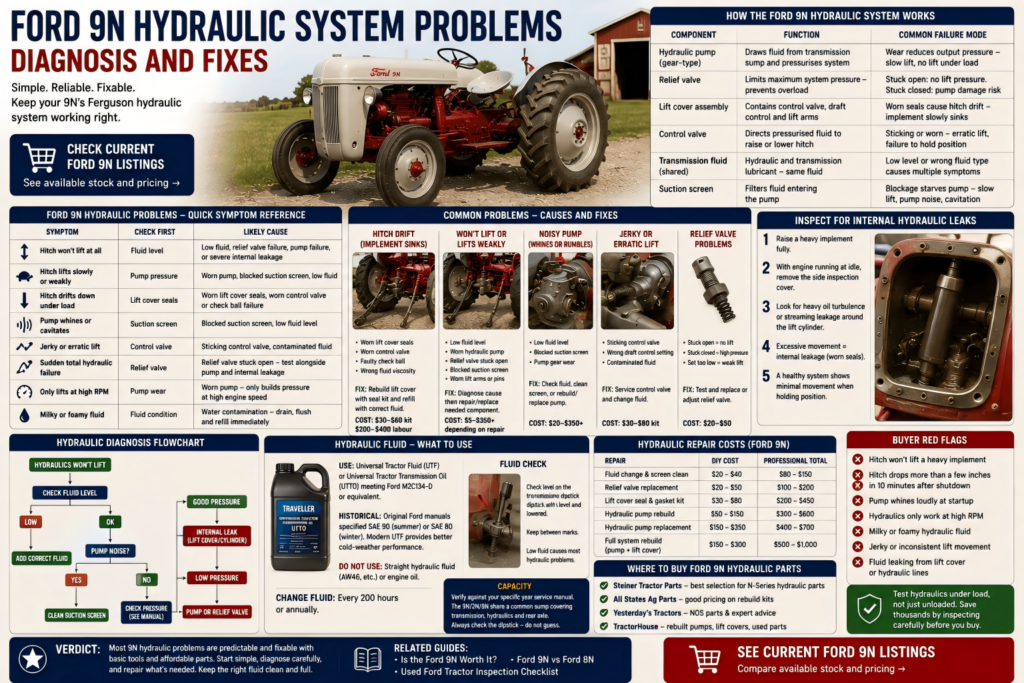
Ford 9N hydraulic system problems follow predictable patterns on these 80-year-old machines — the Ferguson hydraulic system fitted to the 9N is simple and well-documented, which means most problems can be diagnosed with basic tools and fixed with affordable parts. The most common complaints are hitch drift (implement slowly sinking under load), failure to lift under load, noisy pump, and slow or jerky lift response. This guide covers every common hydraulic problem on the Ford 9N, how to diagnose each one, what it costs to fix, and where to buy parts.
👉 Check current Ford 9N listings — see available stock and pricing →
Written by: Farmers Equipment editorial team — specialising in classic Ford tractors from the N-Series through the Thousand Series.
Ford 9N Hydraulic System — How It Works
The Ford 9N uses the Ferguson hydraulic system — a gear-driven hydraulic pump mounted inside the transmission case, sharing fluid with the transmission. This is a non-live system: hydraulic power is only available when the transmission is in gear and the engine is running. There is no independent hydraulic pump circuit. Understanding this design explains why certain problems occur and how they are resolved:
| Component | Function | Common Failure Mode |
|---|---|---|
| Hydraulic pump (gear type) | Draws fluid from transmission sump and pressurises the system | Wear reduces output pressure — slow lift, no lift under load |
| Relief valve | Limits maximum system pressure — prevents overload | Stuck open: no lift pressure. Stuck closed: pump damage risk |
| Lift cover assembly | Contains the control valve, draft control mechanism, and lift arms | Worn seals cause hitch drift — implement slowly sinks |
| Control valve | Directs pressurised fluid to raise or lower the hitch | Sticking or worn — erratic lift, failure to hold position |
| Transmission fluid (shared) | Hydraulic and transmission lubricant — same fluid | Low level or wrong fluid type causes multiple symptoms |
| Suction screen | Filters fluid entering the pump | Blockage starves pump — slow lift, pump noise, cavitation |
Ford 9N Hydraulic Problems — Quick Symptom Reference
| Symptom | Check First | Likely Cause |
|---|---|---|
| Hitch won’t lift at all | Fluid level | Low fluid, relief valve failure, pump failure, or severe internal leakage |
| Hitch lifts slowly or weakly | Pump pressure | Worn pump, blocked suction screen, low fluid |
| Hitch drifts down under load | Lift cover seals | Worn lift cover seals, worn control valve, check ball failure |
| Pump whines or cavitates | Suction screen | Blocked suction screen, low fluid level |
| Jerky or erratic lift | Control valve | Sticking control valve, contaminated fluid |
| Sudden total hydraulic failure | Relief valve | Relief valve stuck open — test alongside pump and internal leakage |
| Only lifts at high RPM | Pump wear | Worn pump — only builds pressure at high engine speed |
| Milky or foamy fluid | Fluid condition | Water contamination — drain, flush, and refill immediately |
Ford 9N Hydraulic System Problems — Symptom Diagnosis
Problem 1 — Hitch Drift: Implement Slowly Sinks Under Load
Hitch drift is the most common Ford 9N hydraulic complaint. The implement raises correctly but slowly sinks back down while working or at rest under load.
| Likely Cause | Diagnosis | Fix | Cost |
|---|---|---|---|
| Worn lift cover seals | Raise hitch, stop engine, load the implement — hitch sinks within minutes | Lift cover gasket and seal kit | $30–$60 kit; $200–$400 with labour |
| Worn or scored control valve | Drift continues after new seals fitted | Control valve replacement or lift cover rebuild | $80–$200 parts |
| Faulty check ball in control valve | Hitch drops rapidly even under light load | Check ball and seat replacement — part of lift cover kit | Included in lift cover rebuild kit |
| Incorrect fluid viscosity | Drift worsens in warm weather | Drain and refill with correct fluid — see fluid section below | $20–$40 fluid cost |
Problem 2 — Hitch Won’t Lift or Lifts Weakly
The hitch raises slowly, fails to lift under load, or doesn’t raise at all.
| Likely Cause | Diagnosis | Fix | Cost |
|---|---|---|---|
| Low fluid level | Check transmission dipstick — simplest check first | Top up with correct fluid | $5–$15 |
| Worn hydraulic pump | Hitch lifts unloaded but fails under implement weight; pressure test confirms low output | Pump rebuild or replacement | $80–$200 rebuild kit; $150–$350 replacement pump |
| Relief valve stuck open | No lift at all — pressure bleeds off through relief valve before reaching lift cylinder | Relief valve replacement | $20–$50 part |
| Blocked suction screen | Pump whines or cavitates; slow lift even unloaded | Remove and clean suction screen | DIY — no parts cost |
| Worn lift arms or pins | Lift arm movement visible but hitch won’t raise implement | Inspect lift arm pins and bushings | $50–$150 parts |
Problem 3 — Noisy Hydraulic Pump
Whining, grinding, or cavitation noise from the pump area.
| Noise Type | Likely Cause | Fix |
|---|---|---|
| High-pitched whine | Low fluid level or blocked suction screen — pump cavitating | Check fluid level first; clean suction screen |
| Grinding or rumbling | Pump gear wear — common on high-hour 9N machines | Pump rebuild or replacement |
| Noise only under load | Pump marginal — adequate for light use but worn | Monitor and plan pump rebuild |
| Noise worse when cold | Fluid viscosity issue or pump wear — improves as fluid warms | Confirm correct fluid; if persists, inspect pump |
Problem 4 — Jerky or Erratic Lift
The hitch raises in surges rather than smoothly, or overshoots the set position.
- Most likely cause: worn or sticking control valve — the valve is not opening and closing smoothly
- Secondary cause: incorrect draft control setting for the implement being used
- Also check: fluid condition — old, contaminated fluid causes erratic valve behaviour
- Fix: lift cover service including control valve cleaning or replacement, fresh fluid
Problem 5 — Relief Valve Symptoms
The relief valve on the Ford 9N is a small spring-loaded ball valve that limits maximum system pressure. It fails in two directions:
| Relief Valve Condition | Symptom | Risk | Fix |
|---|---|---|---|
| Stuck open | No lift at all — pressure bleeds off continuously | No immediate mechanical damage | Replace relief valve — $20–$50 |
| Stuck closed | Hitch lifts normally but system runs at excessive pressure | Pump seal damage, hose failure, lift cover damage | Replace immediately — $20–$50 |
| Set too low | Hitch lifts light loads but fails under heavy implements | No damage but reduced capability | Adjust or replace with correct specification |
How to diagnose a bad relief valve: if the hitch will not lift at all but the pump sounds normal (no whining or cavitation), relief valve failure is one possible cause and should be tested alongside pump output and internal leakage. A worn pump, severe internal leakage, a damaged lift cylinder, or a stuck control valve can produce identical symptoms. A pressure test is the reliable differentiator — zero or near-zero lift pressure with the pump running and pump confirmed healthy points to the relief valve or severe internal leakage rather than pump output failure.
What Is the Most Common Cause of Ford 9N Hydraulic Failure?
Based on the pattern of problems reported by Ford 9N owners, the most common cause of hydraulic failure in order of frequency is:
- Low or incorrect fluid — the simplest cause, checked first
- Worn lift cover seals — causes hitch drift, the most common complaint
- Worn hydraulic pump — causes weak or no lift under load on high-hour machines
- Blocked suction screen — causes pump noise and slow lift, often overlooked
- Failed relief valve — causes sudden total lift failure
What Hydraulic Fluid Does a Ford 9N Use?
This is one of the most important — and most frequently misunderstood — maintenance questions on the Ford 9N. The transmission and hydraulic system share the same fluid, so the correct specification matters for both systems:
| Fluid Type | Recommendation |
|---|---|
| Correct fluid type | Universal Tractor Fluid (UTF) or Universal Tractor Transmission Oil (UTTO) meeting Ford M2C134-D or equivalent — the most practical choice for 2026 |
| Historical note | Original Ford manuals for the 9N specified heavier mineral oils (SAE 90 in summer, SAE 80 in winter). Modern UTF/UTTO provides better cold-weather hydraulic performance than these early recommendations and is what most experienced owners use today |
| Specific recommendations | Quality UTF/UTTO from Traveller, Kubota UDT, or equivalent — verify the product meets M2C134-D or New Holland 134D specification |
| What NOT to use | Straight hydraulic fluid (AW46, etc.) — lacks the friction modifiers required for the shared transmission system |
| What NOT to use | Engine oil — incorrect viscosity and additive package for this system |
| Capacity | Verify against your specific year service manual — the 9N/2N/8N share a common sump covering transmission, hydraulics, and rear axle that holds substantially more than a hydraulic-only system. Always check the dipstick rather than relying on a volume figure alone |
Fluid change interval: every 200 hours or annually, whichever comes first. Old, contaminated fluid is a common cause of erratic hydraulic behaviour and accelerated pump wear on the 9N.
How to Check If the Hydraulic Filter Is Clogged
The Ford 9N does not have a conventional replaceable hydraulic filter element — it uses a suction screen inside the transmission case. A clogged suction screen is often overlooked because owners assume “no filter to change” means nothing to clean:
- Drain the transmission fluid
- Remove the inspection cover on the transmission case — location varies, consult the Ford 9N service manual for your specific year
- Locate the suction screen — a mesh screen on the pump intake
- Remove and clean with solvent and compressed air
- Inspect for damage — replace if torn or deformed
- Reinstall, refill with fresh UTTO fluid, and recheck hydraulic performance
Symptoms of a clogged suction screen: pump whine at startup, slow lift even unloaded, pump noise that worsens under load. These symptoms often improve dramatically after screen cleaning and a fresh fluid change.
Ford 9N Hydraulic Lift Cover Rebuild
The lift cover is the most commonly rebuilt component in the Ford 9N hydraulic system. A lift cover rebuild kit contains new seals, gaskets, check ball and seat, and related components. The rebuild restores hitch hold and lift capacity on machines with worn seals:
- Rebuild kit cost: $30–$80 depending on supplier and kit completeness
- DIY time: 3–5 hours for a first-time lift cover rebuild
- Professional labour: $150–$300 in addition to parts
- Where to buy: Steiner Tractor Parts, All States Ag Parts, Yesterday’s Tractors — see the parts section below for links
A lift cover rebuild is one of the most effective restorations on a Ford 9N — a machine that previously drifted badly or failed to hold implements under load will hold correctly after a thorough lift cover rebuild with fresh seals.
Ford 9N Hydraulic Pump Rebuild
The hydraulic pump on the Ford 9N is a gear-type pump driven from the transmission. Rebuild kits are available and most mechanically confident owners can complete the rebuild:
- Rebuild kit cost: $50–$150
- Replacement pump cost: $150–$350 (aftermarket remanufactured)
- DIY time: 4–6 hours including removal, rebuild, and reinstallation
- Professional cost: $300–$600 total (parts plus labour)
- When to rebuild vs replace: rebuild if pump body and gears show moderate wear; replace if gears are heavily scored or pump body is damaged
Inspecting Internal Hydraulic Leaks
One of the most effective diagnostic methods used by experienced Ford 9N owners requires no specialist tools — only the side inspection cover removed and a heavy implement on the hitch:
- Attach a heavy implement to the three-point hitch and raise it fully
- With the engine running at idle, remove the side inspection cover on the transmission/hydraulic sump
- Observe the fluid inside — look for heavy turbulence, visible streaming leakage around the lift cylinder, or fluid being forced back through passages under pressure
- Excessive internal leakage — visible fluid movement even when the hitch is in the held position — confirms worn seals rather than pump failure
- A healthy system shows minimal internal fluid movement when the hitch is stationary in the raised position
This visual inspection distinguishes between worn lift cover seals (which cause internal leakage visible through the cover) and pump failure (which causes inadequate pressure build-up rather than leakage back through the system). It is faster and cheaper than a formal pressure test and is the first step taken by most experienced classic Ford mechanics.
Hydraulic Repair Costs — Ford 9N
| Repair | DIY Cost | Professional Total |
|---|---|---|
| Fluid change and suction screen clean | $20–$40 | $80–$150 |
| Relief valve replacement | $20–$50 | $100–$200 |
| Lift cover seal and gasket kit | $30–$80 | $200–$450 |
| Hydraulic pump rebuild | $50–$150 | $300–$600 |
| Hydraulic pump replacement | $150–$350 | $400–$700 |
| Full hydraulic system rebuild (pump + lift cover) | $150–$300 | $500–$1,000 |
Where to Buy Ford 9N Hydraulic Parts
- Steiner Tractor Parts — comprehensive N-Series hydraulic catalogue: lift cover kits, pump rebuild kits, relief valves, seals, and gaskets. Recommended for quality N-Series parts
- All States Ag Parts — competitive pricing on pump kits and lift cover rebuild kits
- Yesterday’s Tractors — good source for NOS (new old stock) original Ford parts and community technical advice
- TractorHouse — useful for sourcing rebuilt pumps and lift covers from dealers specialising in classic Fords
Hydraulic Problems to Watch for When Buying a Ford 9N
Before purchasing any Ford 9N, test the hydraulic system under load — not just unloaded. Specific red flags:
- Hitch won’t lift a heavy implement — attach the heaviest available implement and confirm full lift. A hitch that raises unloaded but fails under weight indicates pump wear or internal leakage
- Hitch drops rapidly after engine shutdown — raise the hitch, shut the engine off, return in 10 minutes. More than a few inches of drop in that time indicates lift cover seal wear
- Pump whines loudly at startup — cavitation noise at startup that clears quickly may be low fluid. Persistent whine indicates suction screen blockage or pump wear
- Hydraulics only work at high RPM — a worn pump that only builds pressure at high engine speed is near the end of its useful life
- Milky or foamy hydraulic fluid — water contamination. Drain and inspect before any further use; contaminated fluid accelerates pump and seal wear significantly
- Jerky or inconsistent lift movement — sticking control valve or contaminated fluid; less serious than pump failure but requires lift cover service
See our full Used Ford Tractor Inspection Checklist for a complete pre-purchase walkthrough →
Verdict — Ford 9N Hydraulic System Problems
Ford 9N hydraulic system problems are predictable and fixable. Start with the simple checks — fluid level, fluid condition, suction screen — before assuming a major repair is needed. Most hitch drift issues resolve with a lift cover rebuild kit and fresh fluid. Most weak-lift complaints on high-hour machines trace to pump wear and resolve with a pump rebuild or replacement. The Ferguson hydraulic system was designed to be serviced in the field with basic tools, and after 80 years that serviceability remains one of the 9N’s most practical attributes.
For related guides: Is the Ford 9N Worth It? · Ford 9N vs Ford 8N · Used Ford Tractor Inspection Checklist →
Also available: Ford 8N · Ford 3000 · Ford 4000 · Ford 5000
👉 See current Ford 9N listings →
Frequently Asked Questions
What are the symptoms of Ford 9N hydraulic system problems?
Five main symptoms: (1) hitch drift — implement slowly sinks under load; (2) hitch fails to lift or lifts weakly under implement weight; (3) pump whine or cavitation noise, especially at startup; (4) jerky or erratic lift response; (5) hitch raises but drops rapidly even under light load. Most of these symptoms have straightforward causes — start with fluid level and condition before pursuing more involved repairs.
What hydraulic fluid does a Ford 9N use?
Most owners today use a quality Universal Tractor Fluid (UTF) or UTTO meeting Ford M2C134-D or New Holland 134D specification. Original Ford manuals specified heavier mineral oils, but modern UTF provides better cold-weather performance and is the practical choice for regular use. Do not use straight hydraulic fluid (AW46) or engine oil — both lack the correct additive package. Change every 200 hours or annually. Verify capacity against your specific year service manual — the shared 9N sump covers transmission, hydraulics, and rear axle and holds substantially more than a hydraulic-only system.
What are the symptoms of a bad relief valve on a Ford 9N?
A relief valve stuck open causes sudden total lift failure — the hitch will not raise at all despite the pump sounding normal. A relief valve stuck closed causes the system to run at excessive pressure — the hitch lifts normally but pump seals and hoses are at risk of damage. Replacement cost is $20–$50 for the valve itself. Always replace the relief valve when rebuilding the hydraulic system.
How do I know if the hydraulic filter is clogged on a Ford 9N?
The Ford 9N uses an internal suction screen rather than a replaceable filter element. A clogged suction screen causes pump whine at startup, slow lift even with no implement attached, and pump noise that worsens under load. To check: drain the fluid, remove the transmission inspection cover, and clean the suction screen with solvent and compressed air. This is one of the most frequently overlooked maintenance items on the 9N.
How much does it cost to fix a Ford 9N hydraulic system?
A fluid change and suction screen clean: $20–$40 DIY. Lift cover seal rebuild: $30–$80 in parts DIY, $200–$450 with labour. Hydraulic pump rebuild: $50–$150 parts DIY, $300–$600 total with labour. A full hydraulic system rebuild covering both pump and lift cover: $150–$300 in parts DIY, $500–$1,000 with professional labour.