Knowing the fair price classic Ford tractor before you buy is the single most valuable piece of research you can do — and it is straightforward once you understand what drives the market. Classic Ford tractors range from $800 for a rough non-running 9N to $18,000+ for a fully restored Ford 5000 with a quality loader. The right price for any specific machine depends on model, condition, transmission type, and what the regional market is doing at the time of sale. This guide gives you price ranges for every model, explains the factors that move value up or down, and tells you exactly where to check current prices before making an offer.
👉 See our current Ford tractor listings — compare available stock →
Written by: Farmers Equipment editorial team — specialising in classic Ford tractors from the N-Series through the Thousand Series.
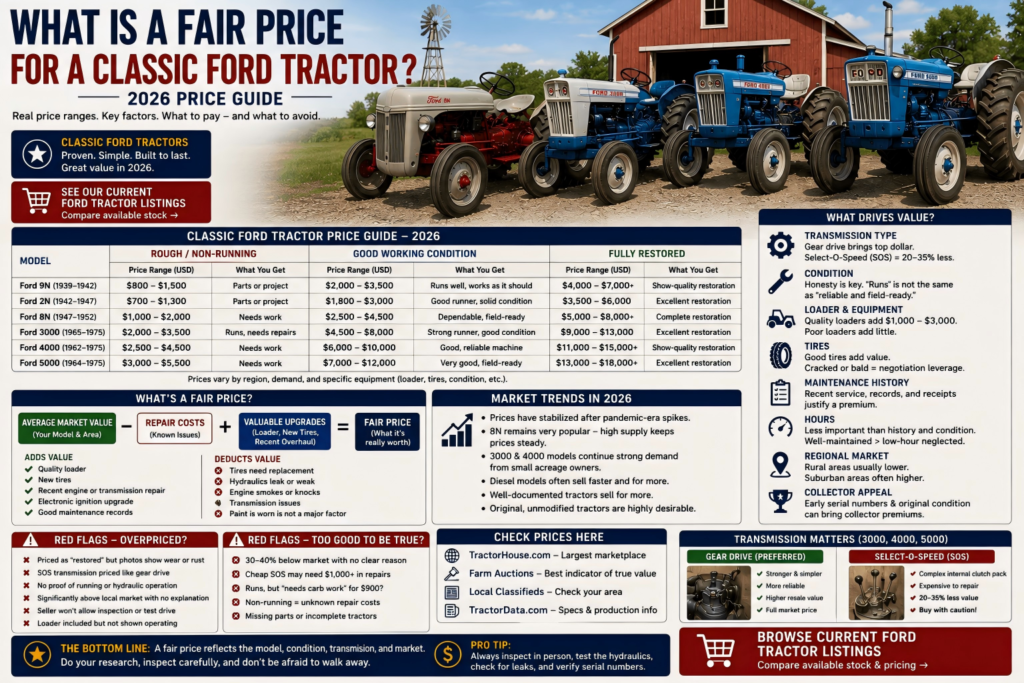
Classic Ford Tractor Price Guide — 2026
| Model | Rough / Non-Running | Good Working Condition | Fully Restored |
|---|---|---|---|
| Ford 9N (1939–1942) | $800–$1,500 | $2,000–$3,500 | $4,000–$7,000+ |
| Ford 2N (1942–1947) | $700–$1,300 | $1,800–$3,000 | $3,500–$6,000 |
| Ford 8N (1947–1952) | $1,000–$2,000 | $2,500–$4,500 | $5,000–$8,000+ |
| Ford 3000 (1965–1975) | $2,000–$3,500 | $4,500–$8,000 | $9,000–$13,000 |
| Ford 4000 (1962–1975) | $2,500–$4,500 | $6,000–$10,000 | $11,000–$15,000+ |
| Ford 5000 (1964–1975) | $3,000–$5,500 | $7,000–$12,000 | $13,000–$18,000+ |
Important notes on this table: these are national market ranges based on typical transaction prices in 2026. Regional variation is significant — rural markets often price lower than suburban markets where hobby farmers are competing for stock. Loader-equipped examples command a $1,000–$3,000 premium for a quality matched loader. Select-O-Speed transmission variants sell at a significant discount — typically 20–35% below equivalent gear drive examples.
How Much Is a Ford 8N Worth in 2026?
The Ford 8N is the most traded classic tractor in the United States — high transaction volume means market pricing is relatively stable and well-established. In 2026, expect to pay:
| Condition | Price Range | What It Gets You |
|---|---|---|
| Non-running / rough | $1,000–$2,000 | Runs but needs significant work, or doesn’t start — parts machine or project |
| Running, needs work | $2,000–$3,000 | Starts and drives, known issues, not inspected or serviced |
| Good working condition | $3,000–$4,500 | Starts reliably, hydraulics work, recently serviced or inspected |
| Very good — recent service | $4,000–$5,500 | Recently serviced, new points/plugs/carb, tight hydraulics, clean |
| Fully restored | $5,500–$8,000+ | Full mechanical and cosmetic restoration, typically show-quality |
A 1950 Ford 8N in good working condition sells for $3,000–$4,500 in most US markets. The same machine with a documented fresh tune-up, new tyres, and tight hydraulics sits at the upper end of that range. A 1950 8N with deferred maintenance and unknown history sits at the lower end — and should be priced accordingly.
What Factors Determine a Classic Ford Tractor’s Value?
Eight factors move classic Ford tractor prices significantly:
1. Transmission Type — the single biggest variable
Gear drive versus Select-O-Speed (SOS) is the most important pricing variable on Thousand Series Fords (3000, 4000, 5000). A gear drive machine in good condition commands full market price. A Select-O-Speed machine sells at a 20–35% discount — because buyers know the SOS transmission is a serious and expensive failure risk. Always confirm which transmission a Thousand Series machine has before referencing a price guide.
2. Condition tier — running vs working vs restored
The difference between a “starts and runs” machine and a “reliably working farm tractor” is $1,000–$2,000 on most classic Fords. The difference between a working tractor and a fully restored example is another $2,000–$4,000 on N-Series machines and $3,000–$6,000 on Thousand Series machines. Be honest about which tier the machine you are considering actually falls into — many sellers price a tired machine as though it were a good working example.
3. Loader — quality matters as much as presence
A quality original or OEM-matched loader fitted to a classic Ford adds $1,000–$3,000 to market value. An unknown fabricated loader or a loader with deteriorated cylinders and damaged bucket adds little and may actually complicate the sale. A loader that is genuinely matched to the tractor — correct hydraulic connections, proper mounting brackets, functional bucket and cylinders — is the one that commands a premium.
4. Hours — less important than most buyers think
Classic Ford tractors that have been well maintained often have odometer-style hour meters that have rolled over or been replaced. Hours matter less than maintenance history and current mechanical condition. A 3,000-hour Ford 8N that has been serviced regularly is a better buy than a 1,200-hour machine that has been neglected. Ask for evidence of maintenance rather than fixating on the hour count.
5. Tyres — a condition flag
Good tyres on a classic Ford add value and signal care. Cracked, flat-spotted, or bald tyres are both a cost (new tyres run $400–$900 for a set on most classic Fords) and a signal about the seller’s broader attention to maintenance. A machine with poor tyres should be priced lower — or you should factor the replacement cost into your offer.
6. Recent service — documented history commands a premium
A classic Ford with a documented recent tune-up (points, plugs, carb service on N-Series; injection service on Thousand Series diesel), fresh oil, working hydraulics, and known maintenance history is worth paying a premium for — because it reduces the unknown cost you are absorbing on purchase. A machine with no service history priced at the top of the range should be negotiated down.
7. Regional market — location affects price significantly
Classic Ford tractors are consistently 10–20% more expensive in suburban and peri-urban markets where hobby farmer demand exceeds supply, versus rural markets where agricultural buyers dominate. The same 8N that sells for $4,500 near a major city may be priced at $3,200 in a farming community two hours away. If you are flexible on travel, checking regional markets outside your immediate area can produce meaningful savings.
8. Early serial numbers — N-Series collector premium
Early Ford 9N examples from 1939 and 1940 — particularly those with documented original provenance — carry a collector premium above standard market pricing. A 1939 9N in excellent original condition can sell for $7,000–$10,000 or more among collectors, well above its practical value as a working tractor. For the Ford 8N, early serial numbers carry modest interest but no significant collector premium.
Is There a Blue Book Value for Tractors?
There is no single equivalent to the Kelley Blue Book for farm tractors — no official standardised pricing guide covers classic Ford tractors in the way automotive blue books cover cars. Instead, fair market value for classic Fords is determined by actual transaction prices from four primary sources:
- TractorHouse.com — the largest online marketplace for farm equipment. Search your specific model and filter by condition and region to see actual asking prices from dealers and private sellers. This is the closest equivalent to a pricing reference for classic tractors
- Farm auction results — auction outcomes are the most accurate indicator of true market value because buyers are competing against each other in real time. Look up recent auction results for your model on TractorHouse or Purple Wave Auctions
- Local classified listings — Facebook Marketplace, Craigslist, and local farm publications show regional asking prices, which may differ significantly from national averages
- TractorData.com — while not a pricing guide, TractorData provides the specifications and production data needed to verify model year, engine configuration, and production numbers — useful context when evaluating whether a seller’s asking price is appropriate for the specific machine
How to Determine the Value of Your Own Tractor
If you are a seller trying to price your classic Ford, or a buyer trying to assess whether an asking price is fair:
- Identify your exact model and year from the serial number — use our Ford Tractor Serial Numbers guide
- Search TractorHouse for your model — filter by your region and note the range of asking prices for comparable condition machines
- Check recent auction results for actual transaction prices rather than asking prices
- Assess condition honestly against the condition tier table above — most overpriced machines are the result of sellers placing their machine in a higher condition tier than it actually occupies
- Identify the transmission type on Thousand Series machines — if Select-O-Speed, price accordingly
- Factor in any known repair needs — subtract realistic repair costs from the good-condition price if the machine requires work
Red Flags — When the Price Is Too High
| Red Flag | What It Means |
|---|---|
| Priced as “restored” but photos show surface rust and worn seat | Seller’s condition assessment is inflated — negotiate down |
| Thousand Series priced at gear drive value but transmission unconfirmed | Always confirm gear drive before accepting pricing — SOS discount applies |
| “Runs great” with no photos of running engine or hydraulics working | Request a video of cold start, hydraulic operation, and driving under load before visiting |
| Price significantly above regional comparables with no explanation | Check TractorHouse for comparable listings before making the trip |
| “New tyres” listed as a major selling point but price is at the top of range | New tyres are maintenance, not an upgrade — don’t pay a premium for basic upkeep |
| Loader listed as “included” but no photos of loader attached or operating | Inspect the loader and confirm it works before valuing it as an asset |
Red Flags — When the Price Is Suspiciously Low
| Red Flag | What to Do |
|---|---|
| Priced 30–40% below market with no stated reason | Inspect carefully — significant problems are likely the reason for the discount |
| Select-O-Speed transmission — priced low for that reason | This is a legitimate discount, not a bargain — budget $1,000–$3,000+ for transmission work if you proceed |
| “Runs but needs carb work” on an 8N priced at $900 | A carb rebuild kit is $35 — the issue is likely more than the carburettor |
| Non-running machine priced as-is | Get it running before paying parts-market prices — or price in the unknown repair cost |
What Was a Ford Tractor Worth New?
For context: when the Ford 8N was introduced in 1947, it sold for approximately $1,150 new — equivalent to roughly $16,000–$18,000 in 2026 dollars adjusted for inflation. Today’s used market prices of $2,500–$4,500 for a good working 8N represent genuine value relative to what these machines cost originally. The Ford 5000 sold for approximately $5,800 new in 1970 — equivalent to roughly $46,000–$50,000 today. A good working Ford 5000 at $8,000–$10,000 in 2026 represents a fraction of its original real-terms cost.
Verdict — What Is a Fair Price for a Classic Ford Tractor?
A fair price for a classic Ford tractor in 2026 is one that accurately reflects the model, condition tier, transmission type, and regional market — not the seller’s asking price. Use TractorHouse to establish a regional comparable range, confirm what you are actually buying against our condition tiers, and factor in known repair costs before making an offer. The classic Ford market is well-supplied — if a machine is overpriced or misrepresented, the right move is to walk away and find the next one.
For model-specific guidance: Is the Ford 8N Worth It? · Is the Ford 9N Worth It? · Is the Ford 3000 Worth It? · Is the Ford 4000 Worth It? · Is the Ford 5000 Worth It? →
Before any purchase: Used Ford Tractor Inspection Checklist →
👉 Browse current Ford tractor listings — compare stock and pricing →
Frequently Asked Questions fair price classic Ford tractor
How much is an old Ford tractor worth today?
It depends entirely on the model and condition. A rough non-running Ford 9N starts at $800–$1,500. A good working Ford 8N sells for $2,500–$4,500. A good working Ford 5000 with a quality loader sells for $8,000–$15,000. Fully restored examples of any model command significant premiums above working-condition prices. Check TractorHouse for current regional asking prices on the specific model you are considering.
Is there a blue book for tractor values?
No direct equivalent to the Kelley Blue Book covers classic tractors. Fair market value is determined by actual transaction prices from TractorHouse listings, farm auction results, and local classified markets. TractorHouse is the most useful reference — search your model, filter by region, and compare asking prices for equivalent condition machines to establish a fair price range.
What is a 1950 Ford 8N worth?
A 1950 Ford 8N in good working condition sells for approximately $3,000–$4,500 in most US markets. Add $500–$1,000 for recent documented service, new tyres, and tight hydraulics. A rough 1950 8N needing work sells for $1,000–$2,000. A fully restored 1950 8N sells for $5,500–$8,000. The year of the machine within the 1947–1952 production run has minimal effect on price — condition and mechanical state are the primary value drivers.
What is considered a vintage tractor?
The broadly accepted definition among collectors and organisations such as the Two-Cylinder Club is a tractor produced before 1960, which covers the Ford N-Series (9N, 2N, 8N) and the Fordson models. The Ford Thousand Series (3000, 4000, 5000) — produced 1962–1975 — occupies a middle ground: too recent for some vintage definitions but old enough to be considered classic. For practical buying purposes, all of the Ford models covered in this guide are considered classic tractors regardless of the precise vintage definition.
How do I figure out how much my tractor is worth?
Five steps: (1) identify the exact model and year from the serial number; (2) search TractorHouse for your model filtered by region; (3) check recent auction results for actual transaction prices; (4) honestly assess the condition tier — rough, working, or restored; (5) for Thousand Series machines, confirm and note the transmission type (gear drive vs Select-O-Speed). Subtract known repair costs from the working-condition comparable price to arrive at a fair offer.