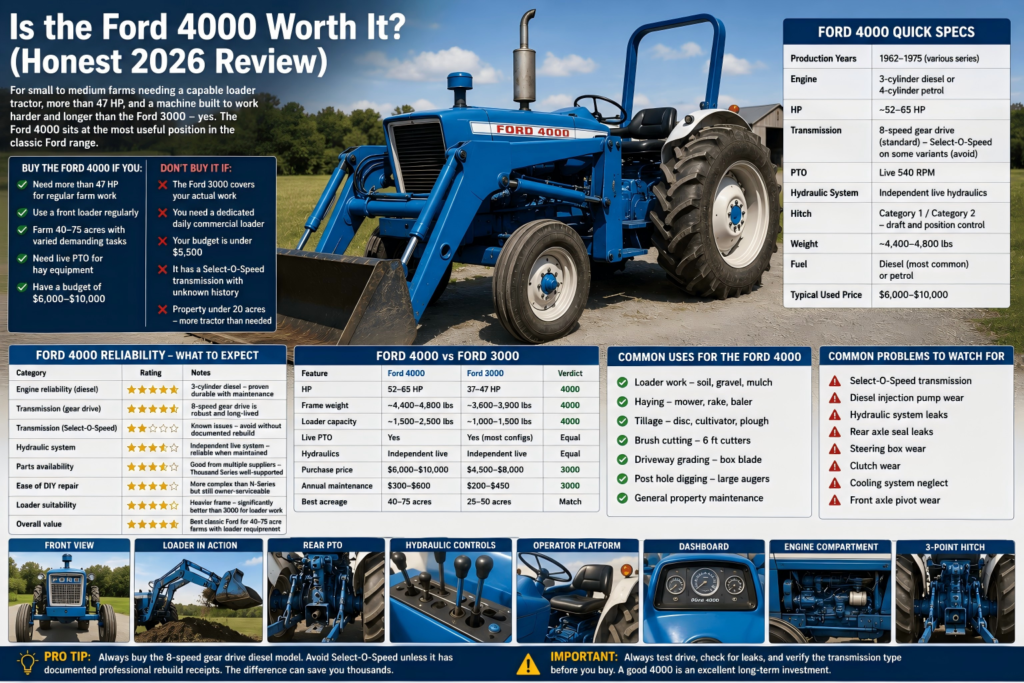
Is Ford 4000 worth it in 2026? For small to medium farms needing a capable loader tractor, more than 47 HP, and a machine built to work harder and longer than the Ford 3000 — yes. The Ford 4000 sits at the most useful position in the classic Ford range: enough power for serious farm work, a heavier frame suited to loader use, live PTO, and a parts supply that remains strong six decades after production. It costs more than the 3000 and less than modern alternatives, and for buyers whose property and workload justify it, the Ford 4000 earns its price in 2026.
👉 Check current Ford 4000 listings — see available stock and pricing →
Written by: Farmers Equipment editorial team — specialising in classic Ford tractors from the N-Series through the Thousand Series.
Buy the Ford 4000 if you:
✅ Need more than 47 HP for regular farm work
✅ Use a front loader regularly — the 4000’s frame handles it better than the 3000
✅ Farm 40–75 acres with varied demanding tasks
✅ Need live PTO for hay equipment
✅ Have a budget of $6,000–$10,000 for a good working example
❌ Don’t buy it if the Ford 3000 covers your actual work — save $2,000–$3,000
❌ Don’t buy it if you need a dedicated daily commercial loader — the Ford 5000 is more appropriate
Is the Ford 4000 Worth It — Pros and Cons
| ✅ Pros | ⚠️ Cons |
|---|---|
| 52–65 HP — handles serious farm implements | Higher purchase price than Ford 3000 |
| Heavier frame — better suited to loader use than 3000 | Higher annual maintenance cost than smaller models |
| Live PTO — essential for hay equipment | Power steering not standard on all configurations |
| Independent live hydraulics | Diesel injection system requires periodic professional service |
| Strong parts availability — Thousand Series well-supported | Heavier machine — less suited to very small properties |
| Diesel efficiency for regular use | More complex than N-Series for DIY maintenance |
Ford 4000 Quick Specs
| Specification | Detail |
|---|---|
| Production years | 1962–1975 (various series) |
| Engine | 3-cylinder diesel or 4-cylinder petrol depending on variant |
| HP | ~52–65 HP depending on year and variant |
| Transmission | 8-speed gear drive (standard) — Select-O-Speed on some variants (avoid) |
| PTO | Live 540 RPM — independent of clutch |
| Hydraulic system | Independent live hydraulics |
| Hitch | Category 1 / Category 2 — draft and position control |
| Weight | ~4,400–4,800 lbs depending on configuration |
| Fuel | Diesel (most common) or petrol |
| Typical used price | $6,000–$10,000 in good working condition |
Ford 4000 Background — What Replaced It and What It Replaced
The Ford 4000 name was used across multiple distinct tractor generations — understanding which generation you are buying matters for parts sourcing and capability expectations:
| Generation | Years | Key Features |
|---|---|---|
| Early 4000 (4-cylinder) | 1962–1964 | 4-cylinder engine, sometimes called 4000 Super Major in export markets |
| Thousand Series 4000 | 1965–1975 | 3-cylinder diesel standard, updated sheet metal, improved hydraulics |
The 1965–1975 Thousand Series Ford 4000 is the most commonly available and most sought-after configuration. It was replaced by the Ford 4600 in 1975 when Ford updated the Thousand Series with the new 600/700 series designations. Parts availability is strongest for the 1965–1975 Thousand Series variant.
Is the Ford 4000 a Good Tractor?
Yes — and it consistently earns that assessment from owners who have used one for serious farm work. The Ford 4000 occupies a practical sweet spot in the classic Ford range: enough power to handle loader work, 6 ft rotary cutters, three-bottom ploughs, and larger disc harrows; a heavier frame than the 3000 that handles those loads more comfortably; and live PTO and live hydraulics standard across most configurations.
Owners who move up from a Ford 3000 to a 4000 consistently note two things: the extra HP matters more than they expected in heavy conditions, and the 4000’s additional weight and frame stability make loader work noticeably less tiring than on the lighter 3000. The 4000 is a machine designed for a full day of varied farm work, not a machine built to the minimum specification for light property maintenance.
Ford 4000 Reliability — What to Expect
| Category | Rating | Notes |
|---|---|---|
| Engine reliability (diesel) | ⭐⭐⭐⭐⭐ | 3-cylinder diesel — proven durable with maintenance |
| Transmission (gear drive) | ⭐⭐⭐⭐⭐ | 8-speed gear drive is robust and long-lived |
| Transmission (Select-O-Speed) | ⭐⭐☆☆☆ | Known issues — avoid without documented rebuild |
| Hydraulic system | ⭐⭐⭐⭐☆ | Independent live system — reliable when maintained |
| Parts availability | ⭐⭐⭐⭐☆ | Good from multiple suppliers — Thousand Series well-supported |
| Ease of DIY repair | ⭐⭐⭐⭐☆ | More complex than N-Series but still owner-serviceable |
| Loader suitability | ⭐⭐⭐⭐⭐ | Heavier frame — significantly better than 3000 for loader work |
| Overall value | ⭐⭐⭐⭐⭐ | Best classic Ford for 40–75 acre farms with loader requirement |
What Ford 4000 Owners Say
Owners consistently praise the Ford 4000’s durability and pulling power. Many report running the same tractor for decades with only routine maintenance — oil changes, filter replacements, and occasional hydraulic attention. The 3-cylinder diesel engine in the Thousand Series variant is particularly well-regarded for its longevity and fuel efficiency relative to its output.
The most common complaint is the Select-O-Speed transmission, which is why experienced buyers overwhelmingly recommend the 8-speed gear drive version. Owners who bought SOS machines without knowing what they were getting into consistently describe it as an expensive mistake. The second most common complaint is the diesel injection system — not because it fails frequently, but because servicing it requires specialist equipment most owners don’t have, making it a recurring professional expense.
Positive ownership notes that come up consistently: the 4000 handles loader work noticeably better than the 3000 — the additional frame weight and HP make a real difference in daily use. Owners who upgraded from a 3000 to a 4000 for loader work rarely look back.
Ford 4000 vs Ford 3000 — Is the Upgrade Worth It?
| Feature | Ford 4000 | Ford 3000 | Verdict |
|---|---|---|---|
| HP | 52–65 HP | 37–47 HP | 4000 — significant advantage for loader and heavy implements |
| Frame weight | ~4,400–4,800 lbs | ~3,600–3,900 lbs | 4000 — better stability under load |
| Loader capacity | ~1,500–2,500 lbs | ~1,000–1,500 lbs | 4000 — substantially more capable |
| Live PTO | Yes | Yes (most configs) | Equal |
| Hydraulics | Independent live | Independent live | Equal |
| Purchase price | $6,000–$10,000 | $4,500–$8,000 | 3000 — lower entry cost |
| Annual maintenance | $300–$600 | $200–$450 | 3000 — lower running cost |
| Best acreage | 40–75 acres | 25–50 acres | Match to your property size |
Upgrade from 3000 to 4000 if: you use a loader regularly, your implements need more than 47 HP, or your property is consistently in the 40–75 acre range. The price premium is real — confirm the upgrade is justified by actual use before committing.
See our full Ford 3000 review for direct comparison.
Ford 4000 vs Ford 5000 — Which Should You Buy?
| Feature | Ford 4000 | Ford 5000 | Verdict |
|---|---|---|---|
| HP | 52–65 HP | 65–75 HP | 5000 — more power, meaningful for heavy work |
| Purchase price | $6,000–$10,000 | $7,000–$12,000 | 4000 — lower entry cost |
| Annual maintenance | $300–$600 | $350–$700 | 4000 — modestly lower |
| Loader capacity | ~1,500–2,500 lbs | ~2,000–3,000 lbs | 5000 — heavier frame, more capacity |
| Parts availability | Good | Good | Equal |
| Best acreage | 40–75 acres | 50+ acres | Match to your property |
| Best for | Varied farm work, loader, hay | Heavy tillage, large hay operations, demanding daily use | Depends on workload |
Buy the 4000 if: your farm is 40–75 acres with varied work including occasional loader use and hay. Buy the 5000 if: your operation regularly demands 65+ HP — heavy tillage, large hay operations, daily loader work at the upper HP limit. See our Ford 5000 review for full details.
Common Loader Models for the Ford 4000
Several loaders were designed or adapted for the Ford 4000 during its production run and in the decades since:
- Ford 730 Loader — the factory-matched loader produced for the Ford 4000 and compatible Thousand Series models. Original 730 loaders are sought-after for their precise fit to the 4000’s mounting points and hydraulic system. Complete sets in good condition command a premium
- Dearborn Loader — Dearborn Equipment Company produced loaders for Ford tractors through the N-Series era and into the early Thousand Series. Some Dearborn loaders adapt to the 4000 with appropriate brackets
- Freeman Loader — a well-regarded aftermarket loader that fits the Thousand Series Ford tractors. Freeman loaders have a strong reputation for build quality and are popular among classic Ford owners
- Allied Loader — Allied Products produced loaders compatible with multiple Thousand Series Ford models. Parts and service manuals are available
- Wagner Loader — Wagner Engineering produced front loaders for Ford tractors including Thousand Series models. Found on the used market in farm auction settings
When buying a Ford 4000 with a loader already fitted, confirm which loader it is and check for parts availability specific to that model. A well-matched original or aftermarket loader with known parts support is worth more than an unknown adaptation.
Ford 4000 Common Problems — What to Watch For
| Problem | Symptoms | Typical Cost to Fix |
|---|---|---|
| Select-O-Speed transmission failure | Slipping, no gear selection, jerky shifts | $800–$2,500+ rebuild — avoid without documented history |
| Diesel injection pump wear | Hard warm starting, black smoke, loss of power | $400–$1,000 rebuild or replace |
| Hydraulic system leaks | Slow lift, hitch drift, external oil leaks | $150–$500 depending on source |
| Rear axle seal leaks | Oil on rear wheels, drips under axle housing | $80–$200 parts |
| Steering box wear | Excessive play, wandering at speed | $250–$600 |
| Clutch wear | Slipping under load, high engagement point | $400–$800 parts + labour |
| Cooling system neglect | Overheating, head gasket failure | $400–$1,000 |
| Front axle pivot wear | Excessive front axle movement, steering imprecision | $150–$350 parts |
Ford 4000 Repair Cost Reference
| Repair | DIY Parts Cost | Shop Labour + Parts |
|---|---|---|
| Clutch replacement | $200–$400 parts | $500–$900 total |
| Injection pump rebuild/replace | Specialist only | $500–$1,000 |
| Injector service (clean/replace) | Specialist only | $200–$500 |
| Water pump replacement | $80–$150 parts | $120–$250 total |
| Radiator repair or replace | $150–$350 parts | $300–$700 total |
| Hydraulic pump rebuild | $150–$300 kit | $400–$900 total |
| Rear axle seal | $40–$80 parts | $150–$300 total |
| Select-O-Speed rebuild | Specialist only | $800–$2,500+ |
| Steering box rebuild | $100–$200 parts | $250–$600 total |
| Head gasket replacement | $100–$200 parts | $400–$900 total |
The Select-O-Speed warning applies equally here as on the Ford 3000 — avoid any Ford 4000 with a Select-O-Speed transmission unless it has a documented professional rebuild with receipts. The gear drive 8-speed is the variant to buy.
Best Implements for the Ford 4000
| Implement | Ideal Size | Notes |
|---|---|---|
| Rotary cutter (brush hog) | 6 ft | Handles 6 ft comfortably in most material — significant upgrade over 3000 |
| Finish mower | 6–7 ft | More coverage per pass than smaller tractors — efficient on larger paddocks |
| Disc harrow | 6–7 ft | Handles primary tillage more comfortably than 3000 in tough ground |
| Box blade | 6 ft | Heavier HP makes grading faster and easier than on smaller models |
| Rear blade | 7 ft | More coverage for snow and grading on larger properties |
| Hay rake | Medium | Live PTO and adequate HP — excellent hay rake tractor |
| Square baler | Standard | Well-suited — live PTO and HP within comfortable range for small square balers |
| Round baler | Small–medium | Capable with small to medium balers — large commercial balers push HP limits |
| 3-bottom plough | 3-bottom | Handles 3-bottom ploughing comfortably in most soil conditions |
| Post hole digger | Up to 12 inch | Handles larger augers more comfortably than 3000 or 8N |
| Front loader | Ford 730 or equivalent | One of the 4000’s primary advantages over smaller classic Fords |
Ford 4000 Fuel Consumption
| Work Type | Estimated Fuel Use | Notes |
|---|---|---|
| Light mowing / finish work | ~0.9–1.3 gal/hr | Light engine load |
| Rotary cutting (6 ft, standard brush) | ~1.3–1.8 gal/hr | Comfortable working load |
| Loader work (moderate cycles) | ~1.5–2.0 gal/hr | Varies with load weight and cycle frequency |
| Heavy tillage / ploughing | ~1.8–2.5 gal/hr | Near maximum engine load |
| General mixed farm work | ~1.3–1.8 gal/hr | Average across varied tasks |
The Ford 4000 diesel delivers better fuel economy per HP than the Ford 8N petrol engine — meaningful for a machine used regularly across a farming season. At typical diesel prices, expect $8–$18 per operating hour depending on work intensity.
Real Ownership Costs — Ford 4000
| Item | Cost | When |
|---|---|---|
| Engine oil and filter | $35–$65 | Every 100 hours or annually |
| Diesel fuel filter | $20–$40 | Every 200 hours or annually |
| Injection system service | $300–$600 | Every 3–5 years or when symptoms appear |
| Hydraulic fluid service | $40–$80 | Every 500 hours or 2–3 years |
| Rear tyre replacement (pair) | $500–$900 fitted | As needed |
| Clutch replacement | $400–$800 parts + labour | Every 1,000+ hours |
| Annual maintenance estimate | $300–$600 | Routine — varies with use intensity |
Example Annual Ownership Cost — Ford 4000 Diesel (Regular Use)
| Item | Estimated Annual Cost |
|---|---|
| Diesel fuel (est. 80–120 hrs/year at 1.5 gal/hr) | $480–$900 |
| Engine oil and filter | $60–$100 |
| Diesel fuel filter | $25–$45 |
| Hydraulic fluid top-up | $30–$60 |
| Miscellaneous repairs | $150–$300 |
| Typical yearly total | $745–$1,405 |
Best Ford 4000 Years to Buy
| Period | Rating | Why |
|---|---|---|
| 1968–1974 Thousand Series | ⭐⭐⭐⭐⭐ | Refined hydraulics, proven 3-cylinder diesel, strong parts availability, best resale stability |
| 1965–1967 early Thousand Series | ⭐⭐⭐⭐☆ | Good machines but earlier hydraulic system and some teething issues on first-year configurations |
| 1975 final year | ⭐⭐⭐⭐☆ | Late production with mature refinements — but parts interchangeability with 4600 series to confirm |
| 1962–1964 early 4000 (4-cylinder) | ⭐⭐⭐☆☆ | Different engine and specification — parts sourcing less straightforward than Thousand Series |
The 1968–1974 Thousand Series Ford 4000 in gear drive diesel form is the strongest all-round recommendation. Production was refined, the 3-cylinder diesel was well-proven by that point, and these are the years with the strongest parts ecosystem and most owner familiarity.
What to Check When Buying a Ford 4000
All the checks from our Used Ford Tractor Inspection Checklist apply — plus these 4000-specific items:
- Transmission type first — confirm gear drive vs Select-O-Speed before anything else. This single factor shapes the entire purchase decision
- Generation — confirm whether it is the 4-cylinder early 4000 (1962–1964) or 3-cylinder Thousand Series (1965–1975). Parts sourcing and capability differ between generations
- Diesel injection system — cold and warm start behaviour, smoke colour, power under load. Ask when the injection pump was last serviced
- Loader history — if fitted with a loader, inspect front axle pivot wear, steering box play, and mounting bracket condition. Loader use accelerates front-end wear
- Serial number — confirm year using our Ford Tractor Serial Numbers guide →
Ford 4000 Buyer Checklist
Before buying — confirm all of these:
☑ Cold start — diesel should start promptly in the cold without excessive cranking
☑ Transmission type — gear drive confirmed (not Select-O-Speed)
☑ PTO engagement — live PTO confirmed; shaft spins with clutch depressed
☑ Hydraulic lift — raises fully and holds position without drifting
☑ Steering play — acceptable limits, no wandering
☑ Differential lock — engages and releases cleanly
☑ Loader pins and mounting — if loader fitted, inspect for crack or wear
☑ Rear tyres — no cracked sidewalls, adequate tread
☑ Serial number and generation — confirmed Thousand Series (1965–1975)
☑ Injection system — no black smoke, even running, good warm restart
Full guidance: Used Ford Tractor Inspection Checklist →
How Much Is a Ford 4000 Worth in 2026?
| Condition | Price Range |
|---|---|
| Running, needs work | $2,500–$4,500 |
| Good working condition (gear drive diesel) | $6,000–$10,000 |
| Fully restored or particularly clean | $11,000–$15,000+ |
| Select-O-Speed variant (discount) | $3,000–$6,000 depending on transmission condition |
Gear drive diesel examples consistently command a premium over petrol or Select-O-Speed variants. Loader-equipped machines may list higher — evaluate the loader quality and condition separately from the tractor price.
Who Should Buy the Ford 4000
- ✅ Farms of 40–75 acres with varied demanding work
- ✅ Regular loader use — the 4000’s frame handles it better than the 3000
- ✅ Hay operations requiring live PTO and more than 47 HP
- ✅ Buyers who need 6–7 ft rotary cutter capability in heavy brush
- ✅ Properties where the Ford 3000 is consistently at its HP limit
Who Should Skip the Ford 4000
- ❌ Your work stays within what a Ford 3000 handles — save the premium
- ❌ Budget under $5,500 — buy a good Ford 3000 instead
- ❌ Looking at a Select-O-Speed variant with unknown history
- ❌ Very small property under 20 acres — the 4000 is more machine than needed
- ❌ Need more than 65 HP consistently — look at the Ford 5000
Verdict — Is Ford 4000 Worth It?
Is the Ford 4000 worth it in 2026? Yes — for farms that genuinely need what it offers. The step from the Ford 3000 to the 4000 is a meaningful one: more HP, a heavier frame suited to loader work, and the additional capacity to handle implements and workloads that push the 3000 to its limits. For farms in the 40–75 acre range with regular loader use and varied heavy implements, the Ford 4000 gear drive diesel is one of the most capable and cost-effective classic tractors available.
If the Ford 3000 covers your actual work — buy the 3000. If you consistently hit the 3000’s limits — the Ford 4000 is the right upgrade. Avoid the Select-O-Speed variant without a documented professional rebuild, budget for diesel injection service every few years, and the 4000 will serve a well-maintained farm reliably for decades.
Compare all models: Ford 8N · Ford 9N · Best Ford Tractor for a Small Farm guide →
👉 See current Ford 4000 listings — compare available stock and pricing →
Ford 4000 Production History and Engine Details
What Tractor Replaced the Ford 4000?
The Ford 4000 was replaced by the Ford 4600 in 1975 when Ford updated its entire Thousand Series range with new 600/700 series designations. The 4600 produced approximately 62 67 HP broadly similar to the late Thousand Series 4000 but with updated sheet metal, refined hydraulics, and improved cab options. The replacement sequence across the Ford Thousand Series:
| Thousand Series (1965 1975) | Replaced by (1975+) | HP Range |
|---|---|---|
| Ford 3000 | Ford 3600 | ~47 HP -> ~52 HP |
| Ford 4000 | Ford 4600 | ~55 65 HP -> ~62 67 HP |
| Ford 5000 | Ford 5600 / 5700 | ~65 75 HP -> ~72 80 HP |
| Ford 7000 | Ford 7600 / 7700 | ~94 HP -> ~98 HP |
The 4600 and later 4610 are solid machines in their own right available at similar prices to late Thousand Series 4000s on the used market with the advantage of slightly later manufacture and updated hydraulics.
What Engine Does a Ford 4000 Tractor Have?
The engine depends on the generation:
- Early 4000 (1962 1964) 4-cylinder engine (either petrol or diesel). Sometimes called the 4000 Super Major in export markets. Less commonly seen than Thousand Series
- Thousand Series 4000 (1965 1975) 3-cylinder diesel (Ford BSD 3-cylinder, 175 cubic inch displacement) is the standard and most desirable configuration. A 4-cylinder petrol engine (Ford EAF 4-cylinder) was also available but the 3-cylinder diesel is what most buyers seek
The 3-cylinder diesel in the Thousand Series 4000 is regarded as one of the most durable engines Ford ever put in a utility tractor simple, fuel-efficient, and capable of running 6,000 10,000+ hours with proper maintenance. This engine is the primary reason experienced buyers specifically seek the 1965 1975 Thousand Series variant over the earlier 4-cylinder 4000.
How Many Ford 4000 Tractors Were Made?
Ford did not publish separate production figures for the 4000 model alone, as it was part of the broader Thousand Series range. Across the full 1965 1975 Thousand Series production run (3000, 4000, 5000, 7000, and related models), Ford produced several hundred thousand units globally with significant manufacturing at both the Highland Park (US) and Basildon (UK) plants. The Ford 4000 was one of the most popular models in the series in the North American market. Exact model-specific production numbers are not publicly documented to the level of the N-Series records. For serial number identification by year, TractorData.com maintains the full Ford Thousand Series serial records.
Ford Tractors Legacy and Rankings
What Are the Best Ford Tractors of All Time?
| Rank | Model | Era | Why It Makes the List |
|---|---|---|---|
| 1 | Ford 8N | 1947 1952 | Most produced two-plow tractor in US history (524,076 units). Best parts availability of any classic tractor. Introduced position control to N-Series. Benchmark small farm classic |
| 2 | Ford 4000 (Thousand Series diesel) | 1965 1975 | Best all-around utility Ford 3-cylinder diesel, live PTO, heavier frame for loader work, proven durable engine. Best classic Ford for 40 75 acre farms |
| 3 | Ford 9N | 1939 1942 | Most historically significant Ford introduced the Ferguson three-point hitch and draft control that became the global standard. Changed agriculture permanently |
| 4 | Ford 5000 | 1965 1975 | Most powerful practical classic Ford at 65 75 HP. Still actively farmed. Best classic Ford for larger operations |
| 5 | Ford 3000 | 1965 1975 | Best value entry into the Thousand Series 37 47 HP, live PTO, strong parts availability, right size for most small farms |
What Is the Most Famous Ford Tractor?
The Ford 8N is the most famous Ford tractor the most widely produced, most widely recognised, and most commonly bought and sold classic Ford in North America. Its grey and red colour scheme is immediately identifiable. The Ford 9N holds the most historically significant position (introducing the three-point hitch in 1939), but the 8N is the machine most people picture when they think of a classic Ford tractor. For many owners and enthusiasts, “Ford tractor” means the 8N by default.
Which Ford Engine Is Considered the Best Ever Built?
For tractors specifically: the Ford BSD 3-cylinder diesel in the Thousand Series (3000, 4000, 5000) is most consistently cited as Ford’s best agricultural engine simple, durable, fuel-efficient, and capable of 6,000 10,000+ hours with maintenance. The flathead 4-cylinder gasoline in the N-Series (8N, 9N) earns respect for extraordinary longevity through mechanical simplicity many original 1940s and 1950s engines still running today. Between them: the 3-cylinder diesel is the stronger pure working engine; the flathead gasoline wins for repairability by any owner with basic tools.
What Is the Rarest Ford Tractor Ever Built?
Among N-Series: the Ford 9N from 1939 1940 with original aluminium hood, grille, and instrument panel early production used aluminium before switching to cast iron. Unmodified original examples are the most collectible. The Ford FW-60 articulated 4WD (1977 1982, 335 HP, built in partnership with Steiger) is the rarest large Ford tractor very low production volumes, significant HP for its era, and increasingly collectible. The 1961 Ford 6000 Commander (a troubled high-HP model Ford largely recalled) is another rare and historically significant piece. Browse our Ford tractors for sale ->
Greatest Tractor Questions
What Is the Greatest Tractor Ever Made?
By historical impact: the Ford 9N (1939) introduced the three-point hitch and draft control that became the global standard for implement attachment. No other single machine changed the mechanics of farming more permanently. The Fordson Model F (1917) made tractor ownership accessible to ordinary farmers for the first time. By longevity in active use: the Massey Ferguson 135 still farmed worldwide after 50+ years. By American row-crop legacy: the John Deere 4020. By modern engineering: the Fendt Vario the CVT transmission that redefined precision agriculture. Each is “greatest” on a different dimension no single machine wins all of them. Browse our Massey Ferguson tractors and John Deere tractors for sale.
What Is the Most Produced Tractor of All Time?
By global unit volume: Mahindra (India) dominant in the massive Indian agricultural market, making it the world’s largest tractor company by units sold annually. The combined Ford N-Series (9N, 2N, 8N) at over 838,000 total units was extraordinary for its era. The Massey Ferguson 135 and related models were produced in the largest numbers of any single utility tractor platform across the 1960s 1980s globally. In the modern market, Mahindra produces more tractors per year than any other single company.
What Is the Oldest Tractor Company Still in Business?
John Deere (1837) has the clearest claim to oldest continuously operating tractor company founded by John Deere with the steel plough and continuously operating under the same corporate identity to the present day. Case IH traces to J.I. Case (1842) and Massey Ferguson to Massey (1847), both through mergers. The McCormick reaper business (1831) predates all of them but passed through International Harvester into CNH through multiple corporate changes the direct lineage claim is more complex. John Deere’s continuous corporate identity from 1837 is the clearest and most commonly accepted answer.
When Was the Last White Tractor Made?
For current Ford 4000 pricing, TractorHouse.com lists active sales by condition and year. White Farm Equipment produced tractors until the company went through a series of ownership changes and ultimately declined. AGCO Corporation acquired the White brand and related assets. The White tractor brand was effectively discontinued as a distinct production line in the early 1990s under AGCO ownership the last White-branded tractors were produced approximately in 1993 1995. AGCO continued to sell some White-branded equipment through existing inventory into the mid-1990s. The brand name persists in limited form for some equipment but active tractor manufacturing under the White name ended in that period.
Frequently Asked Questions
Is the Ford 4000 a good tractor?
Yes — particularly the gear drive diesel variant. At 52–65 HP with live PTO, independent hydraulics, and a heavier frame suited to loader use, the Ford 4000 is one of the most capable classic tractors available for serious small to medium farm work. The Select-O-Speed transmission is the main risk — avoid it unless professionally rebuilt. In gear drive diesel form, the 4000 has an excellent reliability record.
How much is a Ford 4000 tractor worth in 2026?
A Ford 4000 in good working condition (gear drive diesel) typically lists between $6,000 and $10,000. Running examples needing work start at $2,500–$4,500. Fully restored or particularly clean examples can reach $11,000–$15,000. Select-O-Speed variants trade at a discount. Confirm current pricing on TractorHouse before negotiating.
What is the difference between the Ford 4000 and Ford 5000?
The Ford 5000 offers 65–75 HP versus the 4000’s 52–65 HP, a heavier frame with greater loader capacity, and is better suited to large hay operations and demanding daily farm use. The 4000 costs less to buy and maintain, and is more appropriate for farms in the 40–75 acre range. The 5000 makes sense when you consistently need more than 65 HP or run large implements daily.
How many horsepower is a Ford 4000 tractor?
Approximately 52–65 HP depending on the year and variant. Early 4-cylinder models (1962–1964) produce approximately 52–55 HP. The 1965–1975 3-cylinder Thousand Series models produce approximately 55–65 HP depending on the specific engine configuration and year. Always confirm the specific variant when evaluating HP for implement sizing decisions.
Are parts available for a Ford 4000 in 2026?
Yes — the Ford 4000 Thousand Series has good parts availability from multiple aftermarket suppliers including Steiner Tractor Parts, All States Ag Parts, and Sparex. Most mechanical wear items — engine components, hydraulic seals, clutch kits, filters, and electrical components — are available. Some body panels and trim pieces require more searching than the Ford 8N but are still obtainable.